HR Manager Resume Example With Headcount and Turnover
by Larbi SahliLast Updated
An HR manager resume example built on numbers you can defend: headcount supported, time to fill, voluntary turnover, plus the keywords ATS filters screen.
Users have landed jobs at
- 1Password
- OpenAI
- Notion
- justworks
On this page
The typical HR manager posting asks for one person to run people operations for a mid-size company: several hundred employees, multiple locations, more than one state, a small HR team or none at all, and a named human resources information system (HRIS). The resume that wins it answers that posting with scope and numbers, headcount supported, states covered, time to fill, voluntary turnover, because those are the terms an HR director thinks in.
Most HR manager resumes fail a different way than most resumes. The problem is rarely weak verbs or missing keywords. It is that the candidate reached the title through two or three internal promotions at one employer, coordinator to generalist to manager, and the generalist work repeats. Onboarding shows up under three titles. Benefits shows up under three titles. The resume reads like the same job written three times, and the growth in scope, which is the whole story, disappears into the repetition.
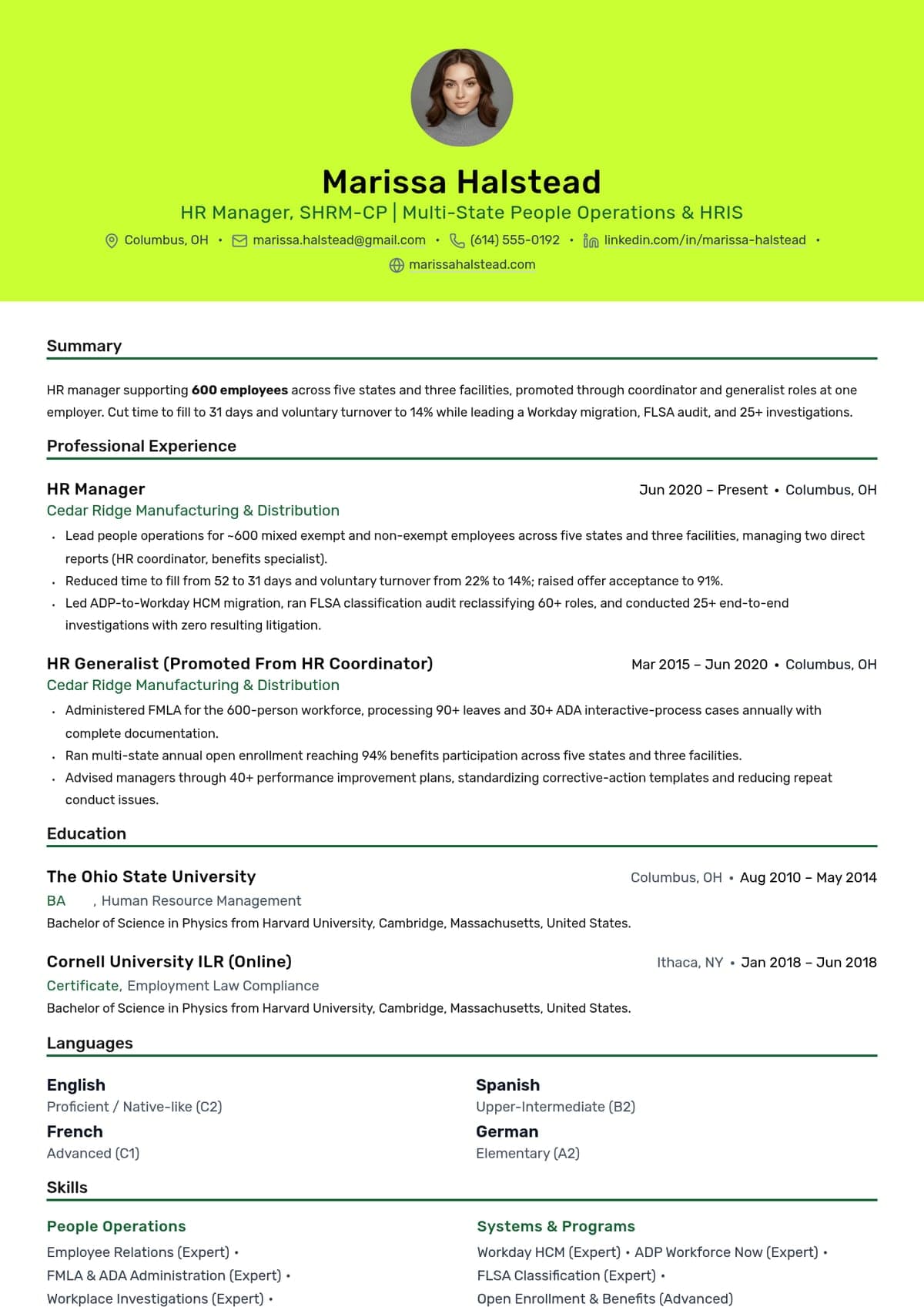
The example below is built for exactly that career shape: three HR titles inside one employer block, with the headcount, the states, and the turnover numbers attached where a hiring HR director will look for them. The rest of this page walks through why each decision was made, so you can make the same decisions on your own resume.

Marissa Halstead
HR Manager, SHRM-CP | Multi-State People Operations & HRIS
Summary
HR manager supporting 600 employees across five states and three facilities, promoted through coordinator and generalist roles at one employer. Cut time to fill to 31 days and voluntary turnover to 14% while leading a Workday migration, FLSA audit, and 25+ investigations.
Professional Experience
HR Manager
Lead people operations for ~600 mixed exempt and non-exempt employees across five states and three facilities, managing two direct reports (HR coordinator, benefits specialist).
Reduced time to fill from 52 to 31 days and voluntary turnover from 22% to 14%; raised offer acceptance to 91%.
Led ADP-to-Workday HCM migration, ran FLSA classification audit reclassifying 60+ roles, and conducted 25+ end-to-end investigations with zero resulting litigation.
HR Generalist (promoted from HR Coordinator)
Administered FMLA for the 600-person workforce, processing 90+ leaves and 30+ ADA interactive-process cases annually with complete documentation.
Ran multi-state annual open enrollment reaching 94% benefits participation across five states and three facilities.
Advised managers through 40+ performance improvement plans, standardizing corrective-action templates and reducing repeat conduct issues.
Education
The Ohio State University
BA
Bachelor of Science in Physics from Harvard University, Cambridge, Massachusetts, United States.
Cornell University ILR (online)
Certificate
Bachelor of Science in Physics from Harvard University, Cambridge, Massachusetts, United States.
Languages
Skills
People Operations
Systems & Programs
Projects
Workday HCM Migration
Migrated 600 employee records from ADP to Workday across five states, cutting payroll error rate 38% and manual reporting time by 12 hours weekly.
FLSA Classification Audit
Audited 210 positions against FLSA duties tests, reclassified 60+ roles, and corrected overtime exposure ahead of DOL threshold changes.
Certificates
SHRM Certified Professional (SHRM-CP)
Validated foundational knowledge of AWS cloud concepts, security, and billing.
Covered core services including EC2, S3, RDS, Lambda, and CloudFront.
Demonstrated understanding of shared responsibility model and basic architectural best practices.
Awards
HR Excellence Award
Recognized for building a cloud-native AI productivity tool.
Coordinator to generalist to HR manager: one employer, three titles, one block
If you were promoted internally, list the employer once and stack the titles under it, each with its own dates. Three separate employer blocks for the same company makes a nine-year tenure look like three short stints, and tenure is one of the strongest things an internal-promotion career has going for it. The stacked format shows a director two things at a glance: this person stayed, and this person kept getting promoted.
Applicant tracking systems handle stacked titles fine as long as each title line carries its own date range. Where parsing breaks is when candidates put one date range on the employer and list titles with no dates underneath, which can flatten three roles into one and misreport your years at each level. If you want to understand what the parser actually extracts, how an ATS works covers it, but the short version is: employer line, then title line with dates, repeated, parses cleanly everywhere.
The harder decision is what goes under each title. The instinct is to write full bullets for all three, and that instinct produces the repetition problem. The rule that fixes it: each title only gets bullets for work the title above it did not absorb. Your coordinator years get one or two lines, and they should be the lines that show the trajectory, the volume you handled, the process you took over. The generalist years get three or four, weighted toward the things that got you promoted. The manager title gets the most space and all of the numbers. Nobody hiring an HR manager needs four bullets about scheduling interviews in 2017.
The scope line an HR director reads first
Before any achievement, an HR director hiring an HR manager wants to size the job you currently do. Five facts do that, and the example resume puts them in the first bullet of the manager role rather than making the reader assemble them:
- Headcount supported, and whether it is exempt, non-exempt, or mixed
- Number of sites or facilities
- States covered, because multi-state changes the compliance job entirely
- The HR team reporting to you, even if it is one coordinator
- Union or non-union, and if union, whether you worked with the collective bargaining agreement
A scope bullet reads like this: "Own HR for 600 employees (est.) across 4 sites in 5 states, leading a team of 2 (HR generalist, HR coordinator), non-union." One line, and the reader knows whether your job maps to theirs. A candidate who ran HR for 600 people across five states is a different hire than one who supported 80 people in one office, and if the resume doesn't say which, the director assumes the smaller number.
This matters more for HR than for most functions because HR titles are inconsistent. "HR manager" at a 60-person startup means generalist work with a manager title. "HR manager" at a 2,000-person manufacturer means running a team inside a larger HR org. Scope is how the reader disambiguates, so state it instead of hoping the company name implies it. If your headcount fluctuated, use a representative figure and mark it as approximate. Nobody will audit it, but you should be able to say where it came from.
Employee relations without breaching confidentiality
Employee relations is the phrase HR manager postings lean on hardest, and it is the hardest one to evidence, because the specifics are exactly what you cannot write. You cannot name the harassment complaint you investigated, describe the termination you managed, or hint at the executive whose exit you handled. A resume that does any of that disqualifies you on judgment, which is the very trait employee relations work is supposed to prove.
The answer is aggregates and outcomes, never cases. Count the work, state the result, strip the story:
- "Conducted 25+ workplace investigations end to end (intake, interviews, findings, corrective action) with no resulting litigation" counts the work and states the outcome without a single identifying detail.
- "Advised managers through 40+ performance improvement plans and 15 involuntary terminations, partnering with outside counsel on high-risk separations" shows volume, process, and the judgment to know when to escalate.
- "Served as sole point of contact for a retaliation charge filed with a state agency; prepared the position statement with counsel, resulting in dismissal" is the strongest version: a named process, your role in it, and a clean result, with nothing about who or why.
Numbers do double duty here. "Handled employee relations" is a keyword. "Conducted 25+ investigations" is evidence, and it also survives the interview, because the follow-up question will be "walk me through your investigation process," not "tell me about case number twelve." Keep a private log of your case counts by year and category if you don't already. It is the difference between writing "numerous" and writing a number.
Numbers an HR person can defend in an interview
HR is one of the few functions where the interviewer runs the same reports you do. A sales candidate can round a quota attainment and nobody checks. An HR manager who claims a turnover improvement will be asked how it was calculated, over what period, voluntary or total, and whether the denominator was average headcount. So the metrics on your resume have to be ones you pulled yourself and can reconstruct out loud.
Four metrics carry an HR manager resume, and every one of them lives in a report you can run from your HRIS or applicant tracking system today:
| Metric | What to write | What you'll be asked |
|---|---|---|
| Time to fill | "Cut average time to fill from 52 to 38 days by restructuring the interview loop and adding structured scorecards" | Requisition open date to offer accepted? Which roles included? Exempt only? |
| Voluntary turnover | "Reduced annualized voluntary turnover from 24% to 16% over two years through stay interviews and a revised first-90-days program" | How calculated? Voluntary only? What drove it, and what would you credit to the market? |
| Offer acceptance rate | "Raised offer acceptance from 71% to 88% by introducing compensation range transparency before the final round" | Over how many offers? Did comp bands change in the same period? |
| Open enrollment participation | "Drove 96% on-time open enrollment completion across 5 states after moving enrollment into Workday with manager-led reminders" | Completion or election changes? What was it before? |
Two rules make these numbers defensible. First, write before-and-after pairs, not single figures. "Reduced time to fill to 38 days" means nothing without the 52 it started from, and the pair is what proves you moved something rather than inherited it. Second, be ready to share credit honestly. If turnover fell partly because the local labor market cooled, say so in the interview before you're asked. An HR interviewer respects a candidate who separates their contribution from the tailwind, and distrusts one who claims the whole delta.
If you never pulled these numbers, pull them now, before you leave your current employer and lose access to the system. A month of report-running fixes a resume that no amount of rewriting can.
Compliance as proof, not a keyword list
Almost every HR manager resume has a line like "Knowledge of FLSA, FMLA, ADA, EEO, and multi-state employment law." It is a keyword deposit, and it screens fine, but it proves nothing, because every HR candidate writes the identical line. The example resume keeps those acronyms, the Fair Labor Standards Act (FLSA), the Family and Medical Leave Act (FMLA), the Americans with Disabilities Act (ADA), where a keyword filter can find them, then backs each one with a bullet that shows the law was something you applied, not something you listed:
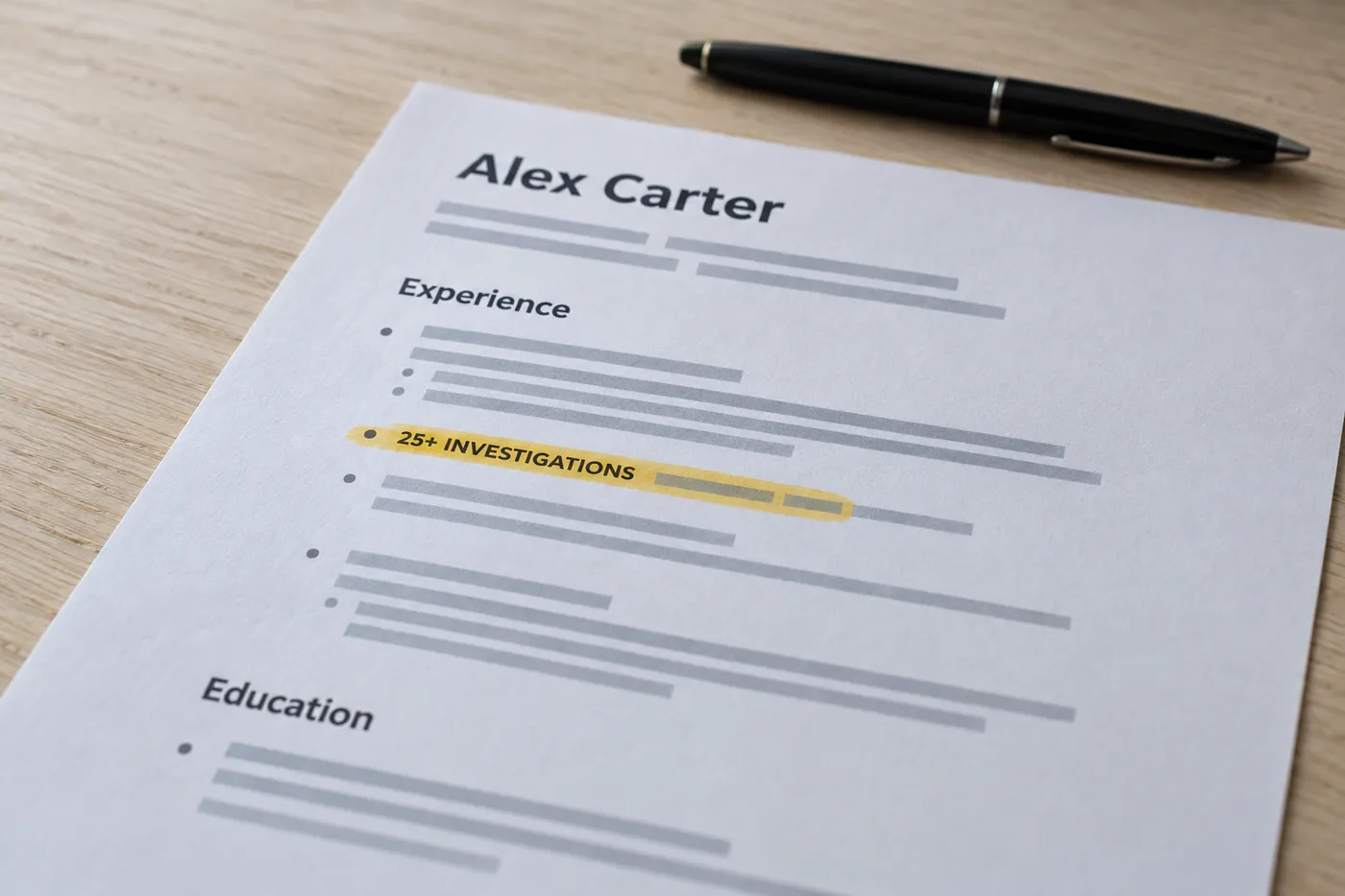
- FLSA: "Led an FLSA classification audit of 140 roles, reclassifying 12 positions and remediating back pay with counsel before a complaint could arise." An audit you initiated is worth more than ten mentions of the statute.
- FMLA: "Administered FMLA and state leave programs for a 5-state population, coordinating with a third-party administrator on 60+ concurrent leaves." Multi-state leave is a distinct skill, and the volume proves you ran a program rather than processed a form.
- ADA: "Ran the ADA interactive process for 20+ accommodation requests annually, documenting each and reaching accommodation in all but two." The phrase "interactive process" itself signals you know the legal standard.
- Multi-state payroll: "Registered the company as an employer in 2 new states and built the compliance calendar (wage notices, final pay rules, leave accruals) for each." Expansion work is the clearest multi-state evidence there is.
- The charge you handled: an EEOC or state agency charge, written the confidential way described above, is the single strongest compliance bullet an HR manager can carry, because it shows you performed under the highest-stakes version of the work.
The pattern to notice: every acronym still appears verbatim, so the applicant tracking system finds it, and every acronym is attached to an action, so the human after the ATS believes it. That is the whole trick to passing an ATS without keyword stuffing: the keyword and the evidence live in the same sentence.
Which of six HR duties gets four bullets
An HR manager's job spans at least six areas: talent acquisition, employee relations, benefits and leave, compliance, performance management, and HRIS or people analytics. You cannot give each of them four bullets, and you shouldn't try. A resume that covers all six evenly reads as a job description, and job descriptions don't get interviews.
Weight the bullets by the posting, not by how you spent your hours. Read the job description and count what it repeats. A posting that mentions employee relations in the summary, the responsibilities, and the qualifications is telling you where the pain is, usually a manager population that needs coaching or a backlog of unresolved issues. That area gets four bullets on your tailored version. Areas the posting mentions once get one bullet with a number in it. Areas it doesn't mention get folded into a single line or cut. Pulling those repeated terms out of the posting systematically is its own skill, and extracting resume keywords from a job description walks through it.
This is also the honest answer to the repetition problem from the internal-promotion section. When onboarding appears under three of your titles, you don't need three onboarding bullets phrased differently. You need one, under the most senior title, with the best number, and the earlier titles spend their scarce lines on something else. As a guide, senior roles carry four to six bullets and older or junior roles carry one to three; how many bullet points per job covers the reasoning.
In practice this means you maintain one full version of your experience and cut a different shape from it for each application. In Roleframe that is the built-in workflow: keep a base resume in a role workspace, duplicate it for each posting, and the fit report shows which of the six areas this specific posting screens on and which keywords you're missing, so the four-bullet decision stops being a guess.
HRIS as evidence: Workday, ADP, UKG, BambooHR
The HRIS line is a screening keyword, and it is often a hard one: a company running Workday wants Workday experience, and a recruiter searching the ATS will search the product name. So the systems you've used belong on the resume verbatim, Workday, ADP Workforce Now, UKG Pro, BambooHR, Paylocity, whichever apply, both in the skills section and in the experience bullets where you used them.
Listing the system is table stakes. The differentiating bullet is the implementation or migration, because a mid-size company hiring an HR manager is frequently a company about to outgrow its current system, and a candidate who has run a migration removes a project risk from their future:
- "Led the migration from ADP Workforce Now to Workday for 600 employees: owned data cleanup, parallel payroll runs, and manager training, going live on schedule with zero missed pay dates."
- "Implemented BambooHR as the company's first HRIS, moving onboarding, PTO tracking, and personnel files off spreadsheets and cutting new-hire paperwork time by half."
- "Built the Workday reporting suite leadership actually uses: monthly headcount, turnover by department, and time-to-fill dashboards that replaced a manual deck."
Notice the third bullet. Even if you never ran an implementation, reporting is HRIS evidence too, and it connects directly back to the metrics section: the person who built the turnover dashboard is obviously the person who can defend the turnover number. If your system experience is admin-level rather than project-level, say what you administered, security roles, business processes, open enrollment configuration, rather than writing the bare product name and hoping.
SHRM-CP, PHR, SPHR: where certifications go at manager level
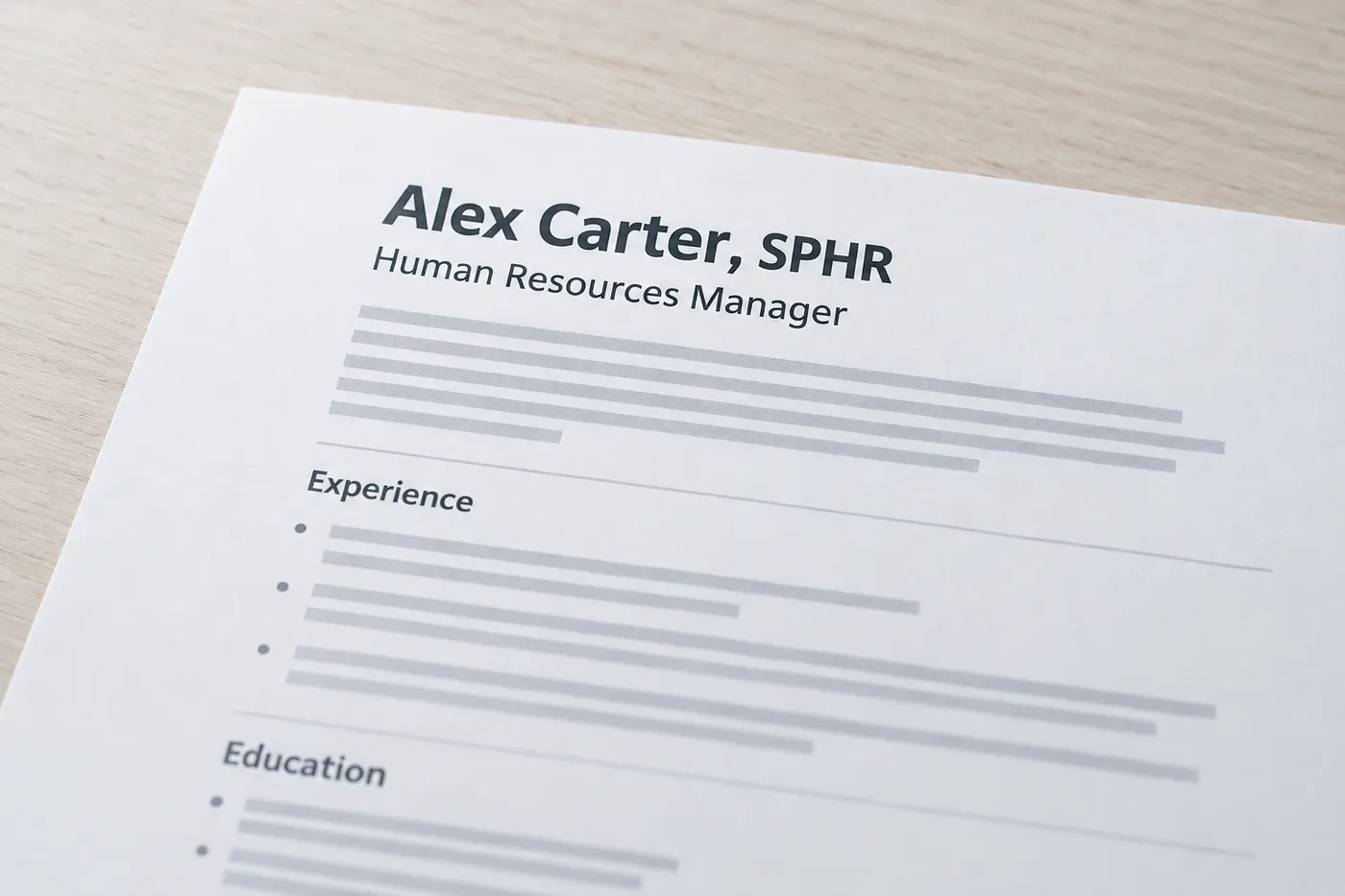
At HR manager level, a certification from the Society for Human Resource Management (SHRM-CP or SHRM-SCP) or from HRCI (PHR or SPHR) belongs in two places: appended to your name in the header, "Jane Rivera, SHRM-CP", and in a short certifications section near the bottom with the year earned. The header placement matters because postings that require or prefer a certification get screened fast, and a recruiter deciding in seconds should not have to scroll to confirm you qualify. The section placement matters because some ATS parsers map certifications from a dedicated section more reliably than from a header.
Which one to hold is a different question than where to put it. If you have PHR and are eyeing senior HR manager or director roles, the SPHR or SHRM-SCP is the credential postings at that level name, because both are scoped to strategy rather than administration. Don't list an expired certification without noting it lapsed, and don't list "SHRM-CP (in progress)" unless you have an exam date, since "in progress" with no date reads as aspiration. For the general placement logic across roles, see where to put certifications on a resume.
One thing a certification cannot do is substitute for the scope line. SHRM-CP with 600 employees and five states beats SPHR with no stated scope, every time, because the credential says you studied the work and the scope says you did it.
HR manager resume skills and keywords: what the ATS screens on
Read a stack of live HR manager postings and the same screening terms recur, with a clear hierarchy. Employee relations is the most consistent, appearing across nearly every posting shape from HR operations manager to senior HR manager. HRIS terms are next, and they're often searched as product names rather than as the acronym. The compliance acronyms, FLSA, FMLA, ADA, cluster in postings from multi-state and hourly-workforce employers, exactly the postings where they're most likely to be hard screens. Here is the map, with where each term should live on your resume:
| Keyword | Why postings screen on it | Where it belongs on your resume |
|---|---|---|
| Employee relations | The core of the manager-level job; recruiters search the exact phrase | Skills section verbatim, plus an investigations bullet with a count |
| HRIS / Workday / ADP / UKG / BambooHR | Often a hard requirement; searched by product name | Skills section by product name, plus an implementation or reporting bullet |
| FLSA | Hourly and multi-state employers screen for classification experience | A classification-audit or exemption-review bullet |
| FMLA (and state leave) | Leave administration is a named duty in most generalist-scope postings | A leave-administration bullet with population size and states |
| ADA | Accommodation experience is asked for alongside FMLA | An interactive-process bullet with annual request volume |
| Performance management | Signals you coach managers, not just process paperwork | A PIP or review-cycle bullet with counts |
| Talent acquisition / full-cycle recruiting | Many HR manager roles own recruiting outright | Time-to-fill and offer-acceptance bullets |
| Benefits administration / open enrollment | Annual, visible, and easy to verify in an interview | An enrollment bullet with a participation figure |
| Multi-state | Changes the compliance job; searched as a phrase | The scope line: states named or counted |
| Onboarding | Common in postings but weakly differentiating | One bullet, once, under your most senior title |
Two usage notes. Write the acronym and the expansion at least once each, "Family and Medical Leave Act (FMLA)", because you cannot know which form the filter matches on. And resist padding the skills section with soft-skill nouns like "communication" and "leadership", which no HR recruiter searches for and every HR recruiter skims past; the broader logic is in skills to put on a resume. Your soft skills are demonstrated by the investigations count and the team you led, which is where they belong.
HR manager resume summary examples
A good HR manager summary is the scope line plus your two best numbers, compressed to three sentences. It should read like the answer to "tell me about your current role," not like a personality statement. Three worked versions:
- Promoted-from-within HR manager: "HR manager with 9 years at one manufacturer, promoted from coordinator through generalist to running HR for 600 employees across 5 states. Cut voluntary turnover from 24% to 16% and time to fill from 52 to 38 days while leading a team of two. SHRM-CP; led the company's migration to Workday."
- Senior HR manager targeting director scope: "Senior HR manager owning employee relations, compliance, and benefits for a 900-person, non-union, multi-state workforce. Conducted 40+ investigations with no resulting litigation and led an FLSA audit covering 140 roles. SPHR, building toward an HR director seat with full people-ops ownership."
- HR operations manager: "HR operations manager focused on systems and process: implemented BambooHR as a first HRIS, then ran the migration to ADP Workforce Now at 600 headcount with zero missed pay dates. Built the reporting suite behind a 96% on-time open enrollment across 5 states."
What all three share: a headcount, a state count, at least one before-and-after metric, and zero adjectives about being passionate or strategic. The claims do the describing. If your summary could survive having every adjective deleted, it's written correctly; if deleting the adjectives leaves nothing, it isn't a summary yet. The full method, with more examples across roles, is in how to write a professional summary.
Format, length, and the file you send
An experienced HR manager resume is two pages, reverse-chronological, single column, standard section headings. You know this format from the other side of the desk: it's the one your own ATS parses without surprises. Two pages is correct at this level because the compliance and metrics evidence needs room; one page forces you to cut exactly the bullets that differentiate you.
Send a PDF unless the posting explicitly asks otherwise. PDF preserves your layout on every screen it's opened on, and modern applicant tracking systems parse text-based PDFs cleanly. The searches for "HR manager resume Word format" mostly trace back to outdated advice; the rare employer that genuinely wants a Word file will say so in the posting, and that is the only time to deviate. How far back to go follows the same logic as any experienced resume, roughly the last 10 to 15 years with older roles compressed to a line; how far back a resume should go has the detail.
Frequently asked questions
- What skills should I include on an HR manager resume?
Lead with the hard, searchable skills: employee relations, FMLA and leave administration, FLSA compliance, ADA accommodations, benefits administration, performance management, full-cycle recruiting, and your HRIS by product name (Workday, ADP Workforce Now, UKG, BambooHR). Each skill in the list should be backed by at least one bullet with a number in your experience section. Skip soft-skill nouns like communication and leadership; no recruiter searches for them, and your investigation counts and team size prove them anyway.
- What is a good summary for an HR manager resume?
Three sentences: your scope (headcount, states, team), your two best before-and-after metrics, and your certification plus one distinguishing project such as an HRIS migration. For example: "HR manager supporting 600 employees across 5 states with a team of two. Cut voluntary turnover from 24% to 16% and time to fill from 52 to 38 days. SHRM-CP; led the migration to Workday." No adjectives, no mission statement.
- What are the top 3 skills for an HR manager?
Based on what postings repeat: employee relations (investigations, coaching managers, terminations), compliance across FLSA, FMLA, and ADA, especially multi-state, and HRIS proficiency in a named system. These three appear in nearly every HR manager posting shape, and they are the three an interviewer will probe hardest, so they should carry your strongest evidence.
- What does a good HR resume look like?
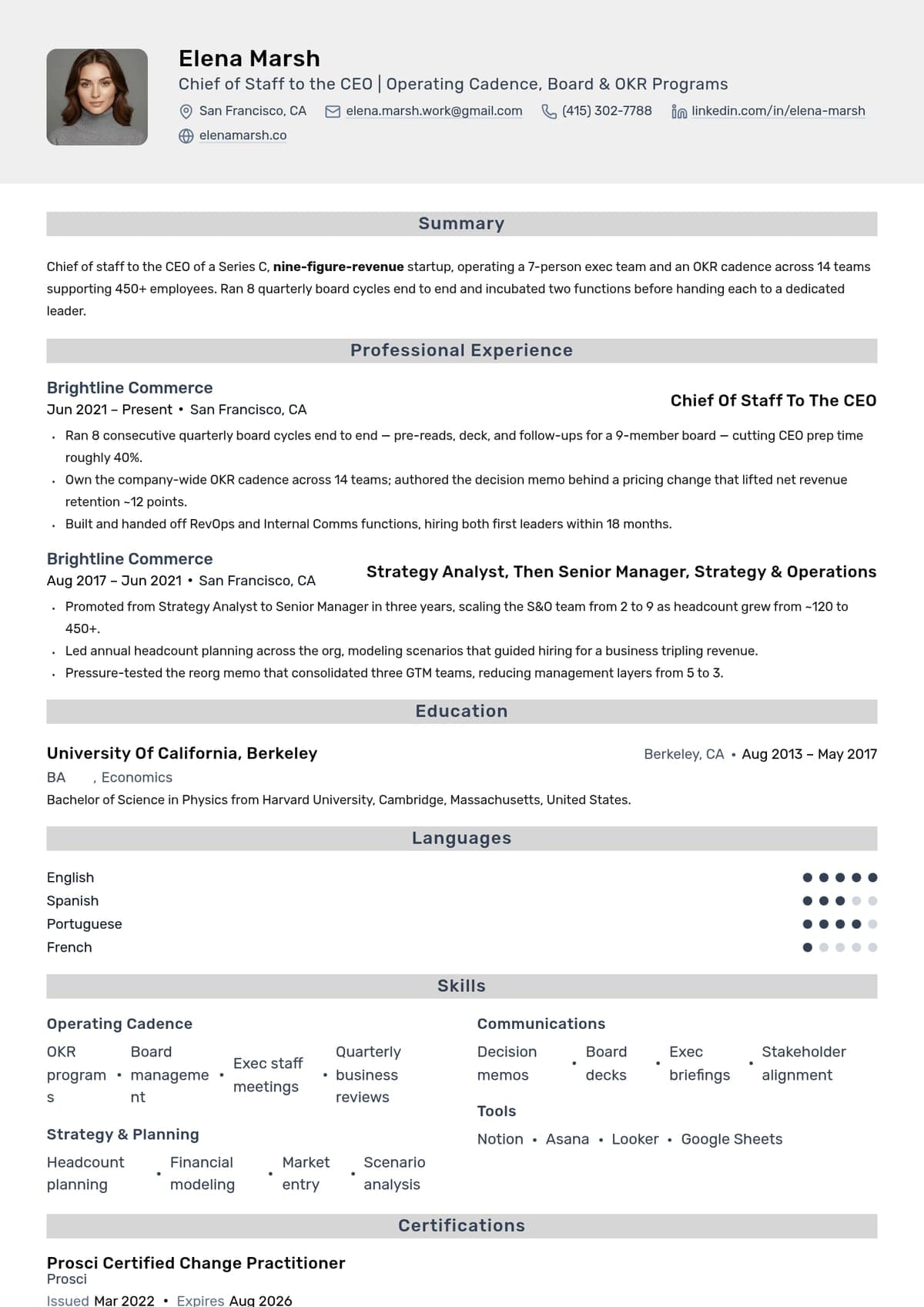
Two pages, reverse-chronological, single column, sent as a PDF. Internal promotions stacked under one employer block with dates on each title. A scope line up top (headcount, sites, states, team, union status), before-and-after metrics you pulled from your own HRIS, compliance acronyms attached to actions rather than listed bare, and confidential work written as aggregate counts with outcomes.
- How do I write an HR manager resume with no HR manager title yet?
Write manager-scope evidence under your senior generalist title: the headcount you supported, the investigations you ran end to end, the project you owned (an audit, an open enrollment, a system rollout), and anyone you functionally supervised, such as a coordinator you trained and directed. The title gap closes when the scope line reads at manager level. Target postings that say "HR manager" at smaller companies, where the generalist-to-manager jump most often happens.
- How is a senior HR manager resume different?
Scale and altitude. A senior HR manager resume shows larger headcount, more states or sites, a bigger team, and at least one bullet where you influenced something above your function: a workforce plan leadership adopted, a compensation structure you built, a compliance risk you surfaced to executives before it became a charge. Certifications shift too; postings at this level name SPHR or SHRM-SCP more often than PHR or SHRM-CP.
- Should my HR manager resume be a PDF or a Word document?
PDF, unless the posting explicitly requests Word. A text-based PDF parses cleanly in modern applicant tracking systems and holds its formatting on every device, which matters when your reader is an HR director opening it on a phone between meetings. You can verify how your own file parses with a free ATS resume test before you send it.
- How do I put confidential HR work on a resume?
Aggregate and anonymize. Count the cases ("25+ investigations"), name the process ("intake through corrective action"), and state the outcome ("no resulting litigation", "charge dismissed"). Never include a department, a role, a timeframe narrow enough to identify a person, or any detail of what happened. Written this way, confidentiality itself becomes evidence: an interviewer reading clean aggregates knows you can be trusted with the next sensitive case.


Ready when you are
Send the tailored resume, not the generic one.
Paste a job posting and Roleframe scores your resume against it, then helps you close the gaps one approved edit at a time, so you apply while the role is still fresh.