How to Test Your Resume Against an ATS (Three Free Checks)
Run an ATS resume test in two minutes: the copy-paste test, the search test, and a keyword scan against a real posting. What each result actually means.

On this page
You can run a meaningful ATS resume test in about two minutes with no tool at all. Two of the three checks below use software already on your computer. The third, a keyword comparison against a real job posting, works by hand and goes faster with a scanner.
Know what you are testing first. An applicant tracking system (ATS) is a recruiting database. Systems like Workday, Greenhouse, Lever, and iCIMS receive your application, parse the resume into structured fields such as name, job titles, employers, dates, and skills, then store everything so recruiters can search and screen. A resume fails at this stage for one of two reasons. Either the software cannot extract your text cleanly, or the extracted text does not contain the words a recruiter searches for.
Paid checkers sell you a score out of 100 and skip past both questions. The same file also parses differently on different platforms, so a score from one tool says little about the system screening your next application. The checks below are cruder and more honest. They show you exactly what breaks, and where.
The copy-paste test
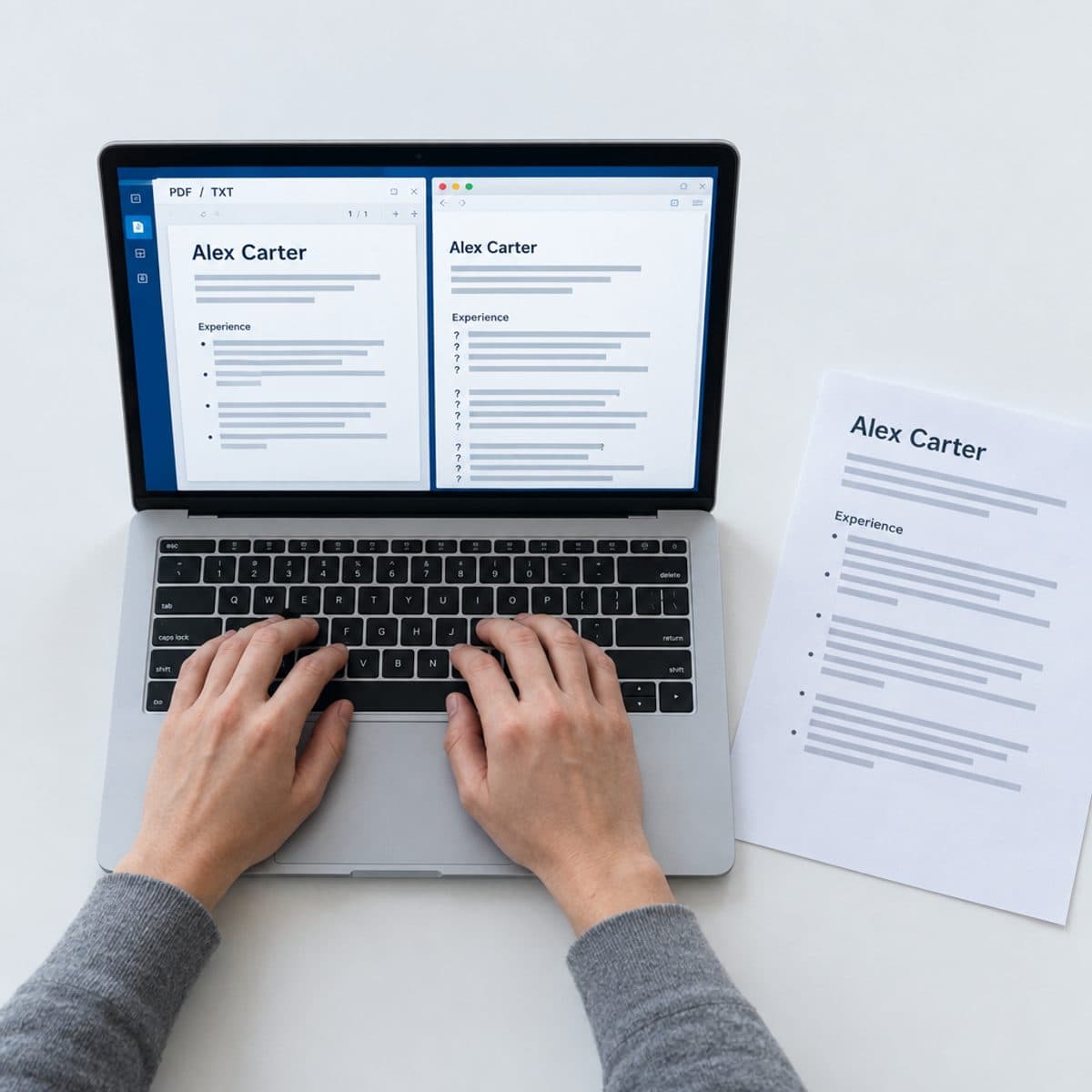
This test approximates the first thing every parser does, which is extract your resume's raw text. Open your PDF, press Ctrl+A (Cmd+A on a Mac) to select everything, copy it, and paste it into a plain-text editor. Notepad on Windows works, or TextEdit on a Mac switched to plain-text mode. Word processors reformat the paste and hide the problems, so use something dumb on purpose.
Now read the paste as if you had never seen the designed version. Check four things:
- Order. Does the text read top to bottom in the sequence you intended? Each job should appear as title, employer, dates, then bullets, with nothing from another section wedged in between.
- Contact details. Are your email and phone number in the paste? Text placed in a document's header or footer region gets skipped by some parsers, and a resume with no reachable contact details is a dead application.
- Dates. Is each date range next to the job it belongs to? Dates floating in their own column can detach from the role, and employment chronology is one of the fields recruiters filter on.
- Characters. Do bullets come through as readable symbols, or as boxes and question marks? Garbled output usually means a decorative font or symbol set the extraction cannot map.
One caveat keeps this test honest. Commercial parsers are smarter than Notepad. Modern systems combine text extraction with layout analysis and named-entity recognition, and newer AI layers can infer skills from context rather than matching exact strings. Smarter is not the same as reliable, though, and parsing quality varies between platforms. If the plain-text paste is chaos, you are betting your application on the parser reconstructing a document you could have made readable yourself. A resume that survives the dumb test survives everywhere.
The search test
This one takes thirty seconds and catches the worst failure an ATS resume test can find. Open your PDF and press Ctrl+F (Cmd+F on a Mac). Search for your own last name. If nothing highlights, your resume has no text layer. It is an image, and a parser gets nothing from it. This happens with scanned documents and with resumes exported as flattened graphics from design tools, and it turns every application into a blank submission.
If your name highlights, keep going, because the same search box now doubles as a recruiter simulator. Recruiters find candidates by searching the ATS database. Greenhouse, for example, supports Boolean candidate search, and other platforms offer similar filtering. So search your PDF for the exact terms a recruiter hiring for your target role would type. The job title. The two or three hard skills the posting leads with. The certification the role requires.
Exact wording matters more than you would like. A recruiter searching for "CPA" will not surface a resume that only says "Certified Public Accountant," and the reverse is also true. Where an abbreviation is standard, put both forms on the resume once, then let Ctrl+F confirm they are findable. If a skill you genuinely have fails the search, that is not a parsing problem. It is a wording problem, and it is the cheapest fix on this page.
The keyword scan against a real posting
The first two checks test whether your resume can be read. This one tests whether it says the right things for one specific job, which is the part most people skip. Open the posting you actually want and copy it into a document. Highlight every concrete noun. Tool names, certifications, methodologies, and the job title itself. Then go through your resume and cross off each highlighted term that appears there in the same words. Whatever is still highlighted is your gap list.
A few rules make the scan sharper. Terms in the requirements section count for more than anything in the company blurb, and a term the posting repeats is usually a term the recruiter filters on. Hard skills are what get searched, since "Python" and "PMP" are filterable strings while "team player" is not. A keyword you add without the experience behind it is a trap you set for your own interview, so only close gaps that are true. When a posting is vaguely written, our ATS keyword lists by job title are a useful cross-check.
By hand this takes ten or fifteen minutes per posting, which is fine for one application and miserable for twenty. This is the one check where a tool earns its place. In Roleframe, you duplicate your base resume for a job, paste the posting, and get a fit report with an ATS score for that posting, the exact keywords you are missing, and a prioritized plan of what to change. It does not rewrite anything for you. You make the edits, with Remi suggesting rewrites bullet by bullet that you approve or discard. The full workflow is in our guide to checking your resume against a job description.
Reading the results
Most failures you find will map to one of a handful of causes, and every one of them has a mechanical fix.
| What you found | Likely cause | The fix |
|---|---|---|
| Text pastes out of order, columns interleave | Multi-column layout or text boxes | Move the experience section to a single column; keep columns only for short lists where scrambled order costs nothing |
| Email or phone missing from the paste | Contact details sit in the header or footer region | Move them into the document body, near the top |
| Ctrl+F finds nothing at all | Image-based or flattened PDF | Re-export a text-based PDF from your editor, never a scan or a graphic |
| Bullets appear as boxes or question marks | Decorative symbols or a nonstandard font | Switch to standard round bullets and a common font |
| Dates detached from their jobs | Dates in a separate column or a graphic timeline | Put dates on the same line as the title and employer |
| Keywords from the posting absent | Your resume describes the skill in different words | Mirror the posting's exact terms wherever they are true of you |
If you also ran a commercial checker and got a number, read it as a direction rather than a verdict. There is no universal ATS score. Each checker grades against its own rubric, and none of them can see how a specific employer configured their system. An 80 that hides two missing must-have skills is worse than a 65 whose gaps are all nice-to-haves. Look at the findings underneath the number, fix the ones that map to the posting's requirements, and ignore the rest. If you want to know which tools produce findings worth acting on, we compared the main options in our review of ATS resume scanners.
What none of these checks can tell you
Every check on this page tests the document. None of them can test the employer's setup, and that setup decides more than most "how to beat the ATS" advice admits.
Employers configure their own screening. Knockout questions reject before any keyword is read, so answering no to a work-authorization question ends the application no matter how well the resume parses. Recruiters then build their own searches and scorecards on top of the parsed data, and some platforms, Oracle Taleo among them, support prescreening questions that disqualify automatically. No generic score predicts any of that.
The AI layer is growing, and it cuts both ways. Major systems keep adding AI features, from Workday's tooling that infers skills from candidate resumes to AI-generated candidate summaries on newer platforms. Semantic matching means a system may credit related experience even without the exact string, and it also means keyword stuffing buys less than it used to. Clear, literal statements of real skills are what the old keyword filters and the new AI layers both reward.
The last gate is always a person. A recruiter reads the resumes that survive the screen in seconds, and a perfectly parseable document full of vague bullets still loses to a messier one with evidence. Pass the three checks, then spend your remaining time on the part no scanner grades, which is proof that you did the job well. If any of the fixes above surprised you, our guide to ATS-friendly formatting covers the document side in more depth.
Frequently asked questions
- Is 80% a good ATS score?
There is no universal scale, so an 80 from one checker is not comparable to an 80 from another, and neither predicts what a specific employer's system will do. Read the findings behind the number instead. If the score is hiding a missing must-have skill or a parsing failure, fix that regardless of the number. If the remaining gaps are nice-to-haves you do not actually have, an 80 is fine.
- Is a 77% ATS resume score good?
The few points between 77 and 80 mean nothing, because checkers grade against their own rubrics rather than the employer's configuration. What matters is what the missing points are made of. A 77 that lacks a couple of nice-to-have keywords belongs to a strong resume, while a 77 that cannot be parsed into clean text belongs to a broken one. Run the copy-paste test to tell the difference.
- Can ChatGPT check my resume's ATS score?
It can compare your resume text against a posting and flag missing terms, which is a legitimate use. It cannot test parsing, because the moment you paste text into a chat you have skipped the extraction step an ATS performs on your PDF. Any numeric score it produces is generated on the spot with no rubric behind it. Use a chat model for keyword brainstorming, and use the copy-paste and search tests for the parsing question.
- How do I pass ATS resume screening?
Submit a text-based, single-column PDF with standard section headings and contact details in the body rather than a header. Mirror the posting's exact terms for skills you genuinely have, and answer knockout questions honestly, since those cause most automatic rejections. Then tailor per job. Recruiters search for the posting's language, and a generic resume rarely contains it. Our quick ATS-friendliness check is a good final pass before you submit.
- Do ATS systems automatically reject resumes?
Less often than the folklore says. Automatic rejection usually comes from employer-set knockout questions, such as work authorization or a required license, rather than from a hidden resume score. The more common fate is quieter. A resume that parses badly or lacks the searched-for terms is never surfaced, so no one rejects it because no one ever sees it.
- Should I test my resume as a PDF or a Word file?
Test the file you will actually submit, and that should be a text-based PDF by default. PDF keeps your formatting fixed, modern systems parse text-based PDFs without trouble, and the search test above confirms yours has a real text layer. Use a Word file only when a posting explicitly asks for one.
- Does a two-column resume fail the ATS?
Sometimes, and the copy-paste test will tell you whether yours does. If the two columns interleave in the plain-text paste, a parser can attach your skills list to the wrong job or lose the reading order entirely. The safe pattern is a single column for the experience section, with columns reserved for short lists where a scrambled order costs nothing.


Ready when you are
Send the tailored resume, not the generic one.
Paste a job posting and Roleframe scores your resume against it, then helps you close the gaps one approved edit at a time, so you apply while the role is still fresh.