How to Check if My Resume Is ATS Friendly
by Larbi SahliLast Updated
Three free ways to test if your resume is ATS friendly, from a copy-paste parsing check to a keyword scan. Plus why the 'no columns' rule is a myth.
On this page
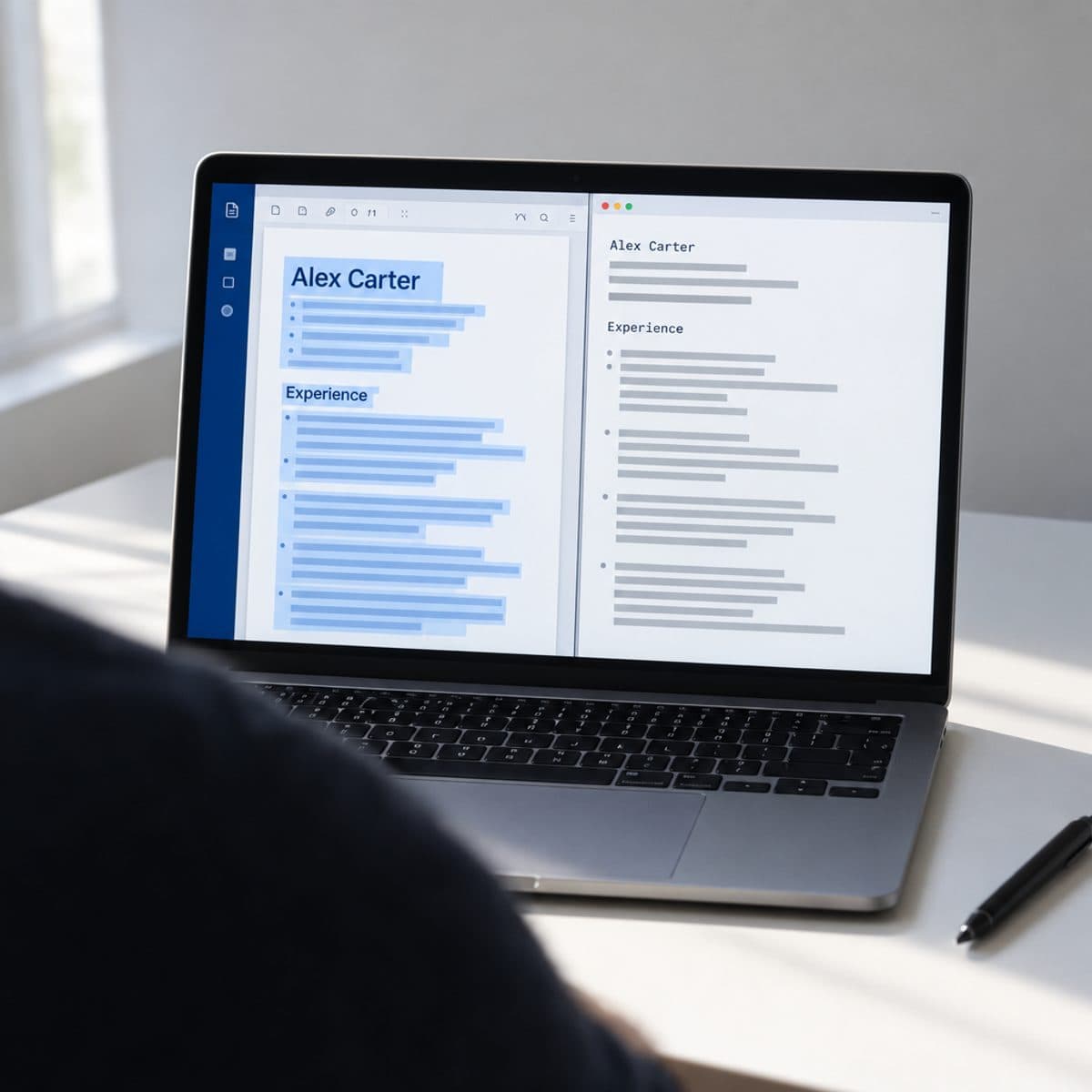
The fastest check: open your resume PDF, press Ctrl+A to select everything, copy it, and paste it into a plain-text editor. If your name, job titles, dates, and bullets come out as readable text in the right order, an applicant tracking system (ATS) can parse your resume. For the full picture, run a free ATS scan that also scores your keyword match against a specific job posting.
What makes a resume ATS friendly
An ATS is the database recruiters use to store, search, and filter applications. When you apply, it extracts the text from your file and maps it into fields: name, contact info, work history, skills, education. "ATS friendly" means two separate things, and most advice online conflates them.
First, parseable. The software can pull your text out cleanly and put each piece in the right field. This is about how your file is built, and it is the part you can test in two minutes.
Second, matchable. When a recruiter searches or filters by keywords from the job description, your resume shows up. This is about content, and it changes with every job you apply to.
A resume can pass one test and fail the other. A plain-text resume with none of the posting's keywords parses perfectly and still never surfaces in a recruiter search. A keyword-rich resume built as a flattened image parses as nothing at all. You need to check both, and the checks are different.
How to test your resume parsing (three free checks)
You do not need paid software to test parsing. Three manual checks catch nearly every real problem.
- The copy-paste test. Open the PDF, select all, copy, and paste into Notepad or any plain-text editor. Read the result top to bottom. Your contact details, section headings, job titles, dates, and bullets should appear in a logical order. Garbled characters, missing sections, or bullets from two jobs interleaved with each other mean a parser will struggle too.
- The search test. Press Ctrl+F in the PDF and search for your phone number, your most recent job title, and two or three core skills. If the PDF viewer can't find text you can see on the page, that text is an image or an outline, and it is invisible to an ATS.
- The reading-order test. In your pasted plain text, check specifically that each job title sits next to its own dates and bullets. Parsers read the text layer sequentially, so a date that lands three jobs away from its title in the paste will land in the wrong field in the database.
If your resume passes all three, the file itself is fine. Any remaining problem is a content problem, which the keyword section below covers.
Common formatting mistakes that actually break ATS scanners
Most "ATS rules" you'll read are folklore. These are the failures that genuinely show up when a parser reads a file.
- Text saved as an image. Design tools like Canva sometimes export text as shapes or flatten the page into a graphic. The resume looks identical, but the copy-paste test returns nothing. This is the single worst failure, because the ATS receives an empty application.
- Contact info trapped in the header or footer. Some parsers skip Word-style header and footer regions entirely. If your email lives there, it may never reach the recruiter's contact field. Keep contact details in the body of the page.
- Icons instead of labels. A phone icon followed by a number gives the parser no signal about what the number is. A tiny label like "Phone" or a recognizable format does.
- Creative section headings. Parsers map sections by heading names. "Experience," "Work Experience," "Education," and "Skills" map reliably. "My Journey" or "Where I've Been" often maps to nothing.
- Skill bars and star ratings. A graphic showing "Python: 4 stars" parses as either nothing or the bare word. Write the skill and let your bullets prove the level.
- Scanned resumes. A printed-and-scanned PDF is a photograph of text. Without a text layer, nothing parses.
- Word text boxes. In .docx files, text boxes float outside the main document flow, and many parsers read them out of order or skip them. This is a Word problem, not a PDF problem, and it is one of the reasons the safest submission format is a properly generated PDF.
Do columns and tables ruin ATS readability?
No, and this myth deserves a proper burial. The most upvoted resume advice on Reddit says one column, always, no exceptions. That was reasonable caution a decade ago. Today it confuses the layout you see with the text layer the ATS reads, and those are two different things.
A PDF stores text as positioned runs with a defined extraction order. When a parser opens your file, it reads that order, top to bottom. A two-column resume built in a proper editor embeds its text in a sane sequence: sidebar skills as one clean block, main-column experience as another, each title with its own dates. It passes the copy-paste test, and it parses.
Where columns actually go wrong is in how the file was made. Word simulates columns with tables or text boxes, and parsers linearize tables row by row, so a title in the left cell gets stitched to an unrelated line from the right cell. Design tools sometimes convert column text to outlines, which parses as blank space. The layout was never the culprit. The export was.
This is exactly why Roleframe's editor exports true WYSIWYG PDFs: what you see on screen is the same document, with a text layer that follows real reading order, so a modern two-column template parses as cleanly as a plain one. You don't have to take that on faith either. Run the copy-paste test on any exported PDF and read the result yourself. The test settles the argument in two minutes, which is more than the "no columns ever" crowd usually offers. For the full formatting picture, see how to make your resume ATS-friendly without ugly design.
One honest caveat: if a specific employer's portal forces you to paste plain text into form fields, columns are irrelevant there anyway, because you're pasting linear text. The practical rule is test your file, don't ban layouts.
How to check your keyword match rate
Parsing gets your data into the database. Keywords get it found. Recruiters filter and search applications by the terms in the job description: tools, certifications, methodologies, job titles. A parseable resume with none of those terms sits in the database unseen.
The manual method works and costs nothing. Print or copy the job posting, highlight every concrete noun: software names, certifications, hard skills, the exact job title. Then Ctrl+F your resume for each one. Every highlighted term you can honestly claim but haven't written down is a gap. Note the exact spelling too. If the posting says "project management," a resume that only says "managed projects" can miss an exact-phrase filter, so use the posting's form at least once.
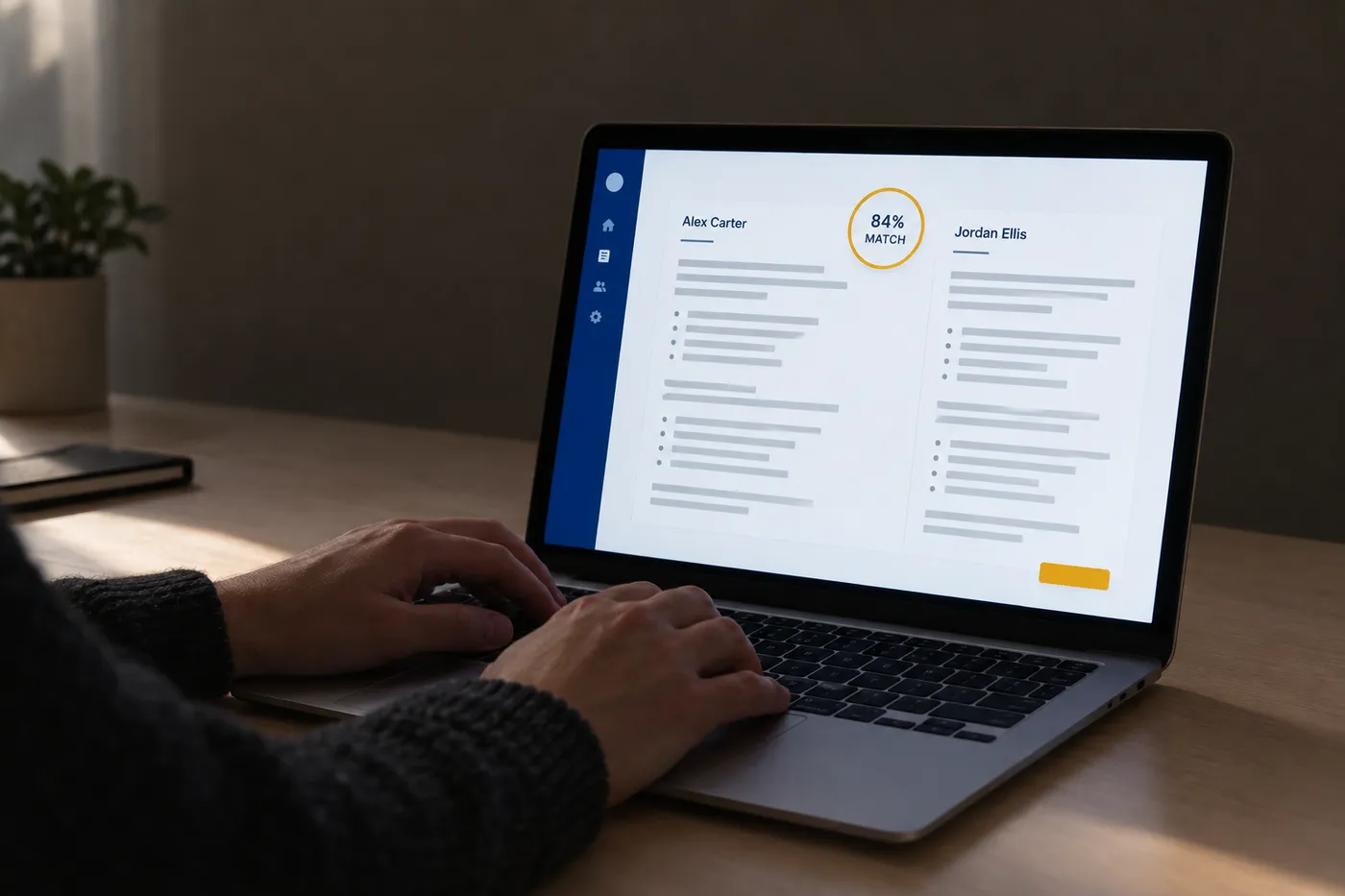
The faster method is to let software do the comparison. Paste the posting into Roleframe and it produces a fit report for your resume against that specific job: an ATS score, the exact keywords the posting asks for that your resume is missing, and a prioritized plan for what to change. It doesn't rewrite anything for you. It shows you the gaps, and you close them yourself with Remi, its career copilot, suggesting edits you approve one at a time. That matters more than it sounds, because a keyword you can't back up in an interview is worse than a missing one. There's a deeper guide to this in ATS resume keywords: stop guessing and start matching.
Running a free ATS test on your PDF
Put the pieces together and a full check takes under fifteen minutes.
- Export your resume as a PDF. PDF preserves your formatting exactly and every major ATS parses text-based PDFs. Only submit another format if a specific employer explicitly demands it.
- Run the copy-paste test and the search test on the exported file. Fix any text that comes out garbled, missing, or out of order before doing anything else.
- Pick one real job posting you intend to apply to. A generic scan without a target job can only judge formatting; keyword match only means something against a specific role.
- Run a scanner that compares your resume to that posting and read the gaps it names, not just the headline number.
- Fix the gaps you can honestly claim, re-export, and re-test. One pass of edits usually resolves most of the list.
On scanners generally: treat the score as a direction, not a grade. Different tools compute different numbers from different rules, so the same resume can score high on one and mediocre on another. The list of named, specific gaps is the product. If you want a comparison of the options, we've reviewed the best ATS resume scanners and where each one earns its keep.
Fixing ATS errors without losing your design
The good news buried in all of this: almost every parsing fix is invisible to a human reader. You rarely have to choose between a resume that parses and a resume that looks good.
- Rename creative headings to standard ones. "Experience" reads fine to humans and maps perfectly for parsers.
- Move contact details out of header and footer regions into the top of the page body. Visually it can sit in exactly the same spot.
- Keep icons if you like them, but make sure the text next to them is real, selectable text.
- Replace skill bars with plain skill names. Recruiters didn't trust the bars anyway.
- Keep your two-column layout if it passes the copy-paste test. If it fails, the fix is rebuilding the file in a tool with a clean text layer, not abandoning the design.
- If your only copy is a PDF from an old tool, you don't have to retype it. You can import and edit a PDF resume online for free and it comes back as editable blocks with your roles and dates in place.
Then re-run the two-minute test after every export. The habit costs nothing and catches regressions before an employer's software does.
Frequently asked questions
- Is a 77% or 80% ATS score good?
There is no universal scale, so the number alone means little. Each scanner computes its score from its own rules, and the same resume can score differently across tools. Real applicant tracking systems mostly don't assign a percentage at all; recruiters search and filter by keywords. Use the score to find the named gaps, fix the ones you can honestly claim, and stop chasing a perfect number. A resume stuffed to hit a high score reads worse to the human who opens it next.
- Can ChatGPT check my resume's ATS score?
Not reliably. ChatGPT never sees your PDF the way a parser does; it reads extracted text and then estimates, which means it cannot detect the failures that actually break parsing, like flattened text or a scrambled reading order. It also has no knowledge of any specific ATS's rules, so any percentage it gives you is invented on the spot. It can be useful for spotting missing keywords in prose. For parsing, use the copy-paste test and a real scanner.
- Do ATS systems automatically reject resumes?
Mostly no. The common picture of software silently binning applications is wrong for the vast majority of hires. An ATS stores and ranks applications; humans decide. Auto-rejection exists mainly for knockout questions, like work authorization or a required license. The real risk is quieter: a resume that parses badly or misses the search keywords is never surfaced when the recruiter filters the pile, which feels identical to rejection from your side.
- Is PDF or Word better for ATS?
PDF, as the default. Every major modern ATS parses text-based PDFs, and PDF locks your formatting so the recruiter sees exactly what you designed. Word files carry their own parsing risks, especially text boxes and tables, and they can render differently on the recruiter's machine. Submit a .docx only when an employer explicitly requires one, and even then keep your master copy as a PDF.
- Does Workday parse PDF resumes correctly?
Yes, Workday and the other major systems (Greenhouse, Lever, iCIMS, Taleo) parse text-based PDFs. Better still, Workday shows you its parse: after upload, it fills the application form with the fields it extracted. Read that preview before submitting. If your titles, dates, and employers landed in the right boxes, you've just watched the actual ATS confirm your file is fine, which beats any third-party checker.
- Should I switch to a plain one-column resume just to be safe?
Only if your current file fails the copy-paste test and you can't rebuild it in a better tool. A well-built two-column PDF parses cleanly, and design that helps a human read your resume in a few seconds has real value too. "One column, always" is a rule for people who can't verify their file. You can verify yours in two minutes, so test instead of downgrading.
Ready when you are
Send the tailored resume, not the generic one.
Paste a job posting and Roleframe scores your resume against it, then helps you close the gaps one approved edit at a time, so you apply while the role is still fresh.