How to Check Your Resume Against a Job Description (And Fix the Gaps)
Check your resume against a job description in five steps: import your PDF, get a fit report, close keyword gaps, and fix section order yourself.


On this page
A resume that never uses the language of the posting usually loses to one that does, even when the candidates are equally qualified. Most mid-size and large employers run applications through an applicant tracking system (ATS) before a recruiter reads anything, and the recruiter who does read it skims. Both passes reward the same thing: obvious, checkable overlap between what the job asks for and what your resume says.
Checking your resume against a job description is how you build that overlap on purpose, before you hit submit. This guide walks through a five-step workflow for doing it, from importing your current PDF to reordering sections for the specific role. It also makes the case for keeping your hands on the keyboard instead of letting an AI rewrite the whole document, because that shortcut has a cost you pay in the interview.
Why generic resumes fail the recruiter's first skim
A recruiter's first pass at a resume lasts seconds, not minutes. They scan for a recognizable title and a couple of skills or employers that match the requisition, then decide whether to keep reading. If the posting says "program manager" and your resume says "delivery excellence lead," that scan comes up empty and you get skipped, regardless of how good the underlying work was.
Before the skim even happens, most applications pass through screening software. Modern applicant tracking systems parse your resume into structured fields and score it against the requirements of the specific job. Newer systems go beyond literal keyword counting and use semantic matching, so "built ETL pipelines" earns some credit against "data pipeline experience." Partial credit is still less than full credit, though. The exact phrase the employer filters on beats a cousin of it every time.
This is why generic resumes underperform. Recruiters and hiring managers consistently say they prefer resumes written for the specific role, with a summary and bullets that mirror the posting's priorities, and tailored applications convert to interviews at a noticeably better rate than one-size-fits-all ones. A generic resume isn't wrong. It's invisible to the two filters that decide whether anyone ever reads it properly.
What checking a resume against a job posting actually means
A real check is a comparison against a defined checklist, not a vibe read. Whether you do it with two browser windows and a highlighter or a resume gap analysis tool, you are answering the same questions about overlap.
- Hard skills and tools: does every named tool, technology, or method in the requirements appear somewhere on your resume, in the posting's exact wording?
- Job title: does your title language map to the standard title the posting uses, or to an internal name nobody searches for?
- Seniority signals: do your years of experience and scope of ownership match what the role calls for?
- The top third: does your summary read like it was written for this role, or for any role?
- Outcomes: for the requirements that matter most, do your bullets show the skill in action with a result, or just list responsibilities?
You can run this by hand. Open the posting and your resume side by side, mark every requirement, and label each one hit or miss. It works, and for your first job posting it's worth doing once just to feel how large the gap usually is. It's also slow enough that most people stop doing it by the third application, which is exactly when guessing takes over. Guessed keywords are the most common way a qualified resume fails a filter, and matching real ATS keywords instead of guessing is a discipline of its own.
The rest of this guide uses Roleframe's workflow, because it's built around exactly this check and I know it end to end. If you want to test your CV against a job description by hand or with another scanner, the same principles apply. The difference is how much of the tedium the tool absorbs and how much of the writing it tries to take away from you.
Step 1: Import your current resume as a PDF
Start from the resume you already have. Nobody should retype a work history to run a check. In Roleframe, you upload your existing PDF and it comes back as editable blocks, with your roles and bullets landing in the right sections, ready to edit in a real editor rather than trapped in a preview.
The import runs a full resume analysis on its own, so the first thing you see is a scored document with its weak sections named. That baseline matters. Before you compare against any specific job, you'll know whether the document itself has structural problems, a summary that says nothing, or experience entries that read like job descriptions instead of achievements.
Two practical notes. Keep the file as a text-based PDF, since scanned images don't parse, in Roleframe or in any ATS. And a free Roleframe account includes an import, so you can run this step without paying anything or entering a card.
Step 2: Paste the target job description
In Roleframe you keep one master resume per target role, a base version that never gets overwritten. Applying to a specific job means duplicating that base into its own workspace and attaching the posting to the copy. The tailored version belongs to that job. The master stays clean for the next one, which is what makes applying to many roles at once survivable.
Paste the full posting, not just the requirements list. Roleframe's job analysis reads it the way a senior recruiter would, working out the role archetype and seniority and mapping every requirement against your actual experience. The parts people skip, like the team description or the "nice to have" section, often carry the signals that separate you from other qualified applicants. Hiring has also shifted toward skills-based screening, where a posting's named skills are compared directly against yours, so the more of the posting the analysis sees, the more precise the comparison gets.
Step 3: Review the prioritized fit report
A short wait later, you have a fit report for that specific job. It's a diagnosis with an ordered treatment plan, not a single number to obsess over.
- ATS score: how the document parses and scores against this particular posting.
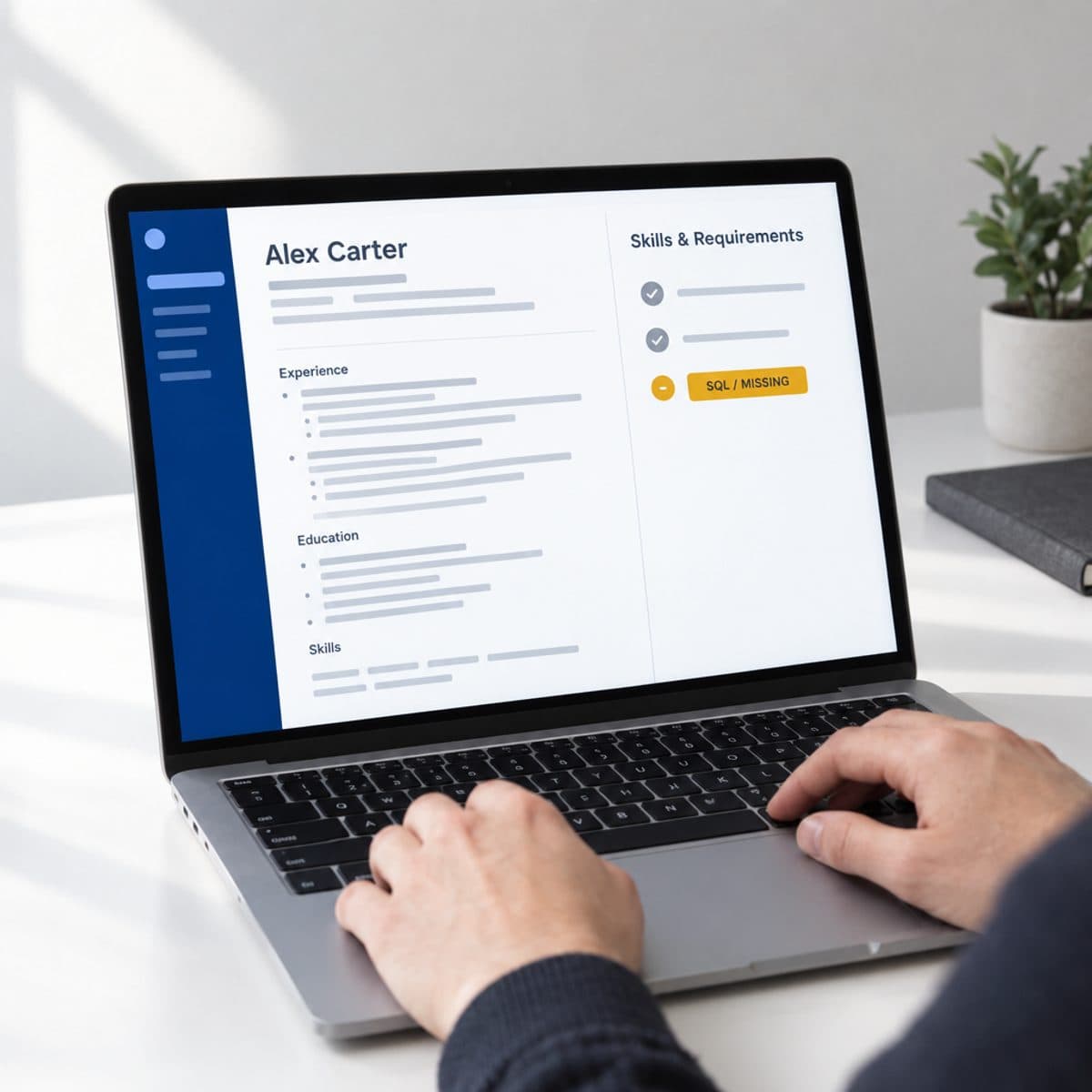
- Keyword coverage: the exact terms recruiter filters scan for, which ones your resume already covers, and which are gaps.
- Job analysis: what the role actually is beneath the title, and what seniority it expects.
- A concrete plan: prioritized changes, what to rewrite and what to move up the page, with the reasoning for each.
Read the plan top to bottom before touching the document. Prioritization is the point. A missing hard skill that appears four times in the posting outranks a soft-skill synonym, and fixing findings in order beats bouncing around the page making cosmetic edits.
Some gaps are honest gaps. If the posting requires a certification you don't hold, no wording fixes that, and knowing it in minute five saves you from spending an evening polishing a long-shot application. The report telling you "this one isn't close" is as useful as it telling you what to fix.
Step 4: Rewrite weak bullets with Remi, your AI copilot
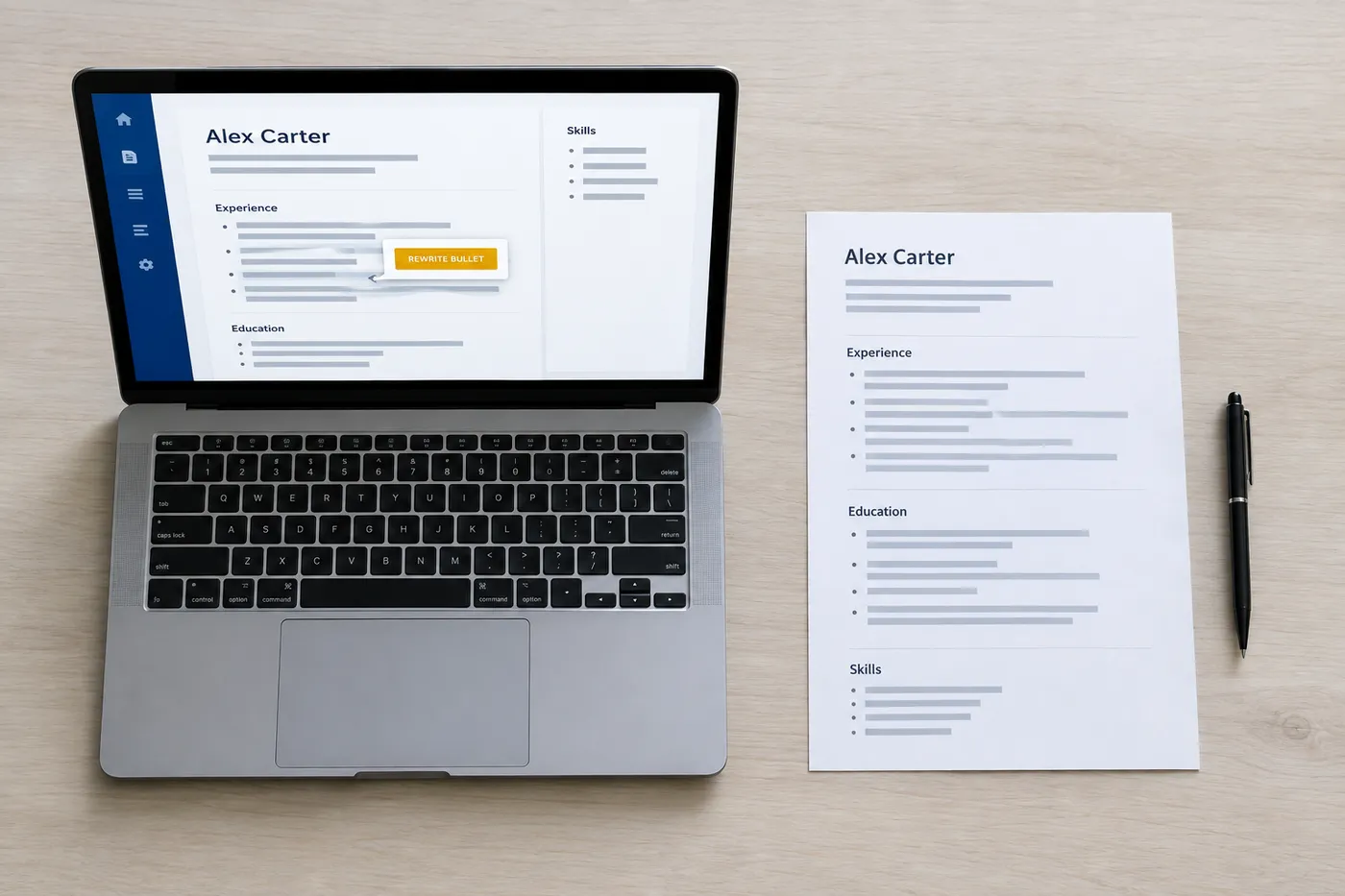
Remi is Roleframe's career copilot, and it lives inside the editor, next to the document you're about to send. It has already read the fit report and the posting attached to your tailored version, so you never paste anything into a chat box or explain the problem from scratch. A finding like "your second bullet never shows stakeholder management" jumps you straight to that bullet, and Remi proposes a rewrite that closes that named gap.
Every proposal arrives as a word-by-word diff showing what would be removed and what would be added. Nothing reaches the document until you accept it, and the tool enforces that rather than trusting you to be careful. Discarding a proposal costs nothing. You can also dictate an instruction instead of typing it, which is faster when you're describing what a project actually involved.
Here's the shape of a good rewrite. Say the posting asks for "cross-functional campaign reporting" and your bullet reads "Responsible for marketing reports." A strong revision shows the skill in action with a result attached, something like "Built the monthly campaign report sales and product used to set quarterly budgets." Same work, same facts, now legible to both the keyword filter and the human reading behind it.
Remi grounds its rewrites in verified facts from your own history and won't invent an achievement to plug a hole. If a gap can't be honestly closed, the right move is to leave it open. Once the resume is done, you can ask Remi for interview practice built from what's actually on the page and the posting you're targeting, which turns the same tailoring work into prep for the conversation that follows.
Step 5: Rearrange sections for maximum impact
Section order is an argument about what the reader should see first, and the fit report will often tell you your current order is wrong for this job. An experienced hire applying within their field leads with experience. A career changer usually needs skills or projects above a work history full of unrelated titles, because the first screen has to show relevance before it shows tenure.
In Roleframe's editor, reordering is a drag. Grab the handle on any block and drop it where it belongs, whether that's above another section or onto a different page entirely. The block keeps its content and its formatting through the move, so nothing gets retyped and no finding in your report gets orphaned.
Most builders either fix the order for you or make moving a section painful enough that nobody bothers, which turns "put your strongest section first" into advice people nod at and skip. If you're unsure what should go where, the best resume section order for your experience level breaks it down case by case.
Why you should never let AI rewrite the whole document
Plenty of tools will take your resume plus a posting and hand back a fully rewritten document in one click. It feels efficient. It's also how you end up in an interview defending a sentence you didn't write.
Two failure modes show up again and again. The first is generic voice, the flattened, adjective-heavy tone that recruiters have learned to recognize on sight because they see it dozens of times a day. The second is worse. A generator optimizing for match score will inflate or invent claims to hit keywords, and a fabricated claim on a resume is radioactive. One probing question and the interview is over, along with your credibility at that company.
| Auto-rewrite tools | Assist model (Roleframe) | |
|---|---|---|
| Who writes the words | The machine, in one pass | You, with Remi proposing edits you approve one by one |
| Keyword gaps | Stuffed in wherever they fit | Named in the fit report; you close the ones that are honestly yours |
| Risk of invented claims | High, because the tool optimizes for match score | Low, because every change is a diff you review before it saves |
| Interview readiness | You memorize someone else's version of your career | You can defend every line because you wrote it |
| Voice | Sounds like every other AI-written resume | Stays yours |
Semantic matching makes the stuffing approach even weaker than it used to be, since modern systems evaluate context around a term, not just its presence. If your current draft already reads like a machine wrote it, that's fixable, and why AI resumes sound generic covers how. The underlying discipline is the same one this whole workflow enforces. The machine finds the gaps. You write the words.
Start tailoring your resume now
The full loop, import, report, targeted edits, and a reorder, takes far less time than a manual side-by-side comparison, and speed is part of the payoff. Postings attract their strongest applicants early, and a tailored resume sent while the role is fresh beats a perfect one sent after the shortlist has formed.
Export your current resume as a PDF, pick one live posting you actually want, and run the check. The gaps it surfaces on that first job will teach you more about your resume than any general advice article, including this one.
Frequently asked questions
- Can ChatGPT analyze my resume against a job description?
Yes, and for a rough first read it's useful: paste both documents in and ask where the resume falls short. The limits show up when you act on the answer. A chatbot works on a pasted copy rather than the file you'll send, gives you rewritten text with no diff to review, and will sometimes invent skills or inflate claims to improve the match. It also can't tell you how your actual PDF parses in an ATS. Using ChatGPT to tailor your resume covers the workarounds and where a purpose-built tool does better.
- How do I match my resume to a job description?
List every requirement in the posting, then confirm each one appears on your resume in the posting's own wording, especially hard skills, tools, and certifications. Standardize your job title if your employer used an internal name. Rewrite your summary so it reads as written for this role, and rework your most relevant bullets to show the skill plus a result rather than a responsibility. Finish by moving your most relevant section toward the top of the page.
- Is there a free way to check my resume against a job description?
The manual method costs nothing: posting and resume side by side, every requirement marked hit or miss. It's accurate and slow. Among tools, a free Roleframe account includes a starter credit balance for trying the AI, which covers running a fit report on a real posting with no card required, and the resume editor itself is free without an account. Most other free scanners give you a partial keyword list and gate the useful findings behind an upsell, so compare what the free tier actually shows before you invest time in one.
- What is a red flag on a resume?
The ones that stop a recruiter fastest are claims that don't hold together: dates that contradict each other, titles inflated beyond what the described work supports, and skills listed with no evidence anywhere in the bullets. Keyword stuffing has joined the list, since a skills section crammed with every term from the posting reads as gaming the filter, and modern semantic screening weighs context around a term rather than its raw presence. An employment gap by itself is rarely a red flag; hiding one clumsily is.
- What match score should I aim for before applying?
There's no universal threshold, and chasing a perfect score usually produces a stuffed, worse resume. Treat the score as a prioritization signal. Close every hard-skill gap you honestly have, mirror the posting's wording for the requirements that appear most often, and stop when the remaining gaps are things you genuinely lack. A resume that's strong on the top requirements beats one that's mediocre on all of them.
- Do I need a different resume for every job I apply to?
You need a tailored version for every job, which is different from writing a new resume each time. Keep one solid base resume per target role, then adjust the summary, the bullet emphasis, and the section order for each posting, usually a fraction of the document. Resume variants: why you need a base resume and tailored versions explains how to run that system without losing track of which version went where.
Ready when you are
Send the tailored resume, not the generic one.
Paste a job posting and Roleframe scores your resume against it, then helps you close the gaps one approved edit at a time, so you apply while the role is still fresh.