Why Your AI Resume Sounds Generic (And How to Fix It)
Fix a generic AI-assisted resume with specific source notes, verified metrics, a reusable editing prompt, and a seven-step review checklist.

On this page
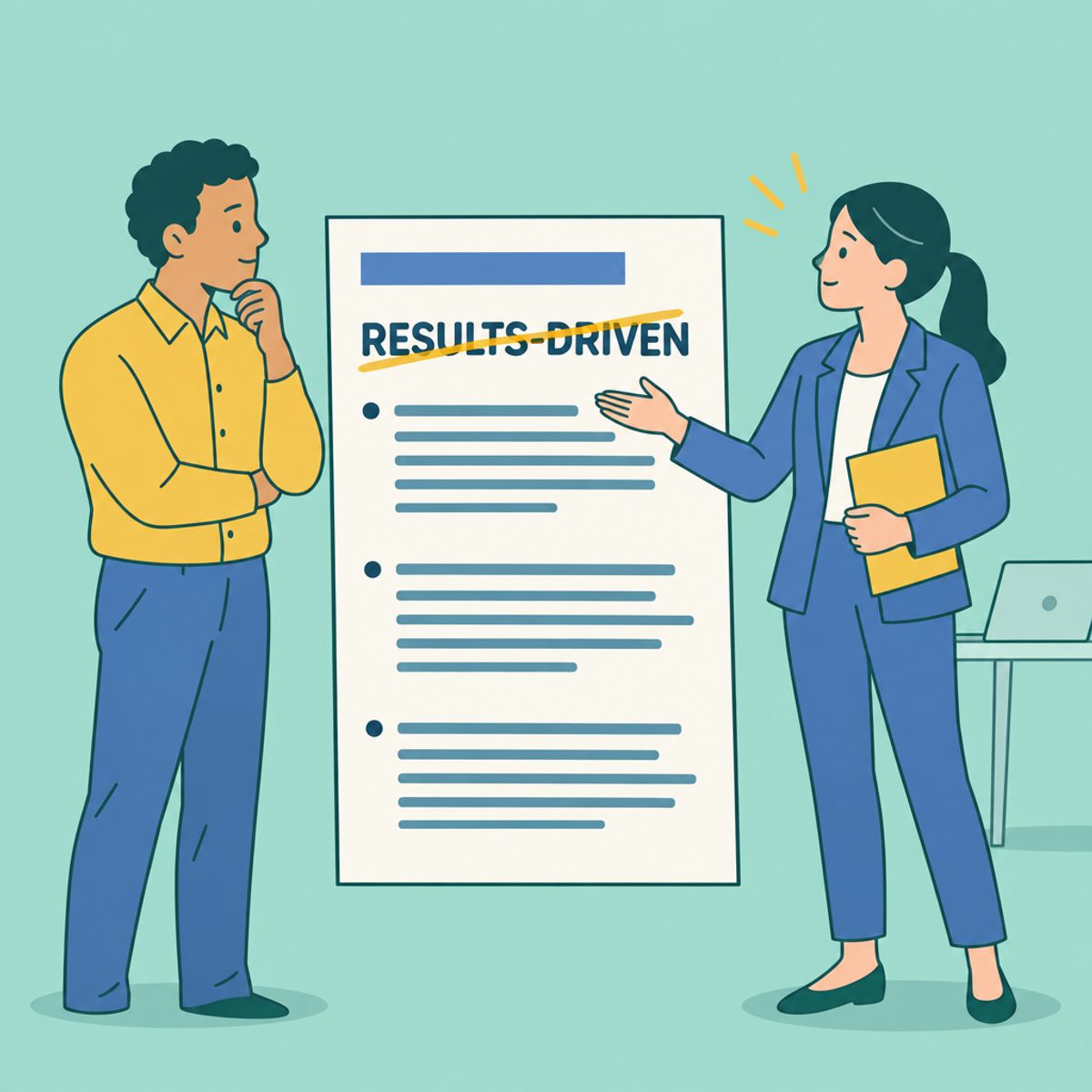
An AI-assisted resume can sound generic when the draft replaces the details of your work with broad claims such as “results-driven professional” or “improved operational efficiency.” The reader gets a category of work without learning what you actually did.
Try this test: cover your name and read the summary. Could it describe almost anyone with the same job title? If so, add the project, responsibility, decision, or result that makes your experience specific.
You do not need to prove whether a phrase was written by AI. You need a resume that accurately explains your qualifications. This guide shows how to improve the brief, review generated suggestions, and replace vague language with evidence.
The thin-brief problem: missing facts leave little to work with
A job title and an instruction to “make this sound impressive” do not establish your achievements. An old resume may also omit the details you remember: why a project mattered, which part you owned, and what changed.
Before requesting a rewrite, create a short note for each important experience. Include the task, your contribution, tools, constraints, and any result you can substantiate. Mark missing information as unknown instead of letting a draft quietly fill it in.
Fictional source note: “Checkout redesign. I coordinated the weekly design/backend review, maintained the issue list, and resolved handoff questions. The team shipped before the launch deadline. I do not have a measured conversion or error-rate result.” This gives an editor useful detail while defining what it must not invent.
Use the draft to make editing decisions
Compare a proposed sentence with the source note. “Spearheaded cross-functional initiatives to drive business impact” loses the task and overstates ownership. “Coordinated design and backend reviews to resolve checkout handoff issues before launch” reflects the fictional note more closely.
The distinction is visible in the claims, not in which tool produced them. A full-document draft can be useful if it has adequate source material and receives careful review; a short rewrite can still introduce errors. Choose a scope small enough that you can check every change.
Harvard’s resume guidance recommends specific, factual language and describes AI as a tool for editing and brainstorming revisions. That is a useful way to approach suggestions: compare them with your evidence before keeping them.
Fluent writing still needs fact-checking
A polished sentence is not verification of a claim. NIST’s generative AI risk profile identifies confidently presented false content as a risk. In a resume, that can mean an invented metric, tool, responsibility, or credential.
Check both accuracy and specificity. “Cross-functional collaboration” may be true but incomplete. “Ran weekly design and backend reviews for the checkout redesign” explains the action. Keep a broader term when it is relevant, then support it with the concrete work.
Three editing problems to look for
These problems can appear in human-written or AI-assisted resumes. Treat them as reasons to revise, not as a reliable test of authorship.
1. Stock phrases with no proof behind them
“Results-driven professional with a proven track record” asks the reader to accept a claim without an example. Replace it with a responsibility or result that matters for the role.
Fictional example: “Rebuilt checkout form validation; monitored validation failures fell from 10% to 7% of attempts over the following month.” That adds a task and a measurable observation. Use a figure only when your records support it, and do not claim the change caused the entire improvement unless you can justify that attribution.
A number is optional. A specific description of a decision, process, or deliverable can also provide evidence.
2. Padded or invented metrics
A figure such as “increased efficiency by 40%” needs an identifiable measure. Ask what was measured, the comparison period, the data source, and your contribution. A round number is not inherently false, and a precise number is not inherently verified.
Fictional example: “Reduced median API response time from 800 ms to 210 ms in repeated tests on the same dataset after adding caching.” The measurement conditions make the claim clearer, but they still need to be true. Do not turn a local benchmark into a production performance claim.
If you cannot substantiate a metric, replace it with an accurate description of the work or leave the figure out.
3. Repetition and an unnecessarily formal tone
A consistent resume structure helps readers. The problem is repetition that hides the substance: several bullets saying “improved efficiency,” a summary full of adjectives, or a skills list with no supporting examples.
Use the verb that describes the action, even if it is ordinary: built, reviewed, tested, coordinated, or wrote. Do not change a correct verb just to make every bullet sound different. Trim wording that adds formality without explaining the work.
Split the review into steps you can check
Rather than asking for a more impressive finished resume, begin with an evidence comparison. Put the posting next to your source notes and identify which requirements they support. Then decide what to emphasize and review the wording.
A useful first request is: “List the job requirements supported by these notes. Quote the relevant source detail for each. Mark unsupported requirements as gaps; do not invent experience.” Verify that comparison before requesting edits.
Working in stages makes changes easier to inspect; it is not a guarantee that the output is correct. Our guide to using ChatGPT to tailor a resume gives more examples of this workflow.
Use a fit report as feedback, then check the evidence
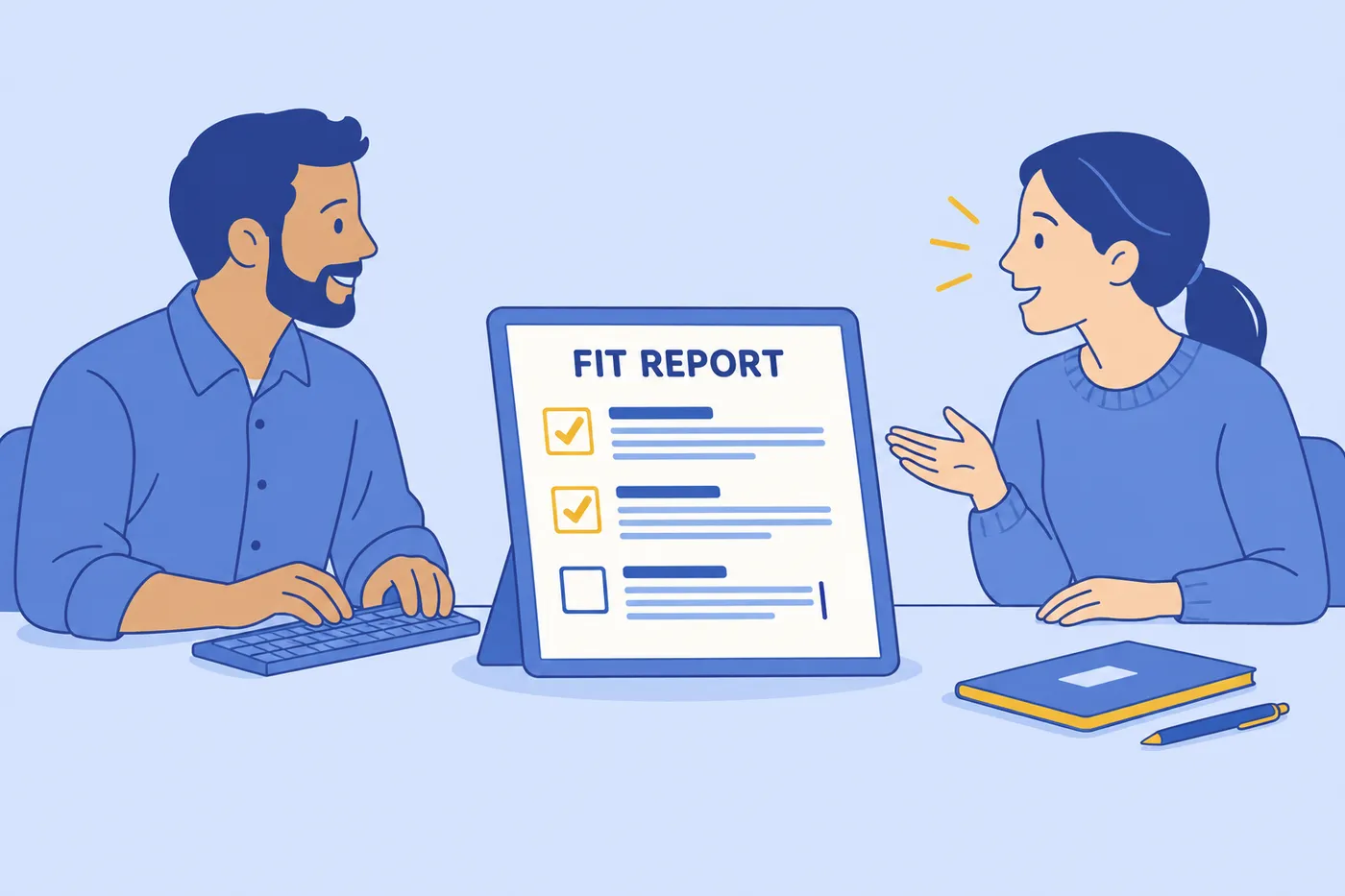
When a resume tool provides analysis or a fit report, compare its suggestions with the actual posting and your source notes. The useful output is a specific editing decision you can evaluate.
- Requirement match: does the tool identify a requirement in the posting and a genuine example in your experience?
- Missing terminology: is a term simply absent from the wording, or do you lack the qualification itself?
- Suggested priority: would moving or shortening an entry make the relevant evidence easier to find?
- Score: what does this tool measure? Its result does not establish an employer’s score or interview decision.
- Interview preparation: can you explain your contribution and the limits of each claim you keep?
You can use Roleframe while tailoring your resume, but the factual review remains necessary for every suggested change. A tool cannot confirm private details of your work just because its explanation sounds confident.
Give the editor a factual brief
Use this brief for one bullet or a small section. Share only information you are permitted to disclose, and remove confidential names or data before sending it to an external service.
Target role: [role]. Relevant posting requirement: [requirement]. Source facts: [what I did, tools, scope, and verified outcome]. My contribution: [individual work versus team work]. Unknown or off-limits details: [missing metrics, confidential data]. Rewrite this as a concise resume bullet. Keep the facts unchanged. Do not add numbers, credentials, tools, or leadership claims. If essential information is missing, ask a question. Explain any change in meaning.
For the fictional checkout note above, an acceptable result might be: “Coordinated weekly design and backend reviews to resolve handoff issues for the checkout redesign before launch.” A draft that adds a conversion increase or changes “coordinated” to “led the engineering team” needs correction.
Pricing and usage allowances do not prove writing quality. Check a product’s current plan details separately, and judge a draft by its accuracy, relevance, and clarity.
How to audit your current resume for AI cliches
Use this checklist on the final document, including any section you wrote without AI assistance.
- Do the name test. If the summary could describe anyone with your title, add a relevant responsibility, specialty, or concrete example.
- Find unsupported claims. Phrases such as “team player” or “proven track record” need evidence. Keep relevant terminology, but explain the work behind it.
- Check each number against a source. Confirm the measure, timeframe, comparison, and your contribution. Label estimates accurately or remove them.
- Check the verbs. Do they describe your role, or did a rewrite turn “supported” into “led”? Read repeated verbs for meaning before changing them for variety.
- Compare with the posting. Highlight requirements your experience supports. Do not add a missing qualification just to improve coverage.
- Restore useful context. For important bullets, explain the constraint, decision, or purpose when it helps the reader understand the work.
- Read the final version aloud. Replace awkward or inflated wording with language you can comfortably explain in an interview.
Make one focused revision at a time. Compare the old and new versions, then check that the new wording preserves the facts. Keep source notes for important claims so future tailoring does not gradually inflate them.
Our guide to resume keywords covers relevant terminology, and common resume mistakes provides broader editing checks. The aim is a document that explains your work clearly and accurately.
Frequently asked questions
- Why do AI models often sound generic?
A brief with few facts gives an editor little specific material. The result may rely on broad descriptions of the role. Add your contribution, context, and verified results, then check whether the revision preserves them. This can improve specificity without assuming every model behaves the same way.
- Is it bad if my resume sounds like AI?
The useful questions are whether the resume is accurate, relevant, and clear. Stock phrases do not reliably establish authorship. Follow the employer’s rules about AI use and revise unsupported or vague claims regardless of who drafted them.
- Why does AI text sound weird even when it's grammatically correct?
A sentence can be grammatically correct while saying little about your work. Replace abstract phrases with the action, object, and relevant context. Keep a professional tone without adding formality that obscures the meaning.
- Why does my ChatGPT resume come out so generic?
Check the source material and request. Provide factual notes, name the job requirement, and ask the tool to preserve uncertainty rather than fill gaps. Review a small section first and compare every claim with your notes before expanding the task.
- How does Roleframe keep my resume from sounding generic?
Use Roleframe as part of your editing process, supplying concrete details and checking suggestions against your work. No tool can guarantee distinctive or accurate writing from incomplete information. Keep the final review focused on factual claims, relevant evidence, and language you can explain.
- Does an "unlimited AI" resume builder produce worse resumes?
A usage allowance does not establish writing quality. Evaluate the source material, the requested task, and the accuracy of the result. Whether you generate one draft or several, review the final claims and follow any employer instructions.

Ready to start your new resume?
Writing a resume takes time, and even a polished one can miss what a hiring manager is looking for. Roleframe helps you build a clear, ATS-safe resume in minutes and tailor it to the job you want.


