Job Search for People With Disabilities: A Practical US Guide
A US job-search guide covering disability employment resources, disclosure choices, accommodation requests, employer checks, and practical example scripts.

On this page
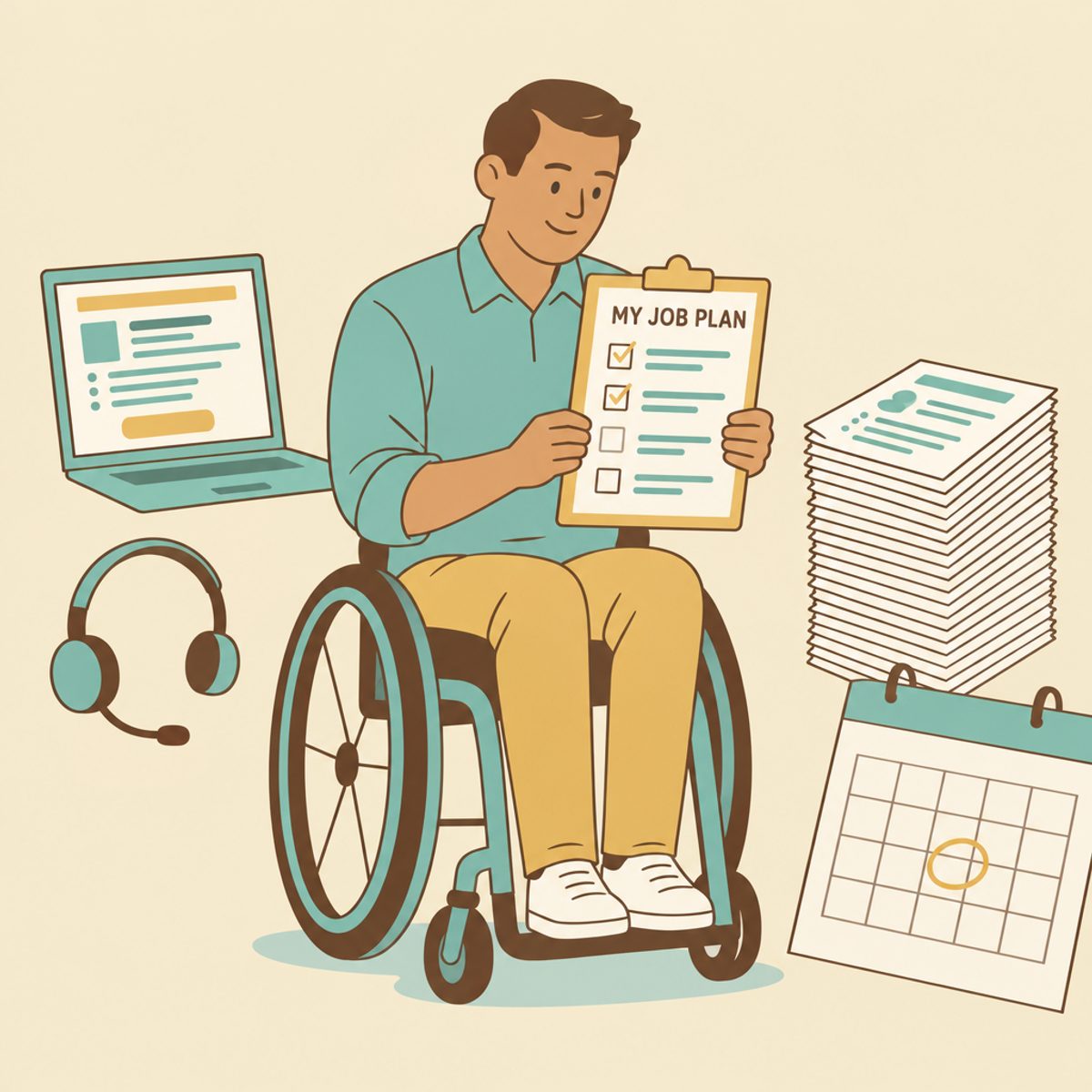
Start with the work you want to do, the skills you bring, and the conditions that let you do it well. Then choose search channels, assess employers, and plan any access arrangements you need during hiring.
This guide focuses on United States programs and federal employment guidance. State and local protections can add to federal law; outside the US, use the relevant employment authority. Disclosure, accommodation requests, and eligibility documents for a disability hiring program are different decisions, explained below.
The page uses both “people with disabilities” and “disabled people.” Use the language you prefer for yourself. The sample scripts are illustrative and should be adapted to your actual needs.
Where to find jobs for people with disabilities
Combine ordinary job-search channels with any specialist support that fits your situation. USA.gov’s employment-resource page links to vocational rehabilitation, independent living centers, federal hiring information, and other programs. Check eligibility and current availability with the provider rather than assuming every service is open to everyone.
General job boards, used with their filters
Search by the role and conditions you need, including hours, location, and schedule where filters are available. Read the duties as well as the tags. A remote job can remove a commute while still involving inaccessible software or meetings that do not fit your needs.
Save questions about the actual tools and working pattern for the recruiter: “Which meeting platform do you use?” or “How much of the work must happen at fixed times?”
Disability-focused job boards
A specialist board such as disABLEDperson can add vacancies to your search. Treat the listing as a lead: confirm that the opening is current, inspect the employer’s own application process, and ask about the conditions relevant to you. A listing alone does not establish that every tool or team is accessible.
Your state vocational rehabilitation agency
Use the state-agency links on USA.gov to find your vocational rehabilitation (VR) service. Ask what help is available for your goals, such as assessment, training, or employment support, and what eligibility and application steps apply.
When making contact, describe your work goal and the barrier you need help with. Ask about waiting periods, documentation, and any costs before committing to a service.
American Job Centers and Centers for Independent Living
American Job Centers provide employment assistance such as counseling, job listings, and training referrals. Contact a local center about services and access arrangements.
USA.gov also links to local Centers for Independent Living. They can be another place to ask about community resources and supports. Confirm what a particular center offers rather than expecting a dedicated job-placement service everywhere.
If you receive SSDI or SSI: Ticket to Work
Social Security’s Ticket to Work is free and voluntary for eligible people ages 18 through 64 who receive SSDI or SSI because of disability. Participants use approved service providers, such as Employment Networks or state VR agencies, for employment support.
Before changing work or earnings, ask about how your particular benefits and health coverage may be affected. SSA’s provider and benefits-counseling guidance explains where to seek help. Participation does not mean every benefit remains unchanged regardless of earnings.
Federal jobs
For federal roles, read the vacancy’s eligibility requirements and the federal-hiring links on USA.gov. A special hiring path may require separate eligibility documentation; it is not a guarantee of appointment.
The Workforce Recruitment Program (WRP) is a candidate talent database used by federal employers, not a list of vacancies. It serves eligible college students and recent graduates with disabilities. Current guidance requires US citizenship, Schedule A eligibility, and program-specific education criteria and documents; check the current application cycle.
AbilityOne employment resources offer another route for people who are blind or have significant disabilities through its network. Read the specific employer’s duties, pay, and eligibility requirements.
Employer disability hiring programs
Look on employers’ own careers sites for disability hiring initiatives, accessibility information, and accommodation contacts. If a dedicated program interests you, check the roles, eligibility, assessment process, and application route. You can also apply through ordinary vacancies for which you are qualified.
Outside the US, look for official employment and disability-support services in your country. Do not assume US program names or legal rules have a direct equivalent.
How to judge an employer before you apply
Rather than relying on a “best employer” list, examine the actual role and process. If an employer cites an award or disability-inclusion index, check the year, criteria, and what was assessed. Recognition is one piece of information, not evidence about every manager or workplace.
A large reported number of disabled employees does not tell you whether this job meets your needs. Ask concrete questions and look for the following details:
- An accommodation statement in the posting with a real contact (a named email or phone number), not just boilerplate
- An application you can actually complete with your tools, with an alternative format offered if you can't
- Flexible or remote options stated in the posting rather than hinted at in the interview
- A disability employee resource group (ERG) that is visible and active, not just listed
- Public disability-inclusion commitments with specifics: accommodation processes, accessibility standards, disclosed representation data
You can ask general questions without giving medical information: “What does a typical week look like?” “How are equipment requests handled?” “Which tools are used for onboarding?” The answers help you identify follow-up questions; they do not guarantee how a future request will be handled.
Disclosure, self-identification, and requests are different
A general resume does not need a diagnosis. Under US federal guidance, employers generally cannot ask disability-related medical questions before a conditional offer, with limited exceptions concerning accommodation. Post-offer inquiries follow different rules. See the EEOC’s medical-inquiry guidance.
Decide what information is relevant to your situation. Requesting an adjustment may require explaining a disability-related need; applying through a specific hiring authority may require eligibility documents. A voluntary self-identification form is not the same as either process.
| Situation | Why you may raise it | What to check |
|---|---|---|
| No current need to disclose | You are applying through the ordinary process and do not need an adjustment | You can revisit the decision if a barrier or request arises. |
| Voluntary self-identification form | You choose whether to provide the requested statistical information | Read the form’s purpose and privacy statement; it is not usually an accommodation request. |
| Before an interview or assessment | You need an adjustment to participate | Contact the organizer early enough to arrange an effective option. |
| After a conditional offer | You need workplace arrangements or must address permitted post-offer inquiries | An offer may still have conditions; check the actual requirements and relevant guidance. |
| During employment | A new or existing barrier needs addressing | Describe the barrier and disability-related need through the accommodation process. |
These illustrative scripts focus on the adjustment and its connection to a disability-related need:
- Before an interview: “I need captions for disability-related hearing access during Thursday’s video interview. Who should I contact to arrange them?”
- Before starting work: “I use a screen reader because of a disability. Could we check the onboarding tools and arrange accessible formats before my start date?”
- On the job: “The reporting template creates a disability-related access barrier for me. Could we discuss an accessible version or another effective way to complete the task?”
EEOC applicant guidance explains that covered employers must consider reasonable accommodation for qualified applicants, subject to limits including undue hardship. Private employers with at least 15 employees fall under the ADA’s employment provisions; federal employment has related Rehabilitation Act protections. State or local rules may differ or add coverage.
Accommodations: what to ask for and how
Identify the task and the barrier first, then discuss an effective adjustment. The following are ideas to explore, not a list of accommodations automatically required in every role. An alternative may be appropriate, and essential job duties still matter.

- An accessible application format or assistance completing an inaccessible form.
- An assessment format or timing adjustment that addresses a disability-related barrier.
- A sign language interpreter, captions, or another effective communication aid.
- An alternative interview format where it addresses the barrier and still assesses the relevant skills.
- An accessible or quieter interview location.
- Compatibility with a screen reader or other assistive technology.
- A schedule adjustment relevant to the job and the access need.
- Remote or hybrid work where it is an effective and reasonable option.
- Adjusted equipment or software suited to the task.
Contact the accommodation person, recruiter, or HR. Explain the adjustment you need and that it relates to a medical condition or disability. Under EEOC guidance, a request can be made in ordinary language and need not initially be written. Keeping a written record can help. Where the disability or need is not obvious, the employer may seek reasonable supporting documentation.
Illustrative email: “Subject: Interview accommodation request — [name], [role]. Thank you for arranging the interview on [date]. Because of a disability-related access need, I would like to discuss [specific adjustment]. The barrier is [brief functional explanation]. Please let me know who handles the request and how we can confirm the arrangements. Regards, [name].”
You do not have to send an entire medical history with the initial request. Ask which information is needed and how to send it securely. The Department of Labor’s support resources include the Job Accommodation Network for free, confidential accommodation guidance.
Test any tool you use, including an AI assistant, with your own access setup before relying on it for an application or timed assessment. A product’s accessibility claim is a starting point for checking your actual workflow.
Your resume: relevant skills and an accurate timeline
Focus on the experience, skills, and qualifications relevant to the role. You can choose to include disability advocacy or community work if it supports your application, without making your medical history part of the resume.
If you want to identify time away, a neutral entry such as “Career break, 2023–2024” can be enough. An interview explanation might be: “I took a career break and am now seeking a role using my coordination experience.” Do not say a condition is resolved or that you need no accommodations unless that is accurate. See explaining an employment gap for further writing options.
Volunteering, caregiving, advocacy, and community work can provide relevant evidence. Label the context accurately and describe your contribution; our guide to volunteer work on a resume offers examples. Follow the employer’s file instructions and check the finished document.
Confirm interview access arrangements
Raise a known access need as early as practical so there is time to arrange it. Confirm the format, location, assessment tools, and contact person. If something remains unresolved, follow up about the specific barrier and possible alternatives.
If asked about a gap, give the explanation you are comfortable sharing and return to relevant experience. If asked how you would perform a task, describe an accurate method, including an accommodation where relevant; do not promise you can do every listed task without considering what it involves.
For a question that seems unrelated to the role, you can ask, “Could you explain how that relates to the job?” The EEOC’s medical-inquiry guidance distinguishes permissible task questions from restricted disability questions. Keep notes and consult the EEOC or the appropriate local agency promptly if you believe discrimination occurred, because complaint deadlines can apply.

Is there a best career for a disabled person?
A diagnosis does not determine a single suitable career. Compare your interests, skills, and priorities with the actual tasks and working conditions. A role that fits one person’s needs may not fit another person with the same condition.
Use this self-check to identify questions for employers or a VR counselor:
- Schedule: do you need flexibility, predictability, or shorter days? Which matters most?
- Location: remote, hybrid or on-site, and what does your commute actually cost you in energy?
- Physical demands: standing, lifting, fine motor work, screen time. Which are fine, which are dealbreakers?
- Sensory environment: open office, customer-facing noise, quiet solo work. Where do you do your best thinking?
- Pace: steady and predictable, or deadline-driven bursts with recovery time?
- Accommodation ease: how standard is the tooling in this field, and how well does it work with yours?
Compare a few target roles using that checklist, then investigate the unknowns. A rating you make from an advertisement is provisional until you understand the work and possible adjustments. Our guide to work choices with ADHD explores another way to think about fit; use it as a discussion aid, not a prescription.
Our job-search plan and organization guide can help you build a routine you can sustain.
Keep the search organized
Track the vacancy, deadline, resume version, contact, and next action in a system you can use comfortably. You may also want a private record of access requests and the arrangements confirmed. Keep sensitive medical documents separate and share them only through an appropriate channel.
You can organize applications in Roleframe or another accessible system that fits your workflow. Check generated summaries against the posting. Start with a manageable next step, such as contacting one support service or reviewing two relevant vacancies.
Frequently asked questions
- Where can I find jobs for people with disabilities?
Use ordinary vacancies alongside relevant support channels. In the US, start with USA.gov’s disability employment resources, American Job Centers, your state VR agency, and federal hiring information. Specialist boards can add leads; verify the employer and program eligibility.
- What are the best companies to work for if you have a disability?
Assess the particular role, manager, tools, and accommodation process. Awards and policies can prompt useful questions, but they do not establish that every workplace is accessible. Ask about the conditions that matter to you.
- What company hires the most people with disabilities?
This guide does not identify a verified company ranking. Reported totals may use different definitions and disclosure methods. A headcount alone says little about whether a specific job and its working conditions fit your needs.
- Do I have to tell an employer about my disability when I apply?
A diagnosis is not a general resume requirement. Disclosure choices can differ when requesting an accommodation, answering lawful post-offer inquiries, or proving eligibility for a specific hiring program. Read the relevant instructions and EEOC guidance rather than treating all these processes as one form.
- Is Ticket to Work free, and who qualifies?
SSA describes Ticket to Work as free and voluntary for eligible people ages 18 through 64 receiving SSDI or SSI because of disability. Check eligibility with an approved provider and seek benefits counseling about how work may affect your particular payments and coverage.
- Does remote work solve accessibility?
It may remove a commute but does not resolve every barrier. Check software, communication formats, meeting schedules, and the actual tasks. An on-site role with effective adjustments may fit better than an inaccessible remote one.
- What is the best career for a disabled person?
Choose by your strengths, interests, goals, and the conditions that help you work effectively. Investigate specific duties and possible adjustments. A VR counselor or other appropriate adviser may help you explore options; a diagnosis alone does not select a career.
Ready to start your new resume?
Writing a resume takes time, and even a polished one can miss what a hiring manager is looking for. Roleframe helps you build a clear, ATS-safe resume in minutes and tailor it to the job you want.


