How to Resign From a Job: Steps From Decision to Last Day
How to resign from a job, step by step: confirm the offer, check your notice period, tell your manager first, hand over well, and sort final pay.

On this page
Before resigning, check your notice obligations, the next step in your plans, and what happens to pay and benefits. Then communicate your decision clearly, keep a written record, and agree a practical handover where possible.
This guide covers a conversation script, written notice, the handover, and final-pay questions. The process needs adapting to your location, employment status, contract, and circumstances. Country examples below are starting points for checking official guidance, not rules that apply everywhere.
The resignation steps, in order
Here is the full sequence. Each step gets its own section below.
- If you are moving to a new job, confirm the written terms, start date, and any outstanding conditions before deciding when to resign.
- Check the notice requirements in applicable law and your employment terms, including any collective agreement.
- Decide whether you would consider a counteroffer and what would actually need to change.
- Use the required resignation channel. A direct conversation with your manager can help when it is appropriate and safe.
- Send or retain a clear written record of the decision, notice, and proposed final date.
- Confirm the last working day and employment end date, which may differ, and discuss the transition.
- Document open work, agree priorities, and return equipment through the proper process.
- Confirm final pay, expenses, leave treatment, benefits, and any documents you need after leaving.
Plan before announcing the decision when possible. An offer with outstanding conditions can still change, and a new start date may conflict with your existing obligations. If you are leaving without another job, consider your financial and support needs separately.
Can you just resign from your job?
You can decide to leave, but the notice and procedure depend on the law and terms that apply to you. Do not treat a company handbook as overriding statutory rights, and do not assume a rule for employees applies identically to contractors or other workers.
For Great Britain, Acas explains the employee notice minimum and checking written terms. GOV.UK also explains that the contract can require written notice. Northern Ireland has its own employment-advice service and legal framework.
Australia’s Fair Work Ombudsman points to the applicable award, enterprise agreement, and contract, including possible reasonable-notice obligations. Singapore’s Ministry of Manpower sets out a different approach, including written notice and salary in lieu.
| Jurisdiction | Notice points to verify in official guidance |
|---|---|
| Great Britain | Acas says employees with at least one month’s service must give at least one week’s notice; written terms may require more. |
| Australia — Fair Work guidance | Check the award, agreement, and contract. The notice period starts the day after notice is given. Lack of a written notice term does not always remove reasonable-notice obligations. |
| Singapore — MOM guidance | Serve the contractual notice or pay salary in lieu unless notice is mutually waived. If the contract is silent, the service-based schedule runs from one day to four weeks. |
| United States | Check your employment terms and applicable state rules. Ask the state labor department or a qualified adviser about notice questions; final-pay timing is a separate issue. |
Do not use “two weeks” as a universal legal rule. Our guide to two weeks’ notice explains the convention. For an unusual contract, repayment clause, immigration consequence, or disputed employment situation, get advice from the appropriate authority, union, or qualified adviser before acting where possible.
Before you resign: the checklist
Use this checklist to identify unresolved questions before you give notice.
- Confirm the new role’s terms and which conditions remain outstanding. Keep a copy of the written offer and agreed start date.
- Review any restrictions on future work, confidentiality, repayment, or solicitation. Get qualified advice if their effect is unclear.
- Ask how accrued leave will be treated under applicable rules and policy; do not assume you can use it during notice without agreement.
- Confirm when coverage ends and what options or election deadlines apply to benefits you need.
- Check bonus and equity plan terms, including eligibility dates and any post-employment exercise deadlines, before making timing decisions.
- Consider a counteroffer against the reasons you planned to leave, rather than deciding under pressure.
- Retain only personal records and materials you are authorized to keep. Do not copy confidential business files, customer lists, or credentials.
Telling your manager: the conversation and the script
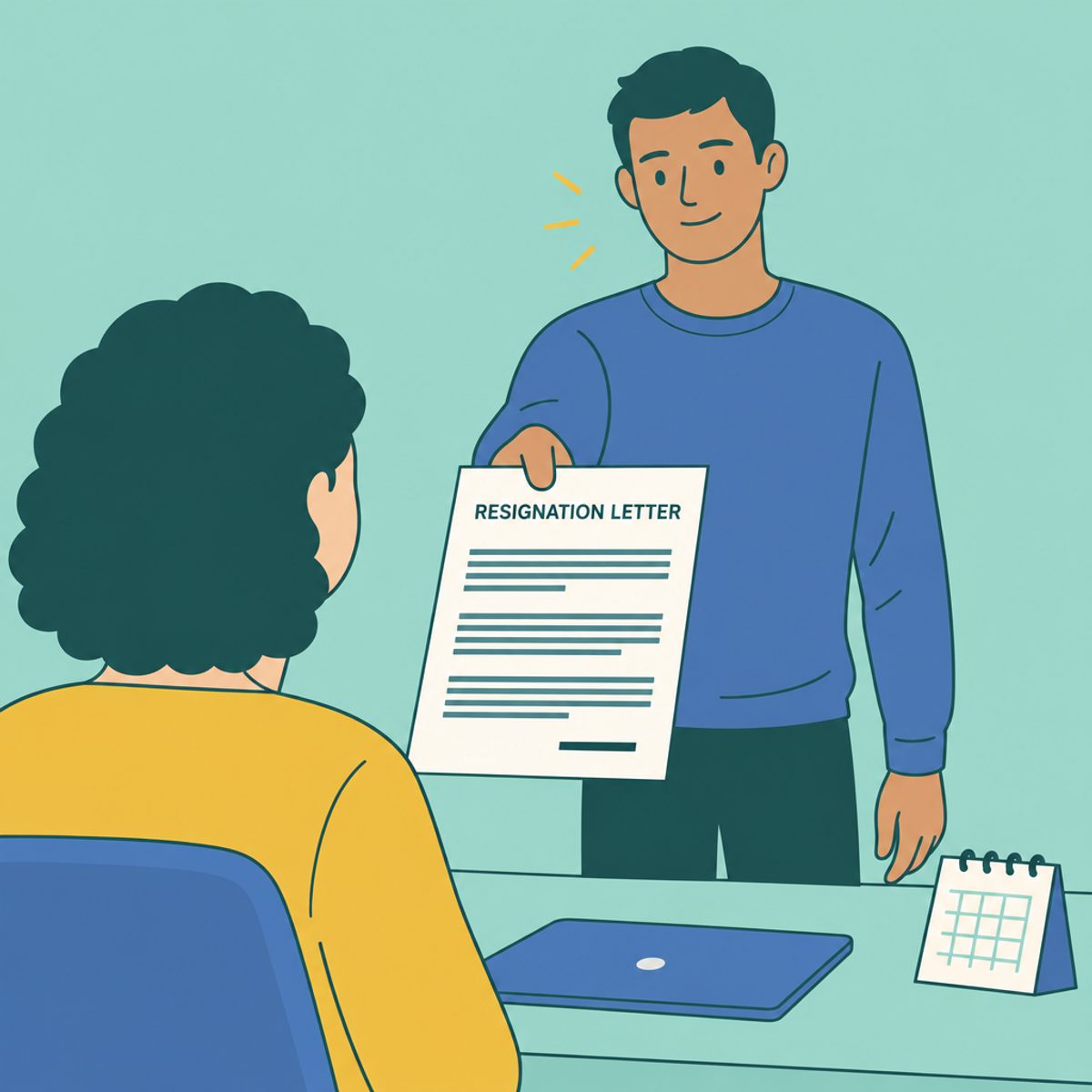
Arrange a private conversation with your manager when that is a suitable route. Follow the employer’s formal process as well. Written notice or contact with HR may be more appropriate if a conversation is inaccessible, unsafe, or impractical.
Illustrative script: “I have decided to resign from my role. Based on my notice period, I propose [date] as my final day of employment. I would like to agree priorities for the transition and will prepare notes on my open work.”
You can add a sincere thank-you or mention a new role if you choose. State the decision clearly; do not say you have accepted another job unless that is true.

If they ask why, or where you're going
Keep the explanation as brief as your circumstances allow. “I have decided to take my career in a different direction” may be enough for an ordinary conversation. You do not need to use the meeting to discuss every frustration.
If the reason involves a dispute, discrimination, health, or potential benefit entitlement, do not assume that leaving it out of every record is best. Get relevant advice about what to document and how before relying on a generic script.
If they counter
Consider whether the offer addresses your reasons for leaving and whether the proposed changes are specific. If you are open to it, ask for the terms in writing and time to evaluate them. If your decision remains unchanged: “Thank you for considering that. I have made my decision and would like to focus on the transition.”
Should I resign on a Friday or a Monday?
There is no universally best weekday. Choose a time that lets you follow the required process and calculate notice correctly. A short private meeting may help, but do not miss a contractual deadline or delay a necessary safety step simply to find an ideal moment.
Making it official: the written notice
Check who must receive notice and how it must be delivered. Writing is a useful record, even where not legally required. The rules differ: Acas describes the value of a written record, while Singapore’s Ministry of Manpower requires termination notice in writing.
Illustrative email: “Subject: Resignation — [name]. I am resigning from my position as [role]. I am giving [notice period], with [date] as my proposed final day of employment. Please confirm receipt and the arrangements for my remaining work and final pay. Regards, [name].”
Adjust the dates to your actual obligations and any agreement. Our resignation-letter guide and two-weeks-notice example offer further wording.
The notice period and the handover
Confirm the last day you will work and the employment end date in writing. Ask separately about pay, leave, benefits, and system access rather than assuming they all stop on the same day.
If the employer asks you to stop work immediately, clarify whether this is paid leave during notice, a mutually agreed early end, or an employer-initiated termination. Those distinctions can affect your rights. Do not assume the remaining notice will be paid or unpaid without checking the applicable rules.
If you need to leave sooner, request an agreed arrangement and record it. An unsafe situation requires a different plan from an ordinary handover: prioritize immediate safety and seek help from an appropriate authority, union, or adviser. Resignation can affect legal claims and benefits, so a generic “effective immediately” letter is not a substitute for situation-specific advice.
The handover document
Make the handover easy for someone else to use. A short overview with links to approved internal documents is often more practical than a long narrative. Cover these six points:
- Open work and its status: each project, where it stands, and what done looks like.
- Next steps: the immediate actions on each item, with dates where they exist.
- Key contacts: who to call for what, internally and externally, with context on each relationship.
- Recurring tasks: the weekly report, the monthly reconciliation, the thing only you knew to do.
- Where files live: the folders, drives, and tools, named specifically enough that a stranger could find them.
- Access: systems the next person needs, handed over through IT or your manager through proper channels. Never passwords in an email.
The last weeks and the exit interview
Agree realistic priorities for the time remaining and identify work you cannot finish. Offer training where feasible, return equipment, and submit expenses through the required process. Keep confirmation of returned property and any authorized personal contact details.
In an exit interview, describe specific events and their effects rather than relying on broad labels. You can raise genuine problems; constructive wording does not require concealing misconduct. Consider confidentiality and the appropriate reporting route. Our exit interview guide offers preparation prompts.
If you change your mind, ask promptly and keep a record. For Great Britain, Acas says an employer does not have to accept a withdrawal request, though it should consider it seriously, particularly in certain circumstances. Do not assume the same outcome in every jurisdiction.

Final pay and benefits
Ask for a written breakdown of the final payment: wages, any owed expenses, leave treatment, commissions or bonuses, and deductions. Confirm when it is due and where the payment statement will be available after your access ends.
In the United States, the Department of Labor explains that federal law does not require an immediate final paycheck, while some states may. Check the relevant state rules and employment terms for your circumstances. A company policy does not settle a question where the law requires something different.
For health coverage, read the plan documents and ask the administrator for end dates, continuation options, costs, and deadlines. COBRA may allow eligible US workers and families to continue coverage in specified situations; it is not automatic coverage for everyone who resigns.
Outside the United States, use the local employment authority and benefit-plan administrator. If an answer is unclear or a payment is missing, keep the records and seek advice promptly.
After you resign: set up the next search
Record accomplishments you are allowed to describe, while you can still verify them. Separate personal achievements from confidential company data, and ask permission before using non-public work in a portfolio.
Keep track of contacts who agree to stay in touch and the version of your resume used for future applications. You can organize applications and documents in Roleframe. Check any generated summary against the actual posting and your own experience.
Frequently asked questions
- How do I politely resign from a job?
Check your notice obligations and required channel, communicate the decision clearly, and keep a written record. A private manager conversation can help when appropriate. Confirm dates and offer a realistic transition plan.
- What should you not do when you resign?
Avoid announcing an unconfirmed departure date, making promises about work you cannot complete, or taking confidential files. Follow the applicable notice process and get advice if the exit involves a dispute, safety concern, or unclear contract term.
- How do I immediately resign from a job?
Check whether you can agree an early end and what local rules allow. Leaving without required notice may have consequences. If immediate safety is at risk, prioritize safety and obtain appropriate support; advice about legal claims, pay, and benefits should be specific to your situation.
- What do you say when you quit your job?
One example is: “I have decided to resign. Based on my notice period, I propose [date] as my final day of employment. I would like to agree transition priorities.” Add thanks or a brief explanation if you choose, and keep the details accurate.
- Can I resign by email or text?
Check the required notice method and recipient. Email can create a useful record, but its legal sufficiency depends on the rules and terms that apply. Do not assume a text message satisfies a process requiring another channel. Request acknowledgment and keep a copy.
- Can I withdraw my resignation after giving it?
Ask promptly and in writing. In Great Britain, Acas says the employer does not have to agree, though it should consider the request seriously. Rules and circumstances elsewhere may differ; do not assume withdrawal is automatic.
- Should I give more notice than my contract requires?
You can consider extra notice if it helps the transition and fits your plans, but first check pay, benefits, the new start date, and what happens if work ends early. Agree any revised dates clearly rather than leaving them open-ended.



Ready to start your new resume?
Writing a resume takes time, and even a polished one can miss what a hiring manager is looking for. Roleframe helps you build a clear, ATS-safe resume in minutes and tailor it to the job you want.


