Letter of Resignation: What to Write and What to Leave Out
A letter of resignation needs three lines. This template marks every line required, optional, or risky, and explains what HR does with it after you send.


On this page
A letter of resignation has one job. It puts on record, with a date, that you chose to leave and that your employment ends on a specific day. Three sentences cover that. Everything else you might add is either harmless courtesy or a future liability, and telling those apart is what this guide does, line by line.
The letter is not really for your manager. Your manager hears the news in a conversation, and the conversation is where the relationship gets handled. The letter is for the file. It gets logged in an HR system and sits in your personnel record indefinitely. Years later it can resurface in an employment verification or a dispute. Write it for that audience.
The short version: the lines that have to be in it
The minimal letter needs four elements, and two of them are dates.
- Today's date at the top. The notice clock starts here, and final-pay math is anchored to it.
- A plain statement that you are resigning, with your exact job title. "Please accept this letter as formal notice of my resignation from my position as [title]" is the standard wording for a reason: nothing in it can be misread.
- Your last working day as a specific calendar date. Not "in two weeks," which invites a disagreement about when the two weeks started.
- Your name, typed or signed. Obvious on paper, easy to forget at the bottom of a rushed email.
Put together, the shortest professional version reads like this:
[Date]
Dear [Manager's name],
Please accept this letter as formal notice of my resignation from my position as [job title] at [company]. My last day of employment will be [specific date].
Thank you for the opportunity. I'm glad to help with the transition over the coming weeks.
[Your name]
That is a complete, professionally safe letter of resignation. Nothing that follows in this article adds anything you owe anyone. It only explains which optional additions help and which ones have burned people.
What a resignation letter is actually for, legally and practically
Legally, most US employees don't owe anyone a letter at all. Federal law generally requires neither advance notice nor a written resignation from at-will employees, per the U.S. Department of Labor, though an employment contract or a collective-bargaining agreement can change that. The UK works differently. Your written employment particulars must state your notice period, and after a month of employment you generally owe at least one week's notice unless your contract says more, per Acas.
So why write one? Because of what happens after you hand it over. The letter does four practical jobs.
- It fixes the dates. Your notice period is counted from it, and your final paycheck and benefits end date are calculated against the last day it names.
- It documents that you left voluntarily. In an unemployment claim or a later dispute, a neutral dated letter is evidence, sometimes for the employer and sometimes for you.
- It starts offboarding. Once HR logs it, access revocation and equipment return get scheduled against your last day.
- It joins your permanent file, which employment verifications and rehire checks can touch long after you've forgotten the letter exists.
Acas describes the letter's purpose in exactly these terms: a dated written record that stays neutral, rather than an explanation of every grievance. Write to that standard and every decision below gets easier.
The template, with every line marked
Below is every line that shows up in resignation letter templates, each with a verdict. Required lines make the letter administratively useful. Optional lines are judgment calls that cost you nothing. Risky lines have a specific downstream consequence, explained in the third column, and most people who wrote them didn't know it.
| Line | Verdict | Why |
|---|---|---|
| [Today's date] at the top | Required | The date starts your notice period and anchors every later calculation of final pay. |
| Dear [Manager's name], | Required | Address your direct manager even if HR gets a copy. That's the reporting line the record should show. |
| Please accept this letter as formal notice of my resignation from my position as [job title] at [company]. | Required | The unambiguous core. "Formal notice" plus your exact job title makes the record clean. |
| My last day of employment will be [specific date]. | Required | This date drives your final paycheck and your benefits end date. Never leave it open. |
| [Your name], typed or signed | Required | The record needs an author. In an email, type it under a standard sign-off. |
| I'm glad to help with the transition, including handover notes and training a replacement. | Optional | Costs nothing and reads well in the file. It also makes your manager's next conversation with their own boss easier. |
| Thank you for the opportunity to work here. | Optional | One sentence of thanks is plenty. Skip it if it would ring false. |
| After my last day I can be reached at [personal email]. | Optional | Useful once your work account is closed, for reference requests or final-pay questions. |
| I'm leaving to pursue a new opportunity. | Optional | A reason is never required. If you give one, keep it exactly this vague. |
| I'll be joining [new company]. | Risky | Can trigger an immediate walkout, and in some industries a non-compete review. Say it out loud if you must. Never write it. |
| I'm resigning because of [grievance]. | Risky | A written grievance becomes a permanent record that HR may treat as a formal complaint, on a timeline you don't control. |
| This resignation is effective immediately. | Risky | If your contract requires notice, this can breach it and cost you money. Get advice before skipping notice. |
| Unless [raise or change] is possible, in which case I would stay. | Risky | Turns your resignation into a negotiation, in writing. Have the counteroffer conversation before anything is signed and dated. |
Look at what the required column amounts to. Dates and a plain statement, nothing more. Every emotional impulse you'll have while writing, gratitude included, lives in the optional and risky rows. That's the design of a good resignation letter: the facts are mandatory and the feelings are elective.
Notice periods, and what your contract probably says
Two weeks is an American convention rather than a legal requirement for most at-will employees, and your contract can override the convention in either direction. Salaried and senior roles often specify four weeks or more. Read the contract before you pick a last day, and look for four clauses in particular.
- The notice period itself. In the UK it must appear in your written particulars, and the statutory floor is one week once you've been employed a month.
- Pay in lieu of notice and garden leave. These clauses decide whether the company can pay you out and walk you the same day, or keep you at home but employed until your notice ends.
- Bonus and vesting dates. If a payout lands three weeks out, set your last day after it. HR calculates from the dates in your letter, and nobody backdates in your favor.
- Non-solicitation and non-compete terms. They shape what you can safely say about where you're going, and who you can contact once you're there.
One more timing point. Notice periods are when counteroffers happen, so know your answer before the letter goes in. A resignation you'd retract for money is a negotiation, and negotiations go better before anything is signed and dated.
Leaving on bad terms without putting it in writing
The letter outlives the anger. If you're leaving because of a bad manager or a culture you can't work in, the resignation letter is still the wrong container for that truth, because everything in it becomes a permanent record you can't edit once it's filed.
Say the hard things out loud instead. An exit interview or a direct conversation with HR gets the point to people who can act on it, without producing a document that either side's lawyer can later read out of context. You lose nothing by keeping the letter neutral. The company already knows the exit is unhappy, and the people who matter heard why in the room.
One genuine exception. If you believe you're being pushed out, or you think you may have a retaliation or constructive-dismissal claim, stop before writing anything warm and voluntary-sounding, and don't write anything angry either. The wording of a resignation can affect what you can claim afterward, and this is the moment for an employment lawyer rather than a template.
Resigning by email, and when that's fine
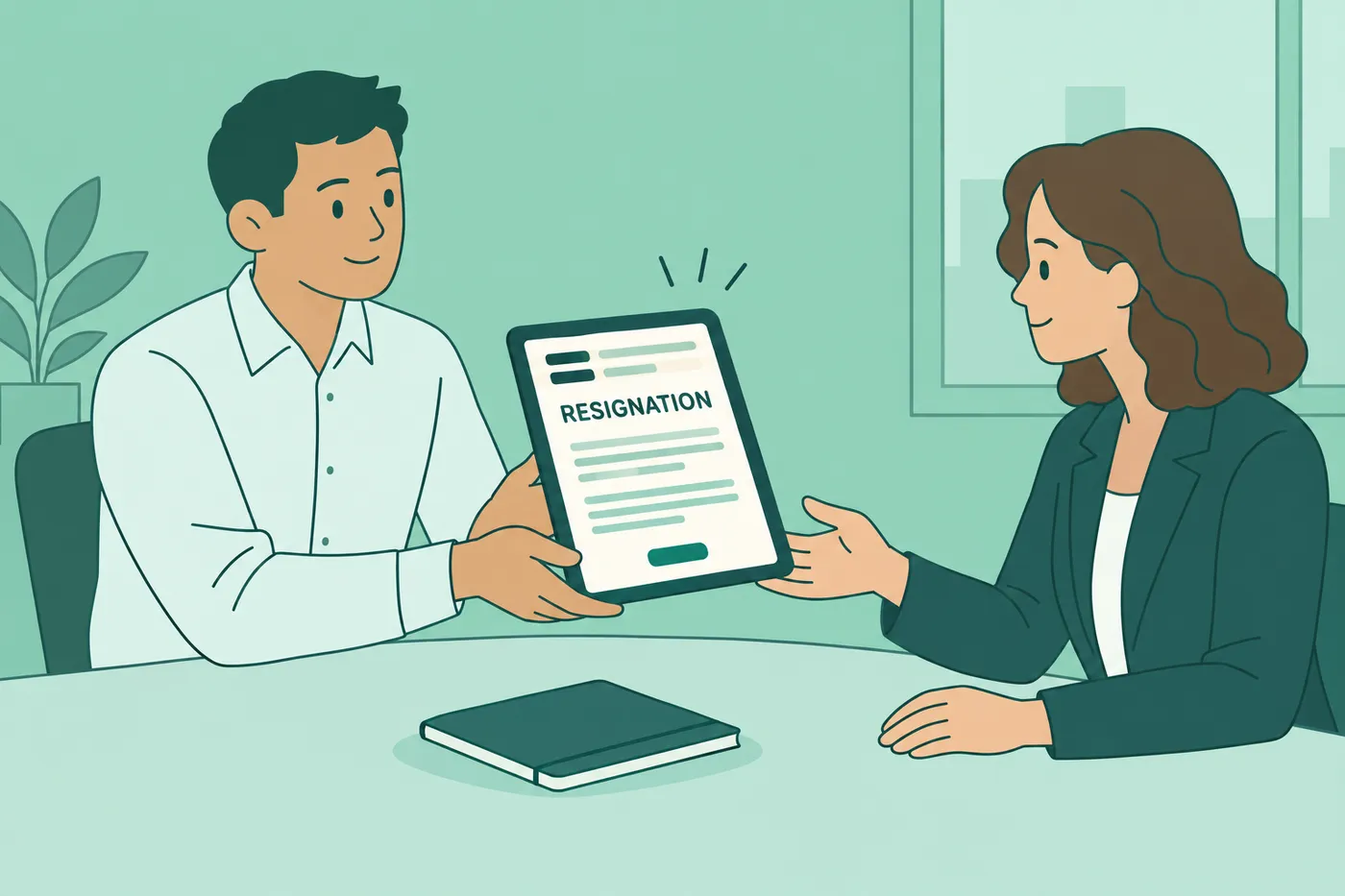
A resignation email is a resignation letter. It carries a timestamp and lands in the same HR workflow. Nobody in HR processes a printed page differently from an email body.
The etiquette is separate from the validity. Tell your manager in a live conversation if you can, then send the email the same day, opening with "as we discussed." Leading with the email and skipping the conversation is what managers remember when a reference call comes three years later.
Email-first, without the conversation, is reasonable in a few situations.
- You're remote and no call is schedulable before your intended notice date.
- The environment is hostile enough that you want a timestamp before any conversation happens.
- Your manager is on extended leave and waiting would eat into your notice period.
- The company's own norms are email-first. Follow the norms.
Keep the subject line boring, something like "Resignation - [Your name]." Send it from your work address to your manager, copying HR if that's the local convention. Keep a dated copy where you can reach it after your access is cut, and ask for a short written reply confirming receipt and your agreed last day. Access sometimes ends faster than planned, and that copy plus the acknowledgment is your entire paper trail.
What HR does with the letter after you send it
The afterlife of the letter explains every rule above. Here's the typical path once it leaves your hands.
- Your manager forwards it to HR, often within the hour. From this point on, the audience is people who have never met you.
- HR logs your resignation date and last working day in the HR system. Those two dates become the source of truth for everything downstream.
- Offboarding starts. Final pay is calculated against your last day, and benefits end dates are set. Equipment return and access revocation get scheduled for the same date.
- The letter itself is filed in your personnel record, where it stays after you're gone.
- Years later it can be pulled. An employment verification touches this file, and so does a rehire-eligibility check or an unemployment claim.
Two consequences follow. An ambiguous last day is a real problem, because it's the one variable every downstream calculation uses. And the person who someday decides whether you're "eligible for rehire" reads this letter cold, with no memory of your work. A neutral page reads well cold. A bitter one never does.
Five lines that have caused real problems
Each of these has appeared in real resignation letters, and each created a problem the writer didn't see coming.
"This resignation is effective immediately."
If your contract or local rules require notice, quitting on the spot can breach them and cost you money, from forfeited pay in lieu to a clawed-back bonus. Even where it's fully legal, it usually converts a clean file into a "not eligible for rehire" flag. If safety or health forces an immediate exit, say so briefly and neutrally, and get advice first if real money is at stake.
"I'm resigning because of how I've been treated."
The vague grievance is worse than a specific one, because HR can't ignore it and can't act on it either. Some companies treat any written allegation as a formal complaint, which opens an investigation on their timeline rather than yours, sometimes while you're trying to serve out a quiet two weeks. Raise treatment issues in the exit interview, where they're heard without becoming an exhibit.
"I'll be joining [competitor] next month."
In client-relationship businesses like sales and finance, naming a competitor in writing is how people get walked out the same hour, with pay stopping earlier than planned. It can also prompt a review of any non-compete you signed, and occasionally a warning letter to your new employer. Where you're going is a conversation topic, shared at your discretion. It's never a letter topic.
"My last day is flexible, whatever works best for the team."
Generous, and a mistake. An open-ended date lets the company pick, and companies pick the date that suits their payroll cycle. The result can be a last day two weeks earlier than you budgeted for, with your insurance ending before your new plan starts. Name a date. You can always agree to move it later, in writing, if asked.
"I would reconsider if my compensation were adjusted."
A counteroffer request inside a resignation letter is the weakest version of that negotiation. If they say no, you've resigned. If they say yes, you're now the employee who resigned to force a raise, which is the first name on the list at the next reorg. If you'd genuinely stay for more money, have that conversation before any letter exists. A resignation letter should mean the decision is made.
Before you send it
Reread the letter once as a stranger, an HR analyst five years from now who never met you. If every line reads as neutral and factual, send it and keep a copy. Then serve the notice the way you want to be remembered, because the notice period, and never the letter, is what former colleagues actually talk about.
If the next role isn't signed yet, the notice period is a head start, and the clock is real. An organized job search beats a scattered one, and a resume tailored to each posting beats a generic blast. Roleframe handles the diagnosis side of that: paste a job posting and get a fit report with your ATS score and the exact keywords you're missing. You make the edits yourself, with Remi suggesting each rewrite for your approval. And if the resignation is part of a bigger move, this career change guide covers the plan from deciding to starting.
Frequently asked questions
- How can I write a simple resignation letter?
Put the date at the top, then two sentences: "Please accept this letter as formal notice of my resignation from my position as [job title]. My last day of employment will be [date]." A line of thanks and an offer to help with handover are optional. Sign it, and that's the whole letter. Adding more rarely improves it.
- Should I give two weeks' notice or just quit?
Give notice if you can. US federal law generally doesn't require it for at-will employees, per the U.S. Department of Labor, but references and rehire eligibility are built during notice periods, and skipping notice is what turns a neutral file into a flagged one. Quit on the spot only when safety or health demands it, and get advice first if real money, like unvested bonuses or pay in lieu, is at stake.
- How do I resign gracefully?
Tell your manager first, live, before anyone else at the company hears it. Hand over a neutral letter the same day. Then be visibly useful through your notice period: handover docs and a trained replacement are what colleagues remember, while the letter's wording is what the file remembers. Get both right and the reference takes care of itself.
- What should you not put in a resignation letter?
Four things, mainly:
- Grievances or criticism, even mild ones, because the letter is a permanent record.
- The name of your new employer.
- Conditions, like "I would stay if my salary were adjusted," which turn a resignation into a failed negotiation.
- Detailed reasons for leaving. "To pursue a new opportunity" is as specific as a letter ever needs to be.
- Do I have to give a reason for resigning?
No. Neither US nor UK rules require a reason in a resignation letter, and HR doesn't need one to process your exit. If you want to include something, one vague clause is the ceiling. Save the honest version for the exit interview, where it can actually change something.
- Can my employer make me leave before my notice period ends?
Often, yes. In at-will US employment, an employer can accept your resignation effective immediately, and whether they owe you pay for the unworked notice depends on your contract and state rules. Plan benefits timing before the letter goes in, and never name a competitor in writing, because that's the line most likely to trigger a same-day exit.



Ready to start your new resume?
Writing a resume takes time, and even a polished one can miss what a hiring manager is looking for. Roleframe helps you build a clear, ATS-safe resume in minutes and tailor it to the job you want.


