Theatre Resume Examples for Acting and Musical Theatre
by Larbi SahliPublished
A complete theatre resume example plus a row-by-row guide to the credits table: ensemble, understudy and workshop credits, training, skills and audition format.
Users have landed jobs at
- 1Password
- OpenAI
- Notion
- justworks
On this page
A theatre audition resume makes your selected credits, training and special skills easy to scan. Clear credit lines identify the show, your role and the producing theatre; they usually matter more than general claims about talent or passion.
The Mississippi State University Career Center recommends organizing theatre experience by relevance and using sections suited to performance, production or technical work. A stage actor and a lighting designer therefore need different emphasis, even when both work in theatre.
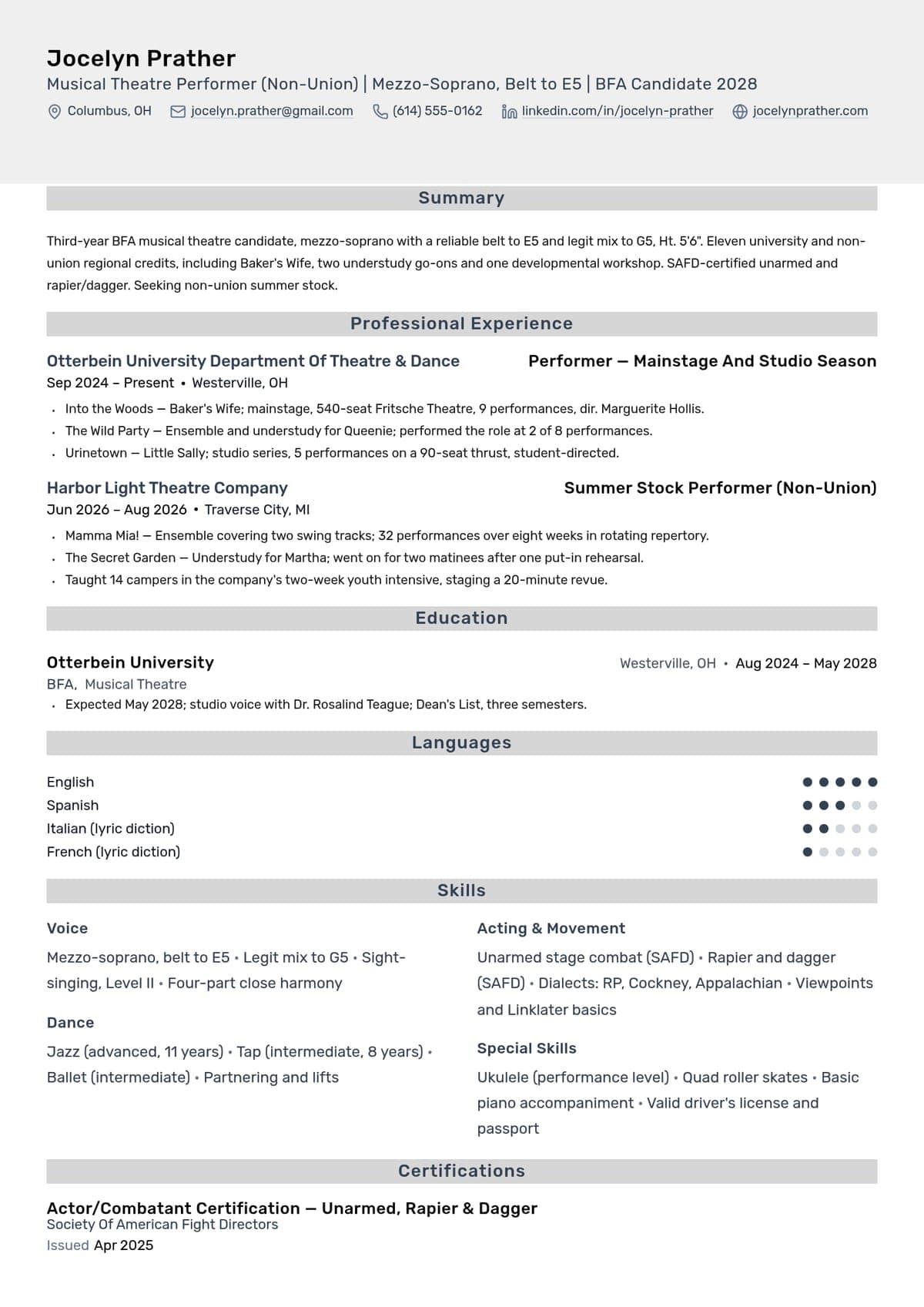
The expanded example below is for a fictional musical theatre student. It uses grouped entries rather than a compact audition table. The row-by-row guide then shows how to convert selected credits into a concise submission, including ensemble, understudy and workshop work.
A complete theatre resume example
Gemma Ostrander, the university, companies, teachers, achievements, dates and figures are fictional examples. Real show titles and credential providers are used only to illustrate formatting; they do not endorse this candidate. Placeholder contact links use example.com.
Read the sample for its credit and training content. Its existing two-page layout is an expanded reference, not the one-page audition version you may be required to submit. For a compact submission, select the relevant credits and use the consistent row formats explained below.
The example separates regional work, university productions and community theatre so their context is visible. Character names identify the parts, and the understudy entry states that performances were given. The developmental workshop is labeled as a workshop rather than a full production.
For your own version, use the actual billing and production details. Keep training concrete through named programs, disciplines and teachers, and request permission separately if you want someone to act as a reference.
What goes on a theatre resume, in order
A useful starting order is name and contact details, relevant vocal or other requested details, selected credits, training and special skills. Put training higher when it is your strongest evidence, or use the order required by the audition or school.
- Name and contact. Make your name prominent, followed by phone, professional email and a working website or reel link. Add representation and accurately stated union status when applicable.
- Relevant performance details. For a singing role, state voice type and a reliable range where useful. Include appearance details only if requested by the call.
- Selected credits. Use consistent show, role and producing-theatre fields, grouped by the context that helps the reader.
- Training. Degree or program, relevant teachers, disciplines, intensives and completed master classes.
- Special skills. Specific abilities you can demonstrate at the level stated, with training or certification details where relevant.
Prepare a concise one-page audition resume when required. The Missouri State audition guide, for example, recommends a single page for pre-professional applications. Keep a longer master record for selecting credits rather than squeezing every entry into tiny type.
What this document is called
Theatre resume and theater resume refer to the same kind of document. Pick one spelling and use it consistently in your own headings and filenames.
A notice may call it an acting resume, performance resume or CV. Follow the requested fields and length instead of assuming that the label alone defines the format. Some applications also ask for separate academic, employment or portfolio materials.
What a stage resume leaves out
For a stage-performance submission, remove details that do not help the audition panel understand your work. A credit generally does not need a paragraph of routine duties. An objective is often unnecessary unless the program asks for one.
Leave out your street address, full date of birth, Social Security number and union membership number. List only the appearance or age information explicitly required by the current application. For a minor, use a parent or guardian’s contact as appropriate.
Day-job employment belongs on a separate job resume unless the audition application requests it or the work is relevant to this opportunity. Naming a director or teacher does not automatically make that person a reference.
The credits table, row by row
Group the work clearly. Use headings such as Regional, Summer Stock, University Theatre, Community Theatre, or Readings and Workshops only when they fit your history. Put the most relevant credits first within each group; keep dates if requested or useful.
Use the actual character or track name. “Penny Pingleton” is more informative than “lead” for a Hairspray credit. Where the official program gives an ensemble or unnamed track, use that wording rather than inventing a character.
Mark ensemble, understudy, swing and cover work accurately. A cover assignment is a valid credit. Say whether you performed the role only when you actually did, and give an appearance count only if you can verify it.
Label the production context. A staged reading, lab or developmental workshop should not imply a fully produced run. A university or community credit should name the producing organization clearly.
Include directors consistently where useful. Three columns can show production, role and company; a fourth can name the director. Include the details requested by the audition, and do not guess at names. The strongest format is the one a reader can scan without confusing your role or the level of the work.
Three rows, fixed
| What people write | What it should say | Why |
|---|---|---|
| Into the Woods | Lead | 2024 | Into the Woods | The Baker | Lakemont Summer Playhouse | A character name and producing company identify the part and context more clearly than a generic “lead” label. |
| Hairspray | Link Larkin | Fairlane Repertory | Hairspray | Link Larkin (understudy, performed 4 shows) | Fairlane Repertory | If you covered the role, state that assignment and report performances only when they actually occurred. The four-show count here is illustrative. |
| The Music Man | Featured Ensemble Lead | 2023 | The Music Man | Ensemble | Harborview Community Theatre | Use the actual credited track rather than a larger-sounding label. These are fictional formatting examples. |
Musical theatre resume: the lines a play resume doesn't need
Voice. Include your voice type and reliable range if they help the musical theatre application. Distinguish a belt or mix range from a broader overall range when that distinction matters. Use the range you can reproduce consistently, not an occasional extreme note.
Dance. State the style, current level and relevant training. An illustrative format is “Tap, intermediate; [teacher/studio], [years].” Years alone do not establish current proficiency.
Other singing work. Cabaret, concerts and staged-concert performances can have their own section when relevant. Label the context so a concert appearance cannot be mistaken for a fully staged role.
Training and special skills, for every stage actor
List degree or conservatory training with a completed or expected graduation date. Add relevant private study, intensives and master classes you completed. Identify the discipline and teacher or organization; an application or acceptance without attendance is not completed training.
For special skills, use specific descriptions: a named dialect, instrument and level, current combat training, sight reading or a particular movement discipline. “Accents” or “musical” gives little information.
List only abilities you can demonstrate safely at the level stated. Distinguish class attendance from an earned qualification and use actual award/expiry dates for credentials. Stage combat training does not authorize unsupervised hazardous performance; production requirements and professional supervision still apply.

Show acting preparation through evidence
There is no need to squeeze acting into a fixed number of skill labels. Use the resume to show relevant voice, movement, scene-study, improvisation or other training. A named course, teacher or performance is more useful here than a self-rating such as “excellent listener.” Pick the disciplines that actually fit your preparation and the call.
High school seniors applying to college theatre programs
A college applicant can use school and community productions, completed training and relevant special skills without pretending to have professional credits. Label class scenes or workshop presentations as such. A short record is acceptable; do not invent work to fill the page.
Use clear show, role and producing-school fields, and follow the program’s current page limit and template. Include academic information when requested. Missouri State’s audition guide emphasizes that a performance resume should reflect the applicant’s actual strengths and experience rather than inflated credits.
For a separate job, scholarship or internship application, see the student resume examples and resume for teens.
What not to do on an acting resume
A final pass should catch inaccurate role labels, inflated skills and submission mistakes:
Keep contexts separate. Screen background work is not a named stage role. If relevant and requested, label it accurately in the appropriate section.
Do not upgrade a credit. Ensemble, swing and understudy assignments should remain what they were. Never imply a performed appearance that did not happen.
Do not pad skills or shrink text to fit. Choose relevant credits and keep the type readable. A long master record is useful for selection, not a reason to ignore a one-page requirement.
Check headshot instructions. Supply the requested file or print format. If a printed resume is to be attached to a headshot, match its dimensions and attach it as instructed rather than assuming a universal stapling rule.
Where the resume summary fits (and where it doesn't)
A compact audition resume often omits a narrative summary so the credits remain prominent. A short factual profile is optional when it helps explain the application or is requested. The expanded example on this page includes a brief profile; remove it when preparing a tighter version if it repeats the header.
An off-stage job application may benefit from a conventional employment resume with responsibility and achievement bullets. An illustrative profile is: “Front-of-house associate with [verified seasons] at [theatre], experienced in ticketing, patron communication and nightly reconciliation.” Replace the placeholders with your actual record.
Keep a short performance section if it supports that job. For more patterns, see the resume summary examples.
Stage, screen and technical theatre resumes side by side
A performance resume, screen submission and technical-theatre job resume may use different credit labels and evidence. Choose the structure that identifies your actual role most clearly. The table below is a starting point, not a billing or union rule.

| Element | Stage resume | Screen resume | Technical theatre resume |
|---|---|---|---|
| Credit groups | Broadway, national tour, regional, summer stock, university, community, readings and workshops | Film, television, new media | By discipline or position: stage management, lighting, scenic, sound, costumes |
| Middle column | The character's name | Actual credited or contracted billing, appropriate to the production and requested submission | The position you held: production stage manager, ASM, master electrician, assistant designer |
| Third column | Theatre or producing company | Production company, studio or director | Theatre or company, plus the designer or director you worked under |
| Skills section | Dialects, voice type, dance styles, combat, instruments | The same, plus on-camera specifics | Equipment, software and paperwork: consoles, QLab, drafting and 3D software, call books, shift plots, budgets |
Lead with the experience relevant to the audition or job. A stage submission may emphasize theatre credits; an on-camera submission may emphasize filmed work. Use the billing you actually received instead of converting it into a larger category.
Design and technical candidates should link an appropriate portfolio when requested or useful. Ohio Northern University’s audition/interview instructions, for example, pair design and production interviews with a resume and portfolio. Check that links work on a phone and that you have permission to share the work samples.
A fill-in theatre resume template
Use these fields as prompts. Delete any optional field that does not apply and follow the call’s required template first. No placeholder is a fact about your own background.
| Line | What you type |
|---|---|
| Name | [FIRST LAST, set in the largest type on the page] |
| Contact | [phone] · [professional email] · [website or reel link] |
| Relevant performance details | [voice type and reliable range, if relevant] · [appearance details only if requested] |
| Union / representation | [accurately described union status, if relevant] · [agency and approved contact, if represented] |
| Credit group heading | [Regional / Summer Stock / University Theatre / Community Theatre / Readings and Workshops / Concerts and Cabaret] |
| Credit row | [Show title] | [Character name, or Ensemble, or Character (understudy, performed X)] | [Theatre or producing company] |
| Training | [Degree or program, school, expected year] · Voice: [teacher] · Acting: [teacher or studio] · Dance: [style, level, years, teacher] · Master classes: [name, name] |
| Special skills | [actual named dialects] · [instrument and level] · [specific current training/qualifications] · [other relevant abilities you can demonstrate] |
Format and submission
Use readable type, consistent columns or credit-line separators, and clear section headings. Make your name and contact easy to find. Prepare a one-page version when the notice requires it; keep the expanded record for future selection.
For an in-person audition, follow the notice’s headshot and print requirements. For an online application, use its requested file type. A PDF is a useful default if none is specified; inspect it before sending and use a filename such as Firstname-Lastname-Theatre-Resume.pdf.
Write union status accurately and leave out membership numbers. Membership and eligibility are not interchangeable; consult the union’s current guidance when needed. Tailor selected credits to the call without changing the underlying facts.
Build your version next
Choose a layout that makes your credits, training and contact details easy to scan. Roleframe’s resume templates provide a starting point, and the editor lets you rearrange sections as the application changes. Replace all sample details and review the exported document before submitting.
You can record applications and follow-up dates in the job tracker. Browse more resume examples by industry for off-stage job applications.
Frequently asked questions
- What should be on a theater resume?
Use name and contact details, relevant voice information, selected credits, training and demonstrable special skills. Add accurate representation or union status when relevant. Include appearance details only if requested, and use the program or audition’s required format.
- How do I list understudy or ensemble work?
Use the actual track name or “Ensemble.” Mark an understudy assignment clearly beside the character’s name, and say that you performed it only if you actually did. Do not imply that a cover assignment was a full performed run.
- How should I describe acting skills?
Show training and demonstrable abilities rather than a list of broad self-ratings. Name relevant scene study, voice, movement or improvisation training, and specific special skills with their current level. Include only skills you can support and demonstrate safely.
- Is a theatre resume different from a theater resume?
No. They are the same document, spelled two ways, and American theatres use both. Pick one spelling and stay consistent within your own document. Actors also call it an acting resume or a theatrical resume, and in the UK the equivalent is an acting CV.
- What do I put on a theatre resume with no experience?
Use school or community productions, completed training and accurately labeled workshop or class presentations where relevant. Do not invent professional credits. Put the most useful preparation first and follow the application’s fields and page limit.
- How long should a theatre resume be?
A concise one-page version is a useful audition format, and many programs require it. Follow the current call. Keep a longer master for choosing credits; the embedded example here is an expanded two-page reference, not a rule for every submission.
- Do I need a headshot and a reel too?
Check the current audition instructions. Many acting applications ask for a photograph and resume, while a reel or portfolio depends on the role. Submit each item in the requested form rather than assuming it must be embedded in the resume or attached in a particular way.
- Should I list my union status and my address?
Include union status accurately when relevant and distinguish eligibility from membership. Do not publish a membership number, full birth date, Social Security number or street address. Check the union’s own rules if you are unsure how to describe your status.

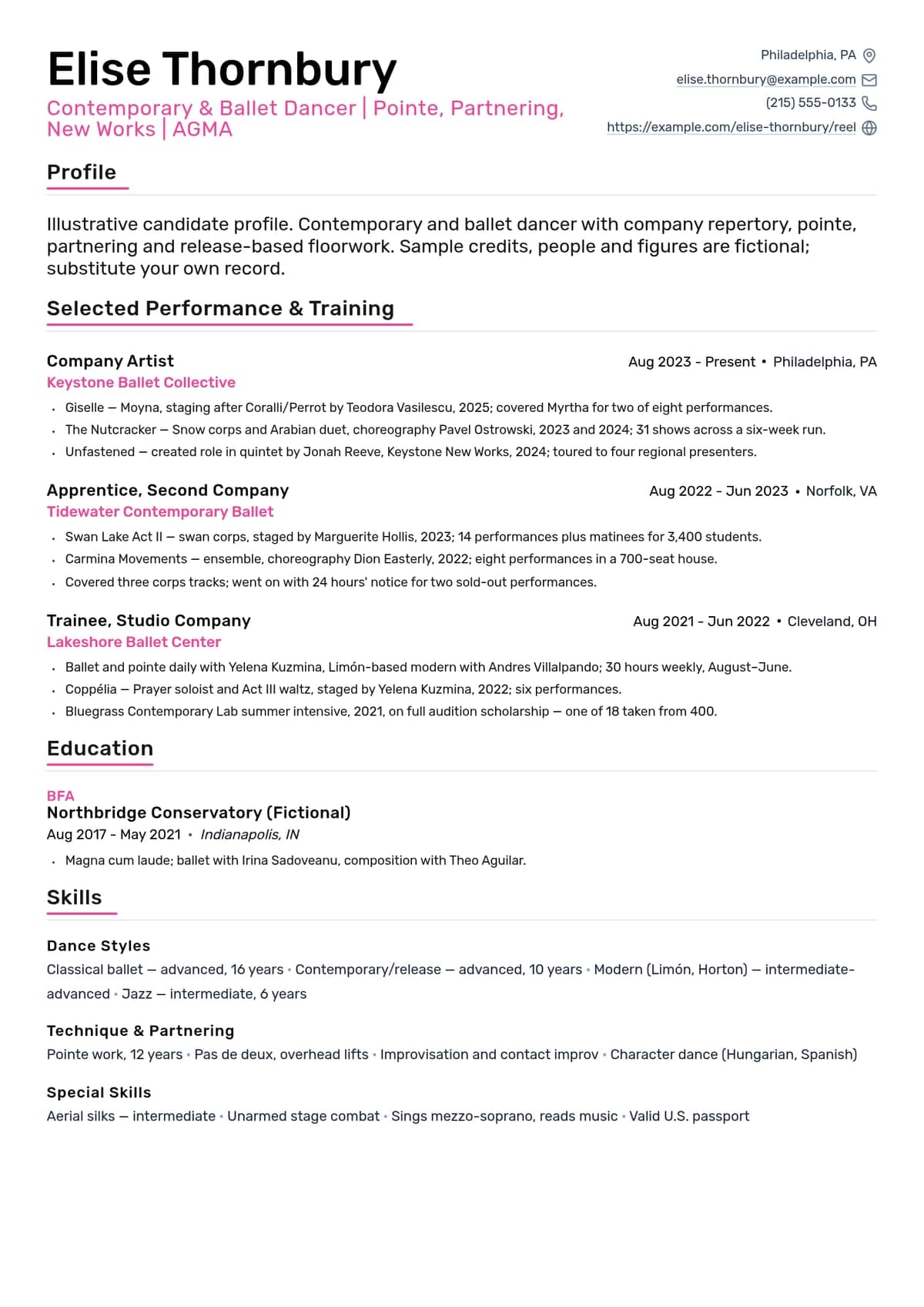
Build yours on the same template.
Every example here is built on a template you can open in the editor. Start from the same layout and write your own experience into it, then download the PDF free, as often as you like.


