Resume for Teens: A Complete Example and Fill-In Template
by Larbi SahliPublished
A complete resume for teens shown in full: a 16-year-old's cashier resume, what a 14-year-old lists instead, availability lines, and a fill-in template.

Users have landed jobs at
- 1Password
- OpenAI
- Notion
- justworks
On this page
A hiring manager at a grocery store, a day camp, or a fast food counter is not expecting work history from a 15-year-old. They are reading for three things: will you show up when scheduled, can you learn the job quickly, and can you deal with people. A teenage resume wins by proving those three through what you already have, which is school, activities, informal jobs, and volunteering.
That is also why most teen resume advice fails you. Template galleries show you boxes to fill without showing what a finished teen resume actually says, and generic articles tell you to 'highlight your skills' without explaining how babysitting or lawn mowing becomes a credible experience entry with dates and numbers. This page does the opposite. You get a complete resume for a 16-year-old applying to a real part-time job, a breakdown of exactly what changes at 14, a table that turns everyday teen activities into strong resume lines, availability lines that respect youth work rules, and a fill-in template you can copy.
A complete resume for a 16-year-old applying for a cashier job
The example below is a high school junior applying for a part-time grocery cashier role. Notice what it does not have: a single formal employer. Every entry is informal work, school, or an activity, and it still reads like the resume of someone a store manager would trust with a register. Lawn mowing and pet sitting appear as real experience entries with dates and client counts, cash handling comes from a school fundraiser, and the availability line answers the manager's first scheduling question before they ask it.
Why this resume works, section by section
A teen resume has a fixed, sensible order: contact details, a short objective, education, experience, activities, skills, and availability. References are optional but strong at this age because they substitute for the work history you do not have yet. Here is what each section is doing in the example above, and how to write yours.
Contact details and a professional email
Name, city and state, phone number, email. That is the whole section. The email matters more than teens expect: a manager who sees skaterboi2010 or an email full of x's forms an opinion before reading a word. Make a free address from your first and last name, and check it daily once you start applying, because that is where interview invitations land. City and state are enough for location. Skip the street address, which we cover in the leave-it-off section below.
A one or two line objective
Experienced adults usually skip the objective. Teens should keep it, because it does a job nothing else on the page can: it names the role you want and the one or two things that make you a safe hire for it. 'Reliable high school junior seeking a part-time cashier position; two years of paid neighborhood work and cash handling experience from a school fundraiser' tells the manager everything in one breath. Keep it to two lines, name the actual job, and swap it for each application. There are more patterns to borrow in our resume objective examples.
Education comes high on the page
School is your main occupation, so it earns a top spot. List your high school, its city, and your expected graduation year. Add honor roll, a strong GPA, and relevant coursework if it connects to the job, like a business or consumer math class for a cashier role. One entry is all you need. Nobody wants your middle school.
Experience, including the informal kind
This is where most teenage resumes go wrong. Teens assume experience means a W-2 job, write 'none,' and submit a half-empty page. Paid informal work is experience. Babysitting for three families, mowing six lawns a week every summer, pet sitting when neighbors travel: each of those is an entry with a title you give it (Babysitter, Lawn Care, Pet Sitter), a date range, and bullets with numbers. The manager reading it learns exactly what they need to know, which is that people in your neighborhood trusted you with their kids, their homes, and their money, repeatedly, over time.
Write each entry the way the example does: what you did, for how many clients or how often, for how long, and anything measurable. 'Mowed and edged six lawns weekly from May through September, keeping every client for a second summer' is a better line than many adults manage.
Activities and volunteering
Clubs, teams, and volunteering prove commitment, which is the trait a first employer worries about most. A student who made six cross country practices a week for two seasons will make a Saturday shift. List the activity, your role if you held one, and the years. Volunteering with a regular schedule is especially strong because it looks exactly like showing up for work, unpaid.
Skills that match the job
List five to eight skills, and make at least half of them point at the posting. For a cashier: cash handling, customer service, basic math, punctuality, Spanish if you have it, and any software you genuinely use. Skip empty entries like 'hard worker,' which is a claim, not a skill. Your experience bullets should prove the hard work; the skills list is for things a manager can act on when building a schedule or a till rotation.
The availability line
Almost no adult resume has this line, and almost every teen resume should. Part-time hiring is a scheduling puzzle, and a manager choosing between two similar applicants picks the one whose availability is already on the page. One line near the bottom does it: which school days you can work and from what time, your weekend availability, and what changes in summer. The next section shows exactly how to write it within the legal limits for your age.
Two references who are not family
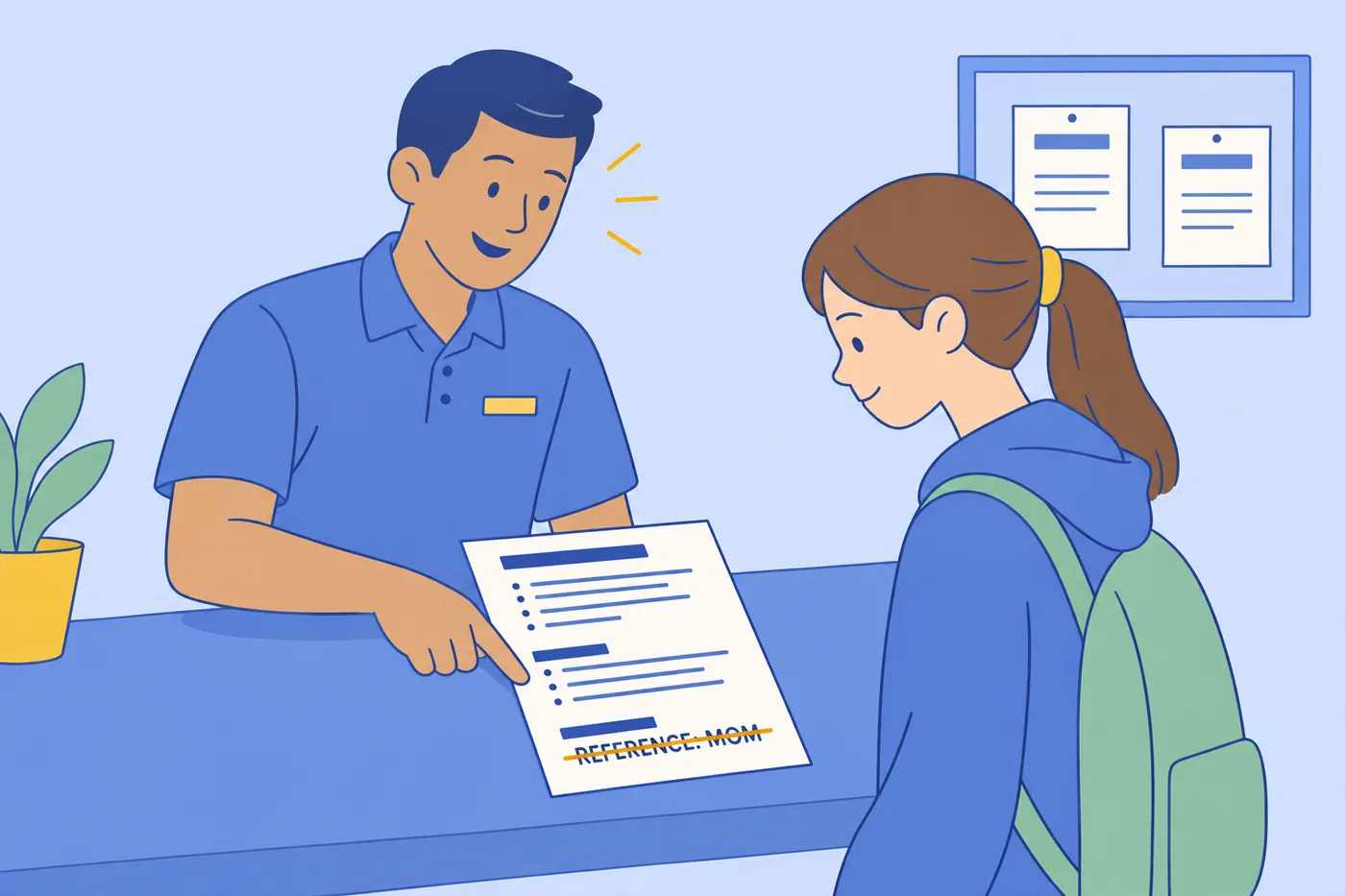
Adults usually leave references off and provide them on request, and that is the standard advice in our guide to references on a resume. Teens are the exception. With no employer to call, a teacher, coach, or a parent you babysit for carries real weight, and listing two of them with their permission saves the manager a step. Name, how they know you, and a phone number or email. Never list your mom, your uncle, or anyone who shares your last name; a family reference reads as having no one else to vouch for you.
What a 14-year-old should put on a resume
The same structure works at 14, with the experience section built entirely from informal work and volunteering. Take a concrete case: a ninth grader applying for a junior counselor role at a city day camp. Their one-page resume holds everything the camp director needs to say yes.
- Education: their high school, expected graduation year, and honor roll both semesters of ninth grade.
- Experience: babysitting two children, ages 4 and 7, a few evenings a month for two years, trusted with meals and bedtime. That entry alone answers the director's core question, which is whether this teen can be responsible for younger kids.
- Volunteering: Saturday mornings at the public library, shelving returns and helping set up the children's story hour. A weekly commitment kept for months reads as reliability.
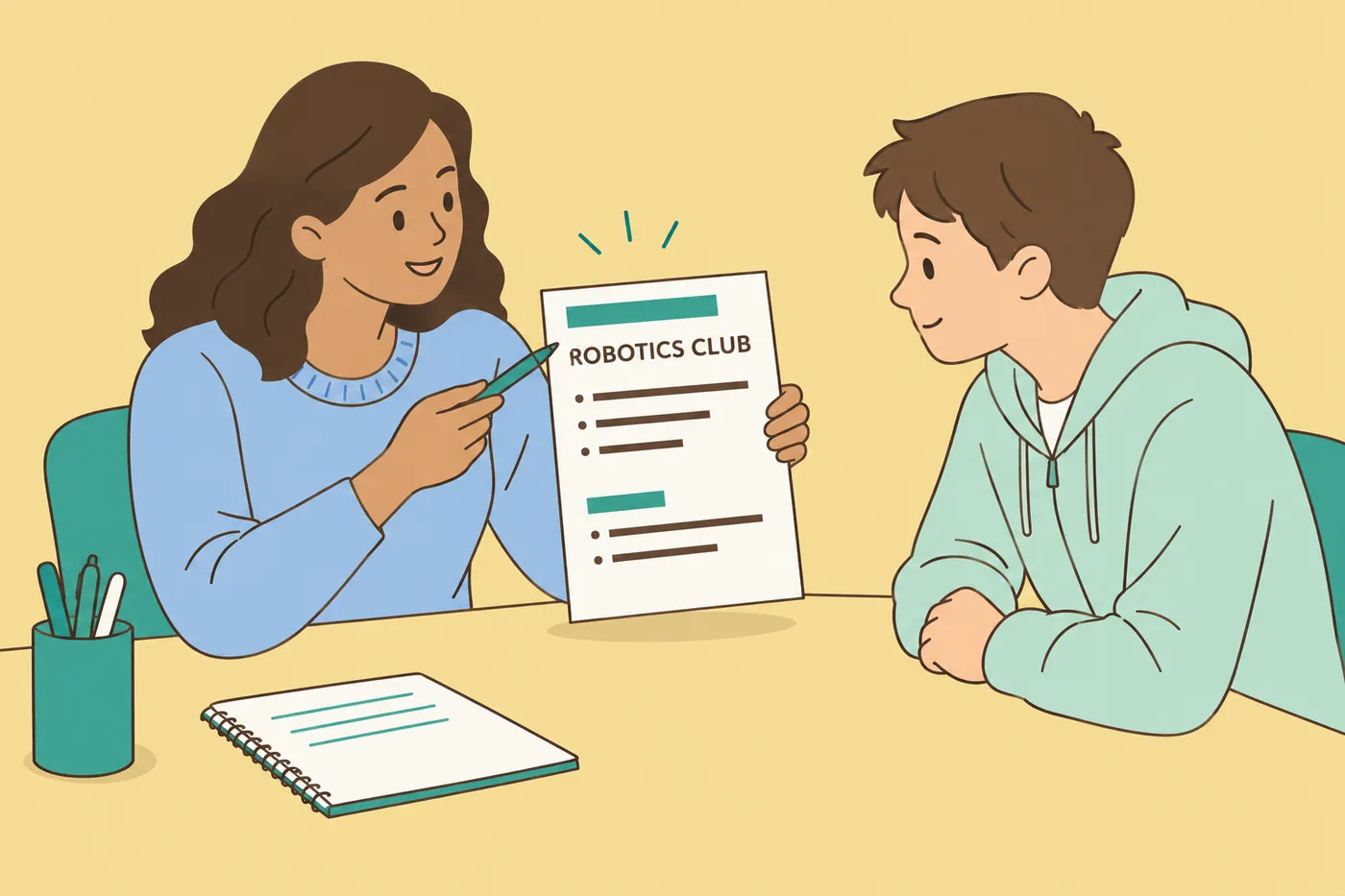
- Activities: the school robotics club, which proves they can work on a team and follow through on a season-long project.
- Skills: patience with young children, first aid basics if they have taken a course, swimming ability for a camp role, and punctuality backed by that library shift.
- Availability: full-time from mid-June through mid-August, which for a summer camp is the line that matters most.
Nothing on that page is padded, and nothing is a formal job. That is the point. At 14, a resume is an organized argument that you show up and can be trusted, assembled from the life you already have.
How a 16-year-old with no experience writes a resume
The same way, with one upgrade: by 16 most teens have done some paid informal work, and it belongs on the page as real entries with dates, not as a vague line in a skills section. The cashier example above is exactly this pattern. Lawn mowing and pet sitting are listed like jobs because they were jobs: recurring, paid, and performed to someone else's standard. If you have genuinely done nothing paid, the 14-year-old formula still works at 16, and volunteering plus a committed activity will carry the page.
Two quick definitional answers while we are here. If you are outside the US and an employer asks for a CV, a curriculum vitae (CV) for a teenager is the same one-page document; the word changes, the content does not. And the 'five P's of a resume' that teachers sometimes mention is an informal classroom mnemonic, with the exact words varying by whoever is teaching it. The advice underneath is stable: keep it short, keep it accurate, keep it professional, proofread it, and match it to the job. Do those five things and you have satisfied every version of the mnemonic.
Turning teen activities into resume lines
The difference between a weak teenage resume and a strong one is rarely the activities. It is the writing. A weak line names the activity; a strong line adds scope, duration, and a number, which turns 'I did a thing' into 'I did a thing reliably, at a measurable scale.' Here is the conversion for the most common teen experiences. The numbers are illustrations; swap in your own real ones, and never inflate them, because a manager can ask about any line in the interview.
| Activity | Weak line | Strong line |
|---|---|---|
| Babysitting | Babysitting | Babysat two children (ages 4 and 7) three evenings a month for two years; trusted with meals, homework, and bedtime |
| Pet sitting | Pet sitter | Pet sitting for five neighborhood families since 2024, including daily feeding, walks, and medication for a senior dog |
| Lawn care | Mowed lawns | Mowed and edged six lawns weekly, May through September, keeping every client for a second summer |
| Tutoring | Helped a kid with math | Tutored a sixth grader in math one hour a week for a full school year; their grade rose from a C to a B+ |
| School club office | Member of Spanish Club | Treasurer, Spanish Club: tracked a $400 fundraiser budget and collected dues from 25 members |
| Sports team | Play on a team | Cross country, two seasons: six practices a week while maintaining a 3.6 GPA |
| Community or faith group volunteering | Volunteer at church | Set up and served at a monthly community dinner for 100+ guests, every first Saturday for 18 months |
| Helping in a family business | Helped at my parents' restaurant | Bussed tables, restocked supplies, and wiped down stations during four-hour weekend shifts at a family-run restaurant |
| School project | Group project for science class | Led a four-person team on a semester-long science fair project; planned the schedule and presented to judges and 60 students |
Availability and work rules: write the line, check the law
Your availability line has to fit inside youth employment law, and that law changes with your age. Here is the general US federal picture under the Fair Labor Standards Act, in plain words. Fourteen is the minimum age for most non-farm jobs. At 14 and 15, federal rules cap work at 3 hours on a school day and 18 hours in a school week, allow up to 8 hours on a non-school day and 40 in a non-school week, and restrict work to between 7 a.m. and 7 p.m. during the school year, extending to 9 p.m. in summer. At 16 and 17, the federal hour caps fall away, but hazardous occupations stay off limits until 18.
States add their own layer, and it is often stricter: many require a work permit or working papers, and many set their own hour and night-work limits for 16 and 17 year olds. The Department of Labor's youth employment pages are the source to check on the day you write your resume, along with your own state's labor department site, because these rules do get updated and your state's version is the one your employer follows.
With the rules in hand, the availability line writes itself. Patterns that work:
- Age 14-15, school year: 'Available weekdays 4 to 7 p.m. (up to two school days per week) and Saturdays 9 a.m. to 5 p.m.' This respects the 3-hour school day cap and the 18-hour school week.
- Age 14-15, summer job: 'Available full-time June 15 through August 15, any shift between 7 a.m. and 9 p.m.'
- Age 16-17, school year: 'Available weekdays after 3:30 p.m., up to 20 hours per week during the school year; weekends fully open.'
- Age 16-17, summer: 'Full availability June through August, including evenings and weekends.'
One honest warning: do not promise availability you cannot keep. If cross country season eats your weekday afternoons from August to November, say so in the interview. A manager would far rather schedule around a known conflict than lose a trained cashier to one.
A fill-in resume template for teens
If you want to draft on paper or in a blank document first, copy this skeleton and replace every bracketed prompt. Each line tells you what goes there and why.
- [Your full name, as it appears on school records, no nicknames]
- [City, State] | [Phone number] | [A professional email built from your name]
- Objective: [One or two lines: the exact job you want + the two strongest proofs you can do it, e.g. 'Dependable sophomore seeking a junior counselor role; two years of babysitting and weekly library volunteering.']
- Education: [High school name, City, State] | Expected graduation [year] | [Honor roll / GPA if 3.5 or above / a relevant course]
- Experience entry 1: [Title you give the work, e.g. Babysitter or Lawn Care] | [Month/year started] to [present or end date] | [One bullet: what you did, for how many people or clients, how often] | [One bullet with a number: duration, repeat clients, money handled, kids watched]
- Experience entry 2: [Second informal job, school fundraiser role, or regular volunteering, same format]
- Activities: [Club or team name] | [Your role, if any] | [Years] | [One line on commitment: practices per week, events run, season length]
- Volunteering: [Organization] | [What you do and how often, e.g. 'Saturday mornings, 3 hours, shelving and children's story hour setup']
- Skills: [Five to eight, at least half matching the job posting: cash handling, customer service, a language, patience with kids, basic math, a specific tool]
- Availability: [School-day hours you can work, weekend hours, and your summer availability, within the legal limits for your age and state]
- References: [Adult #1 who is not family: name, how they know you, contact, with their permission] | [Adult #2, same]
What to leave off a teenage resume
What you exclude signals judgment as much as what you include. Leave off all of the following.
- A photo. US employers do not want one on a resume at any age, and for a minor it is doubly inappropriate.
- Your full street address. City and state are enough; you will be handing this document to strangers.
- Your date of birth. If an employer needs to verify your age for work-permit purposes, the application form will ask. The resume does not volunteer it.
- Family members as references. A teacher, coach, or client you worked for carries weight; a relative carries none.
- Everything since middle school. Pick the activities that prove reliability and people skills for this job, and cut the rest. A teen resume is one page with room to breathe, not a scrapbook.
If this is not quite your situation
This page is built for teenagers aged 14 to 17 applying to part-time and summer jobs. If you are a senior building a resume for college programs, scholarships, or internships, the student resume examples cover that stage with its own conventions. If you are an adult with no work history, the approach differs enough that teen advice will mislead you, and the general process of structuring and writing the document lives in our resume writing guide. And since many part-time applications ask for a short letter alongside the resume, the part-time job cover letter example shows one with its own availability line.
The next step: build yours and send a PDF
You now know what goes on the page. The fastest way to get it there is to open a student-friendly layout from the free resume templates, which opens in Roleframe's free resume builder with no account and no card. Fill in your sections, drag them into the order that puts your strongest proof first, and download a free PDF with no watermark. The PDF has real selectable text, so it prints cleanly for in-person applications and parses correctly when an online application system reads it. Always submit the PDF rather than a Word file; it is the format that keeps your layout intact on every screen it lands on.
Frequently asked questions
- Does a teenager really need a resume for a first job?
Not legally, but practically yes. Many part-time employers accept a bare application form, and a one-page resume stapled to it is what separates you from the other fifteen applicants who filled in the same form. It also gives the manager something to ask about in the interview, which makes the conversation easier for you.
- How long should a teenage resume be?
One page, and it should not be a cramped one. If you are fighting for space at 15, you are including too much. Cut anything from middle school and any activity that does not prove reliability, responsibility, or people skills for the job you want.
- Should a teen put their GPA on a resume?
Include it if it is strong, roughly 3.5 or above, because it is evidence of discipline when you have no work history. Leave it off if it is not, and let honor roll or specific coursework do the work instead. Our guide on whether to put your GPA on a resume covers the edge cases.
- Should a teenager include references on the resume?
Yes, and this is the one age where the standard leave-them-off advice flips. Two non-family adults, a teacher, coach, or someone you babysat or mowed lawns for, stand in for the employer references you do not have yet. Ask their permission first, and give them a heads-up that a call might come.
- Can a 13-year-old make a resume?
You can write one at any age, and it is good practice. Formal employment is a different matter: 14 is the federal minimum age for most non-farm jobs in the US, so at 13 your realistic options are informal work like babysitting, lawn care, and pet sitting for neighbors. Those become the experience entries on the resume you write at 14.
- What if I have nothing at all to put on it?
You have more than you think, and the activities table above exists to prove it. School itself, one regular volunteering commitment, and a single club or team fill a credible page. If the page is still thin, treat that as the to-do list: start a weekly volunteer shift or take on two babysitting or lawn clients now, and in two months you have real entries with dates.

Build yours on the same template.
Every example here is built on a template you can open in the editor. Start from the same layout and write your own experience into it, then download the PDF free, with no watermark.


