Resume Objective Examples, and When to Use One at All
An objective for a resume still wins in three cases. Real examples for first jobs, career changes, and relocations, plus when a summary beats it.

On this page
Most people asking about an objective for a resume should not write one. A recruiter skimming the top of your resume wants to know what you can do for them, and a classic objective mostly announces what you want. For anyone with relevant experience, a short professional summary wins that trade every time.
But "objectives are dead" is lazy advice, and it fails the exact people who need this section most. There are three situations where an objective beats a summary, because in those situations your work history cannot speak for itself. This guide names all three and shows working examples for each. It ends with the same resume opened two ways, so you can see exactly when to switch.
Objective or summary: the honest answer
A resume objective is one or two sentences at the top of your resume naming the role you want and what you bring to it. A professional summary is a short paragraph proving you have already done the job, with your experience level, your key tools, and at least one measurable result. The difference is direction. An objective points forward at what you intend to do. A summary points backward at what you have already done.
Backward-pointing evidence wins with both readers. Hiring has shifted toward demonstrated skills and outcomes rather than titles and stated ambitions, and the applicant tracking system (ATS) that stores and ranks applications surfaces resumes based on what the text shows you have done. A summary carries keywords and proof. A classic objective carries neither.
So the honest answer is a default plus an exception. Default to a summary the moment you have even one job or one substantial project relevant to the target role. Reach for an objective only when your history, read cold, would point the reviewer in the wrong direction, or nowhere at all. The full head-to-head is in our guide to the resume summary vs. objective question. The rest of this page is about the exception, because that is where most advice lets people down.
The three cases where an objective still wins
A summary can only summarize what is on the page. When nothing on the page matches the job you want, a summary either restates the mismatch or invents fit, and recruiters catch both fast. The objective earns its place in exactly one situation, in three flavors. That situation is when the reader needs a frame before the work history makes sense.
- A first job or internship. There is no relevant history to summarize, so the opening has to state the target and prove readiness with coursework, projects, or part-time work instead.
- A career change. Your most recent job title actively argues against you. An objective overrides that title before the reader anchors on it.
- A relocation or a return to work. Your address or a gap raises a question the recruiter will answer with a guess unless you answer it first, in one line, on your terms.
All three follow the same mechanic. Name the exact role from the posting, then immediately pay the reader with something concrete you offer. What killed the objective's reputation was the old formula that did neither, the "seeking a challenging position where I can grow" line that says nothing an employer can use. A modern objective is a summary's forward-facing cousin, and it gets judged by the same standard, which is whether it makes the recruiter's decision easier.
Objective examples for a first job and an internship
With no work history, your objective does two jobs at once. It tells the recruiter which opening you are applying to, using the job title exactly as posted, and it hands over the strongest evidence you have that you can do the work. That evidence usually lives in coursework, a capstone project, a campus role, or part-time work everyone else is embarrassed to mention. Mention it. A concession stand teaches cash handling and conflict management better than most classrooms.
Keep it to two lines. Anything longer reads as a cover letter pasted in the wrong place.
- Finance senior at Ohio State (3.8 GPA) seeking the Financial Analyst Intern role at Cardinal Health. Built a three-statement model for a student fund managing $40K and presented monthly results to its board.
- Marketing graduate applying for the Social Media Coordinator opening at Beam Coffee. Grew a campus food account to 12,000 Instagram followers and ran its content calendar for two years.
- High school graduate applying for the Customer Service Representative role at Lakeline Credit Union. Spent two summers running a busy pool concession stand, handling cash, refunds, and long lines without a manager on site.
- Computer science student targeting the Software Engineering Internship at Datum Labs. Shipped a Django inventory app the campus bookstore still uses; strongest in Python and SQL.
- Newly licensed K-6 teacher seeking a third grade position at Maplewood Elementary. Led a 22-student classroom through a full semester of student teaching, including two students with IEPs.
Notice what none of these say. No "eager to learn," no "opportunity for growth," no adjectives about work ethic. Each one names a specific posting and proves one thing. If your line could go to a different employer unchanged, it is not finished. And if you are writing from zero experience and want more patterns, our resume summary examples for freshers covers the same ground from the summary side.
Objectives for a career change
A career changer's problem is the opposite of a graduate's. You have plenty of history; it just points at the wrong job. If a recruiter reads "High School Teacher, 2017 to present" under a blank opening, they file you under teacher and move on. The objective's job here is to override that anchor before it sets. Lead with where you are going, and treat the old career as evidence rather than identity.
Two rules make or break these. First, translate. "Managed a classroom" means nothing to a software company, while "ran structured conversations with 150 stakeholders a semester" means a great deal. Second, show one thing you have already done in the new field, even if it is a certification, a freelance project, or a volunteer role. Intent without evidence is a wish.
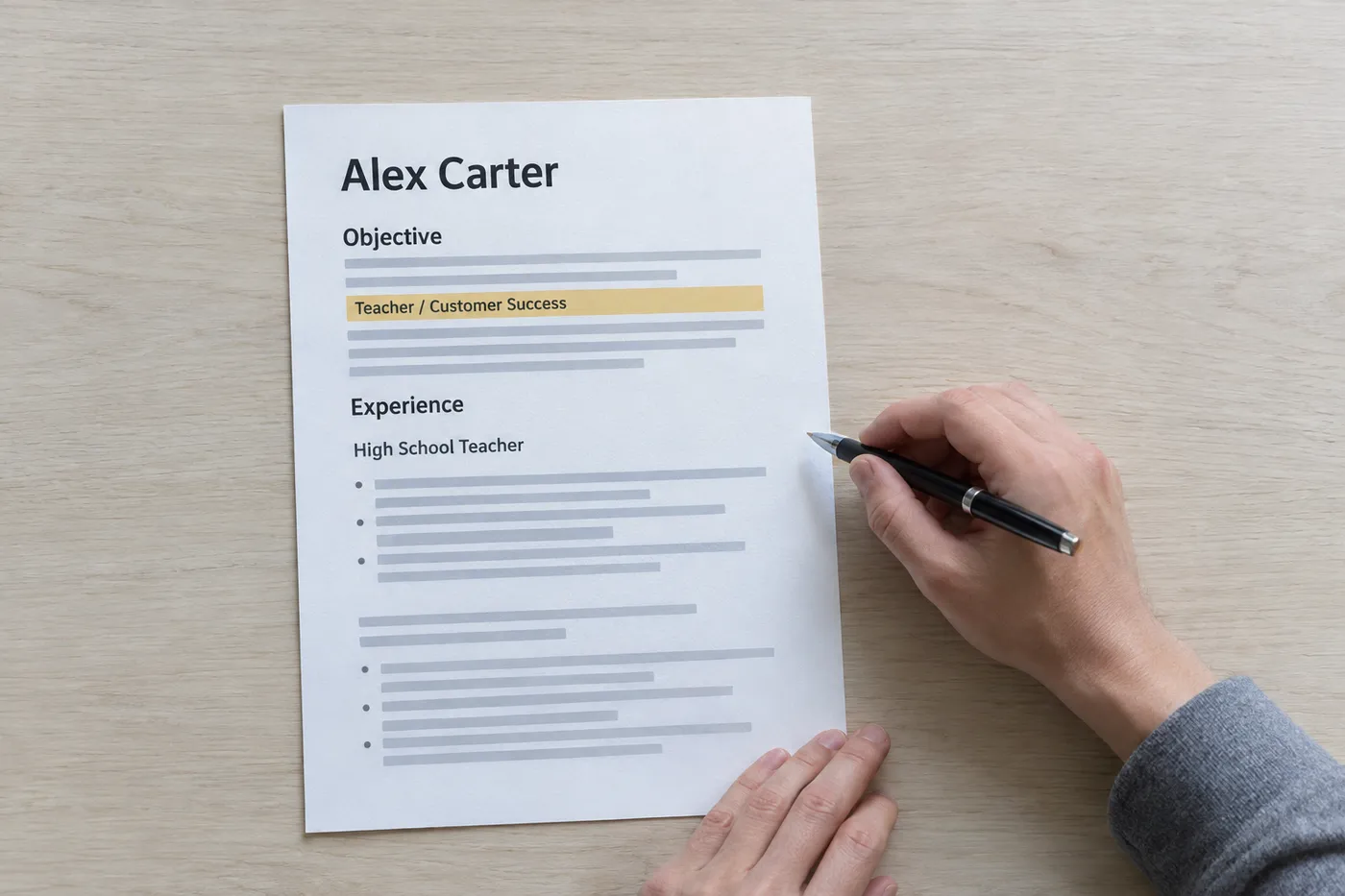
- High school teacher transitioning to customer success, applying for the Customer Success Associate role at Lumen Health. Eight years of managing parent relationships and renewal-style conversations; completed the Salesforce Administrator certification in March.
- Retail store manager moving into HR, seeking the HR Coordinator opening at Fairview Logistics. Hired and onboarded 40+ associates over six years and supported two workplace investigations; SHRM-CP exam scheduled for June.
- Local news reporter targeting the Content Marketing Specialist role at Harbor SaaS. Ten years of interviewing sources and writing on deadline; published three client case studies as a freelancer this year.
- Army logistics NCO seeking the Supply Chain Analyst position at Grainger. Directed inventory for a 600-person battalion and cut requisition turnaround by a third; CPIM certification in progress.
The objective buys you the first read, and the rest of the document has to keep the promise. That usually means moving transferable skills above the work history and rewriting bullets in the new field's language. The opening line itself gets a deeper treatment in our guide to writing a resume objective for a career change.
Objectives for a relocation or a return to work
These two look different but fail the same way, silently. An out-of-state address gets a resume quietly deprioritized because the recruiter assumes you will need convincing, a relocation package, or a long timeline. A multi-year gap gets a guess, and the guess is rarely generous. In both cases one sentence at the top answers the question before it gets asked, which is the entire point of an objective.
For a relocation, state the destination and a date, and make the move sound decided rather than aspirational. "Open to relocation" reads as a maybe; "relocating to Denver in June" reads as a plan. For a return to work, name the break in half a sentence and spend the rest on current capability. You owe no one an apology, and the objective is not the place for one.
- Senior accountant relocating to Denver in June 2026, seeking the Senior Accountant role at Alpine Health. Six years of month-end close and multi-entity consolidation in NetSuite; available for on-site interviews from May.
- Registered nurse relocating to Austin with a Texas license already in hand, applying for the Med-Surg RN position at St. David's. Five years on a 32-bed unit with charge experience.
- CPA returning to public accounting after a four-year career break as a primary caregiver. Seeking the Tax Senior role at Meridian Advisors; license active, with a busy-season contract engagement completed this spring.
- Marketing manager returning after a two-year break, targeting the Email Marketing Manager opening at Coastline Brands. Ran lifecycle programs for a DTC skincare brand before the break and rebuilt the toolkit this year in Klaviyo and GA4.
What makes an objective read as dated
Recruiters do not hate objectives. They hate one specific objective, the version that was taught in the nineties and still circulates on template sites. You can spot it by what it withholds, which is any information the employer could act on.
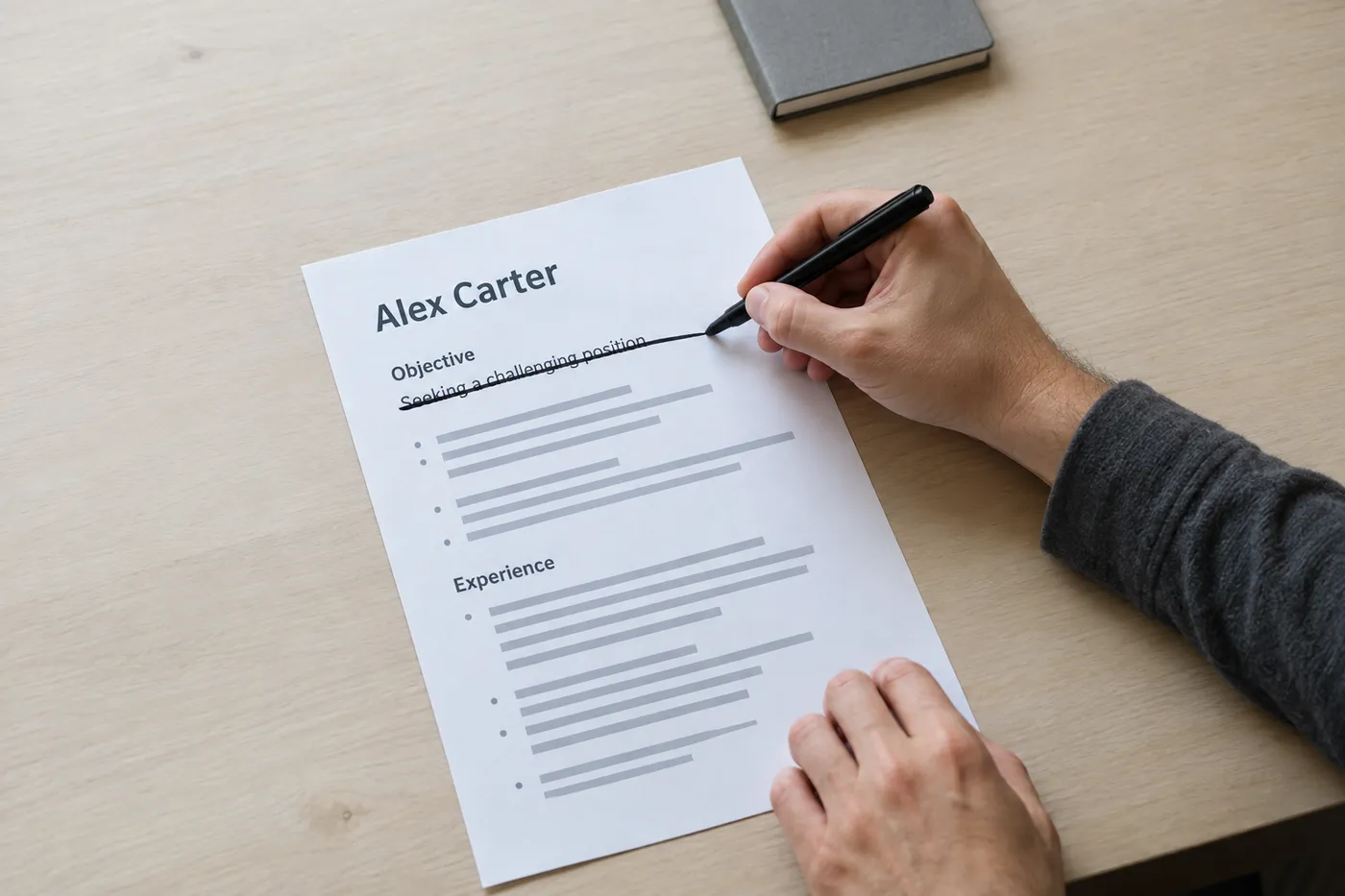
- It opens with "To obtain a position" or "Seeking a challenging role." The sentence structure itself signals a template.
- It only describes what you want. Growth, opportunity, experience, a dynamic team. The employer's problem never appears.
- It could be sent to any company unchanged. No posted job title, no company name, no industry.
- It leans on trait words instead of evidence. "Hard-working team player with excellent communication skills" claims three things and proves none.
- It runs longer than two lines. Past that point it is a cover letter squatting in the wrong section.
- It ends with "where I can use my skills." Which skills, applied to what, is exactly what the reader came to find out.
The fix is the same every time. Replace the wish with an offer. "Seeking a challenging customer service role with room for growth" becomes "Applying for the Customer Service Representative role at Lakeline Credit Union; two years of face-to-face cash handling and a habit of staying calm with a line ten people deep." Same person, same length, different decision from the recruiter.
Converting an objective into a summary
An objective has a shelf life. The moment you have real experience in the target field, even six months of it, the forward-pointing frame stops helping and starts hiding your proof. Converting is mechanical once you see the pattern, because the two sections share a skeleton.
- Keep the role targeting. The posted job title stays in the first line either way.
- Swap intent verbs for evidence. "Seeking to apply" becomes "three years applying," and "eager to contribute" becomes what you contributed.
- Add one number. A summary without a measurable result is an objective in disguise, so pull your best figure forward from the bullets below.
- Name your tools. Recruiters and ATS filters both search for the specific software the posting mentions, so match the posting's terms wherever they are true of you.
- Cut anything about your goals. In a summary, your goals are implied by the application itself.
Before, as an objective. "Recent graduate seeking the Data Analyst role at Finch Retail; built dashboards in a capstone project and strongest in SQL and Tableau." Eighteen months later, as a summary. "Data analyst with 18 months at Finch Retail building Tableau dashboards used by 40 store managers. Cut weekly reporting time from four hours to 30 minutes by automating extracts in SQL. Looking to bring the same reporting automation to a larger retail portfolio." The frame moved from readiness to results, and nothing else changed. For the full pattern with worked examples, see how to write a professional summary.
One resume, shown with both openings
Here is the test case this whole argument rests on. Meet Priya, a retail store manager with six years of experience, currently running a $4M location with a team of 25. Depending on what she is applying for, the same work history needs a different opening, and the difference is not cosmetic. It changes what the recruiter believes by the end of line two.
| Priya's situation | Opening that wins | Why |
|---|---|---|
| Applying for another store manager job | Summary | Her history is the argument. A summary puts six years, $4M in volume, and a 25-person team in the first line instead of making the recruiter dig for it. |
| Switching into HR coordination | Objective | Her title says retail, and the recruiter will anchor on it. The objective names the HR target first and reframes her hiring and onboarding record as HR evidence. |
| Relocating to Portland | Objective line above a summary | Her fit is obvious; her address is not. One dated relocation line removes the out-of-state discount, then the summary does its normal job. |
Her summary, for the like-for-like application. "Store manager with six years in big-box retail, currently running a $4M location and a team of 25. Raised conversion 12% year over year and cut shrink to 0.8% against a 1.4% district average. Looking for a higher-volume flagship."
Her objective, for the HR switch. "Store manager transitioning into HR, applying for the HR Coordinator role at Northway Health. Hired and onboarded more than 60 associates over six years, ran annual review cycles for a 25-person team, and completed the SHRM-CP in April."
Her hybrid, for the relocation. "Relocating to Portland in August 2026 and available for on-site interviews from July." Then the summary continues exactly as written above. One line, then business as usual.
The opening is only the first move. Priya's HR version should also lift a skills section above the work history, while her store manager version leads with experience; the reasoning is in the best resume section order for your experience level. Keeping three living versions of one resume is the part that gets messy in practice, which is what Roleframe is built around. You keep one base resume per target role, duplicate it for each job, and get a fit report that scores the version against the posting and names the exact keywords you are missing. The edits stay yours. Remi, the career copilot in the editor, proposes rewrites one at a time, and nothing lands until you approve it. Save and submit the finished version as a PDF so the formatting survives the trip.
Frequently asked questions
- What is a good objective for a resume?
One that names the posted job title and the company, then offers one or two concrete proof points, all in under two lines. For example: "Marketing graduate applying for the Social Media Coordinator opening at Beam Coffee. Grew a campus account to 12,000 followers and ran its content calendar for two years." If your objective could be sent to a different company unchanged, it is not good yet.
- What is a good opening statement for a resume?
For most people, a professional summary of two to four lines with your title, your experience level, the tools the posting asks for, and one measurable result. Use an objective instead only in three cases: a first job with no relevant history, a career change where your current title misleads the reader, or a gap or relocation that needs a one-line explanation before the history makes sense.
- Do recruiters actually read resume objectives?
They read whatever sits in the top third of page one, which is exactly why a weak objective hurts. The first pass is fast, and a generic line burns the space your best evidence should occupy. A specific objective is often the only full sentence that gets read on that pass, so it is worth writing well or replacing with a summary.
- How long should a resume objective be?
One to two lines, and never more than two sentences. The first sentence names the target role and company. The second delivers your strongest proof point. Anything longer belongs in a cover letter.
- What are the top skills to put on a resume?
There is no universal top five. The right skills are the ones the posting asks for, stated in the posting's own words, because recruiters and ATS filters both search for those exact terms. Pull the requirements from the job description and mirror the ones that are true of you. Our guide to skills to put on a resume breaks them down by role.
- What is a good summary for a resume?
A good summary states your title and years of experience, then names the tools the posting cares about and one quantified result. "Data analyst with three years in retail analytics, working in SQL and Tableau, who cut weekly reporting time from four hours to 30 minutes" does more work than a paragraph of adjectives. Skip anything about your goals, since applying already states them.

Ready to start your new resume?
Writing a resume takes time, and even a polished one can miss what a hiring manager is looking for. Roleframe helps you build a clear, ATS-safe resume in minutes and tailor it to the job you want.


