Skills to Put on a Resume: 120 by Role, and Where They Go
120 skills to put on a resume, grouped by job family, with a placement guide for each one: the skills list, a bullet, or both. Plus how many to list.


On this page
A recruiter can tell in one glance whether your skills section was written for their job or copied from a template. So can the applicant tracking system (ATS) that reads the resume before any human does. Bare entries like "communication" and "team player" match nothing a recruiter searches for, and they crowd out the terms that would have matched.
Most articles on this topic hand you 100 interchangeable words and wish you luck. This one does two things differently. The 120 skills below are grouped by job family, because the right skills for a medical assistant have almost nothing in common with the right skills for a backend engineer. And every skill comes with a placement column that answers the question the other lists skip entirely: does this belong in your skills list, in a bullet under a job, or in both places?
The placement question matters more than the vocabulary. Hiring is shifting toward screening for demonstrated skills rather than titles and degrees, and that screening starts with software matching exact terms. A skill in the wrong place is a skill the pipeline never sees.
Hard skills vs. soft skills, and which one an ATS reads
An ATS reads hard skills. It does not read soft skills in any meaningful way, and this single fact should reorganize your whole skills section.
Hard skills are nouns. Python, Epic, QuickBooks, Salesforce, ICD-10. When a recruiter filters 400 applicants down to 40, they search for these nouns, and the software matches them as literal strings. If the posting says "Google Analytics" and your resume says "web analytics tools," you did the work and still missed the match.
Soft skills are claims. "Leadership" in a skills list is an assertion with no evidence attached, and recruiters have learned to ignore it there. The same skill lands when it appears as a bullet: "Trained four new hires on the closing procedure, all four passed their 30-day review." Nobody searches for the word "training" in a filter, but every human who reads that bullet believes it.
So the working rule is this: hard skills feed the software, soft skills persuade the human, and each belongs where its audience looks. I break down the evidence question in more depth in hard skills vs. soft skills on your resume.
The 120 skills, grouped by job family
How to read the tables. "Skills list" means the skill goes in your dedicated skills section as a searchable noun. "A bullet" means it needs evidence and belongs under a job with a result attached. "Both" means it is central enough to the role that it should appear twice, once for the filter and once as proof. A few entries point to your certifications section instead, because that is where recruiters look for them.
One rule overrides everything in these tables. Match the employer's wording, not mine. If the posting says "Microsoft Excel," write "Microsoft Excel," not "spreadsheets." For a deeper term bank sorted by title, see the ATS resume keywords list.
Software engineering and IT
Specificity wins here. "Cloud platforms" matches no filter; "AWS" does. Name the exact languages and services you have shipped with, not the category they belong to.
| Skill | Hard or soft | Where it goes |
|---|---|---|
| Python | Hard | Both |
| JavaScript / TypeScript | Hard | Both |
| SQL | Hard | Both |
| AWS (or Azure / Google Cloud, whichever you used) | Hard | Both |
| Docker and Kubernetes | Hard | Skills list |
| Git and CI/CD pipelines | Hard | Skills list |
| REST API design | Hard | Both |
| Linux administration | Hard | Skills list |
| Production debugging and incident response | Hard | A bullet |
| LLM integration and prompt engineering | Hard | Both |
| Code review and mentoring | Soft | A bullet |
| Cross-team collaboration | Soft | A bullet |
Data and analytics
Employers filter on tools first and judge the thinking in your bullets second. The data analyst resume example shows how the two work together on a real page.
| Skill | Hard or soft | Where it goes |
|---|---|---|
| SQL (joins, window functions) | Hard | Both |
| Python (pandas, NumPy) | Hard | Both |
| Excel (pivot tables, XLOOKUP) | Hard | Skills list |
| Power BI | Hard | Both |
| Tableau | Hard | Both |
| Data cleaning and ETL | Hard | Both |
| A/B testing | Hard | A bullet |
| Statistical analysis | Hard | A bullet |
| Dashboard design | Hard | A bullet |
| Google Analytics (GA4) | Hard | Skills list |
| Data storytelling | Soft | A bullet |
| Stakeholder reporting | Soft | A bullet |
Marketing and content
Platforms are the hard skills in marketing. "Digital marketing" is a category, and categories do not survive a keyword filter. Name the ad platforms and the email tools you have actually run.
| Skill | Hard or soft | Where it goes |
|---|---|---|
| SEO (on-page and technical) | Hard | Both |
| Google Ads | Hard | Both |
| Meta Ads | Hard | Skills list |
| Google Analytics (GA4) | Hard | Skills list |
| Email marketing (Klaviyo, Mailchimp) | Hard | Both |
| HubSpot | Hard | Skills list |
| Content strategy | Hard | A bullet |
| Copywriting | Hard | Both |
| WordPress | Hard | Skills list |
| Conversion rate optimization | Hard | A bullet |
| Brand voice development | Soft | A bullet |
| Cross-functional campaign management | Soft | A bullet |
Sales and customer success
Sales skills are mostly proven in bullets because the skill and the number are inseparable. "Quota attainment" means nothing in a list; "118% of quota in FY2025" means everything in a bullet.
| Skill | Hard or soft | Where it goes |
|---|---|---|
| Salesforce | Hard | Both |
| HubSpot CRM | Hard | Skills list |
| Pipeline management | Hard | Both |
| Outbound prospecting | Hard | A bullet |
| Discovery and needs analysis | Hard | A bullet |
| Forecasting | Hard | Both |
| Contract renewals and account expansion | Hard | A bullet |
| Customer onboarding | Hard | Both |
| Quota attainment (with the number) | Hard | A bullet |
| Negotiation | Soft | A bullet |
| Objection handling | Soft | A bullet |
| Executive relationship building | Soft | A bullet |
Project and product management
Methodology terms are searchable here, so Agile and Scrum earn a place in the list. Credentials like PMP or CSM go in a certifications section, where recruiters expect to find them; see where to put certifications on a resume.
| Skill | Hard or soft | Where it goes |
|---|---|---|
| Agile and Scrum | Hard | Both |
| Jira | Hard | Skills list |
| Roadmap planning | Hard | Both |
| Sprint planning and backlog grooming | Hard | Skills list |
| Risk management | Hard | A bullet |
| Budget ownership | Hard | A bullet |
| OKRs and goal setting | Hard | Skills list |
| User research | Hard | Both |
| Product analytics (Amplitude, Mixpanel) | Hard | Both |
| Stakeholder management | Soft | A bullet |
| Prioritization under constraints | Soft | A bullet |
| Cross-functional team leadership | Soft | A bullet |
Finance and accounting
Searches in this family often start with the ERP name. List NetSuite or SAP exactly as the posting writes it, and let the process skills like month-end close appear both in the list and in a dated, quantified bullet.
| Skill | Hard or soft | Where it goes |
|---|---|---|
| GAAP | Hard | Skills list |
| QuickBooks | Hard | Both |
| NetSuite (or SAP) | Hard | Skills list |
| Financial modeling in Excel | Hard | Both |
| Accounts payable / accounts receivable | Hard | Both |
| Month-end close | Hard | Both |
| Budgeting and forecasting | Hard | Both |
| Variance analysis | Hard | A bullet |
| Audit preparation | Hard | A bullet |
| Internal controls | Hard | Skills list |
| Financial reporting | Hard | Both |
| Accuracy under deadline pressure | Soft | A bullet |
Healthcare
Clinical resumes get screened on systems and credentials before anything else. Epic experience is a real filter in many hospital systems, so it belongs in your skills list even when it feels like stating the obvious.
| Skill | Hard or soft | Where it goes |
|---|---|---|
| Epic (or Cerner) EHR | Hard | Both |
| Patient intake and vital signs | Hard | Both |
| Phlebotomy | Hard | Skills list |
| HIPAA compliance | Hard | Skills list |
| Medical terminology | Hard | Skills list |
| ICD-10 and CPT coding | Hard | Both |
| Medication administration | Hard | A bullet |
| Care coordination | Hard | A bullet |
| Charting and clinical documentation | Hard | Both |
| BLS / CPR | Hard | Certifications section |
| Patient education | Soft | A bullet |
| Calm under pressure | Soft | A bullet |
Administrative and office support
The trap in admin roles is listing only the obvious software. Calendar ownership and vendor work are the differentiators, so give them bullets with real scale, such as how many executives or how large a budget.
| Skill | Hard or soft | Where it goes |
|---|---|---|
| Microsoft 365 (Excel, Outlook, PowerPoint) | Hard | Skills list |
| Google Workspace | Hard | Skills list |
| Calendar management | Hard | Both |
| Travel coordination | Hard | A bullet |
| Expense reporting (Concur) | Hard | Skills list |
| Data entry (with typing speed, if strong) | Hard | Both |
| Meeting coordination and minutes | Hard | A bullet |
| Vendor management | Hard | A bullet |
| Document management (SharePoint) | Hard | Skills list |
| Event planning | Hard | A bullet |
| Discretion with confidential information | Soft | A bullet |
| Front-desk communication | Soft | A bullet |
Retail, hospitality, and service
Most skills in this family are proven on the floor, which means bullets. The list carries the systems, and ServSafe goes with your certifications. If you are writing a first-job resume, cash handling and a named POS system beat any personality trait.
| Skill | Hard or soft | Where it goes |
|---|---|---|
| POS systems (Square, Toast) | Hard | Skills list |
| Cash handling and register reconciliation | Hard | Both |
| Inventory management | Hard | Both |
| Visual merchandising | Hard | A bullet |
| Upselling and cross-selling | Hard | A bullet |
| ServSafe (food safety) | Hard | Certifications section |
| Opening and closing procedures | Hard | Skills list |
| Loss prevention | Hard | A bullet |
| Staff scheduling | Hard | A bullet |
| Customer service | Soft | A bullet |
| Conflict de-escalation | Soft | A bullet |
| New-hire training | Soft | A bullet |
Education and training
Districts screen resumes on pedagogy terms, so "differentiated instruction" and "IEP" earn their place in the list verbatim. Everything about outcomes belongs in bullets with student data attached.
| Skill | Hard or soft | Where it goes |
|---|---|---|
| Lesson planning | Hard | Both |
| Curriculum development | Hard | Both |
| Classroom management | Hard | Both |
| Differentiated instruction | Hard | Both |
| IEP implementation | Hard | Skills list |
| Google Classroom / Canvas | Hard | Skills list |
| Formative and summative assessment | Hard | A bullet |
| Data-driven instruction | Hard | A bullet |
| Behavior intervention | Hard | A bullet |
| EdTech integration | Hard | Skills list |
| Parent and guardian communication | Soft | A bullet |
| Student engagement | Soft | A bullet |
Where a skill belongs: the list, a bullet, or both
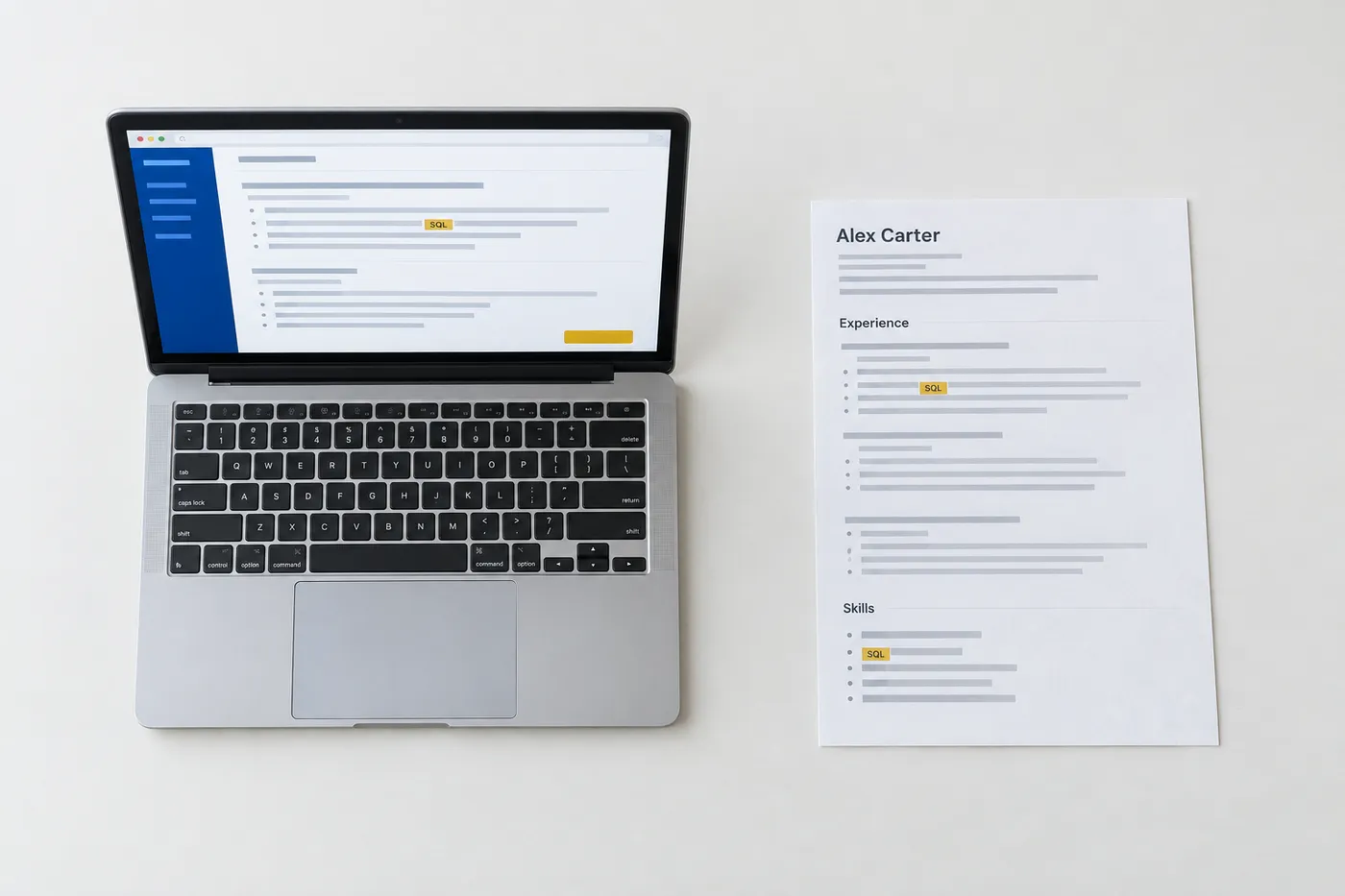
Use one test. Would a recruiter type this skill into a search filter? If yes, it goes in the skills list. If the skill is a claim that needs evidence, it goes in a bullet under the job where you used it. If it sits at the center of the role you want, it goes in both places, once as the searchable noun and once as the proof.
Here is what "both" looks like in practice for an account manager. The skills list contains the single word "Salesforce." Then a bullet under the current job reads, "Grew a 90-account territory 24% year over year, managing the full renewal pipeline in Salesforce." The list entry survives the keyword filter. The bullet survives the human read. Neither works alone.
Soft skills never appear as bare list items on a strong resume. A recruiter who reads "leadership, communication, problem-solving" in a skills section learns nothing except that you have seen other resumes. The same recruiter reading "presented monthly performance reviews to the VP of Sales and two regional directors" now believes you can communicate upward, and you never had to say the word. Show the behavior, and the trait takes care of itself.
How many skills should you list?
Eight to twelve in the dedicated skills section, for most people. Fewer than eight looks thin. More than twelve reads as padding and, worse, dilutes the terms that matter, because a recruiter scanning a 25-item list gives each item less weight.
Technical resumes are the exception, and the fix is grouping rather than cutting. A developer can carry twenty legitimate skills by organizing them into labeled lines, such as "Languages" on one line and "Infrastructure" on another, so the section stays scannable. For worked layouts of both approaches, see these resume skills section examples.
The deeper point is that eight to twelve is a budget, and budgets force choices. Every generic entry you keep is a specific, posting-matched entry you gave up. Spend the slots on the nouns this employer filters for.
Skills to cut today
These entries cost you space and signal nothing. Some actively hurt, because they tell the reader you have not updated the resume in years.
- "Microsoft Word." Assumed for every professional role. The exception is an admin posting that names it as a requirement; then you match the wording.
- "Communication" as a bare list item. Move it into a bullet where something was communicated to someone, with a result.
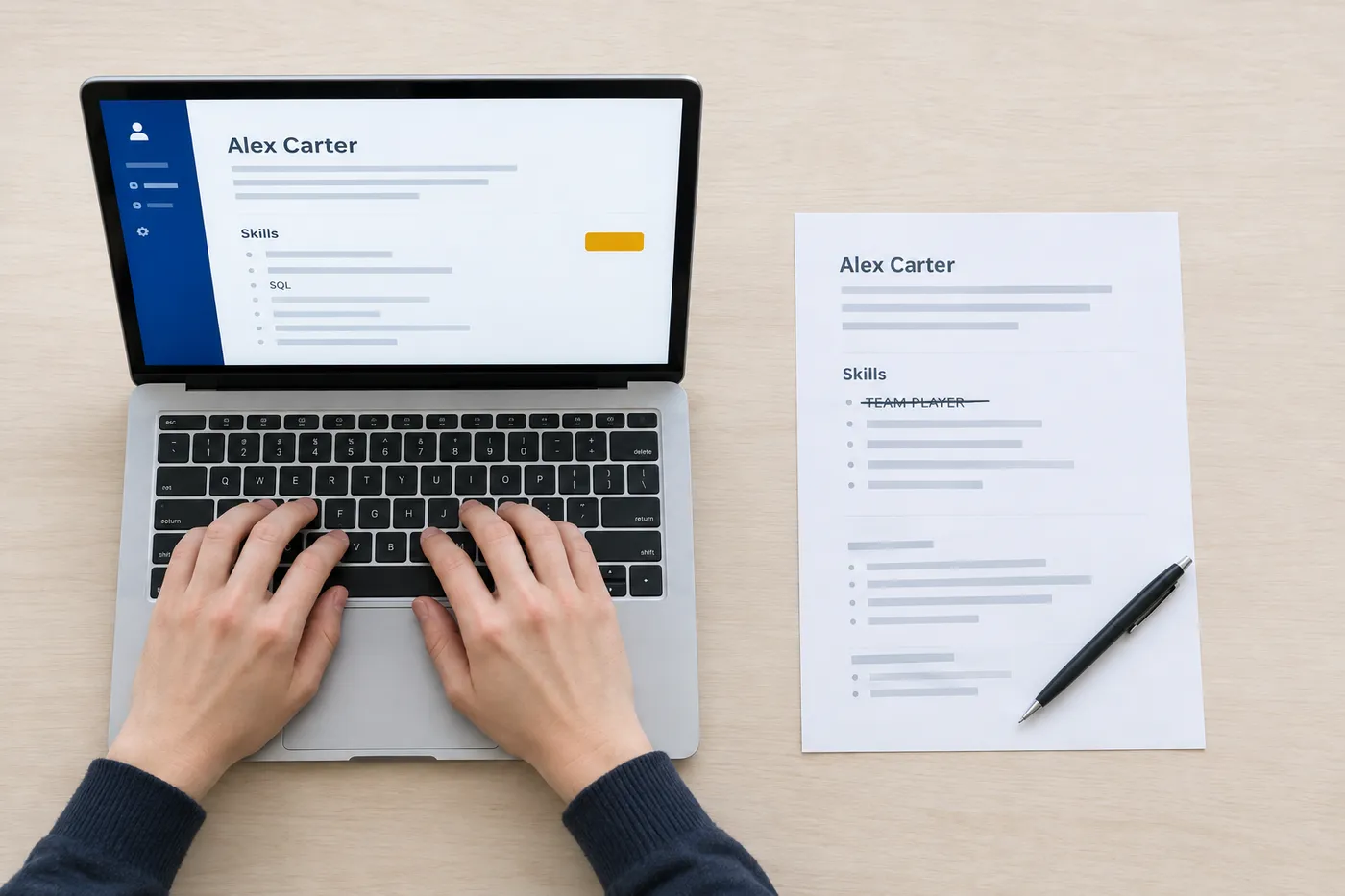
- "Team player," "hard worker," "go-getter." These are personality claims, and a skills section is not the place for personality claims.
- "Detail-oriented." Either prove it with an accuracy figure in a bullet or cut it. The irony of a typo near this phrase has ended real candidacies.
- Dead technology. Fax, dial-up era software, "internet research." Each one dates the whole document.
- "Social media" without platform names. Instagram, LinkedIn, and TikTok are different jobs. Name the ones you have run and what you ran on them.
- "Familiar with AI." AI skills are appearing in more postings across job families, not just in engineering, but the vague version matches nothing. Write the specific skill, such as "prompt engineering" or "AI-assisted reporting," and back it with a bullet showing the task it changed.
- "Multitasking." No recruiter has ever searched for it, and no interviewer has ever been impressed by it.
Check your skills against a posting, not against this article
The tables above are a starting inventory, and that is all any list can be. The skills section that gets you the interview is written against one posting. Here is the manual process, which takes about ten minutes per job.
- Read the requirements and qualifications sections of the posting and mark every noun: tools, systems, methods, credentials.
- Match the employer's exact wording. If they write "Google Analytics," do not write "web analytics." If they write "A/P," mirror it and spell it out once.
- Confirm every must-have requirement appears on your resume, in the skills list or in a bullet, ideally in both when it is central to the role.
- For each big claim in your list, check that a bullet somewhere backs it up. An unproven skill is a question you will be asked in the interview, so make sure you want the question.
The full method, including how to handle requirements you only partially meet, is in how to check your resume against a job description.
Doing this by hand across ten open applications is where most people quit, which is the honest reason tailored resumes are rare. Roleframe compresses the tedious part. You duplicate your base resume for a job, and the fit report shows the exact keywords the posting screens for, which ones your resume already covers, and which are gaps, with an ATS score and a prioritized plan. Then you make the edits yourself, with Remi suggesting rewrites bullet by bullet and you approving every change. The words stay yours, so you can defend them in the interview.
Frequently asked questions
- What are the top 6 skills for a resume?
There is no universal six, and any article that gives you one is guessing about a job it has never read. The formula that works: four hard skills lifted from the posting's requirements section, in the employer's exact wording, plus two soft skills you prove in bullets rather than list. For most office roles the hard four end up being a spreadsheet tool, an industry system like a CRM or an EHR, a method like Agile or month-end close, and a data or reporting skill.
- What are 10 good skills to include on a resume?
A general-purpose ten that shows up across industries: Excel or Google Sheets, SQL, data analysis, project management, a named cloud platform such as AWS, a named CRM such as Salesforce, customer service, written communication, budgeting, and a role-specific certification. Treat that as a menu, not a list to copy. Eight skills matched to the posting beat ten generic ones every time.
- What are 7 soft skills employers look for?
Analytical thinking, adaptability, collaboration, clear communication, time management, resilience, and a visible willingness to keep learning. None of them belongs in your skills list as a bare word, because no ATS filters for them and recruiters skim past unproven claims. Put each one in a bullet where the behavior produced a result, and the reader draws the conclusion for you.
- What skills should I put on a resume with no experience?
Start with hard skills from school and life, not personality words. Google Workspace or Microsoft 365, a language you speak, cash handling from any job or volunteer role, a named tool from coursework, and any certification such as food handler or CPR. Then prove the soft skills through activities: captaining a team shows leadership better than the word does. For a first retail or service job, a named POS system and verified availability matter more than anything else on the page.
- How many skills should I put on my resume?
Eight to twelve in the skills section. Technical candidates can carry more by grouping them into labeled lines, such as one line for languages and one for tools, which keeps the section scannable. Past that point each extra skill weakens the rest, because the reader stops believing you are strong in all of them.
- Should soft skills go in the skills section at all?
No. The skills section exists to survive keyword filters, and keyword filters match hard, searchable nouns. Soft skills earn their space in bullets, in your summary, and in the interview. "Trained four new hires, all four passed their 30-day review" does more for you than the word "mentorship" ever will.
- Can I list a skill I learned outside of work?
Yes, with one condition: you can do the task today and talk about it for five minutes in an interview. A certification course, a personal project, or volunteer work all count as legitimate sources. What you cannot do is list a tool you watched a video about, because the follow-up question comes fast and the interview does not recover from a bluffed answer.

Ready when you are
Send the tailored resume, not the generic one.
Paste a job posting and Roleframe scores your resume against it, then helps you close the gaps one approved edit at a time, so you apply while the role is still fresh.