Part-Time Job Cover Letter: Example With an Availability Line
by Larbi SahliLast Updated
A complete part-time job cover letter example, plus the availability line written five ways: student, parent, full-time worker, retiree, and second job.
Users have landed jobs at
- 1Password
- OpenAI
- Notion
- justworks
On this page
A part-time cover letter is read for one thing before anything else: can you actually work the hours the manager needs covered. A hiring manager staring at a Saturday gap on the rota will pick the applicant who says "I can work every Saturday and three weeknights from 5pm" over a stronger candidate who never mentions hours at all.
Most part-time cover letter advice skips this. The sample letters floating around online talk about passion for customer service and eagerness to learn, and never once name a day of the week. That is the gap this page fixes. Below is a complete example letter from a college student applying for evening and weekend shifts at a supermarket, followed by the availability line rewritten for five situations: a student, a parent, someone keeping a full-time job, a retiree, and someone adding a second part-time job.
A part-time job cover letter example
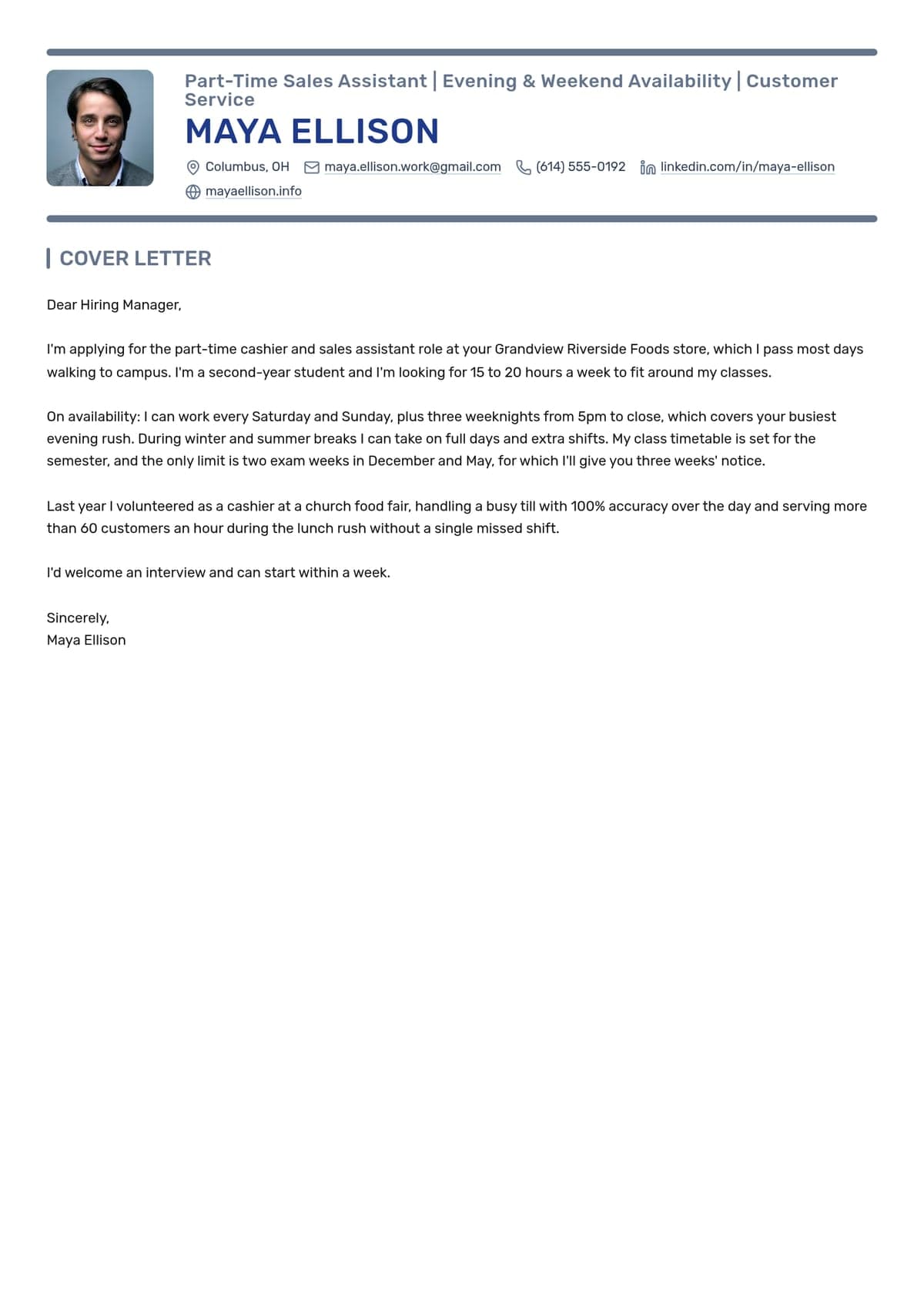
Read the letter below as a manager would. Notice where the availability paragraph sits: second, right after the opening names the role, before any talk of skills. The manager gets the answer to their real question, "can this person cover my empty shifts," within ten seconds. Then the letter earns the interview with proof of reliability, one concrete number, and a closing that asks for a specific next step.

Part-Time Sales Assistant | Evening & Weekend Availability | Customer Service
Maya Ellison
Cover Letter
Dear Hiring Manager,
I'm applying for the part-time cashier and sales assistant role at your Grandview Riverside Foods store, which I pass most days walking to campus. I'm a second-year student and I'm looking for 15 to 20 hours a week to fit around my classes.
On availability: I can work every Saturday and Sunday, plus three weeknights from 5pm to close, which covers your busiest evening rush. During winter and summer breaks I can take on full days and extra shifts. My class timetable is set for the semester, and the only limit is two exam weeks in December and May, for which I'll give you three weeks' notice.
Last year I volunteered as a cashier at a church food fair, handling a busy till with 100% accuracy over the day and serving more than 60 customers an hour during the lunch rush without a single missed shift.
I'd welcome an interview and can start within a week.
Sincerely,
Maya Ellison
The whole letter runs well under a page. For a supermarket, café, or retail role, half a page is the right length. The manager reading it is probably standing at a service desk between tasks, not sitting at a desk with coffee.
Why availability carries a part-time cover letter
Part-time hiring is scheduling first, skills second. The manager posted the job because specific shifts are uncovered: Saturday mornings, weekday evenings, the closing shift nobody wants. Your letter either solves that problem or it doesn't, and no amount of enthusiasm compensates for a schedule that doesn't fit.
A complete availability paragraph answers four questions:
- Which days and hours you can work, named specifically. "Evenings and weekends" is vague; "Monday, Wednesday, and Thursday from 5pm, plus all day Saturday" is a shift the manager can put on a rota.
- Your weekly total. Managers plan in hours per week. Saying you're looking for 15 to 20 hours tells them instantly if you fit the headcount they have budget for.
- How far ahead you know your schedule. A student whose timetable changes each semester should say so, and say when the next change lands. Predictability is worth almost as much as the hours themselves.
- Any known limits, stated once and plainly. Exam weeks, school holidays when childcare changes, a standing commitment on Tuesday nights. Naming these upfront reads as organized. Springing them on the manager in week two reads as unreliable.
One paragraph covers all four. Anything longer starts to sound like a negotiation, and you are not negotiating yet. You are showing the manager that scheduling you will be easy.
Write availability as a match, not a list of restrictions
The same facts can read as an offer or as a complaint. Compare these two sentences describing an identical schedule:
- "Unfortunately I can't work weekday mornings or afternoons because of my classes, and I'm unavailable during exam periods."
- "I can work every Saturday, all day, plus three weeknights from 5pm, which I understand are your busiest periods."
The first sentence lists what the manager loses. The second lists what the manager gets, and shows you thought about when the store actually needs people. Supermarkets are busiest evenings and weekends. Cafés are busiest weekend mornings. Restaurants need Friday and Saturday nights. If your free hours line up with the busy hours, say so explicitly, because that overlap is your single strongest selling point and most applicants never make it.
You can find the busy hours without insider knowledge. The posting often names the shifts. If it doesn't, the business type tells you, or a five-minute visit does. Walk past on a Saturday afternoon and count the queue.
The availability sentence, written five ways
Here is the core availability sentence adapted to the five most common part-time situations. Swap the one that fits into the second paragraph of your letter and adjust the specifics.
Student working around a class timetable
"My classes run weekday mornings and early afternoons, so I'm available every weeknight from 5pm and all day Saturday and Sunday, up to 20 hours a week. My timetable is fixed until the semester ends in May, and I can pick up extra shifts during reading week and the summer break."
The semester end date matters. It tells the manager exactly when your schedule might shift, months in advance. If you're building the rest of your application too, the student resume examples here pair well with this letter.
Parent working around school hours
"I'm available Monday through Friday between 9:15am and 2:45pm, which covers your mid-morning and lunchtime rush. My hours are the same every week during term time, and I can occasionally arrange cover for evening shifts with a week's notice."
The strength here is consistency. School hours don't move, so lead with that reliability rather than treating the pickup deadline as an apology.
Keeping a full-time job
"I work full time until 5pm on weekdays, so I'm available for evening shifts from 6:30pm and any shift on weekends, up to 15 hours a week. My weekday schedule is fixed and has been for two years, so my evenings are dependable."
Leave a realistic gap between jobs. A manager who sees you finish at 5pm and start at 5pm will assume you'll be late, and they'll be right.
Retiree
"I'm fully flexible on days and hours and happy to take the shifts that are hardest to fill, including early mornings and midweek daytime. I'm looking for around 20 hours a week and my schedule doesn't change."
Full flexibility is rare in a part-time applicant pool dominated by students, and midweek daytime coverage is exactly what a store loses when its student staff are in class. Offering the unpopular shifts by name is a genuine advantage; use it.
A second part-time job alongside a first
"I currently work Tuesday and Thursday daytimes at [other employer], so I'm available Monday, Wednesday, and Friday all day, plus weekends. Both schedules are fixed, and my current employer publishes rotas three weeks ahead, so conflicts are easy to avoid."
Name the fact that you already juggle a schedule successfully. It preempts the manager's obvious worry, which is that job one will eat job two's shifts.
The proof paragraph: what convinces a shift manager
After availability, the letter needs one paragraph proving you'll be worth scheduling. For shift work, the evidence managers care about is narrow and concrete:

- Showing up. Attendance and punctuality beat almost everything else in hourly work. "I didn't miss a shift in eight months" is a stronger line than any adjective.
- Handling cash or payments. If you've ever balanced a till, run a card machine, or handled money for a school fundraiser, say so, with the amount if you know it.
- Food safety or hygiene basics, for kitchen and café roles. A food handler certificate is worth a sentence; so is experience prepping in any commercial kitchen.
- Staying useful when it's busy. Serving a lunchtime rush, working a sale weekend, or managing a queue at a school event all prove the same thing: you don't freeze under volume.
No paid work history yet? Draw from school, sports, and volunteering. Running the snack stand at games is cash handling. Being the teammate who never missed practice is attendance. Tutoring younger students twice a week for a year is a fixed commitment you kept. Attach a number wherever one exists: how many customers, how many months, how much money, how many hours a week. One real number outweighs a paragraph of "hardworking and motivated."
If the role is retail, it's worth seeing how experienced candidates frame this same evidence. The sales associate resume example shows the metrics retail employers screen for, and the same numbers belong in your letter.
Seasonal and holiday roles: name the exact dates
For a seasonal posting, dates replace days as the core of your availability paragraph. The manager hiring for the holiday rush needs to know two things: exactly which weeks you can work, and whether you disappear the day the season ends.
Write the dates as a commitment: "I'm available from November 20 through January 8, including Christmas Eve, Boxing Day, and New Year's Eve, with no travel planned." Naming the awkward days is the whole trick. Every seasonal applicant is available in early December. The applicant who explicitly commits to the days everyone else wants off goes to the top of the pile.
Then answer the retention question in one sentence, honestly. If you'd stay on after the season, say "I'd welcome the chance to continue part-time after the holidays." Managers convert good seasonal staff into permanent hires because it saves them a hiring round, and signaling interest costs you nothing. If you genuinely can't stay, don't pretend; a clean, reliable six weeks is still a good hire.
What to leave out
Three things regularly sink otherwise fine part-time letters:
- Apologizing for limited hours. "I know I can only offer 12 hours a week, but..." frames your availability as a defect. The job is part-time. Limited hours are the premise, not a confession. State what you offer and stop.
- A long account of your studies. The manager hiring a weekend cashier does not need your major, your thesis topic, or your career ambitions. One clause ("I'm a second-year student at Ohio State") establishes context; a paragraph about coursework reads as filler and signals you'll quit at graduation.
- Plans in an unrelated field. Telling a supermarket you're pursuing a marketing career tells them you're leaving soon and this job is a placeholder. Even if it's true, it doesn't belong in the letter. What belongs is why you'll be good at this job for as long as you hold it.
The pattern behind all three: everything in the letter should serve the manager's decision. Anything that serves your autobiography instead gets cut.
The short version, and the printed version
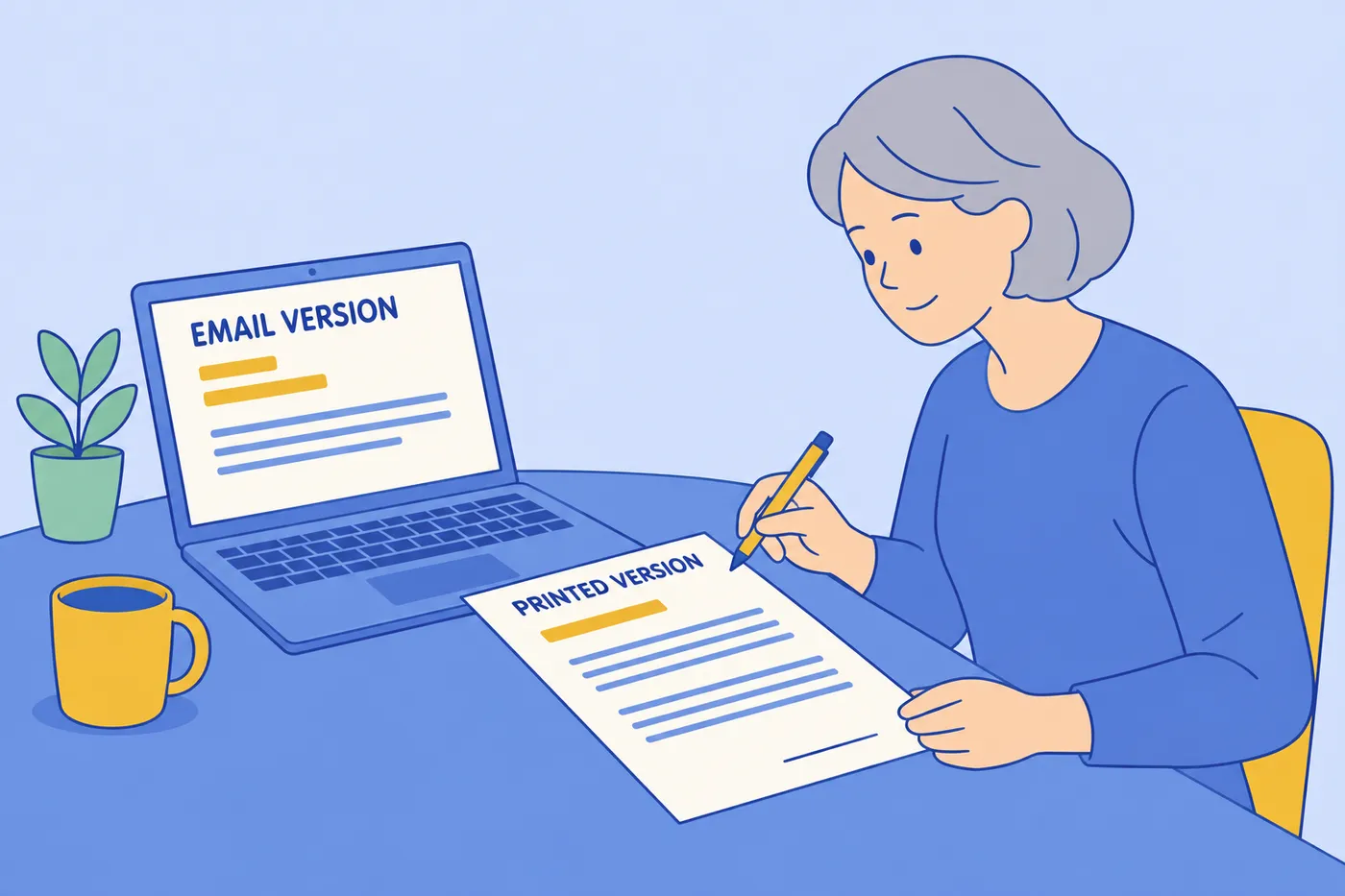
Part-time applications arrive through two channels the standard cover letter format wasn't built for: a small text box in an online application, and a paper handover at the counter. Each needs its own version of the letter.
| Version | Where it goes | Length | What changes |
|---|---|---|---|
| Full letter | Email attachment or upload field | Half a page to one page | Complete structure: opening, availability, proof, closing ask |
| Text-box version | The "anything to add?" or "cover letter" box in an online form | 3 to 5 sentences | Availability plus one proof point, no greeting or address block |
| Printed version | Handed in with a resume at the counter | Half a page | Full letter with a header matching your resume; ask for the manager by name when you hand it over |
The text-box version keeps only what decides the outcome. Compress it to this shape: role, availability, one proof point, ask. For the supermarket example above, that's roughly: "I'm applying for the part-time sales assistant role. I can work every Saturday and three weeknights from 5pm, up to 20 hours a week, with a fixed timetable until May. In my last role at a café I handled the till through weekend rushes for a year without a discrepancy. I'd welcome an interview and can start within a week." Four sentences, every one carrying weight.
The printed version follows the full letter but its delivery matters as much as its content. Ask whoever is at the counter for the hiring manager's name, and if the manager is available, hand it over yourself with one spoken line: your name, the role, and your headline availability. Print both the letter and the resume; save each as a PDF first so the formatting survives any printer.
If the posting asks about age or right to work
Some part-time postings, especially in retail and hospitality, ask applicants to confirm their age or their right to work. Answer in one factual line and move on: "I'm 17 and hold a valid work permit for my state," or "I have the right to work in the US with no restrictions." One sentence, no elaboration, placed at the end of the availability paragraph where it logically belongs.
Do not quote hour limits or permit rules in your letter, and do not rely on a blog post (including this one) for them. Rules for minors' working hours and student visa work allowances vary by state and country and change often. Check the current rules on your government's own website, the Department of Labor's youth employment pages in the US or the official immigration site for visa conditions, before you commit to hours in writing. Promising shifts a permit doesn't allow is worse than not applying.
Check the letter against the posting, then send a PDF
Before sending, hold the letter next to the posting and check four things: the role title matches exactly, your availability covers at least some of the shifts the posting names, the proof paragraph speaks to the top requirement listed, and the closing asks for a concrete next step rather than trailing off with "I look forward to hearing from you."
Chains and larger retailers run applications through an applicant tracking system (ATS), the software that stores and filters applications before a human reads them. Your letter and resume both need to survive that parse, which is one more reason to submit as PDF: it preserves your formatting exactly as you built it. The same check applies to the resume you send alongside the letter; checking your resume against the job description takes ten minutes and catches the keyword gaps that get applications filtered before anyone sees your availability.
This is where Roleframe fits if you want the process handled in one place. Paste the posting, and it scores your resume against it with a fit report naming the exact gaps, drafts a job-specific cover letter from your resume for you to edit, and exports both as clean PDFs. You approve every word before anything goes out, which matters more than it sounds: you'll be asked about your availability and your experience at the counter or in the interview, and the letter has to match what you'll say out loud.
Frequently asked questions
- Do I need a cover letter for a part-time job?
When the posting asks for one, yes, and skipping it filters you out immediately. When it's optional, a short letter still helps because it's the only place to state your availability upfront, which is the deciding factor in most part-time hiring. Even three sentences in an application text box, covering your available shifts and one proof point, puts you ahead of applicants who submitted a bare resume.
- How long should a cover letter for a part-time job be?
Half a page is right for most part-time roles, and never more than one page. For retail, café, and supermarket jobs, aim for three short paragraphs: why you're applying, when you can work, and why you'll be reliable. Managers reading part-time applications are doing it between other tasks, so a letter that makes its case in under a minute wins.
- What five things should a part-time cover letter include?
The role name and where you saw it, your specific availability (days, hours, and weekly total), one or two pieces of proof you'll be reliable, ideally with a number, your start date, and a direct closing ask for an interview. Availability is the one most applicants skip, and it's the one the manager is actually scanning for.
- How do I write a part-time cover letter with no experience?
Lead with availability, because it's the qualification you already have in full. Then build the proof paragraph from school, sports, or volunteering: attendance you kept, money you handled, busy events you worked. "I ran the ticket table at every home game for two seasons" proves punctuality and cash handling without a single day of paid employment. Cut any apology for the missing work history; the manager hiring for a first job expects one.
- Should I put a two-week job on my resume?
Usually no. A stint that short raises questions it can't answer in a bullet point, and leaving it off a part-time application creates no meaningful gap. The exception is when it's directly relevant recent experience, like two weeks of seasonal work at the same chain you're applying to. In that case, list it and label it as seasonal or temporary so the short duration explains itself.
- Should I explain why I want part-time hours instead of full-time?
One clause of context helps, a paragraph hurts. "As a second-year student" or "alongside my full-time role" tells the manager your part-time need is stable and your schedule is predictable, which is reassuring. A longer explanation about your studies, career plans, or personal situation adds nothing to the hiring decision and pushes your actual selling points down the page.
- Should I send the cover letter as a PDF or paste it into the application?
Do whichever the application asks for, and when there's a choice, attach a PDF. PDF keeps your formatting intact through applicant tracking systems and on whatever screen the manager opens it on. If the form only offers a text box, use a compressed version: role, availability, one proof point, and the ask, in three to five sentences with no greeting or address block.
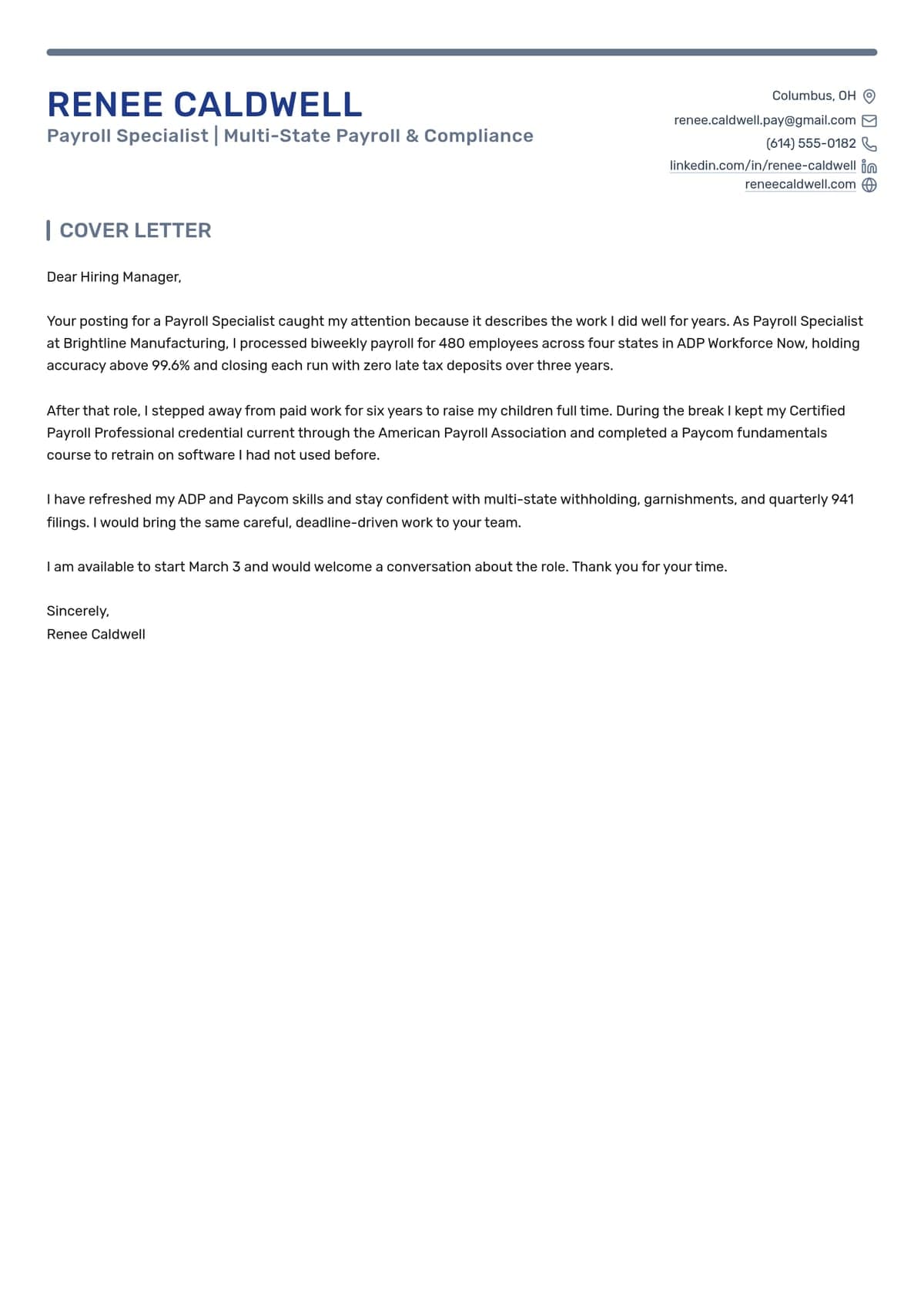
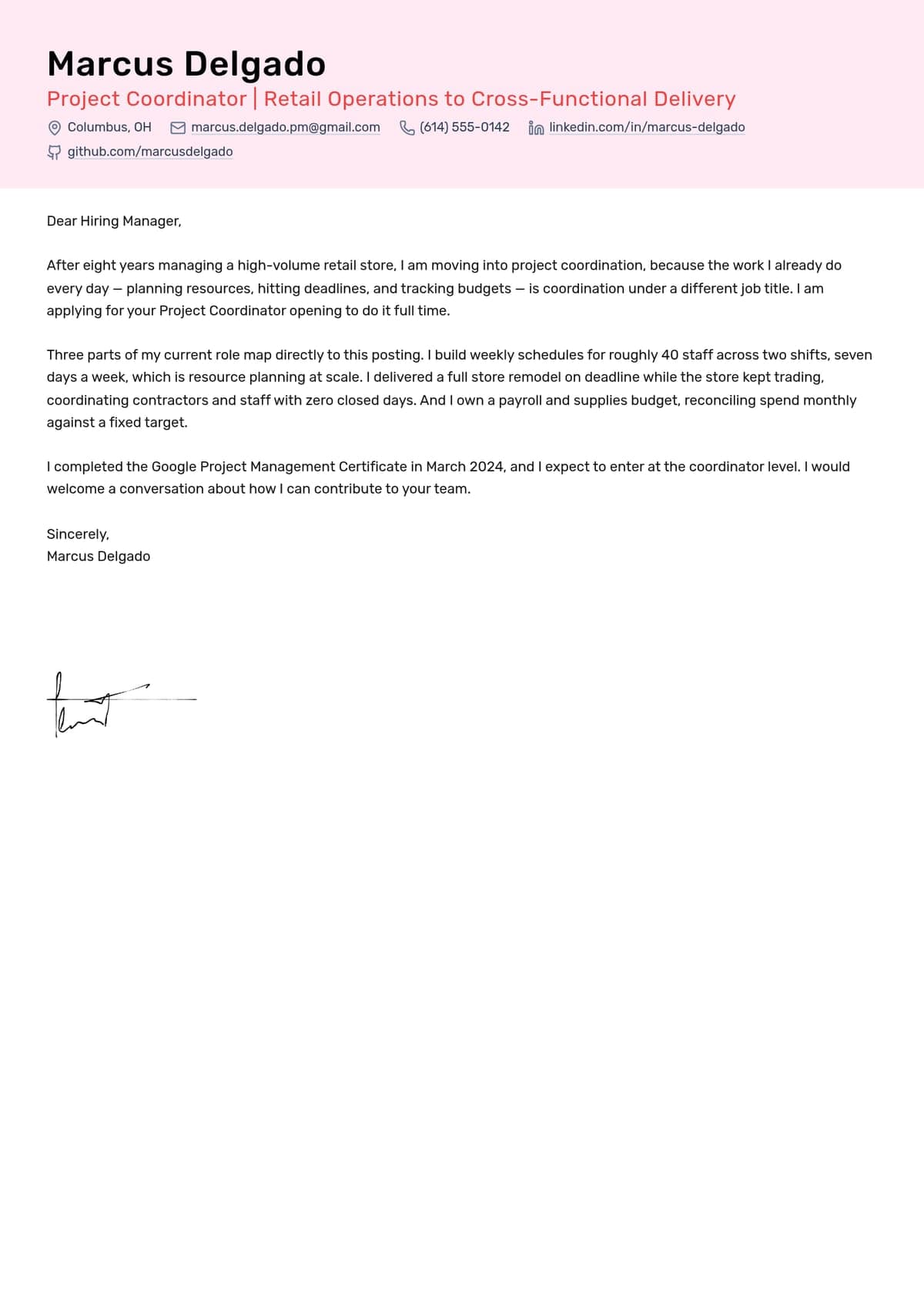

Write yours on the same template.
Every example here is built on a template you can open in the editor. Keep the structure that works and put your own story in it, or let Roleframe draft a first version from your resume and the job posting.


