Short Cover Letter Examples: Simple Letters Under 200 Words
by Larbi SahliPublished
A short cover letter example under 200 words, a fill-in simple cover letter template, and how to cut a long draft down without losing your proof.

Users have landed jobs at
- 1Password
- OpenAI
- Notion
- justworks
On this page
A short cover letter wins when it is specific. Three short paragraphs that name the job, give one real result, and ask for the interview will beat a full page of generic enthusiasm, because the person screening applications reads the first few lines and decides whether to keep going. For hourly jobs, entry-level roles, and quick-apply forms, short is not a compromise. It is the right format.
This page shows you a complete short cover letter under 200 words, breaks down what each paragraph is doing, walks through two more situations (a first job with no work history, and a letter sent as the body of an email), gives you a fill-in simple cover letter template for any position, and shows how to cut a 350-word draft down to under 150 without losing the proof that gets you the interview.
A short cover letter example under 200 words
Here is what a strong short letter looks like for someone with a few years of experience applying for a step up. The candidate is a warehouse associate going for a shipping lead role. Notice what the letter does in its limited space: it names the job in the first sentence, it puts numbers behind two claims, and it ends with a direct ask. Notice also what it skips: no life story, no paragraph about the company's values, no restating of the resume.
Marcus Delgado
Warehouse Associate | Shipping & Dock Operations
Dear Hiring Manager,
I've spent three years on the floor as a warehouse associate, and I'm applying for the Shipping Lead role because I'm ready to run a shift, not just work one. I already do a lot of what the lead does, and I want to make it official.
Over the past year I trained five new hires from their first day to full-speed picking, held a 99.8 percent pick accuracy rate across my zone, and ran the weekend dock schedule so outbound trucks loaded on time without a supervisor on site. When people call out, I'm the one who reworks the assignments and keeps orders moving.
I'd welcome the chance to talk in person about how I can lead your shipping team — could we set up an interview?
Sincerely,
Marcus Delgado

Count the sentences doing real work in the example above. Every one either matches the candidate to the posting or proves a claim with a number. That is the whole trick. "Trained five new hires" and "99.8 percent pick accuracy" tell a hiring manager more than three paragraphs of adjectives, and "ran the weekend dock schedule" answers the exact question a shipping lead posting is asking: has this person already done pieces of the job?
What to write in a short cover letter
A short cover letter has three paragraphs, and each one has a single job to do:
- Paragraph 1: the job and your best match. Name the exact job title and the company, then state in one sentence why you fit. Not everything about you. The one thing the posting asks for that you clearly have.
- Paragraph 2: one or two proof lines. A specific result from your current or most recent role, with a number if you have one. Trained people, hit an accuracy rate, handled a volume, covered a shift nobody else would. If you have two strong proofs, use two. If you have one, one is enough.
- Paragraph 3: the ask. One or two sentences. You want the interview, you are available, thank you. Done.
Nothing else goes in. No paragraph about your journey, no summary of your resume, no speculation about company culture. If a sentence does not match you to the job or prove something, cut it.
When short is the right choice
Short is the default for most applications, and the only sensible choice in four situations:
- Quick-apply forms. If the application has an optional text box for a note, a 100-to-150-word version of the three-paragraph structure is exactly what it is for. A full formal letter pasted into a form field reads as tone-deaf.
- Email applications. When you email a resume, the email body is the cover letter. Nobody opens an attachment called cover_letter.pdf when the email above it is blank, and nobody reads a long email either.
- Hourly and entry-level jobs. A store manager screening thirty applications for a cashier opening is not reading page-long letters. A short note that names the job and shows one real proof stands out precisely because most applicants send nothing, or send a template.
- Postings that ask for a brief note. Some postings say it outright: "include a short note about why you're interested." Believe them. Following the instruction is the first test.
A short cover letter for a first job
No work history does not mean no proof. Take a high school senior applying to be a grocery cashier. The three-paragraph structure holds; only the source of the proof changes.
Paragraph 1 names the job and the store, and states availability, because for a first job, availability is a qualification. "I'm applying for the part-time cashier position at your Elm Street store, and I'm available weekday evenings and all weekend" does more for this application than any sentence about being a hard worker.
Paragraph 2 pulls proof from school and volunteering. Handling the cash box for the school store proves you can count a drawer and be trusted with money. Sorting donations at a food bank every Saturday proves you show up on schedule when nobody is making you. These are real cashier qualifications, and a hiring manager reads them that way. What they are not is filler, so write them as specifics: how often, for how long, what you were responsible for.
Paragraph 3 is the same direct ask as any other letter. First-job applicants tend to end with an apology for their lack of experience. Don't. You gave your proof; ask for the interview.
A letter built this way lands between 120 and 170 words, which is exactly right. Students applying for internships face the same no-history problem with a slightly more formal register, and the internship cover letter examples show how that version differs.
The email version: when the letter is the email body
A line cook with four years of experience applying to a restaurant by email should not attach a formal letter. The email is the letter, and the format changes in three ways:
- The subject line does the naming. "Line cook application, [your name]" or the job title from the posting. A vague subject like "Job" or "Resume" gets skimmed past on a busy manager's phone.
- No address block, no date. Email carries that information already. Open with the greeting and get to the point in the first line.
- Even shorter. 100 to 150 words. The manager is reading this between services. Job named, best proof given (four years on the line, running the grill station on weekends, which are the highest-volume shifts), resume attached as a PDF, available for a stage or an interview.
The proof paragraph matters most here because kitchen hiring runs on specifics: which station, what volume, which shifts. "Weekend grill station lead" is a credential every chef understands instantly. If you are deciding which of your kitchen skills to name, the line and prep cook skills guide ranks what employers actually screen for.
Are short cover letters okay?
Yes, when they are specific. A 130-word letter that names the job and gives one real, verifiable result does more for you than 400 words that could have been sent to any employer. Hiring managers do not weigh cover letters by the pound. They scan for two things: did this person read the posting, and can they point to something they have actually done. A short letter that answers both questions is a complete letter.
The exceptions are structural, not stylistic. Some academic postings and many public sector applications ask you to address listed selection criteria point by point, and a UK-style civil service application or a university posting with "address the person specification" language means exactly that. In those cases the posting's instructions set the length, and a breezy 150-word note reads as a failure to follow directions. The same logic applies to a federal application, where the documents themselves follow different rules. Everywhere else, short and specific wins.
A simple cover letter template for any position
This basic cover letter template works for any job. The bracketed parts in bold are the three slots that must change for every single application: the job title and company, the one result that matches this posting, and the reason for this employer. Everything else can stay stable.
Dear [hiring manager's name, or "Hiring Manager"],
I'm applying for the [exact job title] position at [company]. My [years of experience / current role] fits what the posting asks for, especially [the requirement you match best].
In my [current or most recent role] at [employer], I [one specific result, with a number if you have one]. [Optional second proof line, one sentence.]
I'd like to bring that to [company] because [one concrete reason for this employer: the shift, the location, the product, the step up]. I'm available for an interview at your convenience. Thank you for your time.
[Your name]
[Phone] · [Email] is how it closes, with your resume attached as a PDF.
One warning. A letter sent unchanged to twenty employers reads exactly like a letter sent unchanged to twenty employers. The three bold slots are not optional polish; they are the letter. "Your company" instead of a name, or a proof line that fits any job on earth, tells the reader you spent thirty seconds on this, and they will spend less than that on you.
How to make a long cover letter short
Most long cover letters are a short letter with three kinds of padding wrapped around it. Take a typical 350-word draft and cut it in passes, and watch what leaves: nothing the hiring manager needed.
| Step | What you cut | Why it goes | Words left |
|---|---|---|---|
| Start | Nothing yet | A 350-word draft: intro, a resume walkthrough, company praise, two examples, a long close. | ~350 |
| Pass 1 | The paragraph that restates the resume ("As my attached resume shows, I have held positions at...") | The resume is attached. Repeating it wastes the reader's time twice and proves nothing new. | ~250 |
| Pass 2 | The generic company praise ("I have long admired your commitment to excellence and innovation...") | It fits every company, so it flatters none. If you have a real, specific reason for this employer, one sentence covers it. | ~195 |
| Pass 3 | The weaker of your two examples, plus the throat-clearing close ("I believe my skills and passion would make me a valuable asset...") | One strong proof beats two diluted ones, and the close needs one sentence: the ask. | ~145 |
What survives the cuts is the short letter that was always hiding inside the draft: the job named, your best proof, and the ask. The discipline transfers to everything else you write in a job search, including your resume bullets, where the same restated-and-padded problem shows up as buzzwords doing the work numbers should do.
How short is too short?
A cover letter has a floor, and it is lower than most people think but not zero. The minimum viable letter contains five things: a greeting, the exact job named, one piece of proof, one ask, and a sign-off with your name. That can fit in 60 words. Below that, you are not sending a short letter; you are sending a signal that you didn't try.
Here is one that fails: "Hi, I saw your posting and I'm very interested. My resume is attached, let me know if you have questions. Thanks!"
Every element is missing. Which posting? No job title, so it reads as a mass send. Why you? No proof, so there is nothing to evaluate. What do you want? "Let me know" is not an ask. The tone is a text message, which is fine for a friend and wrong for a stranger deciding your income. Two more sentences would have fixed all of it.
The four mistakes that sink short letters, in the order they get applications rejected:
- No job title. The reader may be hiring for four roles. Name yours in the first sentence.
- No proof. "Hard-working team player" is a claim anyone can make. One number or one concrete responsibility is evidence.
- Text-message tone in a professional email. No greeting, lowercase everything, "thx." Short does not mean casual.
- A letter built for any job. If your letter would work unchanged for a different employer, it is not finished.
What makes a strong opening sentence
The strongest opening sentence does two jobs at once: it names the position and it attaches your single best qualification to it. Each of the three situations on this page opens the same way, with details swapped:
- Experienced, stepping up: "I'm applying for the shipping lead position at [company], where my three years on the floor and my experience running the weekend dock schedule match what you're looking for."
- First job: "I'm applying for the part-time cashier position at your [location] store, and I'm available every weekday evening and all weekend."
- Email application: "I'm a line cook with four years of experience, currently leading the weekend grill station at [restaurant], and I'd like to apply for the line cook opening you posted."
None of these opens with "To whom it may concern, I am writing to express my interest." That sentence tells the reader nothing and costs you the only line you can be sure gets read. Put the job and your best fact first, and the rest of the letter just has to back it up.
Finish it in the next ten minutes
You now have the structure, a rendered example, and a template with three slots to fill. The fastest honest path from here: write your three paragraphs, read them once asking "does every sentence match or prove," cut what doesn't, and send it as a PDF, or as the email body if you're applying by email. If you want a tool for it, there are free cover letter builders that need no sign-up, and hourly applicants can borrow the availability framing from the part-time job cover letter example.
Frequently asked questions
- What do you write in a short cover letter?
Three short paragraphs. First, name the exact job title and company, plus the one qualification of yours that best matches the posting. Second, give one or two proof lines: a specific result from your work, school, or volunteering, with a number if you have one. Third, ask for the interview and say when you're available. A greeting at the top, your name and contact details at the bottom, and nothing else.
- Is a 150-word cover letter too short?
No. A 150-word letter that names the job and includes one real, specific proof is a complete cover letter, and for hourly, entry-level, and quick-apply situations it is the ideal length. The floor is lower than the length: what makes a letter too short is a missing job title, missing proof, or a missing ask, not a low word count.
- Are short cover letters unprofessional?
The opposite, in most hiring. A short, specific letter respects the reader's time and shows you can identify what matters. The exceptions are applications that explicitly ask you to address listed criteria, common in academic and public sector hiring, where the posting's instructions set the length. Follow the posting; everywhere else, short and specific wins.
- Should the cover letter be the email body or an attachment?
When you apply by email, write the letter as the email body and attach only your resume, as a PDF. A blank email with two attachments makes the reader do extra work, and many never open the letter file. Keep the email version to roughly 100 to 150 words and put the job title in the subject line.
- What are the most common cover letter mistakes?
Five show up constantly: restating the resume instead of adding proof, generic praise of the company that fits any employer, no job title in the first sentence, claims with no evidence behind them ("hard-working team player"), and sending the identical letter to every job. A short letter avoids the first two by having no room for them; the last three you have to catch yourself.
- What's a good opening sentence for a cover letter?
Name the position and attach your best qualification to it in the same sentence: "I'm applying for the shipping lead position at [company], where my three years on the floor and experience running the weekend schedule match what you're looking for." Avoid "To whom it may concern" and "I am writing to express my interest," which spend your most-read line saying nothing.
- Can I send the same short cover letter to every job?
You can reuse the structure and most of the sentences, but three things must change every time: the job title and company name, the proof line you lead with (pick the one that matches this posting best), and your reason for this specific employer. A letter with those three slots updated takes about five minutes and reads as written for the job. A letter without them reads as spam, however good the template was.

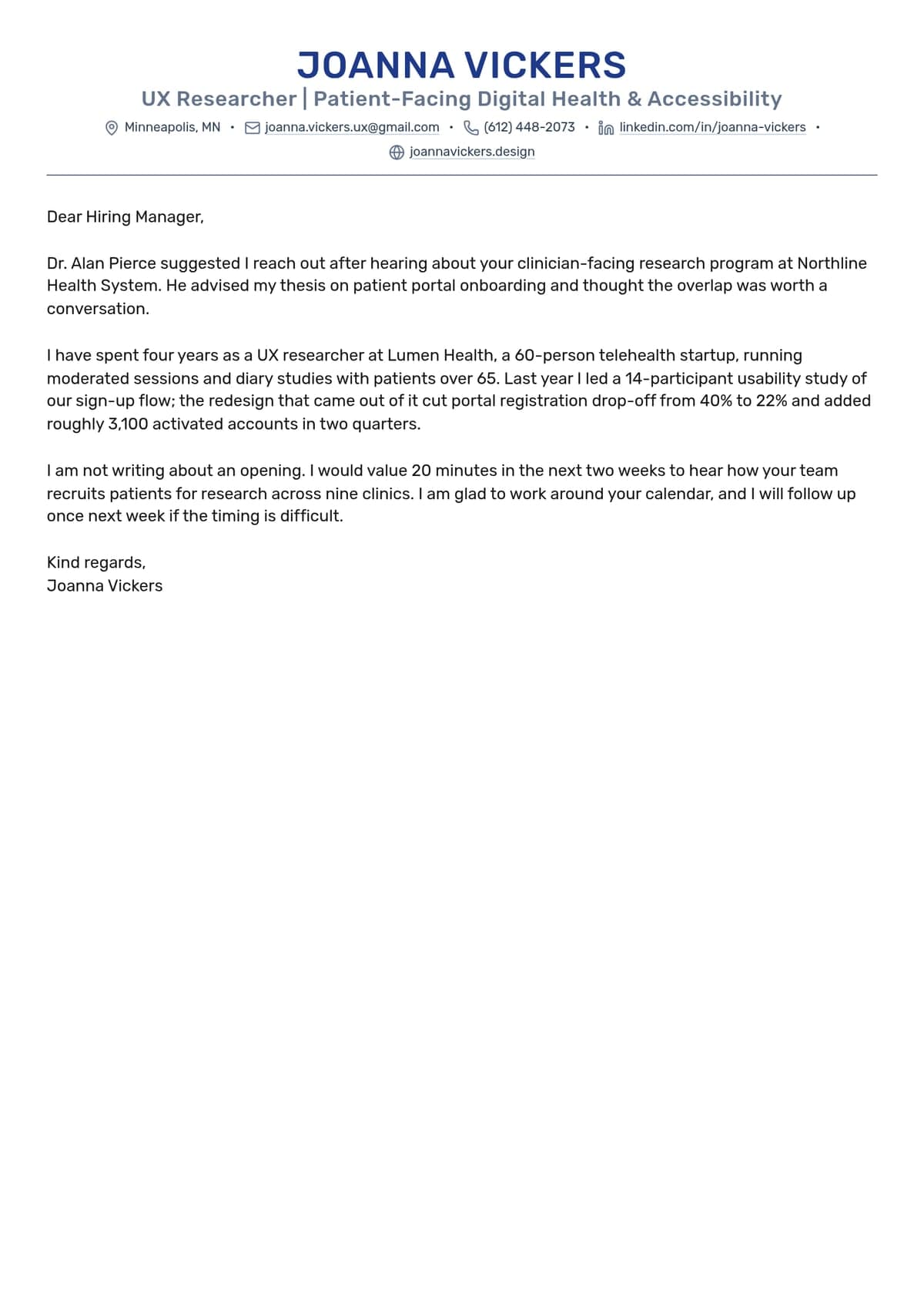

Write yours on the same template.
Every example here is built on a template you can open in the editor. Keep the structure that works and put your own story in it, or let Roleframe draft a first version from your resume and the job posting.


