Cover Letter Examples for Internship Applications (5 Fields Compared)
by Larbi SahliLast Updated
Internship cover letter examples for software engineering, finance, marketing, research, and nonprofit roles, with the exact sentences that change per field.
Users have landed jobs at
- 1Password
- OpenAI
- Notion
- justworks
On this page
An internship cover letter has one job: convince someone you can do work you have never been paid to do. That is a different problem from a normal cover letter, and the generic samples floating around university career sites mostly ignore it. They tell you to "express enthusiasm" when what the recruiter actually needs is evidence.
This page takes a different approach. Instead of one all-purpose sample, it breaks down what a strong internship letter looks like in five fields: software engineering, finance, marketing, a research lab, and a nonprofit. The skeleton of the letter stays the same across all five. What changes is a handful of specific sentences, and once you see exactly which ones, you can write a tailored letter for any internship posting in under an hour.
Below is a full software engineering internship letter you can study line by line. After it, we walk through every paragraph, then show precisely which sentences you swap for finance, marketing, research, and nonprofit applications.

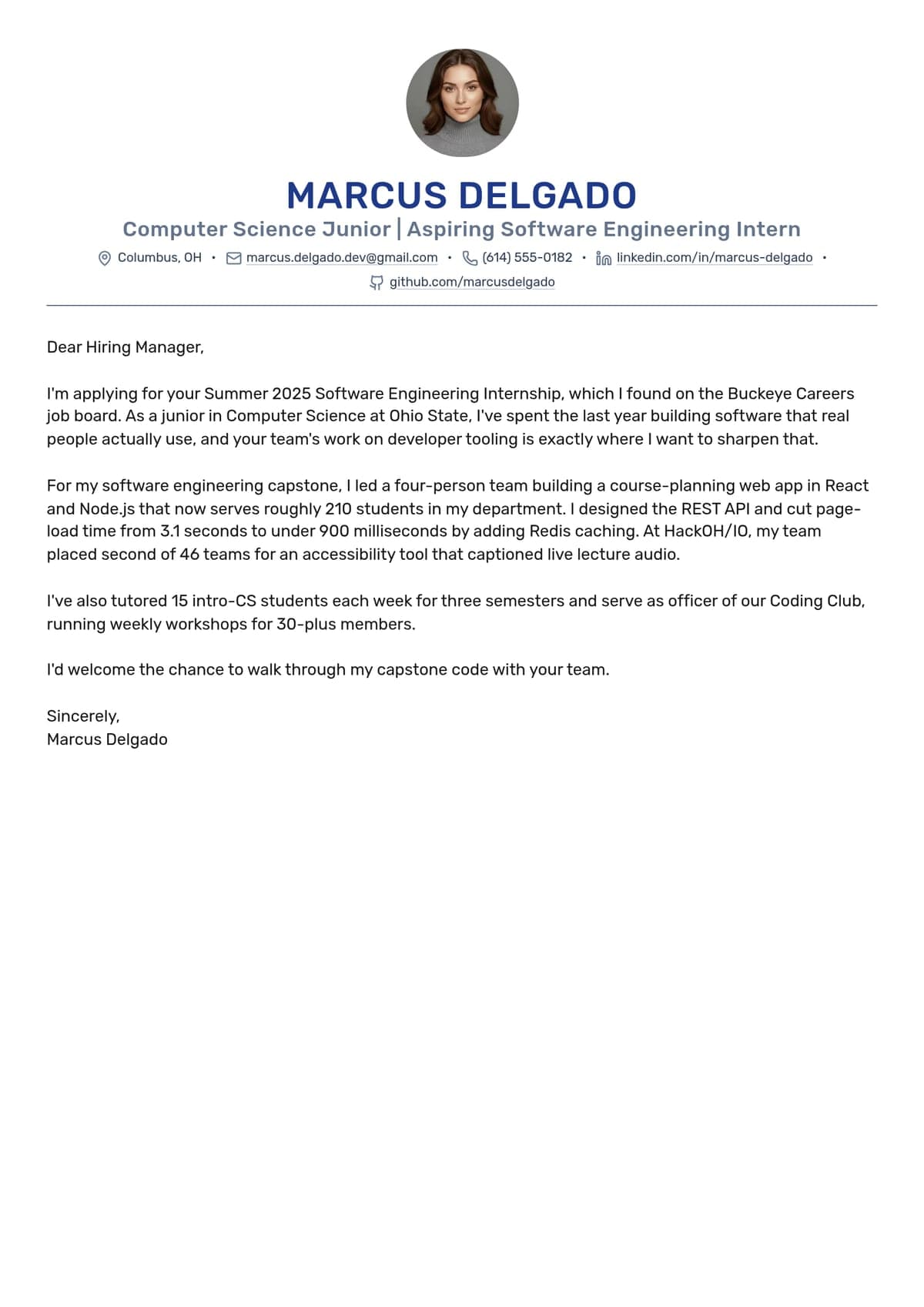
Marcus Delgado
Computer Science Junior | Aspiring Software Engineering Intern
Dear Hiring Manager,
I'm applying for your Summer 2025 Software Engineering Internship, which I found on the Buckeye Careers job board. As a junior in Computer Science at Ohio State, I've spent the last year building software that real people actually use, and your team's work on developer tooling is exactly where I want to sharpen that.
For my software engineering capstone, I led a four-person team building a course-planning web app in React and Node.js that now serves roughly 210 students in my department. I designed the REST API and cut page-load time from 3.1 seconds to under 900 milliseconds by adding Redis caching. At HackOH/IO, my team placed second of 46 teams for an accessibility tool that captioned live lecture audio.
I've also tutored 15 intro-CS students each week for three semesters and serve as officer of our Coding Club, running weekly workshops for 30-plus members.
I'd welcome the chance to walk through my capstone code with your team.
Sincerely,
Marcus Delgado
What an internship letter has to prove when you have no experience in the field
Recruiters screening intern applications are not looking for experience. They know you do not have it. They are looking for three things, and your letter should be built around proving each one.
- Evidence you can already do a junior version of the work: a class project, a lab assignment, a competition entry, a personal project with something real to show.
- Evidence you actually want this internship, at this company, and did not paste the same letter into forty portals. One sentence that could only be written about this employer does the job.
- Evidence you are reliable: you showed up somewhere, repeatedly, with responsibility. A campus job, a tutoring gig, a society treasurer role all count.
Most student letters fail on the first point. They spend three paragraphs on enthusiasm and personality, then hope the transcript carries the rest. Flip that ratio. Enthusiasm gets one sentence; evidence gets the longest paragraph in the letter.
The second point matters more than students expect. Intern hiring is high-volume, and the fastest way a recruiter cuts the pile is by dropping every letter that could have been sent anywhere. A letter that names the company's product, a recent launch, or the specific team is instantly in the smaller pile.
The opening paragraph: program name, term, and how you found the posting
The first paragraph of an internship letter is administrative, and that is fine. Intern programs run on cohorts, terms, and requisition numbers, and the coordinator reading your letter may be sorting applicants across several programs at once. Make their job easy in your first two sentences.
A complete opening covers four facts: the exact program name as the posting writes it ("Software Engineering Intern, Summer 2026", not "a software internship"), the term you are applying for, the requisition or job ID if the posting shows one, and where you found it. That last one is not filler. "I found this role through the campus recruiting session Ms. Alvarez ran at Purdue in October" tells the recruiter you were in the room, and it gives them a colleague's name to anchor you to.
Then add one sentence of who you are: your year, your major, your school. That is the whole opening. Four to five sentences, no life story, no "ever since I was a child." Compare the two versions:
- Weak: "I am writing to express my strong interest in an internship opportunity at your esteemed company."
- Strong: "I am applying for the Software Engineering Intern position (req 4471) for Summer 2026, which I found through the University of Michigan engineering career fair. I am a junior studying computer science with a focus on distributed systems."
The weak version could open a letter to any company on earth. The strong version proves you read the posting, which already puts you ahead of most of the pile.
The evidence paragraph: coursework, projects, labs, and competitions
This is the paragraph that gets you the interview, so give it the most space and the most specificity. The rule: one project, told properly, beats five projects listed. Pick the single strongest thing you have built, analyzed, or produced, and give it four sentences: what it was, what you specifically did, what tool or method you used, and what the outcome was.
What counts as evidence, roughly in order of strength:
- A project with a real outcome outside the classroom: an app with actual users, a club website you maintain, an analysis a professor used, a competition placement.
- A capstone or major course project where you owned a defined piece. Name your piece, not the group's. (If it belongs on your resume too, here is how to list a capstone project properly.)
- A lab or research assignment where you ran a real method: a titration series, a regression on real data, a literature review with a named professor.
- Coursework alone, if it maps directly to the posting's requirements. "My data structures and databases courses covered SQL and query optimization, which your posting lists as core to the team's work" is thin but usable.
Numbers rescue thin material. "Built a study-group matching app" is forgettable. "Built a study-group matching app that 120 students in my dorm used during finals week" is a fact a recruiter repeats to the hiring manager. Users, rows of data, competition rank, budget managed, attendance at an event you ran: any honest number works.
One warning: mirror the posting's language, not your syllabus's. If the posting says "data analysis in Python," write "data analysis in Python," not "STAT 3200: Statistical Computing." The recruiter searches for the posting's words, and so does the applicant tracking system (ATS) behind the portal. If you want to see which of the posting's terms your materials are missing, pulling keywords from the job description takes ten minutes and works for the letter as well as the resume.
The software engineering internship letter, paragraph by paragraph
Look back at the example above and notice what each paragraph is doing, because the structure is the reusable part.
Paragraph one handles the administrative facts: program name, term, requisition number, source, and one sentence of identity. Nothing else. It ends before the recruiter's attention does.
Paragraph two is the evidence paragraph, and for a software role it is built on a project, not a course list. It names the stack, states what the candidate personally built, and lands on an outcome someone can verify: real users, a hackathon placement, a public repository. For engineering internships specifically, a GitHub link is close to mandatory, and it belongs in your header as well as your resume. Where to put your GitHub link covers the details, but the short version is: make it one click away, and make sure the pinned repos are the ones you would want opened.
Paragraph three is short and does the reliability work: a campus job or club role, framed for what it proves rather than what it was. Tutoring proves you can explain technical ideas to a confused audience, which is most of code review. A club officer role proves you can be trusted with something that breaks if you flake.
Paragraph four closes with a specific ask. "I would welcome the chance to talk about how my capstone work maps to the team's stack" beats "I hope to hear from you at your earliest convenience" every time, because it gives the reader a concrete reason to say yes.
If you are also building the resume side of this application, the entry-level software engineer resume example pairs with this letter, and there are more software engineer cover letter examples for full-time roles when you get there.
The finance internship letter: three sentences change
Here is the useful secret of internship letters: moving from software engineering to finance does not mean rewriting the letter. The skeleton, the opening structure, the reliability paragraph, and the close all survive intact. Three sentences change, and they are all in predictable places.
The identity sentence. The engineering version names a major and a technical focus. The finance version names the major plus the credential-track signal finance recruiters scan for: relevant coursework (financial accounting, corporate finance, valuation) and, if it is strong, your GPA. Finance is one of the few fields where GPA still gets screened early, so if yours helps, state it. If you are unsure, when GPA helps and when it hurts applies to the letter the same way it applies to the resume.
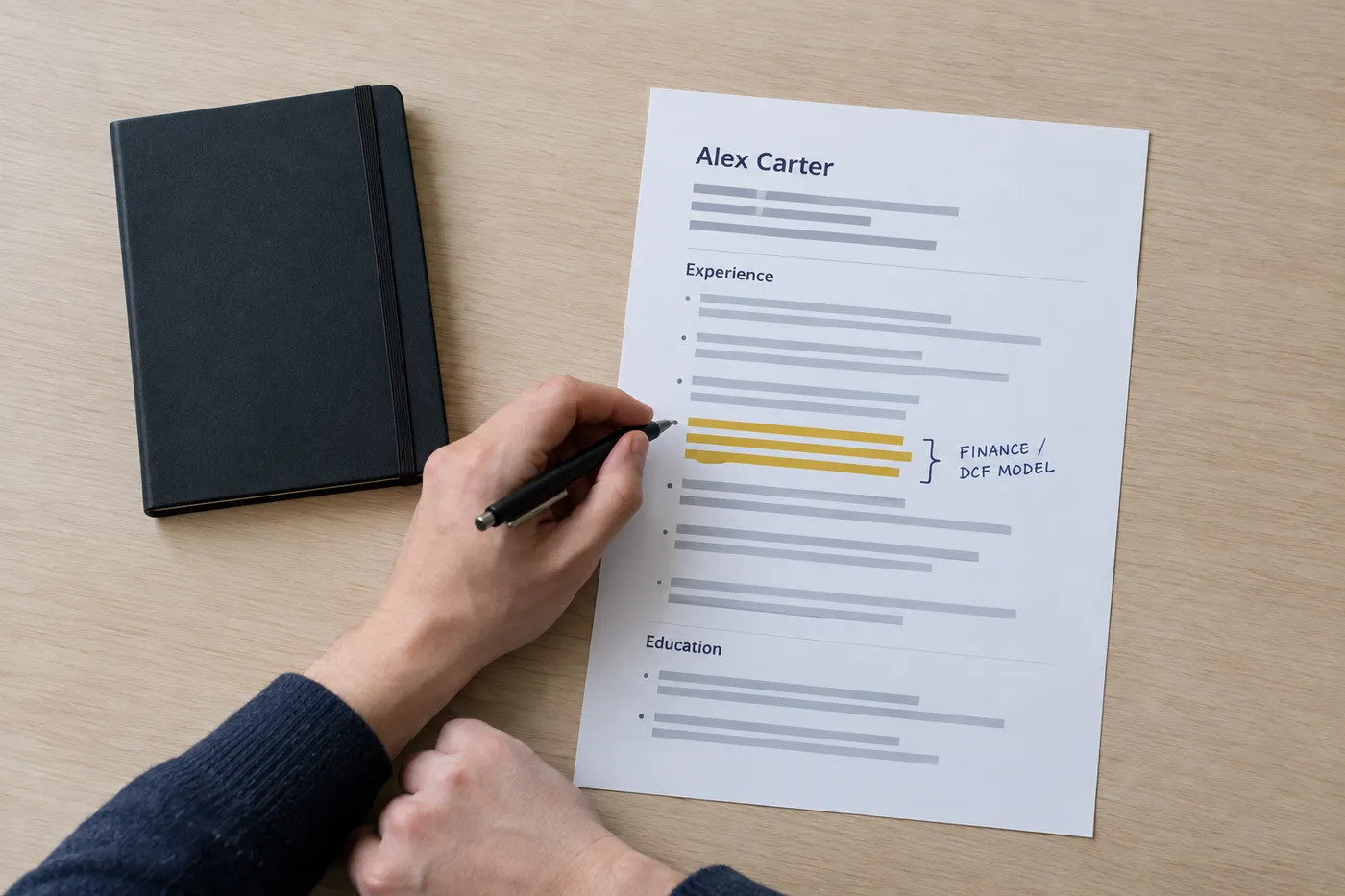
The evidence sentence. Instead of a shipped project, finance evidence is an analysis: a stock pitch for an investment club, a case competition, a valuation model built in a corporate finance course, managing a student fund's position. The winning shape is the same as engineering's: what you analyzed, what method you used (DCF, comparables, three-statement model), and what came of it. "I built a three-statement model for our investment club's pitch on a mid-cap industrial, and the club took the position" is a complete piece of evidence in one sentence.
The motivation sentence. Finance recruiters, especially in banking and asset management, test for informed interest harder than any other field. "I am drawn to your firm's culture" gets deleted. A sentence naming the group, the kind of deals or coverage it does, and why that specific work interests you is the price of entry. If you are aiming at banking specifically, the investment banker cover letter examples show what that sentence looks like at full-time level; the intern version is the same sentence with humbler evidence behind it.
Everything else in the letter carries over unchanged. That is worth internalizing, because it means applying to a finance internship and a software internship in the same week is not two writing projects. It is one letter and six edited sentences.
Marketing, research lab, and nonprofit letters: what each field swaps in
The same three-sentence pattern holds for the remaining fields. Each has one distinctive move the other fields do not use.
Marketing: the portfolio link
Marketing internships are won by shown work, so the distinctive move is a link, placed in the evidence paragraph, to something the recruiter can see in thirty seconds: a campus event's Instagram you ran, a newsletter you write, a class campaign deck, a blog. The evidence sentence pairs the link with a number: "I ran the marketing club's Instagram for two semesters and grew it from a dead account to the channel that filled our 200-seat speaker events." Growth, attendance, and engagement are all numbers a student can honestly own. If you have no public work yet, a course campaign project with a stated result stands in. For tone and structure one level up, the marketing coordinator cover letter examples are the closest full-time reference.
Research lab: name the faculty supervisor and the methods
A research internship letter is read by a scientist, not a recruiter, and scientists read for two things: whose lab trained you, and which methods you can run without supervision. So the distinctive move is naming names. "I have worked in Professor Okafor's microbiology lab since sophomore year, where I run PCR and gel electrophoresis independently" answers both questions in one sentence. Add one sentence connecting your interest to the target lab's actual published work, which means reading at least the abstracts before you write. Enthusiasm for "research" in general reads as not having done any.
Nonprofit: mission fit is evidence, not decoration
Nonprofit hiring managers screen hard for mission fit because interns who do not care burn out on unglamorous work fast. The distinctive move is proving the fit with something you already did, unpaid, before this application existed: volunteering at a related organization, organizing a fundraiser, running a mutual aid effort in your dorm. "I care deeply about food insecurity" is a claim. "I coordinated volunteer shifts for our campus food pantry for three semesters" is evidence. If your history connects to the organization's specific cause, that sentence goes first in the evidence paragraph, ahead of coursework.
Side by side: the sentences that change across all five fields
| Field | Evidence sentence built on | Field-specific move | What the close asks about |
|---|---|---|---|
| Software engineering | A shipped project or hackathon result, with stack named | GitHub link, one click from the header | How your project maps to the team's stack |
| Finance / accounting | A pitch, model, or case competition, with method named | GPA and coursework stated up front; group named precisely | The group's specific coverage or deal type |
| Marketing | A channel or campaign you ran, with a growth or attendance number | Portfolio or live-work link in the evidence paragraph | A campaign or channel the company actually runs |
| Research lab | Methods you run independently, with the training lab named | Faculty supervisor named; target lab's work referenced | A specific project or paper from the lab |
| Nonprofit | Unpaid work you already did for the cause | Mission fit proven with past action, placed first | The program area you would support |
Read the table column by column and the pattern is obvious: every field wants the same letter with different proof. That is why the fastest way to write five tailored applications is to write one strong letter and maintain a swap list, not to start from a blank page five times.
Campus jobs, tutoring, and society roles: the paragraph most students waste
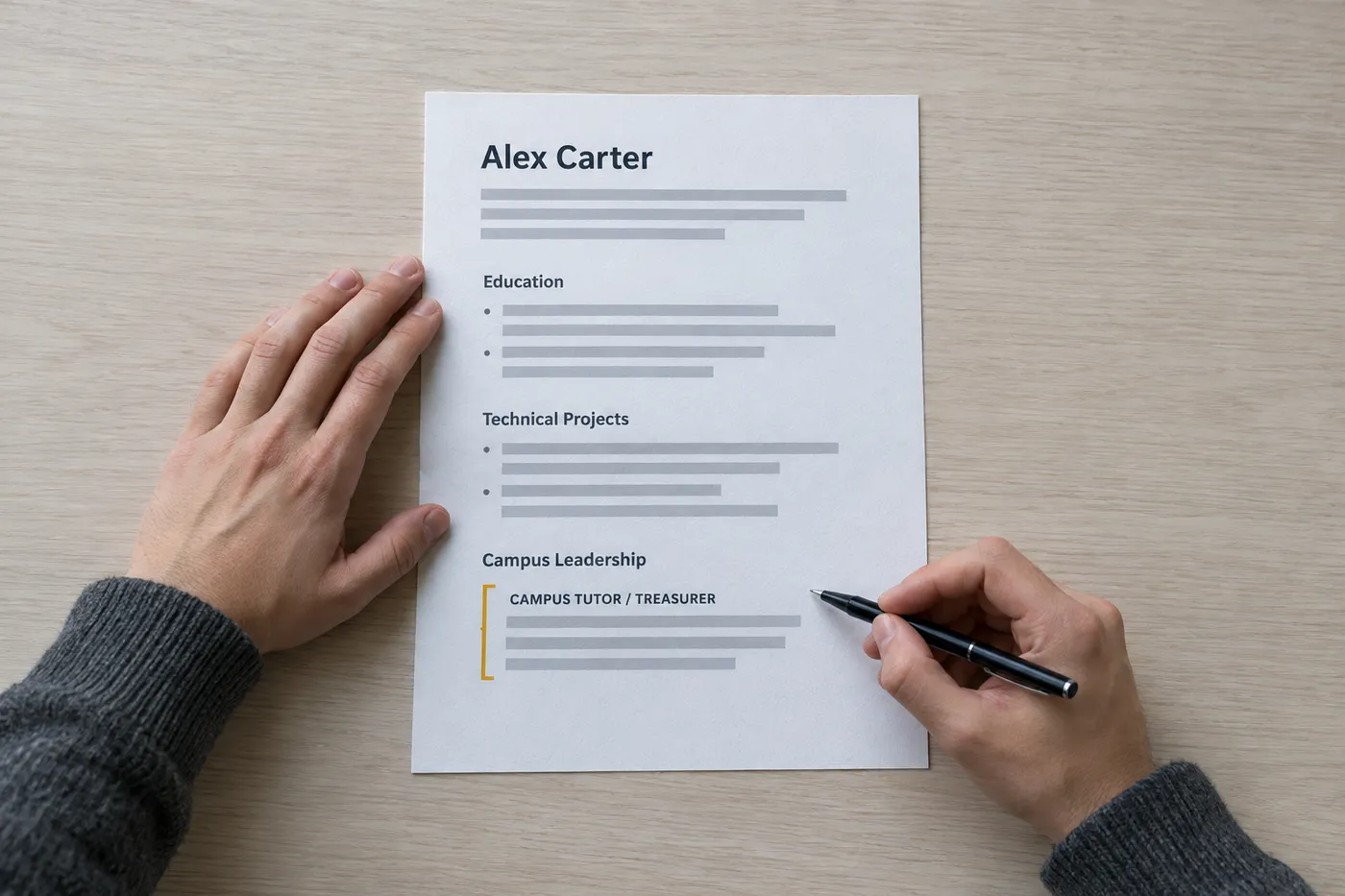
The third paragraph exists to answer an unspoken question: will this person show up? Students either skip it, assuming a dining hall job is beneath mention, or bloat it into a second resume. Both are mistakes. The right move is one short paragraph that stacks two or three commitments and frames each for what it proves.
The framing is the whole trick. Nobody cares that you shelved library books; they care that you held the same job for two years, which is the strongest reliability signal a 20-year-old can offer. Translate each role:
- Tutoring or TA work proves you can explain hard things clearly, a skill every field on this page lists.
- A cash-handling or shift job proves trustworthiness and punctuality under a manager who was not your parent.
- A society officer role (treasurer, events lead, editor) proves you ran something with real consequences for dropping it.
- Summer jobs prove stamina and the ability to work with people you did not choose.
Three sentences, maximum four, then move to the close. If you have a genuinely strong item here, like managing a club budget in the thousands, promote its number into the sentence. Otherwise keep this paragraph brisk. It is a supporting witness, not the star.
Deadlines, length, and the file the recruiter actually sees
Apply early, and treat the posted deadline as fiction. Many intern programs review on a rolling basis and fill seats before the deadline passes, especially in finance and tech. The letter you send in week one competes with a small pile; the same letter at the deadline competes with the whole applicant pool. Being early is the cheapest advantage in intern recruiting.
One page, and realistically less. Three to four paragraphs, somewhere around 250 to 350 words. A student letter that runs long signals padding, because the reader knows you do not have a decade of material. Short letters with dense evidence read as confident.
PDF, always, unless the portal explicitly demands otherwise. A PDF renders identically on every machine; a Word file can reflow, break, or open with tracked changes you forgot about. Save the letter as a PDF and check it once after export.
Name the file like the recruiter will see it, because they will. "coverletter_final_v3 (2).pdf" sits in their download folder telling a small story about you. Use Firstname-Lastname-Cover-Letter-CompanyName.pdf. Same convention for the resume. It takes ten seconds and it is one of the few parts of the application where perfection is free.
Match the letter to the resume. Same header, same fonts, same contact details. A mismatched pair looks assembled from parts, which, to be fair, it usually was. If you build both in the same editor this problem disappears; Roleframe's resume and cover letter editor is free to use without an account and exports a clean, unwatermarked PDF, which for a student budget is the correct price.
Check your letter against the posting before you send it
The single most common failure in intern applications is a letter written once and sent everywhere. The fix is a five-minute check per application: put your letter next to the posting and confirm three things. The program name and term match the posting's wording exactly. Your evidence paragraph uses at least two or three of the posting's own key terms. And one sentence in the letter could not have been written about any other company.
If you want that check done systematically, paste the posting into Roleframe and it will draft a job-specific cover letter for you to edit, and show you which of the posting's keywords your materials cover and which are gaps. You edit and approve everything yourself, which matters, because a recruiter can smell an untouched machine letter, and you will be asked about its claims in the interview. The guide to AI cover letter generators explains why most tools get this wrong and what a draft-then-edit workflow looks like instead.
Frequently asked questions
- What should I write in a cover letter for an internship?
Four paragraphs. An opening that names the exact program, term, requisition number, and how you found it, plus one sentence on your year and major. An evidence paragraph built on your single strongest project, course, lab, or competition, with a specific outcome. A short paragraph stacking campus jobs, tutoring, or club roles as proof of reliability. A close with a specific ask about the team's work. Total length around 250 to 350 words.
- How do I write an internship cover letter with no experience?
Stop treating coursework and projects as second-rate evidence. A capstone with a named outcome, a case competition placement, a lab method you run independently, or a club channel you grew are all real proof of ability, and intern recruiters expect exactly this kind of material. Tell one piece of evidence properly, with a number, instead of listing everything you have touched. Then use a short paragraph of campus jobs and society roles to prove reliability.
- What are the most common internship cover letter mistakes?
Five show up constantly: a letter so generic it could go to any company, an opening that starts with childhood passion instead of the program name, listing courses instead of showing one project with an outcome, running past one page, and sending a file named something like final_v3.pdf. Every one of them is fixable in minutes, and fixing the generic-letter problem alone puts you ahead of most of the pile.
- How do I answer 'what are you looking for in an internship'?
Name three things and make them specific to the role: a defined skill you want to build (say, working in a production codebase or building live financial models), exposure to how the field actually operates day to day, and mentorship from people doing the job you want. Avoid answers about resume-building or 'seeing if I like it,' which tell the interviewer you are shopping rather than committing.
- Should an internship cover letter mention GPA?
Depends on the field and the number. Finance, consulting, and some engineering programs screen on GPA early, so if yours is strong, put it in the opening paragraph's identity sentence. If it is middling, leave it out of the letter and let the transcript speak when asked. Marketing, nonprofit, and most startup internships care far more about shown work than about the number.
- How long should an internship cover letter be?
One page at most, and closer to half or two-thirds of a page in practice: three to four paragraphs, roughly 250 to 350 words. Recruiters skim intern letters in seconds on the first pass, so a short letter dense with evidence beats a long one padded with enthusiasm. If a sentence does not prove ability, interest, or reliability, cut it.
- What file format should I use for an internship cover letter?
PDF, unless the application portal explicitly requires something else. A PDF looks identical on every device; other formats can reflow or break. Name the file Firstname-Lastname-Cover-Letter-CompanyName.pdf, because the recruiter sees the file name before they see a word you wrote, and match the letter's header and fonts to your resume so the pair reads as one application.
- Can I use the same cover letter for every internship application?
You can reuse the skeleton, and you should, but never the whole letter. As the comparison on this page shows, moving between fields changes only a handful of sentences: the identity line, the evidence sentence, and the motivation sentence. Between companies in the same field, even less changes. Budget fifteen minutes of editing per application. Recruiters delete the letters that clearly got zero.


Write yours on the same template.
Every example here is built on a template you can open in the editor. Keep the structure that works and put your own story in it, or let Roleframe draft a first version from your resume and the job posting.


