
Entry-Level Software Engineer Resume Example & ATS Guide
by Larbi SahliLast Updated
A complete entry level software engineer resume example, plus the ATS keywords junior SWE postings actually filter for and how to structure every section.

On this page
The hardest resume you will ever write is your first one. You have an internship or two, a handful of projects, a degree that is not finished or barely is, and you are competing against hundreds of applicants for every junior opening. The recruiter screening that pile spends seconds per resume, and before a human even looks, an applicant tracking system (ATS) has already parsed yours and matched it against the posting's keywords.
The good news: most entry-level software engineer resumes are bad in the same fixable ways. They bury projects at the bottom, describe internships as coursework, list twenty technologies with no evidence for any of them, and open with a summary that says "passionate about coding." Fix those four things and you are ahead of most of the pile. This guide shows you how, with a full example resume and the specific keywords junior software engineer postings filter for.
What makes a winning entry-level software engineer resume
A recruiter reading a junior software engineer resume is answering one question: can this person write production code, or have they only followed tutorials? Everything on the page should feed that answer.
Three things separate the resumes that get callbacks from the ones that don't:
- Evidence of shipped code. A deployed project with real users, an internship feature that made it to production, an open-source contribution that got merged. "Shipped" beats "studied" every time, even at small scale.
- Numbers wherever they honestly exist. "Built a REST API" is a claim. "Built a REST API serving 3 endpoints used by a 5-person team's internal dashboard" is evidence. Junior candidates skip numbers because their numbers feel small. Small numbers still beat no numbers.
- Keyword alignment with the actual posting. ATS filters and recruiter searches run on specific terms: languages, frameworks, and practices named in the job description. If the posting says Python and Git and your resume says neither, you may never be seen, regardless of how good your projects are.
Notice what is not on that list: a long work history. Nobody expects one at this level. What hiring managers expect is proof that the fundamentals stuck (data structures, version control, debugging) and that you can function on a team. Your internships, projects, and coursework carry that proof if you frame them right.
Entry-level software engineer resume example
Here is a complete example for a recent computer science graduate moving from an internship into a full-time role. Read it once top to bottom, then come back to it as each section below explains the choices it makes.
Kevin Tran
Entry-Level Software Engineer | Full-Stack Web & REST APIs

Summary
Built and deployed a REST API serving 8 endpoints for 300+ campus users during a summer internship, cutting page load latency by 35%. Recent Computer Science graduate fluent in Python, JavaScript, and React, with production experience shipping tested features and a habit of writing clean, reviewable code.
EXPERIENCE
Software Engineering Intern
Shipped a customer notifications feature to production used by roughly 1,200 daily users, built with Node.js and Express
Added 42 unit and integration tests, raising service coverage from 61% to 88%
Optimized a Postgres query path that reduced an endpoint's p95 latency from 480ms to 210ms
Student Software Developer
Built React components for an internal course dashboard used by 40+ staff each week
Fixed 30+ bugs in a Django scheduling tool, closing the backlog by nearly half
Automated a weekly reporting script in Python, saving the team about 3 hours per week
Computer Science Teaching Assistant
Led two weekly lab sections of 25 students on data structures and Java fundamentals
Reviewed and graded 300+ programming assignments with detailed code feedback
Held office hours that helped raise the section's average project score by 11%
EDUCATION
University of Washington
BSc
Bachelor of Science in Physics from Harvard University, Cambridge, Massachusetts, United States.
SKILLS
Languages
Frameworks & Tools
LANGUAGES
PROJECTS
TripSplit & LeetTracker (deployed web apps)
Solo Developer
github.com/kevintran-dev
TripSplit (React, Node.js, Postgres) and LeetTracker (TypeScript, Express) — both deployed live with 150+ combined users; full source on GitHub
CERTIFICATIONS
AWS Certified Cloud Practitioner
Validated foundational knowledge of AWS cloud concepts, security, and billing.
Covered core services including EC2, S3, RDS, Lambda, and CloudFront.
Demonstrated understanding of shared responsibility model and basic architectural best practices.
AWARDS
Dean's List (four consecutive quarters)
University of Washington
Recognized for building a cloud-native AI productivity tool.
How to format your resume for 0-2 years of experience
One page. At this experience level there is no debate: a second page signals that you cannot prioritize, which is itself a negative signal for an engineer. If you are fighting for space, cut older coursework and shrink the skills list before you touch projects or internship bullets. There is a fuller breakdown of the one page vs. two page question by experience level if your situation is unusual.
Section order matters more for you than for a senior engineer, because your strongest material is not your work history. The order that works for most entry-level candidates:
- Header: name, phone, email, city, GitHub link, LinkedIn. No street address needed.
- Summary: two to three lines, covered below.
- Education: above experience while you are within a year or two of graduating.
- Experience: internships, co-ops, part-time technical work.
- Projects: this is a load-bearing section for you, not an afterthought.
- Skills: grouped by category.
If your projects are stronger than your internship, put projects above experience. The rule is simple: your best evidence goes highest on the page. The right resume section order shifts with what you have, and moving a section should take seconds, not a rebuild.
Keep the formatting itself boring. Single column or a simple two-column layout, a standard readable font, no headshot, no skill bars, no icons in place of section names. ATS parsers have improved, but a plain structure with clear section headings ("Experience", "Education", "Projects", "Skills") still parses most reliably. Save and submit as a PDF, which locks your formatting in place; only send anything else if an employer explicitly asks for it.
Writing a summary that highlights potential over tenure
The default junior summary is "Passionate and motivated computer science graduate seeking to grow as a software engineer." It says nothing a recruiter can verify and nothing that distinguishes you from the other four hundred applicants who wrote the same sentence.
A summary that works at this level does three things in two or three lines: names your strongest credential, points at one concrete thing you built or shipped, and names the two or three technologies most relevant to the posting. Compare:
- Weak: "Recent CS graduate passionate about software development, eager to learn and contribute to a dynamic team."
- Strong: "Computer science graduate with a summer internship at a fintech startup, where I shipped a payments-reconciliation feature to production in Python. Built and deployed two full-stack projects (React, Node.js, PostgreSQL) with live users. Looking for a backend-leaning entry-level role."
The strong version is longer, and every extra word is a fact. It also front-loads keywords the ATS and the recruiter are both scanning for. If you are deciding between a summary and an objective statement, the short answer is that a specific summary wins for almost everyone; the summary vs. objective breakdown covers the exceptions. And if you have no internship at all, there are summary examples for candidates with no experience that show how to lead with projects and coursework instead.
Structuring the education section for recent grads
While you are within roughly two years of graduating, education sits above experience and earns more than the usual one line. Include:

- Degree, major, university, graduation month and year (or expected date, clearly labeled "Expected May 2026").
- GPA if it is 3.5 or above. Below that, leave it off; nobody penalizes an absent GPA, but a mediocre one invites the question. More nuance in the guide on when a GPA helps and when it hurts.
- Four to six relevant courses, chosen against the job posting. Data Structures & Algorithms, Operating Systems, Databases, and Distributed Systems signal fundamentals; pick the ones the role cares about.
- Honors, scholarships, dean's list, hackathon placements, teaching-assistant roles.
If your route was a bootcamp rather than a degree, the same logic applies: it goes in education, with the program name, dates, and the stack you built in. There is a dedicated guide on how to put a coding bootcamp on your resume. A capstone project, whether from a degree or a bootcamp, usually earns its own entry in the projects section rather than a line under education, and listing a capstone project the right way makes it read as engineering work instead of homework.
How to frame internships and co-ops as real experience
An internship is real experience. The mistake juniors make is writing it like a syllabus: "Learned about agile development. Assisted the team with various tasks. Gained exposure to AWS." A recruiter reads that as "watched other people work."
Write internship bullets the way a full-time engineer would write theirs: action verb, what you built, the technology, and the outcome. Three to five bullets per internship is the right range. The transformation looks like this:
- Before: "Assisted with backend development tasks using Python."
- After: "Built and deployed a Python service that validated incoming payment records, cutting manual review time for the ops team by roughly a third."
- Before: "Participated in code reviews and agile ceremonies."
- After: "Shipped 14 pull requests to a production codebase over 12 weeks, each through code review and CI, working in two-week Scrum sprints."
The "after" versions do double duty. They prove production habits (code review, CI, sprints) and they plant the exact vocabulary ATS filters scan for. If you don't have a precise number, use an honest approximation ("roughly a third") or a countable fact (14 pull requests, 12 weeks). Counting your own merged PRs takes five minutes and gives you a number no one can dispute.
Part-time technical work counts here too: a campus web dev job, freelance sites for local businesses, a research assistantship where you wrote analysis scripts. If you wrote code someone else depended on, it belongs in experience.
The projects section: proving you can ship code
For a candidate with under two years of experience, projects are where interviews are won. This is the section that answers "can they actually build something" when the work history can't yet.
Two or three projects, each with a name, a one-line description of what it does and who it is for, the tech stack, and one or two outcome bullets. The bar for a project that helps you: it is deployed somewhere a stranger can use it, or the code is public and readable. A live URL or a GitHub link turns a claim into evidence. Put your GitHub link in the header as well, and make sure the pinned repos are the ones you would want an interviewer to open.
What separates a strong project entry from a weak one:
- Weak: "Todo app built with React." Every reviewer has seen a thousand of these, and it signals tutorial-following.
- Strong: "Course-planner web app used by ~200 students at my university to check prerequisite chains. React frontend, Node.js/Express API, PostgreSQL; deployed on a cloud VPS with a CI pipeline running the test suite on every push."
- Strong: "CLI tool for batch-renaming photo libraries by EXIF date, published as an open-source package; merged 3 community pull requests and maintain the issue tracker."
Tutorial projects are fine as a starting point, but push each one somewhere the tutorial didn't go: add auth, write tests, deploy it, get one real user. That last mile is the part that reads as engineering. The full guide on how to list coding projects on a software engineer resume goes deeper on choosing and writing them up.
Top ATS keywords for entry-level software engineer roles
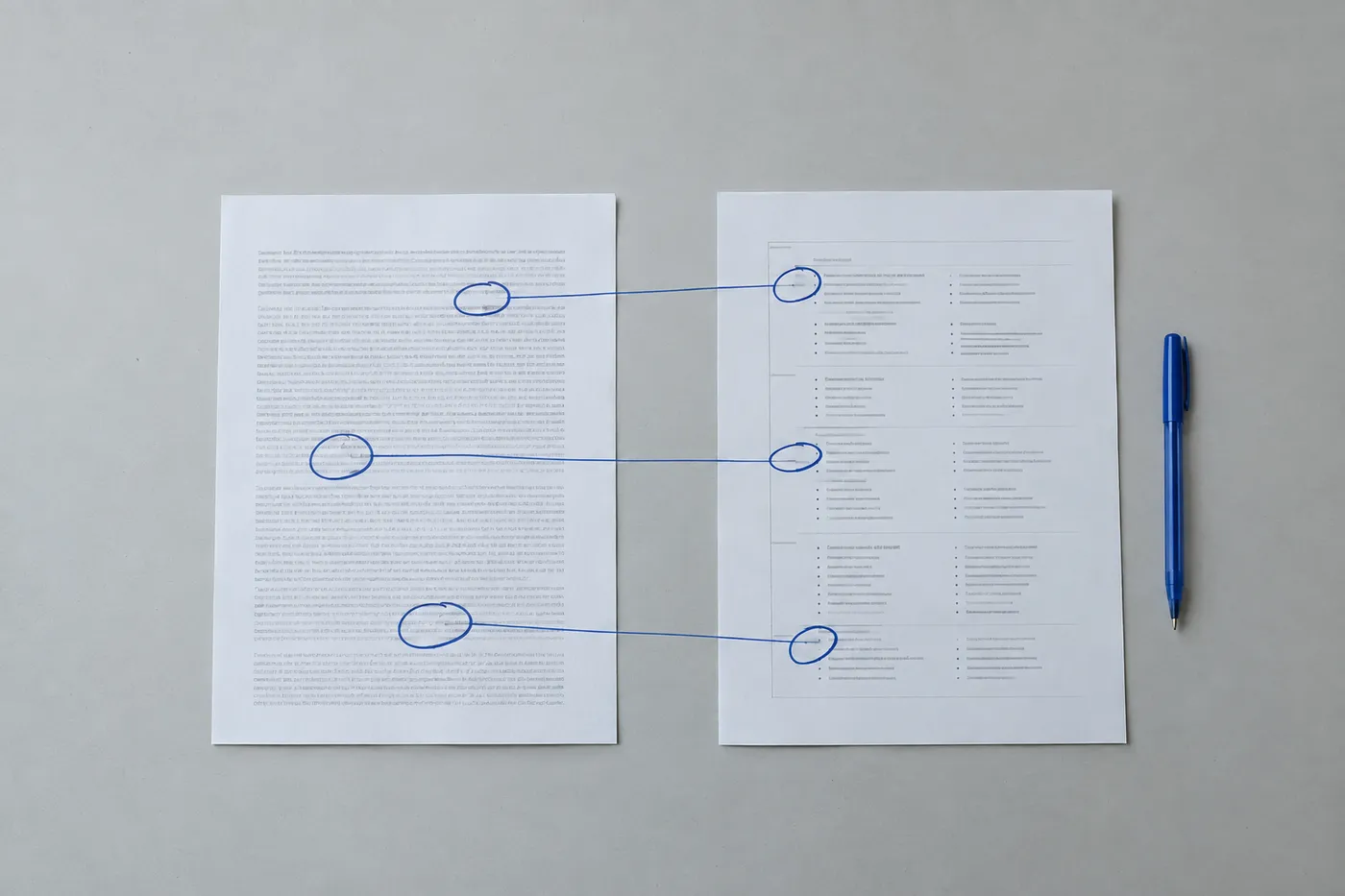
Roleframe's fit reports work by reading real job postings the way a recruiter does and matching a resume against the exact terms each posting filters on. Across junior and entry-level software engineer postings, the same terms come up again and again, and they cluster into predictable groups. These are the keywords worth checking your resume against before you send it:
| Keyword | Category | How often it appears in junior SWE postings |
|---|---|---|
| Python, Java, or JavaScript | Language | Near-universal; almost every posting names at least one, usually two |
| SQL | Language / data | Very common, even for frontend-leaning roles |
| Git / version control | Tooling | Near-universal; often an explicit requirement line |
| Data structures and algorithms | Fundamentals | Very common; frequently phrased exactly this way |
| REST APIs | Architecture | Very common in backend and full-stack postings |
| Object-oriented programming (OOP) | Fundamentals | Common; often paired with a named language |
| Agile / Scrum | Process | Common; recruiters search these terms directly |
| Unit testing / test-driven development | Practice | Common, and a strong differentiator when backed by a bullet |
| CI/CD | Practice | Increasingly common, even for entry-level roles |
| React (or another named frontend framework) | Framework | Common in full-stack and frontend postings |
| AWS / cloud services | Infrastructure | Common; a named cloud provider appears in a large share of postings |
| Debugging / troubleshooting | Fundamentals | Common; easy to cover honestly in an internship bullet |
| Linux / command line | Tooling | Regular in backend and infrastructure-adjacent roles |
Two rules for using this table. First, match the posting's exact wording: if the job says "RESTful APIs," write "RESTful APIs," and if it says "CI/CD," don't paraphrase it as "automated deployments." ATS keyword matching is more literal than people expect. Second, never list a keyword you can't back in an interview. A keyword in your skills list with no supporting bullet anywhere on the page is a red flag to a technical reviewer, and an invented one is worse. The broader mechanics are covered in how ATS resume keyword matching actually works.
The keywords also shift by posting. A junior role at a data-heavy company weights SQL and Python; a product startup weights React and shipping speed. This is why one static keyword list only gets you so far, and why checking your resume against each specific posting beats optimizing for the average.
Hard skills vs. soft skills: finding the balance
Your skills section should be almost entirely hard skills, grouped so a skimmer can parse it in two seconds: Languages, Frameworks & Libraries, Tools & Platforms. Eight to fifteen items total. A wall of thirty technologies signals padding, and any technical interviewer will probe the weakest item on the list, so only list what you can discuss.
Soft skills belong on your resume, but never as a list. "Communication, teamwork, problem-solving" as skills-section entries is dead weight; every applicant claims them and none can be verified from a list. Instead, demonstrate them inside experience and project bullets:
- Collaboration: "Paired with a senior engineer to refactor the auth module" or "shipped 14 PRs through code review."
- Communication: "Wrote the onboarding docs for the internal API, now used by every new intern."
- Ownership: "Maintained the issue tracker for my open-source tool and triaged community bug reports."
Hiring managers for junior roles weight soft skills heavily, because they are hiring for trajectory rather than current output. They just don't trust the word; they trust the story. The hard vs. soft skills guide covers how employers actually screen for each.
Import your PDF and edit it live
If you already have a resume, don't retype it. Upload the PDF to Roleframe and it comes back as editable blocks, with your roles, dates, and bullets in place, and an analysis already run so the first thing you see is a scored document with its weak sections named. From there, the workflow matches how this guide says to apply: keep one base resume, and for each job, duplicate it and paste the posting to get a fit report that shows your ATS score, the exact keywords that posting asks for that you are missing, and a prioritized plan. Then you make the edits yourself, with Remi, Roleframe's career copilot, proposing rewrites bullet by bullet that you approve or discard. Nothing lands on the page without your sign-off, which matters when a technical interviewer is going to probe every line.
Frequently asked questions
- How long should an entry-level software engineer resume be?
One page, no exceptions at 0-2 years of experience. Recruiters expect it, and a second page at this level reads as an inability to prioritize. If you are short on space, trim the skills list and old coursework before cutting internship bullets or projects.
- How do I write an entry-level software engineer resume with no experience at all?
Lead with projects and education instead of experience. Build two or three projects that are deployed or have public, readable code, write outcome-focused bullets for each, and pull relevant coursework into the education section. A specific summary that names your stack and your strongest project replaces the work history a recruiter would otherwise scan for. Anything where someone depended on your code, including a research assistantship or a site you built for a club, can honestly sit under experience.
- Should I put my GPA on an entry-level SWE resume?
Include it if it is 3.5 or higher, skip it below that. No recruiter penalizes a missing GPA, but a weak one invites doubt you didn't need to introduce. If your major GPA is meaningfully stronger than your overall, you can list it labeled as "Major GPA."
- Should my resume be a PDF or a Word document?
PDF, unless a specific employer explicitly asks otherwise. A PDF preserves your formatting exactly on every screen and every parser, while an editable document can reflow and break. Modern applicant tracking systems parse a cleanly structured PDF reliably; the parsing failures people fear come from complex layouts, not from the format itself.
- Do I need a summary or an objective on a junior software engineer resume?
Use a summary, and make it specific: your credential, one shipped thing, and the two or three technologies the posting cares about, in two or three lines. A traditional objective ("seeking a position where I can grow") tells the employer what you want without giving them a reason to want you. The only time an objective-style line earns its place is a sharp career change where your target needs stating.
- How many projects should I put on my resume?
Two or three, chosen for relevance to the posting over recency. Each needs a one-line description, the stack, a link, and at least one outcome bullet. One deployed project with real users beats five tutorial clones, so if you are choosing where to spend a weekend, push one project over the deployment line rather than starting a new one.
- Do the same rules apply to a junior software engineer resume with 1-2 years of experience?
Mostly, with two changes. Move experience above education once you have a year of full-time work, and let projects shrink to make room for richer work bullets with production numbers: latency improvements, incidents handled, features shipped and adopted. Keep it to one page; that rule doesn't relax until well past the two-year mark.
- Should I tailor my resume for every junior SWE application?
Yes, and it costs less time than people fear. The structure stays constant; what changes is the summary's named technologies, the order of skills, and which project or bullet leads. Junior postings vary widely in stack, so a resume tuned to the average posting matches none of them well. Keeping a base resume and spinning off a tailored version per job, the workflow described above, makes each pass a few minutes rather than a rewrite.


Ready when you are
Send the tailored resume, not the generic one.
Paste a job posting and Roleframe scores your resume against it, then helps you close the gaps one approved edit at a time, so you apply while the role is still fresh.