New Grad Nurse Resume Example: Clinical Rotations, Capstone and Licensure
by Larbi SahliPublished
A full new grad nurse resume example for a med-surg residency, plus how to write clinical rotation bullets and an honest licensure line before the NCLEX.
Users have landed jobs at
- 1Password
- OpenAI
- Notion
- justworks
On this page
A new graduate nursing resume should show clinical preparation, education and your current licensure status. Make it clear which units you attended, the supervised work you performed, and the qualifications you currently hold. Paid healthcare experience helps when you have it, but student placements belong on the page too.
The University of Minnesota School of Nursing recommends listing clinical and practicum experiences with hours and giving an immersion experience more detail. Use those details to show the part of your preparation that fits the residency.
The example below shows how to write that evidence without presenting supervised student work as independent RN practice. The later sections cover rotation bullets, capstone work, accurate licensure wording and how to retain useful experience from a previous career.
What a new graduate nursing resume should establish
Help the reader answer four practical questions: what nursing education have you completed, what relevant clinical preparation do you have, which credentials are current, and what is your real licensure status?
For each selected placement, name the setting, facility, dates and hours you can verify. Describe your own activities and supervision rather than making claims about what all students do. A residency may request a separate rotation list, so check the application before expanding the resume.
Keep it concise and readable. One page is a useful target for many new graduates, but a second page may be appropriate for required clinical detail or substantial relevant experience. The expanded example on this page uses two pages; it is a content reference rather than a universal length requirement.
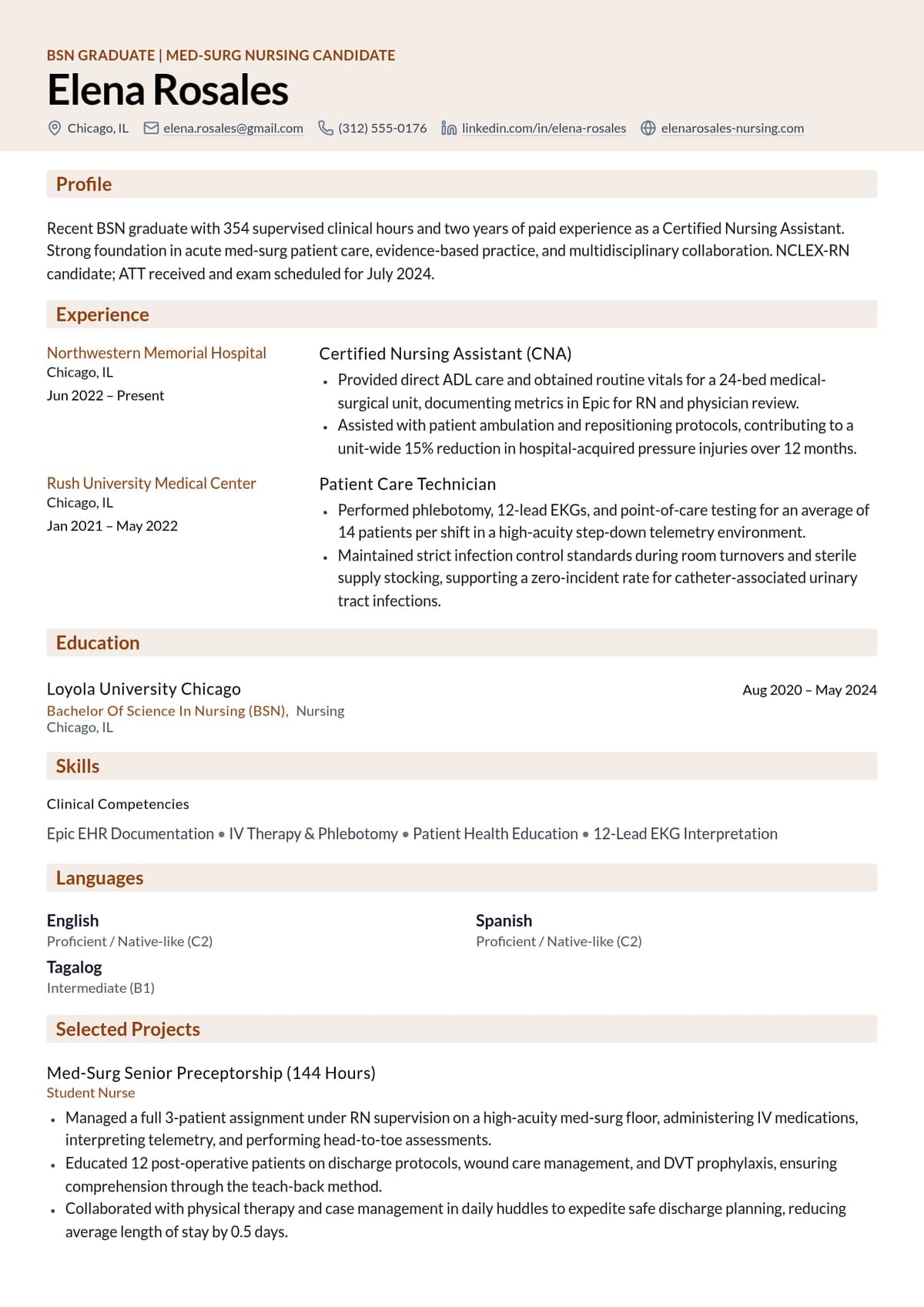
A complete new grad RN resume example
This is an illustrative pre-licensure BSN graduate, not a real applicant or endorsement. Chloe Farnsworth, the school, employers, placements, achievements, dates and figures are fictional. Real credential and regulatory organizations are named only to show formatting. Replace all sample content with your own verified record, and confirm the requirements of your licensing board and residency.
Why the example is built this way, section by section
The header and your credentials
Use only credentials you hold today. A completed BSN can appear after your name; “RN” should not appear as an earned credential before the relevant board issues your license. Passing an exam and holding a license are separate events. The Ohio Board of Nursing, for example, explains the education and examination steps for RN licensure.
Use phone, professional email, city and state, plus an optional current professional profile. State application and examination progress in a clearly labeled licensure section. Do not put a pending license in a way that could be read as an active license.
A short profile, when it adds useful context
A brief summary can connect your degree, relevant placements and application status. It is optional; do not use it to repeat every section or to claim experience you do not have. A targeted objective can also work when it states a specific role and relevant preparation.
An illustrative line is: “BSN graduate with a 144-hour supervised medical-surgical capstone; NCLEX-RN scheduled for [booked date].” Use a date only if it is actually booked, and substitute your own hours. See the professional summary guide and summary vs. objective for more options.
Licensure and certifications, high on the page
Create an easy-to-find licensure and certifications block. For each current credential, include its full name, abbreviation, issuer and expiration date where applicable. Keep an application or exam-status line distinct from a certification.
For example, “Basic Life Support (BLS), American Heart Association, expires [month/year]” is clearer than “BLS.” The American Heart Association states that its course completion cards are valid for two years through the end of the issue month. Use the dates on your own card and include ACLS only if you have actually completed it and it is relevant.
Education with a clear completion date
List the degree, institution and graduation date. If the degree is in progress, say “Expected [month/year]” and keep that wording consistent with the headline and licensure section. A completed degree should not still be labeled expected.
Include GPA when the employer requests it or when you choose to highlight it. Use the actual grading scale and do not substitute an unofficial threshold for the residency’s requirements. See whether to include GPA for the general decision.
Clinical rotations: the section that does the work
For a clinical entry, identify the facility, unit or specialty, dates and hours. Add the patient population and two or three relevant supervised activities when there is room. Keep an accurate distinction between hands-on work, observation and simulation.
Give the placement that best fits the posting appropriate emphasis, while making dates easy to follow. You can group selected relevant rotations separately from a full chronological list. Yale’s nursing resume guide notes that employers differ in whether they want every rotation and its hours on the resume or in a separate document. Follow the application’s requirements.
Capstone or preceptorship, given its own entry
Give a substantial capstone or preceptorship its own entry if it is your strongest relevant experience. Include the unit, dates, hours and the care you participated in with your preceptor. A patient count must describe your supervised assignment, not imply independent responsibility for those patients.
For a quality-improvement or evidence-based-practice project, say what you reviewed or created and who received it. Do not claim a fall, infection or readmission reduction unless you have an approved measurement that supports it and can explain your contribution. A presentation or recommendation is still useful evidence. See how to list a capstone project.
Work experience, healthcare or not
Include relevant paid work such as nursing assistant, patient care technician, unit clerk or medical scribe, with the actual title, setting, dates and responsibilities. The title alone does not establish a shift length, unit type or clinical scope; describe your own job.
Non-healthcare employment can show reliability, communication and responsibility. Keep it shorter than your relevant clinical preparation. Label student placements as clinical education and paid roles as employment so the reader can distinguish them.
Skills: specific, supportable, and drawn from the posting
List skills you can substantiate at your current level, such as supervised vital-sign measurement, documentation, wound-care assistance, patient education or SBAR handoff practice. State when a skill was performed under supervision or only practiced in simulation. Do not turn a course topic into a claim of independent competence. See nursing skills for a resume for categories to consider.
Use the posting’s terminology where it accurately describes your experience. Writing out “medical-surgical” once can help a reader understand an abbreviation. There is no reliable rule that an applicant tracking system will reject “med-surg”; accuracy and clear context matter more than guessing how a particular parser works.
Three clinical rotation bullets, rewritten
The examples below are fictional rewrites, not reports of real students or measured patient outcomes. Adapt only the parts that match what you actually did, with the required supervision. Observation is valid to report when it was your role; do not replace it with hands-on care you did not provide.
1. The shadowing bullet
Weak: “Medical-surgical rotation. Observed nursing care and assisted staff as needed.”
More specific, if true: “Completed 120 hours on a medical-surgical unit; assisted with assessments, intake/output documentation and patient education for a two-patient assignment under an RN preceptor’s supervision.”
This version names duration, context and activities without claiming independent care. If you only observed medication administration, say “observed”; do not add an administration claim to strengthen a bullet.
2. The patient education bullet
Weak: “Gained experience in patient education and communication.”
More specific, if true: “Reinforced the RN’s discharge instructions using teach-back under supervision and reported questions to the primary RN before discharge.”
Name the teaching method and your actual part in the process. Do not claim that education reduced readmissions unless that outcome was measured and your contribution can be supported.
3. The capstone bullet
Weak: “Capstone in acute care. Worked alongside my preceptor.”
More specific, if true: “Completed a 144-hour medical-surgical capstone; participated in care for up to three patients with an RN preceptor, practiced SBAR handoff, and presented a rounding-checklist proposal to the unit educator.”
The hours, patient count and project are illustrative. Use your own records, identify the supervision and report the project’s actual output. Do not describe supervised practice as independent patient management.
One rule that overrides all of this: no patient identifiers
Leave patient names, initials, room and record numbers, exact care dates and identifying case details off a resume. Describe broad populations and your responsibilities instead of an individual case. Avoid unusual combinations of details that could reveal a patient even when the name is omitted.
The US Department of Health and Human Services explains that health information can be identifiable through names, dates and other characteristics. Follow your school and placement confidentiality rules as well; a resume is not a place for patient-level data.
How to write the licensure line before you pass the NCLEX
You may be applying before you have an active license. Make your current stage explicit and check whether the residency accepts applicants at that stage. An application date, received authorization or booked exam date should be factual; none guarantees when a license will be issued.
The official NCLEX registration process separates applying to the nursing regulatory body from registering with Pearson. After the regulator declares you eligible and Pearson registration is complete, you receive an Authorization to Test (ATT). You need that authorization before scheduling an appointment, and you must test within its validity dates.
- Before authorization: “RN licensure application submitted to [Board], [month/year]; NCLEX-RN registration complete; awaiting eligibility/ATT.” Use only the steps actually completed.
- After booking: “NCLEX-RN candidate; ATT received [date]; exam scheduled [booked date].”
- Before degree completion: “BSN expected [month/year]; preparing application for licensure by examination in [state].” Do not claim eligibility before the board confirms it.
- After the board issues the license: “Registered Nurse, [State], license [actual number if requested], expires [actual date].” Passing the exam alone does not justify an active-license claim.
Do not put “RN” after your name before the license exists, invent a booked date, or list a planned certification as completed. “Application pending” is useful only when the application has actually been submitted; include an as-of date and the next confirmed step.
Check the current rules with your own licensing board. Update your resume and application portals after the board issues the license. Use the expiration date shown by the regulator; license renewal cycles are not universally two years.
The career changer with an ADN: translating non-nursing work
Previous work can support a career change into nursing, including an ADN route, without being rewritten as clinical practice. Retain the actual job title and use specific examples of scheduling, communication, recordkeeping and accountability.
A retail manager may have led shifts and resolved customer complaints. Those are transferable experiences, but they are not patient triage, clinical staffing or charge-nurse judgment. Let the recruiter see the relevance without changing what the work was.
| Original non-nursing line | More specific non-nursing wording, if true |
|---|---|
| “Managed a team” | “Led shifts of up to [verified number] retail associates and reassigned floor coverage as customer demand changed.” |
| “Handled customer complaints” | “Resolved customer complaints at the service desk and escalated safety incidents through the store’s process.” |
| “Responsible for opening and closing” | “Completed daily opening and closing checklists, cash controls and inventory records.” |
| “Trained new hires” | “Trained [verified number] new associates using the store’s onboarding checklist and documented completed training.” |
Keep prior-career details brief and below the strongest relevant clinical preparation. Use clinical terms only for clinical work you actually performed. Customer queues are customer queues; teaching a new employee is not a nursing preceptorship.
The transferable skills guide and career change resume guide offer more rewriting patterns. In Roleframe’s resume builder, you can move the capstone or clinical section ahead of earlier employment while keeping its content together.
Check the residency’s actual requirements
Residency eligibility and application documents vary by employer. Use the current posting as your checklist rather than assuming that every program uses the same screen. The following details help a reader understand your preparation.
- Relevant placements. Identify the unit, dates, hours and supervised activities rather than listing only a course title.
- Capstone context. Include its hours and your role; a supervised patient assignment should remain explicitly supervised.
- Paid experience, where you have it. State the actual setting and responsibilities. A paid healthcare job is not a universal prerequisite unless the posting says so.
- Licensure and certification status. Compare the program’s requirements and deadlines with confirmed application, exam and credential dates. A booked NCLEX date is not a guaranteed license issue date.
Keep motivation brief on the resume and use a cover letter or interview to explain why the specialty interests you. Connect that interest to an actual placement or learning experience instead of an unsupported claim of passion.
For interview preparation, see nursing interview questions and answers. Treat suggested answers as prompts to adapt to your own experience, not stories to borrow.
Format and file: what to send
Follow the application’s requested file type. If none is specified, a PDF can preserve the layout you designed, but open it to verify page breaks and selectable text. Check all fields that the portal extracts rather than assuming an upload parsed correctly.
Use clear headings, a readable font, consistent dates and a restrained layout. Keep contact and clinical details easy to find. A photo, decorative chart or skills rating is usually less useful here than a precise description of preparation.
Cut repetition before reducing text size. A one-page version may be enough; retain a second page when the employer requires a complete rotation record or you have substantial relevant material. Your school’s guidance and the employer’s document requirements should guide the final choice.
If you are not actually a new grad, use a different example
This page fits the period around degree completion and a first RN role, when clinical placements remain important evidence. If you already work as an RN, the registered nurse resume example shows how to emphasize employed clinical experience.
For advanced practice applications, use the nurse practitioner resume example. As employed nursing experience grows, reduce or remove student placements that no longer add relevant information; there is no automatic one-year cutoff.
Frequently asked questions
- Should a new grad nurse resume be one page?
One page is a useful starting target, but it is not a universal requirement. Use a second page if required clinical details or substantial relevant experience need it. Follow the residency’s instructions, keep text readable and remove repeated information before compressing the layout.
- What do I put for licensure if I haven't taken the NCLEX yet?
State the steps actually completed, with dates: application submitted, ATT received, or an exam appointment booked. Do not claim a confirmed test date before booking it, and do not add RN as an earned credential before the licensing board issues your license. Check the board’s current requirements for your jurisdiction.
- Do I list every clinical rotation?
Follow the employer’s instructions. Some programs want a complete rotation list or a separate clinical-hours document; others need only relevant placements on the resume. Give your strongest relevant experience detail, and identify the setting and hours accurately without duplicating capstone hours in a total.
- Should I include my GPA?
Include it when requested or when you choose to highlight it. Report the true GPA and scale. A program’s published eligibility threshold takes priority over any general resume suggestion.
- Objective or summary on a new grad RN resume?
Either can work when it is specific and brief, and either can be omitted when it adds little. A profile can connect your degree, relevant placements and current licensure progress. Avoid generic motivation lines or claims of independent practice.
- Can I get a nurse residency with no healthcare work experience?
A lack of paid healthcare employment does not mean the resume is empty. Describe supervised clinical placements, capstone work, relevant projects and other employment accurately. Each residency sets its own eligibility requirements, so check the posting rather than assuming acceptance.
- How do I tailor the same resume to five different residency postings?
Keep a master record, then select the relevant placements, skills and projects for each posting. Use the employer’s terms where they describe your actual experience. Keep dates and credentials consistent across copies, and verify the application fields after uploading.
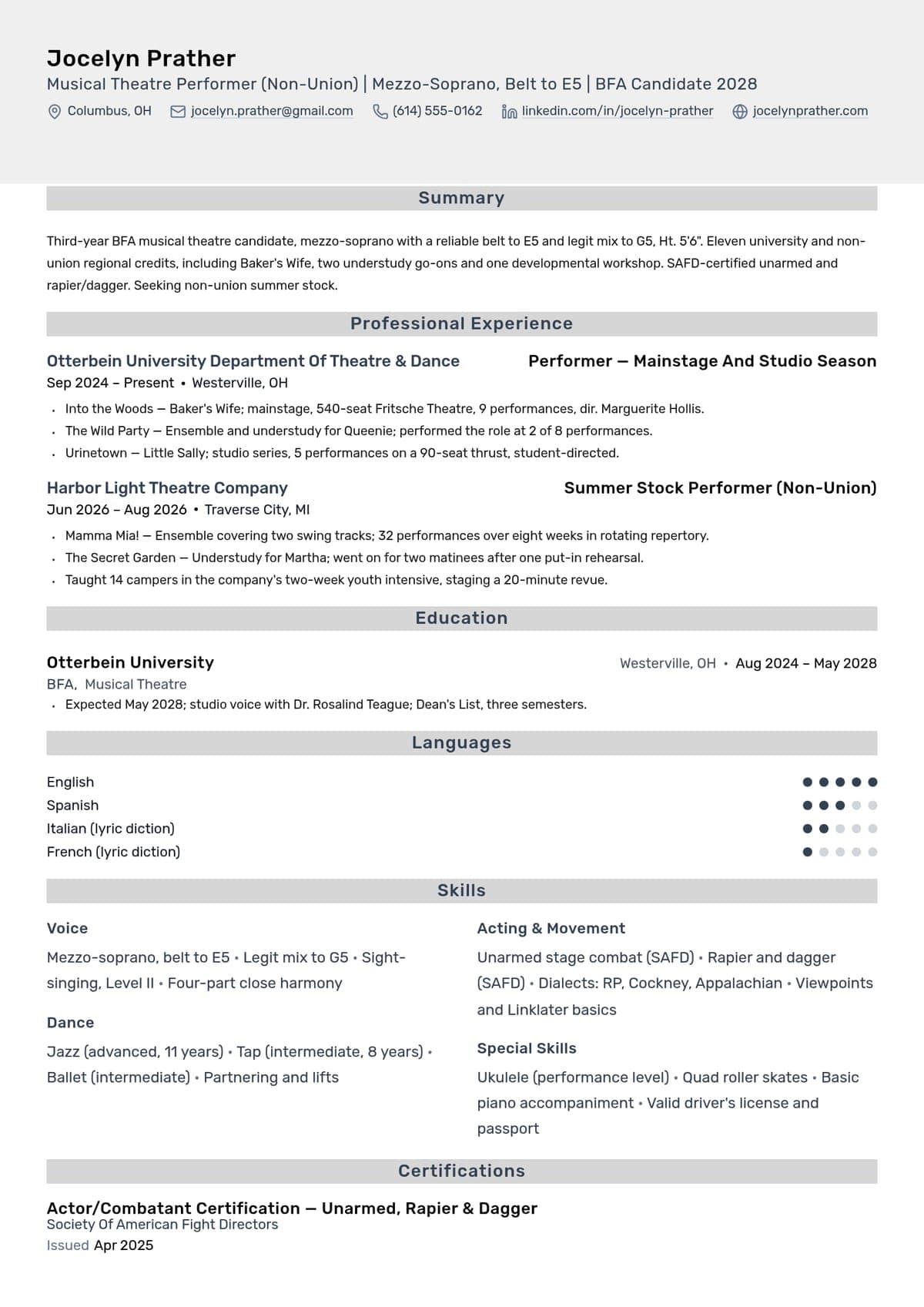

Build yours on the same template.
Every example here is built on a template you can open in the editor. Start from the same layout and write your own experience into it, then download the PDF free, as often as you like.


