Dancer Resume Example for Auditions, Intensives and College
by Larbi SahliPublished
A complete dancer resume example for company auditions, plus how to format credit lines, training, union status and skills for intensives and college.
Users have landed jobs at
- 1Password
- OpenAI
- Notion
- justworks
On this page
A dancer resume helps an audition panel find your performance credits, training and usable skills quickly. Lead with the work that fits the call: company repertory for a company audition, commercial credits for a filmed project, or training for a student application.
A useful credit identifies the production or piece, your role, the company, and the choreographer or staging credit where known. A precise line is more informative than a claim such as “experienced performer.” Teaching and arts administration applications may need a conventional employment resume alongside your performance resume.
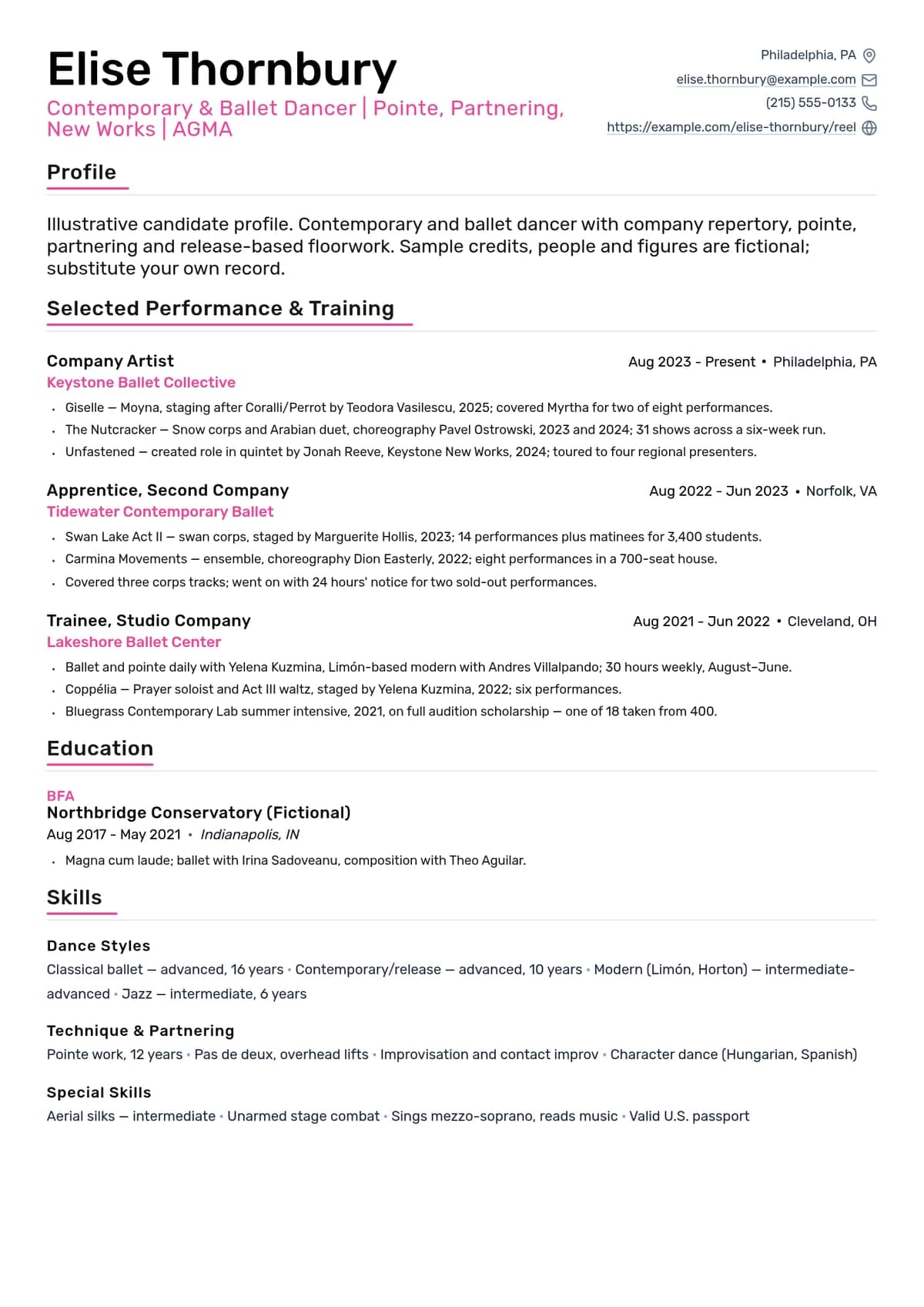
The example below is an expanded content reference for a fictional dancer. Elise Thornbury, the employers, teachers, credits and figures are illustrative. Real work titles and credential providers are used only to demonstrate formatting; they do not endorse the example. Replace every sample detail with your own record and select a shorter version when an audition specifies one page.
What a dancer resume has to do
Make the first screen or printed page easy to scan. Put your name and contact details at the top, followed by clearly labeled sections. Use the same order for the details within each credit so the reader does not have to decode every line.
Name the company, production and role even when the work was local or unpaid. Distinguish a performed role from an understudy assignment, and a class presentation from a professional production. You do not need to inflate a small credit to make it useful.
How the example is built, section by section
Header
Use your name, phone number, professional email address and city or region. A street address is unnecessary for contacting you about an audition. See whether to put your address on a resume for the general guidance.
Add a working reel or portfolio link and accurately stated union affiliation when relevant. Include physical details only when the application requests them. If the notice asks for a separate video submission, follow that process even when a reel link also appears in your header.
Performance credits
For a working performer, selected performance credits usually deserve space near the top. Use a consistent pattern: production or piece, role or track, choreographer or staging credit, company and year. Credit the version you actually performed; do not guess at a choreographer or imply an original staging when you danced a later adaptation.
Group concert, commercial and screen work when that makes the mix easier to read. Put the most relevant recent work first within each group. A compact line per credit often works better than duty bullets. The expanded example groups repertory under company entries; you can convert those lines into a tighter audition list.
Training
For training, list the school or program, relevant teachers, styles and dates or years studied. Separate a summer intensive from an ongoing program so the duration is clear. In its dance resume guidance, USC Kaufman suggests condensing long teacher lists to the instructors who best represent your training.
A teacher’s name identifies your training; it is not permission to present that person as a reference. Ask separately before giving anyone’s contact details to a company.
Styles and special skills
Name the styles and techniques that fit the call, with honest levels where useful: ballet, contemporary, jazz, tap, hip-hop, partnering or floorwork. Distinguish years of study from current proficiency. A style you studied years ago should not be presented as an advanced skill you can perform today.
Choreography and education
Give performed choreography a short section when it matters to the application: work title, your role, ensemble size if useful, venue or program, and year. Label a workshop or class showing accurately.
List a relevant degree, school and completion date. A working dancer may place education after performance credits, while a college applicant should follow the school’s required order. See the education section guide for the basic fields.
The student version: same sections, different order
A student with limited professional credits can lead with training and then selected performances. Follow the program’s own template where one is supplied. An application may also ask for academic information or a brief statement; those requirements take priority over a general audition format.
Use the following sections where you have relevant material. Omit an empty category rather than inventing experience to fill it.
- Training by style and duration. Name the studio, teachers and years studied. “Ballet, 9 years” is an illustrative format, not a threshold you must meet.
- Intensives and workshops completed. Name the program and year. Include a scholarship or audition selection only when it actually happened.
- Performance and competition work. Identify the piece, solo/duet/group context, choreographer and event. Include a placement only if you received it.
- Repertory and roles. Name roles you performed. Label understudy work or repertory studied in class so it cannot be mistaken for a performance credit.
- School and activities. Add graduation year, academic details requested by the program, leadership and relevant teaching assistant work.
- Skills. Select styles and supplementary abilities you can demonstrate at the level stated.
Leave age and date of birth off the resume unless the application asks for them. For a minor, use a parent or guardian’s contact details and avoid publishing a home address.
You can move section blocks in the Roleframe editor as your experience changes. A simple template makes the training and credit lines easy to follow. For more on choosing an order, see resume section order by experience level.
The conventions dance resumes follow
Use these as starting points, then check the current audition or program instructions. There is no single format that overrides every application.
- Respect the page limit. Prepare a concise one-page audition version when requested. Keep an expanded master for selecting credits; the example above is an expanded reference. USC Kaufman, for example, requires its own one-page template.
- Keep the order clear. Use recent or relevant work first within labeled sections.
- Lead with your strongest relevant evidence. That may be performance credits for a working dancer or training for a student.
- Keep prose brief. Credit and training lines should do most of the work. Include a short profile or objective only when it adds necessary context or the application requests one.
- Follow the photo instructions. Send a headshot or dance photo in the requested file or print format. Do not assume it should be embedded in the resume.
- Use the requested file format. A PDF is a useful default when the notice does not specify another format. Open the exported file to check alignment, links and page breaks.
- Name the file clearly. Use a pattern such as “Firstname-Lastname-Dance-Resume.pdf.”
Height, appearance and union affiliation
Only include height or other appearance details when the call asks for them. College and company requirements differ. USC Kaufman’s published resume guidance, for example, excludes height, weight, eye color and age. Check the current instructions for your specific opportunity.
Write union status accurately, without a membership number. AGMA represents performers and staging staff in fields including opera, ballet and concert dance. Actors’ Equity Association represents professional actors and stage managers in US live theatre, including musical theatre performers. SAG-AFTRA’s dancer resources cover work such as filmed productions, commercials and music videos. Membership and eligibility are distinct; describe only the status you actually hold.
Five credit lines a director can read at a glance
The following are illustrative formats, not credits to copy. Replace the bracketed fields, dates and roles with your own verified history. Use the same separators within each section.
| Credit type | Line format | What the reader takes from it |
|---|---|---|
| Company repertory | [Repertory work] | [Role or corps track] | [Choreographer / staging credit] | [Company] | [Year] | Repertory level, staging lineage, and that you hold classical corps work |
| Named role in a story ballet | [Story ballet] | [Named role or understudy assignment] | [Choreographer] | [Company] | [Year] | The exact role and whether you performed or covered it |
| Commercial or music video | [Artist] – “[Track]” music video | [Actual performer credit] | Choreographer: [Name] | [Production company] | [Year] | Screen credibility, camera experience, and the choreographer's network |
| Competition piece | “[Title]” | Contemporary solo | Choreographer: [Name] | [Studio] | [Actual placement, if any], [Event], [Year] | For students: selection, placement, and who built the piece on you |
| Original choreography | “[Title]” | Choreographer and performer | [Number] dancers | [Venue or showcase] | [Year] | That you can make work, not only perform it |
Keep separators and ordering consistent. Add scale only when it helps explain the work and you can support the number. A performance count, run length or touring schedule can be useful; an estimate presented as a precise achievement can mislead.
For example, “[Company], [Dates], [Documented number] performances per season” shows the structure of a measurable line. Do not copy a sample count or imply that a large number alone makes the credit stronger.
Skills, written the dance way
Write current proficiency plainly: “ballet, advanced; contemporary, advanced; tap, intermediate.” Those levels are illustrative. Use the terms your teachers and recent experience support, and be ready to demonstrate what you list.
Add relevant supplementary skills such as singing, acting, languages, an instrument, acrobatics or teaching. For physical skills, state the specific discipline and training level. A resume entry is not evidence that you are qualified to perform a hazardous stunt; include only work within your training and discuss any production-specific requirements separately.
Generic phrases such as “hard working” use space without identifying a technique or performance credit. Show collaboration and reliability through the work itself when the application needs that evidence.
Two variants worth building
The dance teacher resume
For a dance teaching job, lead with teaching experience that matches the studio’s needs. Name the studio, dates, styles, age groups and levels taught. Add class frequency or choreography responsibilities when you can verify them. An illustrative line is “Ballet I–III, ages 7–14, six classes weekly.”
Keep selected performance credits below the teaching section. List current certifications, first aid and safeguarding training where relevant to the posting. The teacher resume examples show how to describe classroom responsibilities accurately.
The college dance program applicant
A college dance application may use a required template with academic details and an objective as well as dance training. USC Kaufman’s published instructions are one example of why a blanket “no objectives” rule would be wrong. Use the current program requirements first.
If you list repertory studied without performing it, label the entry “repertory study” and name the class or teacher. For a broader school application, see the student resume examples and teen resume example.
Preparing the submission
Read the current notice for file type, page limit, required photos, video links, forms and deadlines. A resume link does not replace a video upload when the organizer asks for one.
Keep an editable master with your full record, then save a clearly named version for each application. Check that its dates, role labels and reel link match what you enter in the form. Keep a copy of what you sent so a later callback refers to the same information.
Frequently asked questions
- How long should a dancer resume be?
Prepare a concise one-page audition version when the company or program requests it. Follow any required template or limit. Keep a longer master for selecting credits; the embedded example on this page is an expanded content reference, not a promise that every application accepts two pages.
- What do you put on a dance resume with no experience?
Training carries the document. List your studio, the styles you have studied with the number of years for each, your teachers, and any intensives or workshops you have attended. Add recital and competition pieces with the choreographer and any placement, then school activities, leadership and teaching assistant work. A first resume with four years of honest ballet training and three named recital pieces is a real resume.
- Do I need a headshot on my dance resume?
Follow the audition or program instructions. A photo may be requested as a separate file, a print alongside the resume, or within a particular application form. Do not assume every application requires an embedded headshot; some college programs explicitly request text-only resumes.
- How do you write a dance resume for a child?
Use the student structure and keep it to one page: training by studio and style with years, teachers, recital and competition pieces, and intensives. Leave out the home address, and leave off date of birth unless the application form asks for it. Parent contact details go in the header in place of the dancer's own. Photos go only where the casting notice requests them.
- Should a dance resume be a PDF or a Word file?
Use the file format specified in the notice. When none is given, a PDF is a useful default for preserving your layout. Check the exported file yourself and make sure links and page breaks work. If a portal requests Word or plain-text fields, follow that requirement.
- What skills should go on a dancer resume?
List the styles and techniques relevant to the call with honest proficiency levels, followed by useful extras such as singing, acting, languages, instruments or teaching. Name specific training for acrobatics or stage combat and avoid implying qualifications you do not hold.
- Do competition placements count as performance credits?
For a student, yes, and they belong in their own section rather than mixed with professional credits. Write the piece title, whether it was a solo, duet or group, the choreographer, the event and the placement. Once you have company or commercial work, competitions move down the page or come off it entirely.
- Should I list my union status if I am non-union?
State non-union status if the notice asks for it or distinguishes calls by status. If you belong to a union, name the union accurately in the header. Do not describe eligibility as membership, and do not publish a membership number. Check the union’s own current guidance when uncertain.

Build yours on the same template.
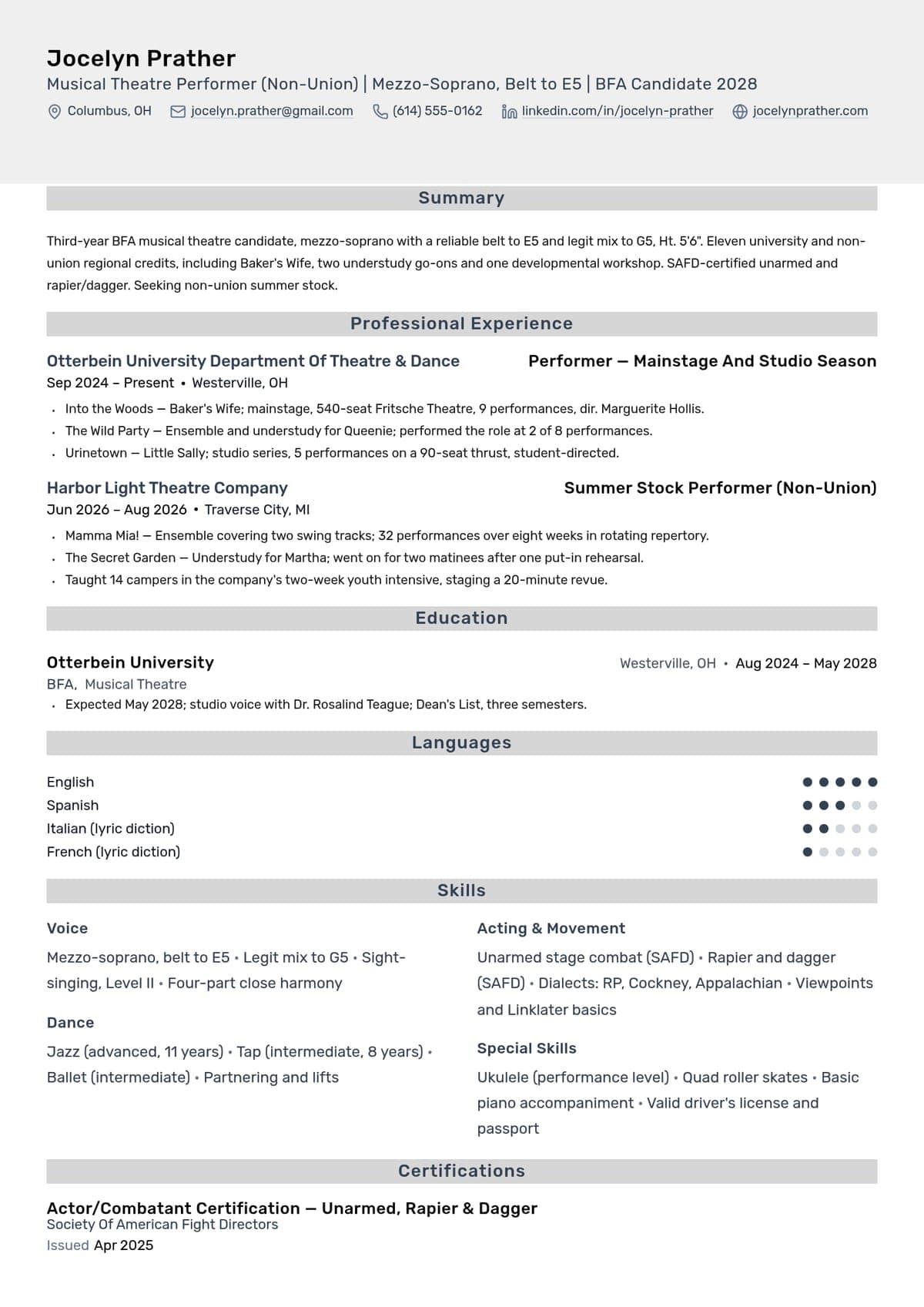
Every example here is built on a template you can open in the editor. Start from the same layout and write your own experience into it, then download the PDF free, as often as you like.


