
Teacher Resume Examples: Templates and the ATS Keywords Districts Search For
by Larbi SahliLast Updated
Teacher resume examples with a complete sample, the ATS keywords districts filter for, and section-by-section guidance on IEPs, certifications, and licensure.

On this page
A principal screening applicants gives each teacher resume well under a minute, and before that even happens, most district applications sit inside an applicant tracking system (ATS) where HR staff search the pool by keyword. Two filters, and a generic resume fails both.
This page gives you a complete teacher resume example to copy, the keywords district screeners actually search for, and section-by-section fixes for the parts teachers get wrong most often. Certifications buried at the bottom of the page is the big one; vague IEP experience is a close second.
What Makes a Great Teacher Resume
The teacher resumes that get interviews share one trait: they show what happened to students, not what the teacher was assigned to do. "Responsible for teaching fourth-grade math" tells a principal nothing. "Raised fourth-grade math benchmark scores from 58% to 74% in one year through small-group reteach cycles" tells them exactly what you would do on their campus.
Beyond outcomes, a strong teacher resume gets five things right.
- Reverse-chronological format. Districts want your most recent classroom first. Skip functional formats; screeners read them as hiding something.
- Certifications near the top. Licensure is a legal requirement, so make your certificate findable in the first five seconds of a scan.
- Keywords that match the posting. HR searches applicant pools for terms like "classroom management" and "IEP." If the phrase is not on your resume, the search skips you.
- Numbers you can defend in an interview. Benchmark growth, referral reductions, parent attendance rates.
- A clean single-column layout, saved as a PDF. Decorative graphics confuse parsers and impress nobody who signs teaching contracts.
On length, keep it to one page as a new teacher or career changer, and let it grow to two pages once you have five or more years plus committee, coaching, or curriculum work. Districts read two-page teacher resumes without complaint, but every line still has to earn its place. The breakdown by experience level is in our guide to whether a resume should be one page or two.
Teacher Resume Example (Finished Document)
Here is a full teacher resume sample for an experienced elementary teacher. The person and schools are fictional; the structure and the level of detail are what you should copy.
Why this example works
Certifications sit above the summary because a screener's first question is whether you can legally teach in the state. The summary leads with a number a principal can picture on their own campus. Every experience bullet names either a student outcome or a system districts recognize, such as ARD meetings and MTSS tiers.
Notice what is missing. There is no objective paragraph about seeking a rewarding position, and no "passionate educator" filler that a keyword search can never match. No photo, and no second column for the parser to mangle.
Adapting the example to your situation
New teacher resume. Move education above experience and treat student teaching as a real position with its own bullets. Name the grade level and the student population, and include one measurable win from your placement, even something as small as a reading group moving up a level. State your certificate, or your scheduled exam dates, in the header, because districts hiring first-year teachers screen for certification status before anything else.
Elementary teacher resume. Weight the document toward literacy and family communication; elementary principals hire for both. Terms like guided reading and running records carry more weight here than at any other level.
High school teacher resume. Lead with your subject and any AP or dual-credit experience. Quantify with pass rates and course loads rather than reading levels, and mention department or extracurricular leadership, since secondary principals hire for the master schedule as much as for the classroom.
Private school teacher resume. State certification is often optional, so the weight shifts to your degree and subject depth. Evidence of parent partnership matters more than in public districts, and so does anything showing you contribute to school life beyond your classroom, from advising to coaching.
Top ATS Keywords for Teachers (Real Job Data)
Here is what actually happens inside a district ATS. Your application is parsed into a searchable record, and when a posting draws hundreds of applicants, HR staff and principals filter the pool by keyword instead of opening every file. A resume that says "supported students with individualized plans" never surfaces in a search for "IEP." Same experience, zero visibility.
Run a few district postings through Roleframe's per-job fit report and the same terms come back again and again as the ones screeners filter on. The table below lists the ones that recur across teaching roles at every level, with where each belongs on the page.
| Keyword | Why districts filter for it | Where it belongs |
|---|---|---|
| Classroom management | The first competency principals screen for; large pools get filtered on this term early | One experience bullet with a system and a result, plus the skills list |
| Differentiated instruction | Signals you can teach a mixed-ability room, which describes every public classroom | An experience bullet naming the method, such as stations or flexible grouping |
| IEP / 504 | Special education compliance is a legal obligation; screeners search the acronyms, not paraphrases | Experience bullets with plan counts and process language like ARD meetings and goal tracking |
| Lesson planning / curriculum | The core of the job; postings usually pair it with a standards framework | Bullets that name the standards you planned against (TEKS, Common Core, state equivalents) |
| Data-driven instruction | Districts under accountability pressure want teachers who act on assessment data | A bullet tying an assessment to an instructional change and a result |
| ELL / ESL support | A high-need area in most districts and often a hard filter for bilingual campuses | Certifications section if endorsed; otherwise experience bullets naming supports like SIOP |
| Parent / family communication | Principals field parent complaints and hire teachers who prevent them | A bullet with a channel and a number, like conference attendance |
| Behavior intervention / PBIS | Framework language tells a screener you work within a schoolwide system | An experience bullet plus the skills list |
| Google Classroom / district LMS | Postings name the platform the district runs, and the match is often literal | Skills list, using the exact platform name from the posting |
| Collaboration / PLC | Grade-level and department teams are how districts actually operate | A bullet about co-planning or shared curriculum work |
Match the exact phrasing of the posting you are answering. If a district writes "positive behavior interventions and supports," spell it out once and use PBIS after that, since a literal search can miss either version alone. Do not stuff a skills list with every term in the table. Screeners open the file after the search, and a keyword with no experience behind it reads as padding and costs you trust. The full mechanics of matching without stuffing are in our guide to ATS resume keywords.
Writing a Professional Summary for Education
Your summary is three to four lines answering the only question a screener has, which is why they should read the rest of the file. Write it last, after your bullets exist, and build it around your strongest number. A summary written first turns into adjectives; a summary written last turns into evidence.
Skip the old-style objective statement unless you are changing careers into teaching. The general craft, with more worked examples, is covered in our guide on how to write a professional summary.
Three models you can adapt.
- Experienced teacher. "Middle school science teacher with eight years in high-need schools. Raised eighth-grade state science assessment pass rates from 64% to 81% over three years through inquiry-based labs and weekly data cycles. Trained mentor for two first-year teachers."
- New teacher. "EC-6 certified teacher with a full-semester student teaching placement in a bilingual second-grade classroom. Planned and taught guided reading for five groups daily and moved four students up a full reading level. Seeking a primary classroom on a Title I campus."
- Career changer. "Former corporate trainer completing alternative certification in secondary math. Eight years designing and delivering instruction to adult learners, now applying the same skills to Algebra I. Certification exams passed; classroom placement in progress."
Detailing Classroom Experience and IEPs
The experience section is where teacher resumes go generic. "Created lesson plans" and "managed a classroom" appear on every application in the pool because they describe the job itself, not your version of it. Each bullet should carry an action, a method, and a result a principal could verify by calling your reference.
Compare the difference in these pairs.
- Weak. Responsible for classroom management.
- Strong. Cut behavior referrals from 14 to 5 per semester by introducing a restorative circle routine and a tiered consequence system families signed off on.
- Weak. Worked with special education students.
- Strong. Implemented accommodations for nine IEP and 504 plans, co-taught daily with an inclusion specialist, and documented goal progress ahead of every ARD meeting.
The strong versions are longer, and that is fine. A specific 30-word bullet beats a vague 8-word one every time a human reads the file.
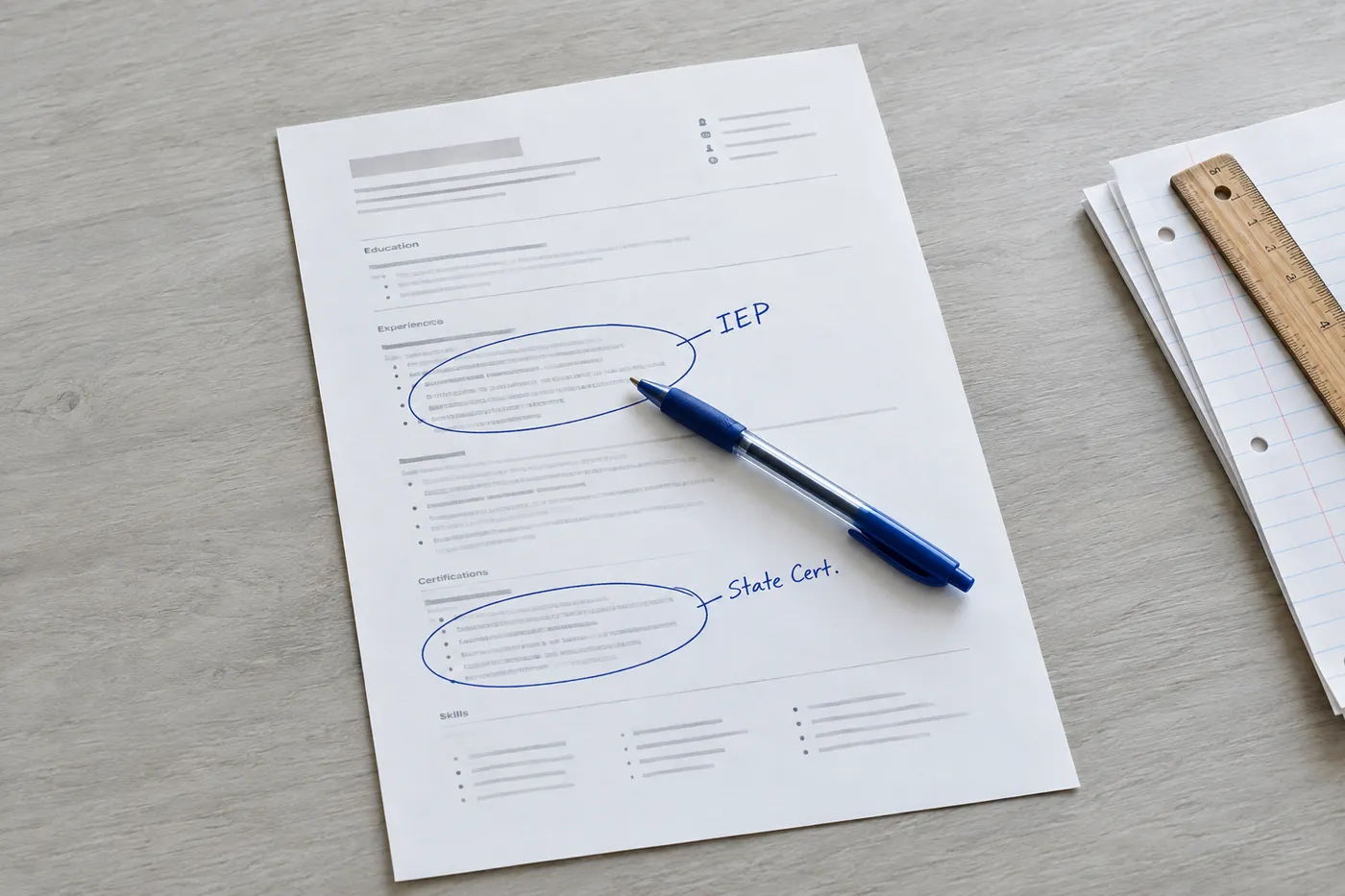
IEP experience deserves precision because districts search for it directly. Name the number of plans you carried and the process you followed. "Attended ARD meetings and tracked accommodation delivery for nine students" is searchable and credible; "familiar with special education" is neither. If you co-taught, say so and name the model, because inclusion staffing is a live concern in almost every district. The same rule applies to intervention frameworks. MTSS and RTI are search terms, so if you screened students or delivered Tier 2 instruction, write those exact words.
Highlighting Certifications and Licensure
Licensure is the first legal filter on a teaching application, so certifications belong directly under your header whenever a posting requires a specific certificate. A screener who cannot find your license in five seconds moves to the next file. The general placement rules are in where to put certifications on a resume, but for teachers the answer is almost always "high on page one."

- Write the exact certificate name and issuing state, such as "California Multiple Subject Teaching Credential" rather than "teaching license." Screeners search official names.
- Give each endorsement its own line (ESL, Reading Specialist, Gifted and Talented). Every endorsement is a separate keyword someone may filter on.
- If your certificate is pending, say so with a date. "Texas EC-6 Core Subjects, exam scheduled May 2026" keeps you in the pool; silence removes you.
- Applying across state lines? Note reciprocity in one line, for example "eligible for New York certification via interstate reciprocity."
- Add trainings districts recognize, like CPI or Wilson Reading, only if they are current and relevant to the posting.
How to Format Your Education Section
Where education goes depends on where you are in your career. A new teacher puts it above experience, because the degree and certification path are what a screener verifies first. After a couple of years in your own classroom, experience moves back on top and education shrinks to the essentials.
| Your situation | What to show | Where it goes |
|---|---|---|
| New graduate | Degree, major, graduation year, student teaching placement, GPA if it is strong | Above experience |
| 2 to 5 years teaching | Degree, major, and year on one or two lines | Below experience |
| 10+ years teaching | Degree and institution; the year is optional | Below experience, kept brief |
| Career changer (alternative certification) | Original degree plus the certification program, named in full | Above experience, next to certifications |
List a master's degree first if you hold one. "M.Ed. in Curriculum and Instruction" is itself a searchable phrase, and many districts pay on a degree-based salary schedule, so it is never dead weight. On GPA, include it only when it helps, which usually means recent graduates with strong numbers; our guide to whether to put your GPA on a resume covers the cutoffs.
Import Your Current Resume Into a Free Editor
You do not have to rebuild any of this from a blank page. Roleframe's resume editor is free to use with no account. Export your current resume as a PDF and import it, and it comes back as editable blocks with your roles and dates in the right places. The import runs a resume analysis on its own, so the first thing you see is a scored document with its weak sections named.
From there, paste a district posting and the fit report shows your ATS score against that specific job, along with the keywords from the tables above that your resume is missing. Remi, Roleframe's career copilot, helps you rewrite bullets one at a time, and you approve every change, so the resume stays yours to defend in an interview. When you finish, the PDF export matches the editor exactly, and PDF is the format district systems parse most reliably.
Frequently asked questions
- What should I include on a teacher resume?
Six sections, in roughly this order: a header with your name and certification status, a certifications section, a three-to-four-line professional summary, experience with measurable student outcomes, education, and a short skills list. Experienced teachers can add a line for committee or leadership roles. Leave out photos, full mailing addresses, and references, since districts collect references through the application itself.
- What is the best resume format for a teacher?
Reverse chronological, single column, saved as a PDF. Districts verify a work history in order, and a functional format that hides dates reads as a red flag. Single-column layouts also parse cleanly in the tracking systems districts run applications through.
- How do I write a good resume as a teacher?
Lead every experience bullet with what happened to students. Benchmark growth, referral reductions, and parent attendance are the kinds of numbers principals trust. Then check the posting for its exact keywords, like IEP or PBIS, and make sure each one you can honestly claim appears somewhere on the page.
- What should a teacher resume look like in 2026?
Clean and text-first. One or two pages depending on experience, a single column, standard fonts, and no photos or graphics. The visual bar has not moved much; what has changed is that keyword matching decides whether a human ever sees the file, so the words matter far more than the design.
- Should a new teacher list student teaching as experience?
Yes, as a full position under experience with its own bullets, not as a line under education. Name the school, the grade, and the length of the placement, and include at least one measurable outcome. It is the closest thing to classroom evidence a first-year candidate has, so treat it with the same seriousness as a paid role.
- How do I list substitute teaching on a resume?
Group it under one heading, such as "Substitute Teacher, Various Districts" with the date range, rather than listing every school. Then write bullets about patterns, like the grade levels you covered and any classes you carried for weeks at a stretch. A long-term sub role with real instructional responsibility deserves its own entry.
- Should I send my teacher resume as a PDF or a Word document?
PDF, unless a district's application explicitly demands a Word file, which is rare. PDF preserves your layout on every screen and parses reliably in modern tracking systems. Whatever you send, keep the layout to a single column so the parsed text reads in the right order.


Ready when you are
Send the tailored resume, not the generic one.
Paste a job posting and Roleframe scores your resume against it, then helps you close the gaps one approved edit at a time, so you apply while the role is still fresh.