Should I Put My Address on My Resume?
by Larbi SahliPublished
City and region are often enough for a resume. See clear header examples for remote work, relocation and applications that request more detail.
On this page
For a typical job-search resume, city and region are a practical default; add the country when needed for clarity. You usually do not need to publish your full street address unless the application specifically requires it. State relocation or remote-work preferences separately. A location line does not establish citizenship, work authorization or eligibility for a role.
Use the location detail the application needs
A city or region helps the reader understand where you are based. For example, "Austin, TX, USA" gives geographic context without publishing a home street and apartment number. Include the contact channels you can actually monitor so the employer can reach you.
Check the posting for on-site, hybrid, travel and location requirements. A city alone may not answer whether you can attend the office, work particular hours or meet an eligibility condition. Explain those points in the appropriate application field or conversation rather than expecting the header to settle them.
Read the posting and form before adding more detail
Look for the actual location wording: an office address, an approved region for remote work, a travel expectation or required working hours. Match your response to that request. If a separate form needs a residential or mailing address, check that you are on the legitimate employer's application site and understand the request before submitting it.
A resume and an onboarding or background-check form are different documents. You can keep a resume's location line broad while supplying additional information through the appropriate verified process when required.
Remote jobs: what location should you list?
For remote applications, state your actual location at the level relevant to the posting, such as city and country or region and country. Add a preference if useful: "Denver, CO, USA | Open to remote roles." If the posting asks about working-hour overlap, answer that explicitly.
Remote does not mean every location is eligible for every role. Read the employer's listed restrictions and ask for clarification when needed. Do not imply that living in a particular city proves you have work authorization or that you can work any time zone.
What if you're relocating?
If you have a firm relocation plan, state it as a future move: "Currently in Denver, CO; relocating to Seattle, WA in [month year]." If you are only willing to move, use "Denver, CO | Open to relocating to Seattle." These are fictional formats; replace them with accurate details.
Do not list the destination as your current residence before you live there. Clarify any start-date or on-site availability constraint with the employer.
| Your situation | What to put in your header |
|---|---|
| Applying locally | City, region; country if needed for clarity |
| Applying to remote roles | Actual city/region and country | Open to remote roles |
| Relocating with a firm plan | Current location; relocating to destination in [month year] |
| Student with campus and home locations | Current base and relevant future availability, described clearly |
| Verified application requests full address | Supply the required detail through that process; add it to the resume only if instructed |
Keep unnecessary personal details off shared copies
A resume may be uploaded, forwarded or saved by recipients. Limiting it to the information needed for the application reduces how much personal detail you distribute. Review public versions separately from documents sent through a verified hiring process.
Use an email address and phone number you are comfortable sharing, and avoid government identification numbers or financial details in the resume. Check an unfamiliar employer and its application site before supplying additional personal information. A professional-looking form alone is not verification.
Location fields and automated parsing
Application systems may collect location in a form, extract it from a resume or use both. Complete the requested fields accurately and check any information copied from your uploaded file. A city-only header does not guarantee inclusion in every location search, and omission does not prove automatic rejection.
Put contact details in ordinary document text so they remain easy to find. Greenhouse's parsing guidance identifies headers, footers and text boxes as possible sources of contact-field errors. A visually prominent block at the top of the page can be ordinary body text rather than the word processor's repeating header feature. See our ATS-friendly formatting guide for more layout considerations.
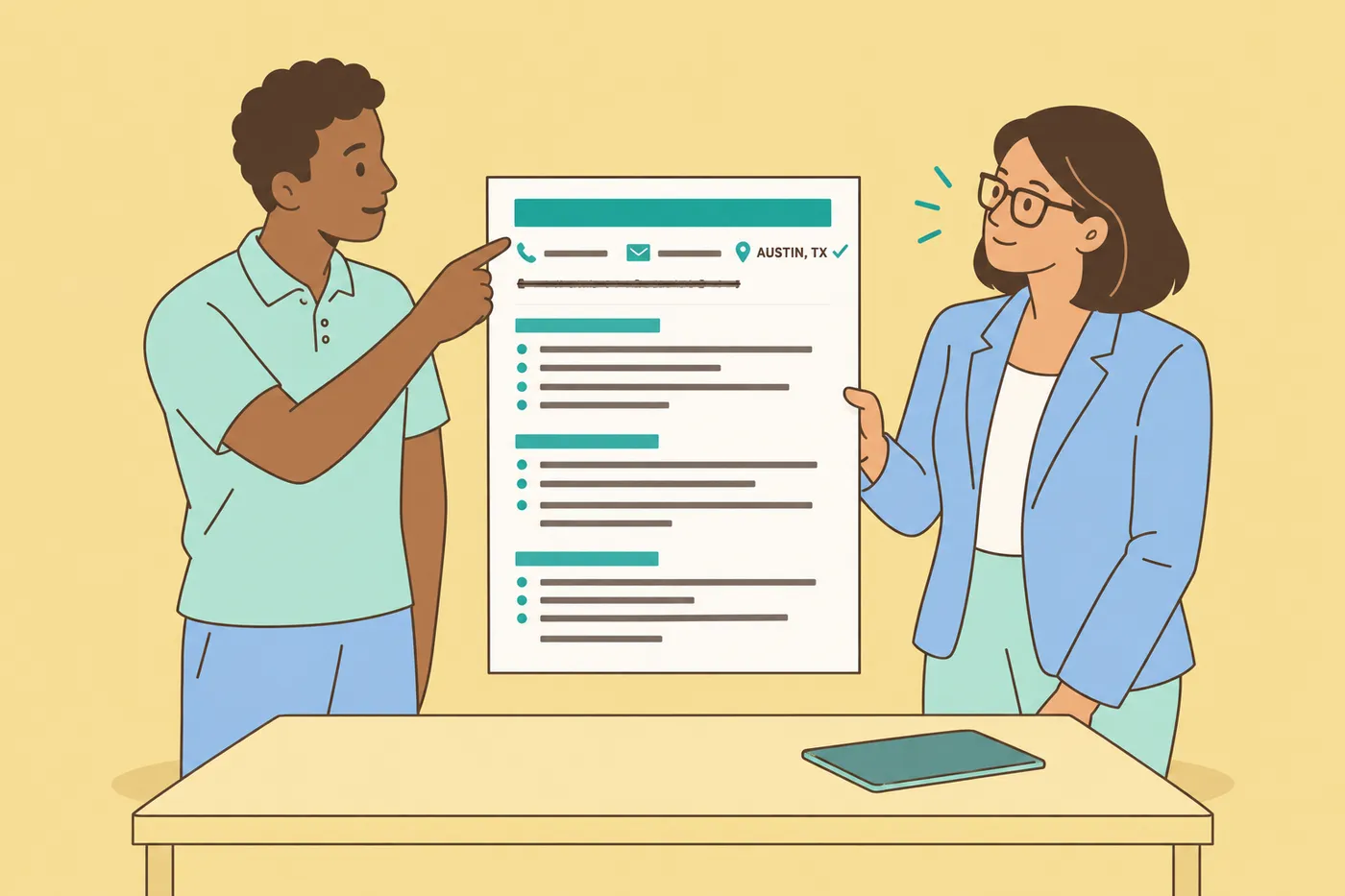
What a clean contact header looks like
Start with your name, a contact method and relevant location information. Add a professional profile or portfolio when it helps the application. There is no need to include a LinkedIn account or GitHub profile you do not use. Our section-order guide covers arranging the rest of the document.
- Your name, clearly readable.
- City and region, with country when useful.
- A phone number you can reliably use, if appropriate to the application.
- An email address you monitor.
- An optional current professional-profile link.
- An optional relevant portfolio or project link.
A fictional example: Jordan Reyes | Austin, TX, USA | (512) 555-0147 | jordan.reyes@example.com. Add your actual portfolio link if relevant. Check that the email and any links are correct and that the line remains readable in the exported file.
Setting up your contact header in Roleframe
Use Roleframe's resume builder to enter a concise location line and the contact details you choose to share. Review each application copy after making changes, especially when relocating or using different contact information.
Download the format accepted by the employer, then open it to inspect the header, line breaks and links. If an application extracts your details into fields, review those fields before submission.
Frequently asked questions
- Should I put my zip code on my resume?
Add a postal or ZIP code if the application requests it or it serves a clear purpose. For a general resume, city and region are often enough. Do not assume that every employer uses the same geographic search or that one format guarantees a match.
- Should I put my address on my cover letter?
For an uploaded or emailed letter, a compact contact block matching your resume is often sufficient. Use a full mailing address if required by the application or appropriate for a postal letter. Follow the actual instructions rather than treating formal address blocks as universally required or obsolete.
- Should I include my phone number and email address?
An email address you monitor is useful, and a reachable phone number can give the employer another channel. Follow the application's requirements and choose contact methods that work for you, including relevant accessibility needs. A professional email can be an existing address; it does not have to follow a particular naming formula.
- I'm a student with a campus address and a home address. Which do I use?
Describe where you are based and where you will be available for the job. For example, "Boston, MA during term; available in Chicago, IL from [month year]" makes the distinction explicit. Use only the detail the employer needs.
- What if the online application form asks for my full address?
First verify the employer and application site and check whether the field is required. Provide the requested address through the legitimate process when appropriate, or ask the hiring contact if the purpose is unclear. You do not necessarily need to repeat it on a resume shared elsewhere.
- Does leaving my address off my resume look suspicious?
Omitting a street address is a reasonable privacy choice for a typical resume. Include a broader location if it helps explain your availability. If an employer asks for more detail, respond accurately through the appropriate process.
- What else should I leave off my resume?
Avoid unnecessary sensitive details such as financial information and government ID numbers. Requirements and conventions for photographs and personal details differ by application and country, so check the instructions rather than assume one legal rule applies everywhere. See our resume mistakes guide for a broader content check.



Ready to start your new resume?
Writing a resume takes time, and even a polished one can miss what a hiring manager is looking for. Roleframe helps you build a clear, ATS-safe resume in minutes and tailor it to the job you want.


