How Do You Address a Cover Letter, With or Without a Name?
by Larbi SahliPublished
How to address a cover letter in every situation: exact greetings for seven cases, a five-minute way to find the name, and the fallback when none turns up.
On this page
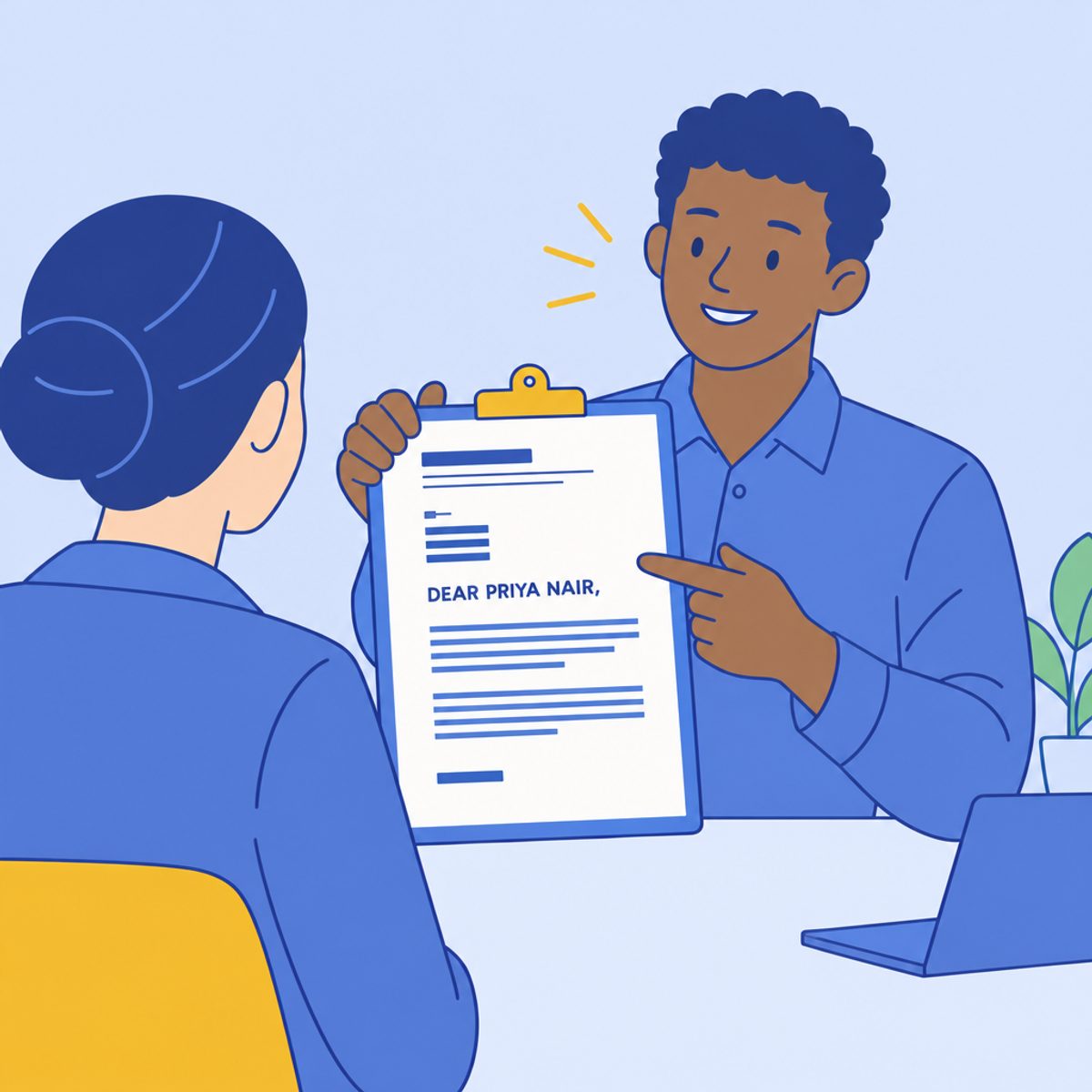
Address a cover letter to the person who will read it, by full name or title and last name: Dear Priya Nair, or Dear Ms. Nair,. If the posting names no one, spend five minutes checking the company site and LinkedIn for the hiring manager. If no name turns up, write Dear Hiring Manager, or greet the team. Never use To Whom It May Concern.
Who to address a cover letter to, in order
Work down this list and stop at the first person you can identify.
- The contact named in the posting. If the ad says "send applications to Marcus Webb," address Marcus Webb, full stop.
- The hiring manager for the role, meaning the person you would report to. This is who your letter is really trying to persuade.
- The head of the department the role sits in, when the direct manager is unclear.
- The team, when no individual surfaces: Dear Finance Hiring Team,
The common mix-up: the posting names a recruiter, but your research found the actual manager. Address the named contact. They asked for the applications, they read them first, and skipping over them to greet their colleague reads as either careless or presumptuous. You can still mention the manager's team in the body of the letter.
How to find the name in five minutes
Most "no name" situations are really "I didn't look" situations. Run these checks in order and time-box the whole thing to about five minutes.
- Reread the posting. The name is often buried at the bottom, in a "questions?" line, or inside the application email address (p.nair@company.com tells you a lot).
- Check the company's team or about page. Small and mid-size companies usually list department heads with titles.
- Search LinkedIn for the likely manager's title plus the company: "customer support manager" plus the company name. For a small company, the head of that function is usually the hiring manager.
- Look at who shared or posted the job on LinkedIn. Recruiters and managers post their own openings, and the poster is usually the right recipient.
- For a small local employer, call the front desk and ask who is hiring for the role. Thirty seconds, and you'll often get a name nobody else applying bothered to find.
Know when to stop. If five minutes of looking produces nothing, use the fallback and move on. A clean Dear Hiring Manager, sent today beats a perfectly addressed letter sent after the interview slots fill. And do not guess: a wrong name does more damage than no name.
The exact greeting for every situation
All names below are fictional. The comma shown is correct for email and for letters uploaded to an application portal; a formal printed letter takes a colon instead (more on that below).
| Situation | Greeting | Why this form |
|---|---|---|
| You know the name | Dear Priya Nair, or Dear Ms. Nair, | Both are correct. Full name is the safer default because it needs no title decision. |
| Name known, gender unclear | Dear Jordan Blake, | Full name, no title. Guessing Mr. or Ms. from a name is the riskiest move on this page. |
| Doctor or professor | Dear Dr. Nair, or Dear Professor Okafor, | A professional title outranks Mr. or Ms. In academia, Professor is the safe form even for associate ranks. |
| No name found | Dear Hiring Manager, | The standard fallback. Capitalize both words; it functions as a title here. |
| Team greeting fits better | Dear Customer Support Hiring Team, | Use the department name exactly as the posting words it. |
| Agency recruiter | Dear Marcus Webb, | Address the recruiter, not the end client. The recruiter decides whether your letter goes forward. |
| A referral got you the intro | Dear Ms. Nair, | The greeting stays standard. The referral belongs in your first sentence, not the salutation. |
| Internal application to a manager you know | Dear Daniel, or Dear Mr. Ruiz, | Match how you address this person at work today. Suddenly going formal with someone you chat with reads as odd. |
How to address a cover letter without a name
Dear Hiring Manager, is the standard fallback, and it carries no penalty. Recruiters know that most postings hide the manager's identity, and a tidy generic greeting signals nothing except that the posting was anonymous. Capitalize both words.
A team greeting sometimes reads better, particularly when the posting itself talks about the team: Dear Customer Support Hiring Team, or Dear Engineering Recruiting Team,. It shows you read the ad closely enough to know where the role sits, which is more than a generic greeting does.
Two options to retire. To Whom It May Concern announces that the letter was written for nobody in particular, which is the exact impression a cover letter exists to avoid, and it has read as dated for years. Dear Sir or Madam has the same problem plus a gender assumption baked in. Both were built for an era when you genuinely could not know who ran a department; that era ended when companies put their org charts on LinkedIn.
Two tempting shortcuts that backfire. A guessed name is worse than no name: if you address the letter to the person who left that job last quarter, the actual reader knows instantly that you scraped a stale page. And a first name alone (Dear Priya,) for someone you have never met assumes a familiarity you have not earned. Some cultures and companies are fine with it; enough are not that the clean fallback wins.
Titles, punctuation, and spelling
Four rules cover nearly every case.
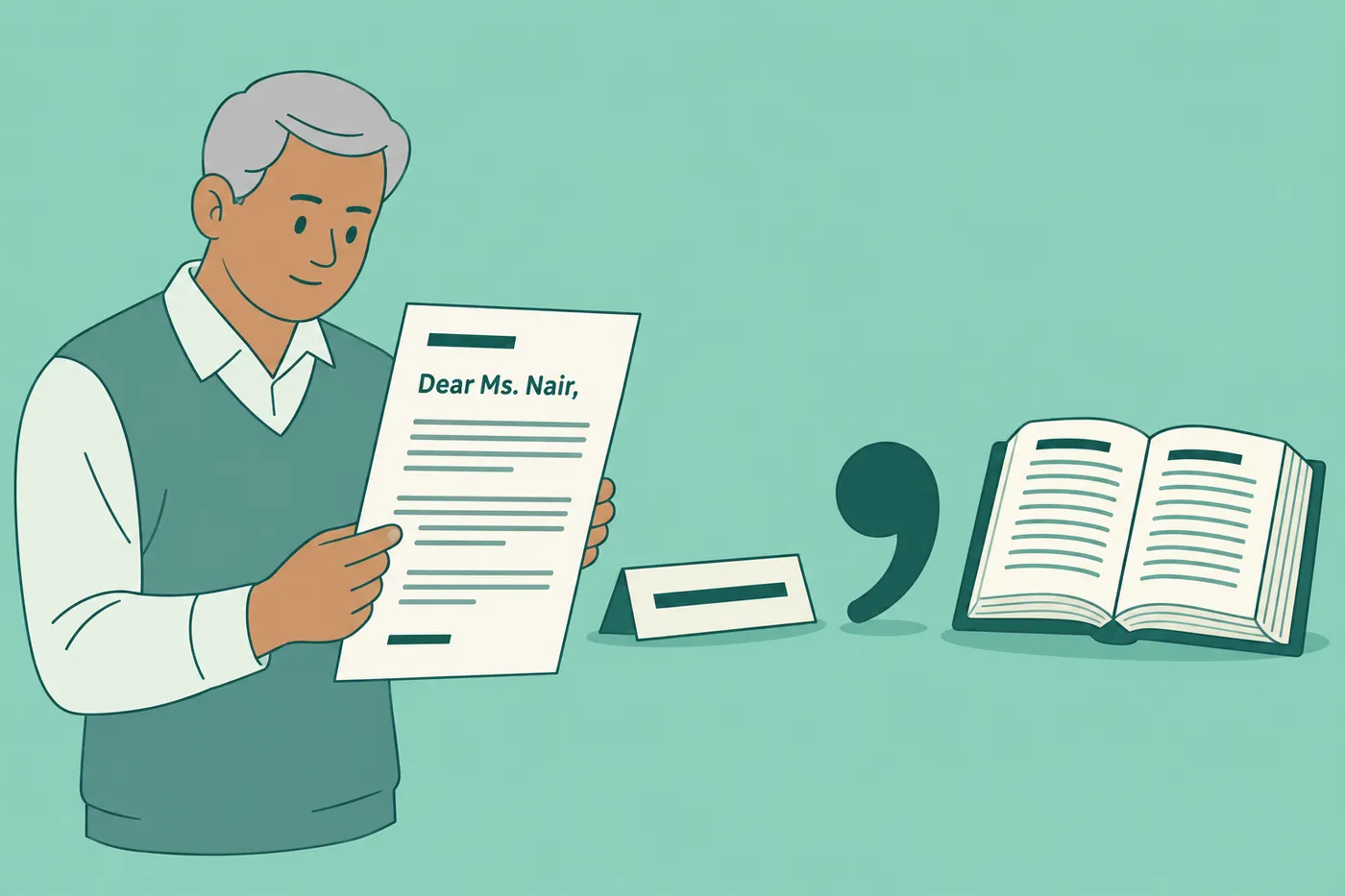
- Use Ms., never Mrs. or Miss, unless the person uses one of those herself (in an email signature, a bio, or the posting). Ms. carries no marital-status claim, which is the point.
- When you are not certain a title fits, drop it and use the full name. Dear Sam Kowalski, is always correct; Dear Mr. Kowalski, is only correct if Sam is a man.
- Punctuation follows formality. A comma after the name in email and in letters uploaded to a portal: Dear Ms. Nair,. A colon in a formal printed letter: Dear Ms. Nair:. If in doubt, the comma is standard for almost every application today.
- Copy the name exactly from its source, character for character. Hyphenated surnames keep the hyphen: Dear Ms. Okafor-Reyes,. Two-part surnames keep their capitalization as the person writes it: Dear Ms. de la Cruz,, not Dear Ms. Cruz,.
The spelling rule deserves the extra beat. A recruiter forgives a generic greeting; a misspelled version of their own name is the first thing they notice and the last thing they forget. Copy and paste it from LinkedIn or the posting rather than typing it from memory.
Addressing a cover letter sent by email
The greeting itself does not change. What changes is everything around it: an emailed cover letter drops the printed address block entirely, and your first paragraph starts directly under the greeting. No date, no employer address, no "RE:" line in the body. The subject line does the job the reference line used to do.
Contact blocks, dates, and the employer's address format for a printed or attached letter are a separate question with its own rules, so I'll leave them out of this page. For the greeting, email and attachment behave the same: name if you have one, Dear Hiring Manager, if you don't, comma after.
Five greeting mistakes that sink applications
Each of these has ended an application before the second sentence. Each has a thirty-second fix.
- A misspelled name. Fix: copy and paste the name from its source, then read it once more before sending.
- Another company's name left over from an earlier letter. This is the most common casualty of reusing a template. Fix: search the finished letter for every company name in it before you send.
- Dear Sir in a letter that lands on a woman's desk, or vice versa. Fix: never assume gender from a role. Use the full name or the neutral fallback.
- Hey, or Hi there!. Casual greetings signal that you'd write to a client the same way. Fix: Dear plus a name or Dear Hiring Manager, even at casual companies. Nobody was ever rejected for being one notch too polite.
- Brackets left from a template or an AI draft: Dear [Hiring Manager Name],. This one is fatal because it proves the letter is a mass send. Fix: search your final letter for [ and { before every submission.
What comes after the greeting, the opening sentence itself, is a different craft with its own rules, so I'll leave it there. Get the greeting right and that first sentence at least gets read.
Once you have the name, use it twice more
The name you spent five minutes finding is worth more than one greeting. The same person is who you write to when you follow up on the application a week later, and who receives your thank-you email after the interview. Applicants who address three touchpoints to the same human come across as organized in a way a generic applicant never does.
So record it somewhere attached to the job, not in your head. If you're using Roleframe to run the search, save the posting to its job tracker and draft the cover letter there, with your resume open beside it. Remi drafts the letter from your actual experience and the posting you saved, and you edit every line before it goes out, so the letter that opens with the right name also sounds like you wrote it. Because you did.
Frequently asked questions
- What's the correct way to address a cover letter?
Use Dear plus the recipient's full name or title and last name, followed by a comma: Dear Priya Nair, or Dear Ms. Nair,. If you cannot find a name after a few minutes of looking, use Dear Hiring Manager, or greet the team by its name in the posting.
- How do you address a cover letter to an unknown recipient?
Dear Hiring Manager, is the standard and carries no penalty. A team greeting like Dear Finance Hiring Team, works when the posting emphasizes the team. Avoid To Whom It May Concern and Dear Sir or Madam; both read as dated, and the second assumes a gender. Never guess a name, because addressing the wrong person is worse than addressing no one.
- Is 'Dear Hiring Manager' too generic?
No. Recruiters see it constantly and know most postings hide the manager's identity. What actually hurts is a wrong name, a misspelled name, or template brackets left in the greeting. Dear Hiring Manager is a neutral opening that lets the rest of your letter do the persuading. A found name is better, but the fallback costs you nothing.
- Should the greeting end with a comma or a colon?
A comma for email and for letters uploaded to an application portal, which covers nearly every application today: Dear Ms. Nair,. A colon belongs in a formal printed business letter: Dear Ms. Nair:. If you're unsure which register you're in, the comma is the safe modern default.
- What if the posting lists two contacts, or the role has co-managers?
Address both, in the order the posting lists them: Dear Ms. Nair and Mr. Webb,. If one is clearly the application contact and the other the manager, address the application contact alone. For three or more people, switch to the team greeting rather than writing a roll call.
- Can I open with 'Hi' and a first name?
Only when you already have a first-name relationship with the reader, such as an internal application to your own manager or a recruiter you've been emailing back and forth. For a cold application, Dear plus a full name is the floor. A greeting one notch too formal is forgettable; one notch too casual is memorable in the wrong way.
- What are the golden rules of a cover letter greeting?
Three cover it. Address a real person when five minutes of looking can find one. Copy the name exactly as its owner spells it, title included. When no name exists, use a clean fallback like Dear Hiring Manager rather than a guess, a gendered form, or To Whom It May Concern. Everything else on this page is a footnote to those three.


Ready to write your cover letter?
Writing a cover letter takes time, and a generic one is easy to spot. Pick a letter template that matches your resume, or let Roleframe draft a first version from the job posting using only what your resume backs up.


