Thank You Email After an Interview, With Six Examples
Thank you email after interview examples for six real situations: panel, final round, rejection, a bad interview. Plus timing, subject lines, and what to skip.

On this page
Most thank-you emails read like a receipt. "Thank you for your time, I enjoyed our conversation, I look forward to next steps." A hiring manager cannot tell that message apart from the last forty they received, and it does nothing for your candidacy except confirm you know the ritual.
The version worth sending has one working sentence in it. Something specific from the conversation, continued a step further, so the interviewer re-reads it and remembers why you were interesting. Everything else in the email is courtesy. That line is the point.
This guide gives you the skeleton, then six complete emails for the situations most templates ignore: a panel interview, a final round, an interview that went badly, a rejection, a referral, and the silence after a stated deadline passes. Copy the structure, never the wording. An interviewer who has read this article too will notice.
The template, and the one line that makes it worth sending
A good thank-you email is three short paragraphs and under 150 words. Here is the skeleton.
- Open with a specific thanks. Not "thank you for your time" but thanks tied to something real. "Thank you for walking me through how the team actually runs sprint planning" tells them you were listening.
- The working line. Take one thing the interviewer said and add to it. A thought you had after the call, a relevant experience you can now connect to their problem, a resource you offered to share. This is the sentence that separates your email from the pile.
- Close with interest and availability. One line. You want the job, you are around for questions, done.
The working line deserves a moment more. In the interview, the hiring manager described a problem. On the way home, you thought of something you should have said about it. That thought is the email. "Your question about the pricing migration stuck with me, and I keep landing on the same answer: start with the annual-plan cohort, because that is where churn risk is lowest." A sentence like that shows you are still working on their problem after the meeting ended, which is exactly the behavior they are hiring for.
If you cannot write a working line, you were not paying enough attention in the interview. That is fixable next time. For this one, pick the moment where the conversation got most specific and build from there.
When to send it, and why the same day matters
Send it the same day, within a few hours of the interview, and no later than the next morning. The 24-hour rule you see everywhere is the outer limit, and treating it as a target misses why timing matters at all.
Interviews get debriefed fast. On many teams the interviewers compare notes the same afternoon or the following morning, and once the debrief happens, opinions are largely set. An email that arrives before the debrief can be part of how the interviewer forms their score. An email that arrives two days later is read by someone who has already decided and moved on.
Two practical adjustments. If the interview ended late in the day, the next morning is fine and probably better than a 10 p.m. send, which can read as anxious. And if you have blown past two days, drop the thank-you framing entirely. A late thank-you draws attention to its own lateness. Fold your interest into whatever the next natural touchpoint is instead.
Write the email while the conversation is fresh. The working line comes from a detail you will not remember as sharply tomorrow, so draft it within an hour of walking out, even if you schedule the send for the morning.
Example 1: Thanking a panel without sending six identical emails
Panels compare notes. If three interviewers each receive the same email with the name swapped, at least one of them will notice, and a copy-pasted thank-you lands worse than none. The fix is to send separate messages that each reference a different exchange. You spoke with each person about something distinct; the emails should prove it.
Subject: Thank you, Product Manager interview
Hi Maria,
Thank you for today's conversation, and especially for being candid about the roadmap tradeoffs. Your question about sequencing the pricing migration stuck with me on the way home, and I keep landing on the same answer: start with the annual-plan cohort, because the churn risk there is lowest and it gives you a clean read before touching monthly.
I left more interested in the role than when I walked in. If it would be useful, I am happy to send over the rollout brief I mentioned.
Thanks again, and I look forward to hearing about next steps.
Best,
Dana Ruiz
(555) 201-4437
For the other panelists, keep the same skeleton and swap the middle. The engineer who grilled you on data quality gets a line about data quality. The designer who asked how you handle disagreement gets a line about that. Two or three sentences of difference is enough; nobody expects three unrelated essays.
If you do not have direct addresses, send your notes to the recruiter who scheduled the loop and ask them to forward each one. Recruiters do this routinely, and asking signals more care than skipping the panel entirely.
Adding the thing you wish you had said
Every interviewer expects a candidate to think of a better answer in the parking lot. The thank-you email is the accepted place to deliver it, with one hard rule: two sentences, one topic, and then move on. A long correction turns your email into a second interview, and you will lose that one too.
Three shapes this can take. You can supplement an answer you gave too thinly ("I should have mentioned that the migration I described was also under a compliance deadline, which is why the phased approach mattered"). You can answer a question you fumbled outright, which is covered in the bad-interview example below. Or you can add a qualification you forgot existed until the job came up in conversation, like a certification or a directly relevant project.
What you should never do is relitigate. "When you asked about X, what I meant was..." followed by four paragraphs reads as defensive, and it forces the interviewer to re-evaluate an answer they had probably already forgiven. Add, do not argue.
Example 2: After a final round
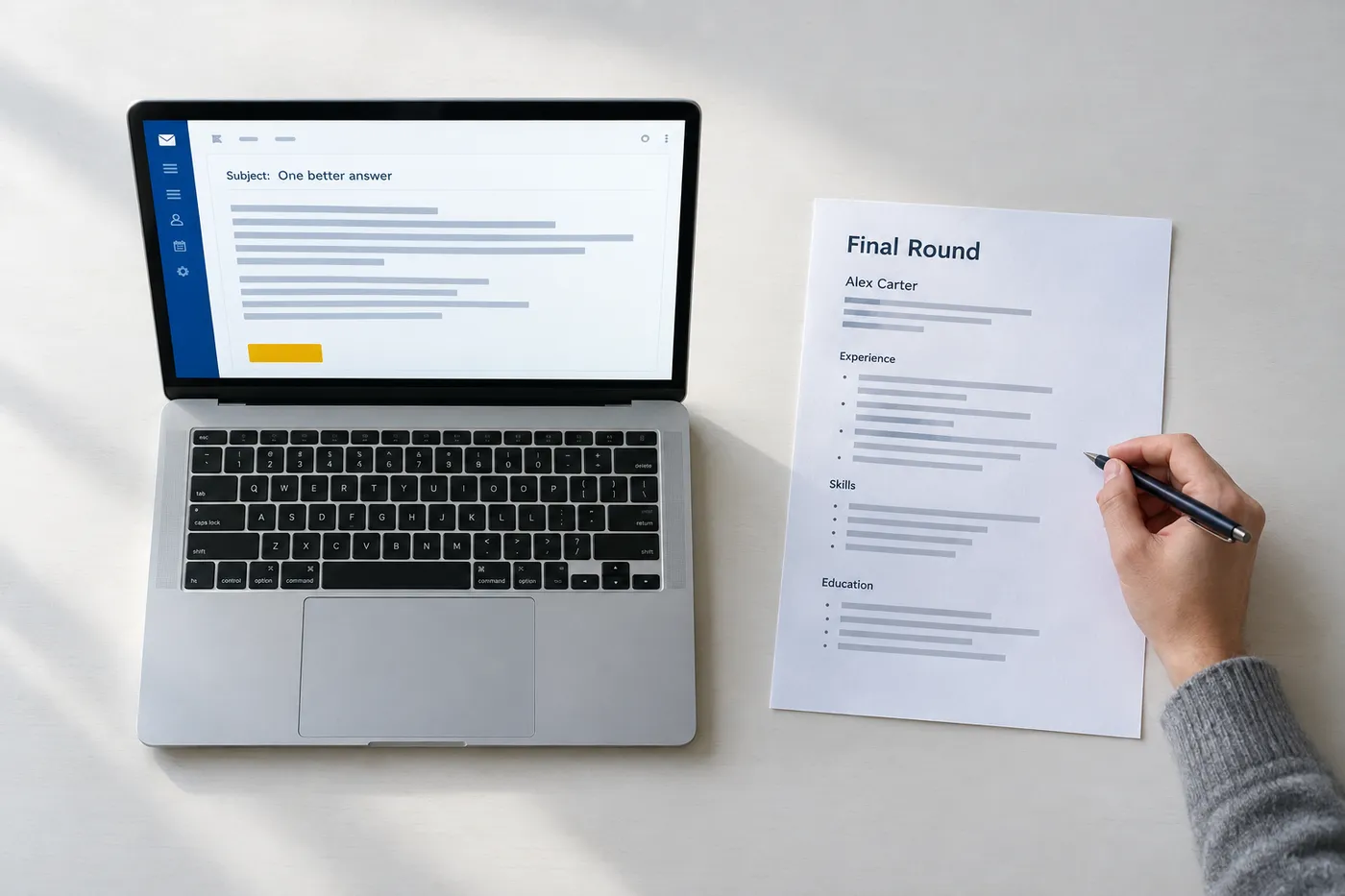
By the final round, the company is choosing between two or three people who can all do the job. Your email should read like a decision aid, short, confident, and organized around what they told you matters most. This is also the one email where restating your case in a single line is expected rather than pushy.
Subject: Thank you, and a note after the final round
Hi Priya,
Thank you for making time for a fourth conversation, and for letting me meet the team. It confirmed what I hoped: the two things you said matter most in year one are stabilizing the reporting pipeline and getting sales numbers people trust, and I have done that exact rebuild once before at similar scale. I would start with the data-quality audit we discussed.
I understand you are deciding by the end of next week. If anything comes up in the meantime that would help the decision, I am easy to reach.
Best,
Sam Okafor
Notice what this email does not do. It does not ask whether you got the job, it does not negotiate, and it does not manufacture urgency. Naming their timeline back to them shows you listened and quietly sets up a legitimate follow-up if the date slips.
Example 3: When the interview went badly
A bad interview is the situation where the thank-you email earns its keep, because it is your only remaining move. It will not rescue a disaster, but interviews are often less binary than they feel from the inside, and a composed email after a shaky performance is itself evidence of how you handle a bad day.
The approach is honesty without groveling. Name the weak answer once, give the better version in two or three sentences, and do not apologize beyond a single acknowledgment.
Subject: Thank you, and one better answer
Hi Jordan,
Thank you for the interview today. I want to give you a better answer to your question about the missed Q3 deadline, because the one I gave in the room was thinner than the real story. The short version is that I renegotiated scope with the client within 48 hours, we shipped the core feature two weeks late instead of the full release two months late, and the client renewed the following quarter.
I know how I answer under pressure is part of what you are evaluating, so I will not pretend that moment went well. The work behind it did, and I would welcome the chance to show you more of it.
Best,
Lena Park
Then do the harder thing and fix the underlying problem before the next interview. Fumbled behavioral answers almost always trace back to stories you never structured; the STAR method exists for exactly this. If you want reps rather than reading, Remi, the career copilot inside Roleframe, runs practice rounds built from what is actually on your resume, asks a question at a time, and tells you where an answer was thin. The email above fixes one answer; practice fixes the pattern.
Example 4: After a rejection
Almost nobody sends a thank-you after a rejection, which is precisely why it works. Recruiters keep pipelines, first-choice candidates decline offers, and "similar role, different team" openings appear constantly. A gracious note after a no is how you become the person they call first when any of that happens.
Subject: Thank you, and please keep me in mind
Hi Marcus,
Thank you for letting me know, and for running a genuinely thoughtful process. I would have loved the role, and I understand the decision.
Two asks before I go. If there is any feedback you can share about where I fell short, I will put it to use. And if a similar role opens on your team or elsewhere at Meridian in the coming months, I would like to be considered. The problem you are working on got more interesting to me the more I learned about it.
Best of luck with the launch.
Warm regards,
Alex Chen
Keep it short and keep it warm. Do not ask why the other candidate won, do not argue the decision, and do not fish for reassurance. The feedback request will often go unanswered for legal-caution reasons; ask once and let it go. The email's real job is the second ask.
Example 5: After a referral
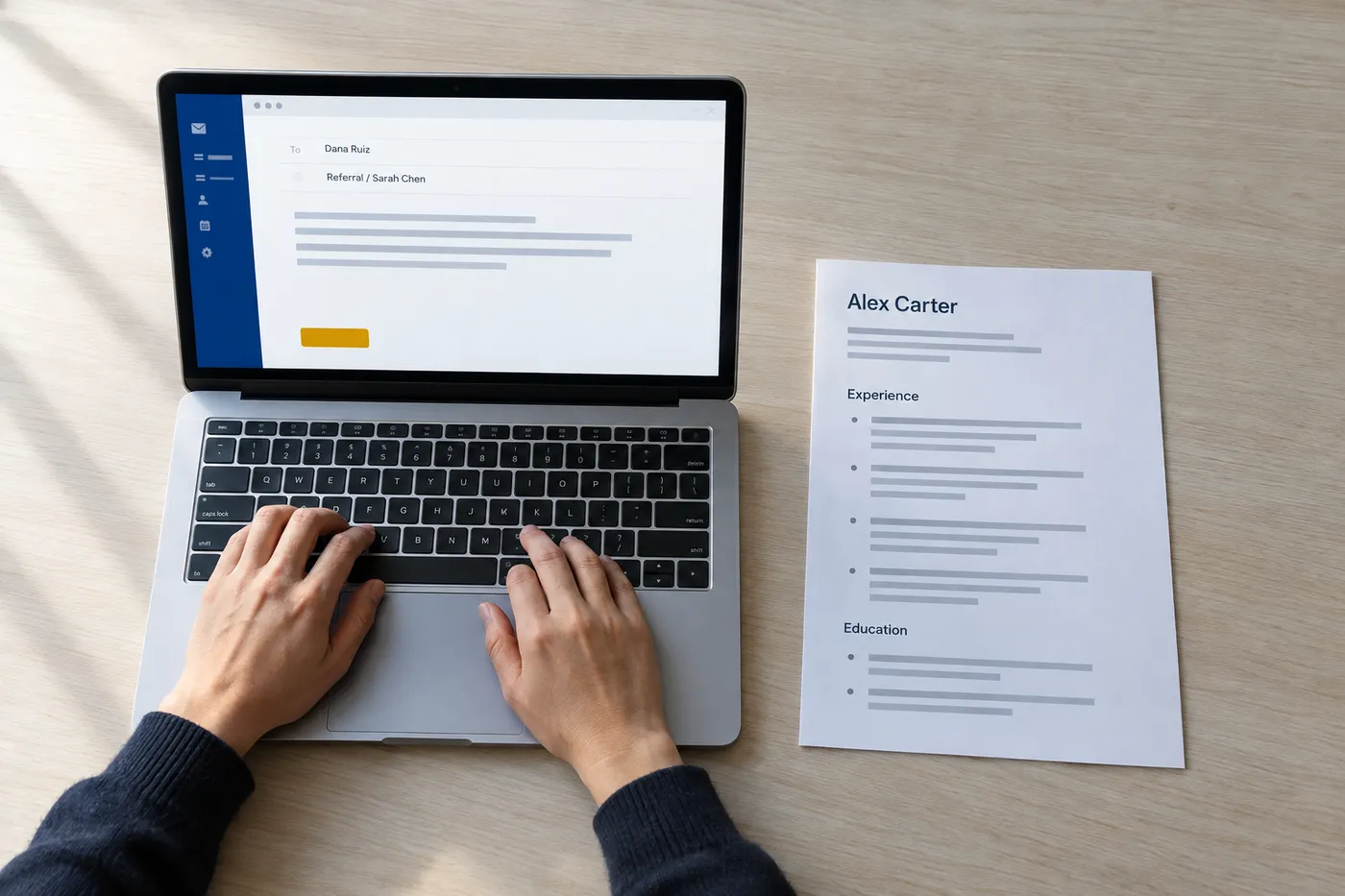
When someone referred you, two emails are due, and most candidates send only one. The interviewer gets your normal thank-you, ideally acknowledging the referral naturally, because it reminds them a colleague vouched for you. The referrer gets a separate note, because their reputation is now attached to your candidacy and they are wondering how it went.
Subject: Thank you, Data Analyst interview
Hi Sofia,
Thank you for meeting with me today. Tom had told me the team was serious about self-serve dashboards, but hearing how much of your week still goes to ad hoc requests made the problem concrete. The stakeholder-tiering approach you described is close to what I built in my last role, down to where it broke, and I would enjoy comparing notes on that.
I appreciate you making the time on short notice.
Best,
Ravi Mehta
And the note to Tom, which can be two lines in whatever channel you normally use:
Hi Tom, the interview with Sofia went well. Thank you again for putting my name in; whatever happens, I owe you a coffee. I will keep you posted.
The update to the referrer is not optional politeness. People who hear back about their referrals refer again. People who do not, do not.
Example 6: When you have heard nothing
This one has a prerequisite: the timeline they gave you has passed. Following up before the stated decision date reads as impatience, and following up twice in a week reads worse. Wait until they are late, then send one short, unresentful nudge, ideally with a small piece of new information so the email carries something besides the question.
Subject: Re: Thank you, Operations Manager interview
Hi Claire,
When we spoke on the 14th you mentioned a decision by the end of last week, so I wanted to check in. I am still very interested, and my own timeline has not changed.
One small update since we met: the Lean Six Sigma certification I mentioned came through, so that box is now checked.
I know these processes slip, so no rush on my end. I would just appreciate knowing where things stand.
Best,
Dana Ruiz
Send it as a reply to your original thank-you so the whole history sits in one thread. If a second week passes in silence, send one final short check-in, then let it go and keep applying elsewhere. Silence past two nudges is an answer. This is also where tracking matters; when you are running many applications at once, stated timelines blur together fast, and an organized job search is what makes a well-timed follow-up possible at all.
Subject lines that get opened
The best subject line is often no new subject line at all. Reply to the thread the recruiter used to schedule the interview, and your email opens with full context, lands in an inbox that already recognizes you, and never touches a spam filter. When you do need a fresh subject, name the role and keep it plain.
| Subject line | Verdict | Why |
|---|---|---|
| Re: Interview confirmed, Tuesday 2:00 p.m. | Best option | Replying in-thread carries the whole scheduling context and gets opened by default. |
| Thank you, Marketing Manager interview, Dana Ruiz | Good | Names the role and the sender; findable later when they search their inbox during the debrief. |
| Thank you, and one better answer | Good | Signals the email contains something beyond courtesy, which earns a real read. |
| Thank you!! | Weak | No role, no name, and the punctuation does you no favors. |
| Following up | Weak | Indistinguishable from a sales email; easy to skim past. |
| Great meeting you today :) | Weak | Reads as filler and tells the recruiter nothing about what is inside. |
What not to attach
The safest number of attachments on a thank-you email is zero. An attachment turns a fifteen-second read into a decision, and it can trip corporate mail filters that a plain-text email sails past. A few things people attach that they should not.
- Your resume, again. They have it in their applicant tracking system (ATS), and re-sending it suggests you think they lost it. The exception is when they explicitly asked for an updated version; send it as a PDF so the formatting survives every inbox and parser it passes through.
- An unsolicited 30-60-90 day plan or slide deck. It reads as presumptuous at the thank-you stage, and a plan written without inside knowledge is usually wrong in ways that hurt you. Save strategic thinking for the working line, one sentence of it.
- Letters of recommendation or reference lists. References come when asked, at the stage they are asked for.
- Large portfolio files. If work samples came up, send a link, not a 40 MB PDF. A link is one click and clogs nobody's inbox.
- Read receipts or tracking pixels. Recruiters notice tracked emails more often than senders think, and it starts the relationship with surveillance.
If the interviewer asked you to send something specific, that request overrides all of this. Send exactly what was asked for, name it clearly in the email, and still default to PDF for anything document-shaped.
Frequently asked questions
- Do employers respond to thank you emails after an interview?
Sometimes, and the response tells you less than you hope. A warm reply is a mildly good sign; silence means nothing at all, because many interviewers read and appreciate the email without answering. Do not send a follow-up asking whether they received it, and do not read tea leaves in the reply speed. The email did its job the moment it was read.
- How do I write a short and sweet thank you email?
Three sentences will do it. "Thank you for the conversation today, especially the walkthrough of how the team handles on-call. Your point about alert fatigue matched what I fixed in my last role, and I would enjoy taking a run at it here. I am looking forward to next steps." Specific thanks, one working line, close. Short is fine; generic is the only real failure.
- What should I say when reaching out after an interview with no update?
Wait until the timeline they gave you has passed, then send one short check-in as a reply to your original thread. Reference the date they mentioned, restate your interest in a sentence, and add a small piece of new information if you have one. No guilt, no pressure. If two polite nudges spread over a couple of weeks go unanswered, move on.
- Does a thank you email actually affect the hiring decision?
It rarely flips a no into a yes, and skipping it rarely sinks a strong candidate. Where it matters is the middle, when two finalists are close and the debrief is looking for tiebreakers. A specific, well-timed email is a small positive signal that costs you ten minutes, and in a close race small signals decide things. A sloppy or copy-pasted one is a small negative signal, which is why generic is worse than nothing.
- Should I send the thank you on LinkedIn instead of email?
Email first, always. It is where hiring correspondence lives, it is searchable during the debrief, and it does not depend on the interviewer checking a social inbox. Use LinkedIn only when you have no email address and no recruiter to forward through, and even then keep the message as short as a good subject line plus two sentences.
- What if I don't have the interviewer's email address?
Send your note to the recruiter or coordinator who scheduled the interview and ask them to forward it. For a panel, write each message separately and say who each is for. Recruiters handle this constantly, and the request itself reflects well on you. Guessing the address format from the company domain is a gamble; a bounced email or a note landing with the wrong person is worse than the forwarding step.
- Is a handwritten thank you note ever worth it?
Almost never for the decision itself, because mail takes days and most hiring decisions do not. If a process moved slowly, or an interviewer went far out of their way for you, a handwritten note after the email can be a memorable extra. Treat it as relationship building, and never as a substitute for the same-day email.

Ready when you are
Send the tailored resume, not the generic one.
Paste a job posting and Roleframe scores your resume against it, then helps you close the gaps one approved edit at a time, so you apply while the role is still fresh.