How to Follow Up on a Job Application (With Email Templates)
by Larbi SahliLast Updated
How to follow up on a job application: exact timing by situation, who to email, three copy-paste templates, and the mistakes that end a candidacy.
On this page
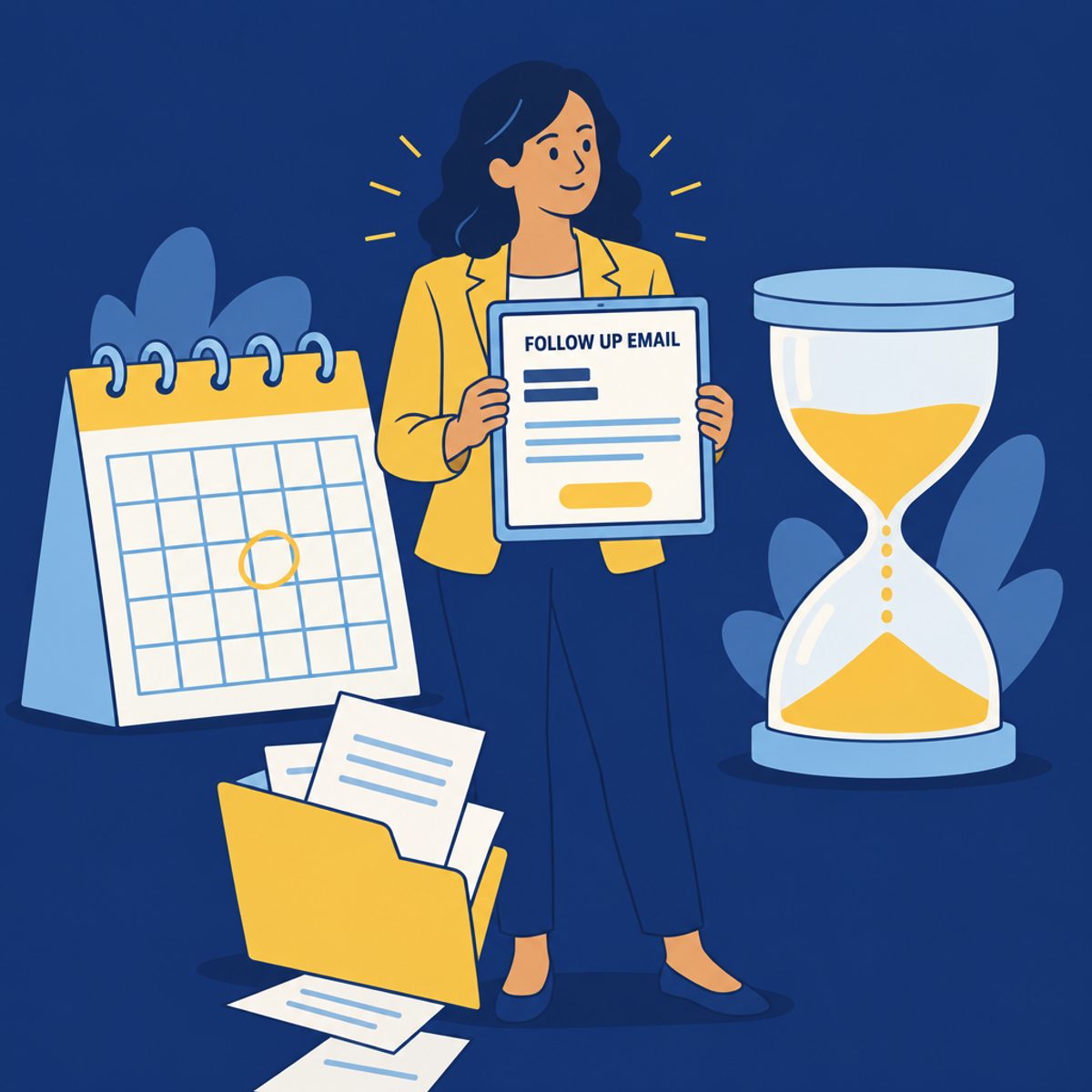
Wait one to two weeks after applying, then send one short email to a named person, usually the recruiter or hiring manager. Name the role in the subject line, restate your interest in two or three sentences, and ask about next steps. If you hear nothing, follow up once more a week later. After that, stop chasing and keep applying elsewhere.
Why one to two weeks is the right window
Recruiters batch applications. On most corporate roles, nobody reads submissions the day they arrive; the recruiter reviews the pile once or twice a week, shortlists, and books screens. A follow-up on day two lands before anyone has looked at your resume and reads as impatience. A follow-up on day ten lands right when the shortlist is forming, which is the one moment a polite nudge can move you from the maybe pile to the call list.
The pattern in tracked application data backs this up. Applications that turn into interviews tend to turn early, within the first couple of weeks, and the odds fade steadily after that. A large share of applications never get any reply at all, which is worth knowing before you invest emotional energy in a third message: silence past a month is usually the answer, not a queue.
So the rule you can quote: wait one to two weeks, email one named person once, follow up one more time a week later, then stop. Everything below is about adjusting that rule to your specific situation and writing the email so it helps rather than hurts.
When to follow up, by situation
The one-to-two-week default assumes a standard corporate posting with no stated deadline. Five common situations change the math.
- A posted closing date. Do not follow up before it. The team is not reviewing anyone until applications close, so a nudge beforehand is noise. Wait until three to five business days after the deadline, then send your check-in.
- A rolling posting ("open until filled"). These are reviewed as applications arrive and often close quietly once a shortlist exists. Follow up earlier here: seven to ten days after applying. Speed matters more on rolling roles than anywhere else.
- You were referred. Your referrer is your first channel, not email. Around a week in, ask them to ping the hiring manager internally: a two-line Slack message from a colleague outweighs any email you can write. If nothing moves by the two-week mark, send your own note and mention the referral by name.
- A staffing or recruiting agency. Follow up after two to three business days. Agency recruiters are paid on placements and work fast; if they have not called within a few days, your profile is not an active match, and a quick nudge either revives it or gets you an honest no.
- A portal-only application (USAJOBS, government, many large enterprises). The portal status is the channel. There is often no reachable human, and federal timelines run on their own clock. Check the portal weekly, and treat statuses like "referred to hiring manager" as real signals. An unsolicited email to a government HR inbox rarely helps and occasionally violates the stated process.
Who to contact, and how to find them
A follow-up sent to a named person gets read. A follow-up sent to careers@company.com goes where all careers@ mail goes. Work through these options in order.
The contact on the posting. Some listings name a recruiter or include a direct email. Use it. This person expects application questions; that is the job.
The recruiter on LinkedIn. Search the company name plus "recruiter" or "talent acquisition," and check who posted or reshared the job. A short connection note or InMail naming the role works fine here; recruiters live on LinkedIn and treat it as a professional channel, not an intrusion.
The hiring manager, at small companies. At a 20-person company there may be no recruiter at all. The person who would manage you is often reachable and often grateful for a direct, brief note. Guess conservatively: "head of marketing" for a marketing role, the owner for a very small business.
Your referrer. If someone inside submitted or endorsed you, they can see the internal status in seconds. Ask them before you email anyone.
The portal, when it is the only door. If the company routes everything through an applicant tracking system (ATS) with no human contact anywhere, respect that. Log in, check the status, and put your energy into the next application instead of hunting for an email address the company deliberately did not publish.
Follow-up email templates after applying
Every template below follows the same skeleton: a subject line that names the role, a first line that says who you are and when you applied, one sentence of evidence you fit, and a specific, low-pressure ask. Keep the whole thing under 100 words. Nobody has ever been hired because a follow-up was long.
Template 1: The standard check-in (one to two weeks after applying)
Subject: Following up on my Product Analyst application (Jordan Lee)
Hi [Name],
I applied for the Product Analyst role on [date] and wanted to check in on the timeline for next steps. I'm still very interested: the focus on retention analytics maps directly to my current work, where I built the dashboards our growth team uses to prioritize experiments.
Happy to send anything else that would be useful. Thanks for your time.
Jordan Lee
[phone] · [LinkedIn]
Template 2: The referral nudge
Subject: Referred by Maria Chen: Senior Accountant application
Hi [Name],
Maria Chen on your finance team suggested I apply for the Senior Accountant role, and I submitted my application on [date]. I've spent the last four years running month-end close for a company at a similar stage, so the role feels like a strong match on both sides.
Could you let me know where things stand in the process? Glad to work around your schedule for a call.
[Name, phone]
Template 3: After the posted closing date
Subject: Registered Nurse (Med-Surg) application: checking in after the June 14 close
Hi [Name],
I applied for the Med-Surg RN position before the June 14 closing date and wanted to confirm my application is in the review pool. I currently carry a five-patient load on a comparable unit and hold the certifications listed in the posting.
If there's a rough timeline for interview scheduling, I'd appreciate knowing it so I can hold availability. Thank you.
[Name, phone]
Adjust the evidence sentence to the strongest overlap between your background and the posting, and keep it factual. This is also a good moment to reread the job description; if you spot a requirement your resume undersells, say so in one line rather than attaching a revised resume unprompted. You can check your resume against the job description first so the sentence you pick is the one the posting actually screens for.
Phone, LinkedIn, or walking in: when email is the wrong channel
Email is the default for corporate and remote roles because it respects the recruiter's queue. Three settings flip that.
Small businesses and owner-operated shops. The owner is on the floor, not in an inbox. A phone call in a slow hour (mid-morning for most trades and offices, mid-afternoon for restaurants) gets an answer the same day. Say who you are, name the job, and ask if they're still hiring. Thirty seconds.
Trades and field work. Contractors, HVAC companies, and plumbing outfits hire by phone and word of mouth. If the posting listed a number, calling is not pushy; it is how the industry communicates. Ask for the person who does the hiring, and have your availability and license status ready to state.
Hospitality and retail. Showing up in person still works here, with rules: go during off-peak hours, dress the way staff dress on a good day, ask for the manager, and keep it under two minutes. "I applied online for the server position last week and wanted to introduce myself" is exactly enough. Never do this at a corporate office; the front desk cannot help you, and the recruiter will hear about it as a negative.
LinkedIn messages sit between channels. A short message to the recruiter who posted the role is fine anywhere. A message to the hiring manager's personal profile is fine at startups and small companies, riskier at large enterprises with formal processes. One message, never a sequence.
Following up on many applications at once
Follow-ups fail at scale for a boring reason: you lose track. Apply to 40 roles and by week three you cannot say which application is nine days old, which recruiter you already messaged, or which company had the June 14 deadline. The worst version of this is following up on the wrong role or misnaming the company, which reads worse than no follow-up at all.
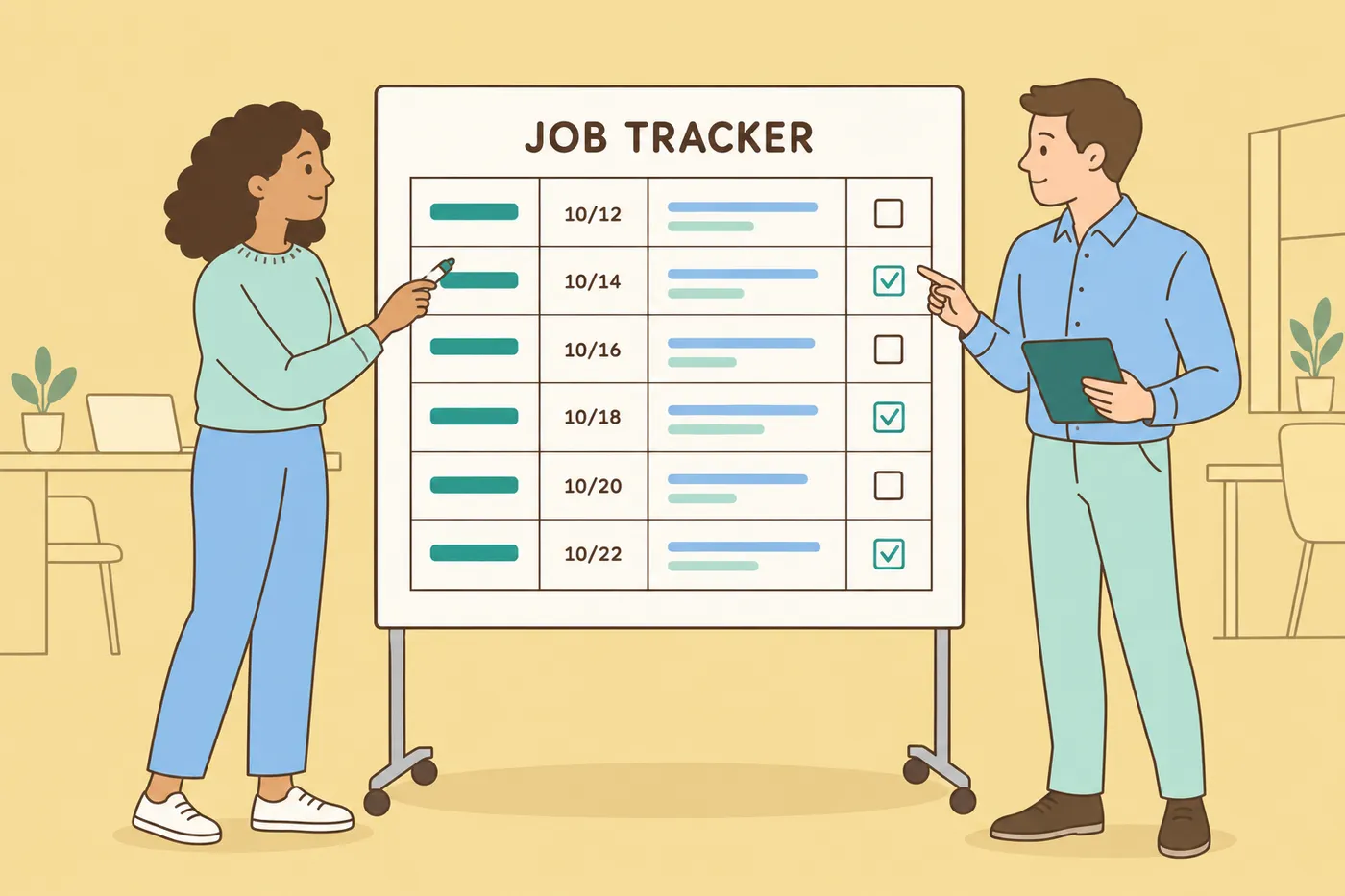
The fix is recording four fields per application: date applied, the contact person, the follow-up date (applied date plus ten days is a fine default), and the last status. A spreadsheet handles this at low volume; here is a job search spreadsheet template if you want to start there. Past a couple dozen active applications, a purpose-built tracker earns its place: Roleframe's job tracking stores each posting with its dates and status, keeps the tailored resume you sent attached to the job, and the Chrome extension captures postings as you apply, so the "which version did I send them?" question never comes up. There is a longer playbook in how to organize your job search if you are running 50+ applications.
Whatever tool you use, review it twice a week. Send the follow-ups that are due, mark the roles that have gone silent past a month as closed, and move that energy into new applications.
Follow-up mistakes that end a candidacy
A follow-up is low risk done right and genuinely damaging done wrong. These are the versions recruiters remember for the wrong reasons.
- Chasing too early. A message within the first few days signals you either did not read the process or will not respect it once hired. Nothing has happened yet; there is no update to give you.
- The third message. Two touches is the ceiling. A third unanswered message converts "interested candidate" into "person we now screen calls from." Silence after two notes is an answer.
- The vague "any update?" with no role named, no date, no context. The recruiter is running fifteen requisitions and cannot place you. Every message must name the role, the date you applied, and your full name, even if it is your fourth exchange.
- Pushing for a decision. "I need to know by Friday" only works if you genuinely hold another offer, and even then it belongs in a phone call, not a cold follow-up. An invented deadline gets you withdrawn from consideration, not prioritized.
- Guilt or grievance. "I'm disappointed not to have heard back" has never produced an interview. If the process frustrates you, the productive response is more applications, not a message the recruiter screenshots for the team channel.
- The wrong channel. Calling a Fortune 500 recruiter's cell, messaging the hiring manager on Instagram, or showing up at a corporate lobby. Match the channel to the company, per the section above.
What silence means, and when to move on
Silence usually means nothing about you. Postings get put on hold, filled internally, or quietly cancelled; recruiters change jobs mid-search; a shortlist of five got the calls and the other 200 applicants got nothing. No-response is the single most common outcome of an online application, and treating each one as a personal verdict will burn you out by week six.
The practical rule: after your second unanswered message, mark the application closed in your tracker and stop thinking about it. If the company reaches out in week seven, wonderful, but your plan should not depend on it. A healthy pipeline has enough active applications that no single silence matters.
Reapplying is fine, and often smart. If the same role reposts after a month or two, the first search likely failed and the bar may have moved; reapply with an improved resume rather than the identical one. For a different role at the same company, there is no cooldown at all. Most applicant tracking systems keep your history, so make sure the new submission is visibly stronger: sharper bullets, better keyword coverage for the new posting, and a summary written for that role rather than recycled.
After you get the interview, the rules change
Everything above covers the gap between applying and hearing back. Once you have spoken to a human, follow-up becomes both expected and higher-stakes: a thank-you note within 24 hours of each interview, and a check-in if the stated decision date passes. The timing, tone, and templates for that stage are different enough to deserve their own guide, and we wrote one: thank you email after an interview, with six examples. While you wait, put the time into preparation rather than inbox-watching; a tight answer to "tell me about yourself" does more for the next stage than any follow-up email can.
Frequently asked questions
- How do you politely ask about the status of your application?
Name the role and the date you applied, then ask directly: "I applied for the [role] position on [date] and wanted to ask where things stand in the review process." Add one sentence restating your interest and stop there. Politeness here is brevity plus specificity; a short message that respects the recruiter's queue reads as professional, while a long apologetic one reads as anxious.
- How do I professionally say I'm following up?
Say it plainly in the subject line and first sentence: "Following up on my [role] application from [date]." You do not need a softer euphemism; "following up" is standard business language and recruiters expect it. What makes it professional is what comes next: one line of evidence you fit and a specific ask about next steps, all in under 100 words.
- How do you ask if you're still being considered for a job?
Ask exactly that, framed around planning rather than pressure: "Could you let me know if I'm still under consideration? I'm scheduling next steps in my search and want to prioritize this role." That phrasing gives the recruiter an easy yes or no and signals you have other options without bluffing a deadline. If the answer is no, thank them and ask to be kept in mind for future openings.
- Should you follow up on a job application at all?
Yes, once, in most cases. A well-timed follow-up costs the recruiter ten seconds, confirms genuine interest, and occasionally surfaces an application a filter buried. The exceptions: postings that explicitly say "no calls or emails," government and portal-only processes where the portal status is the official channel, and any role where you have already sent two unanswered messages.
- How long should you wait to follow up on a job application?
One to two weeks is the default. Go earlier for staffing agencies (two to three business days) and rolling "open until filled" postings (seven to ten days), and later when there is a posted closing date: wait until three to five business days after the deadline. If a second follow-up a week after the first also gets silence, close the loop on your end and move on.
- Is it OK to follow up on a job application by phone?
It depends entirely on the employer. For small businesses, restaurants, retail, and the trades, a short call is normal and often more effective than email; call during a slow hour, name the job, and keep it under a minute. For corporate roles, stick to email or LinkedIn; an unsolicited call to a recruiter at a large company interrupts their day and rarely helps your case.
- Can you follow up through the application portal?
Check the portal status first; many systems show stages like "under review" or "referred to hiring manager," which answers your question without any message. Some portals include a messaging feature, and a short note there is fine as your one follow-up. On government systems like USAJOBS, the portal is the only legitimate channel, so check weekly and skip the email hunt.


Ready to start your new resume?
Writing a resume takes time, and even a polished one can miss what a hiring manager is looking for. Roleframe helps you build a clear, ATS-safe resume in minutes and tailor it to the job you want.


