How to Answer 'Tell Me About Yourself' (Without Rambling)
by Larbi SahliLast Updated
Answer 'tell me about yourself' with the present-past-future formula in under 90 seconds. Example answers for career switchers, grads, and experienced pros.

On this page
Answer "tell me about yourself" with a 60-to-90-second pitch in three parts: present (your current role and what you're good at), past (the experience that got you here), and future (why this job is the logical next step). Build it around the posting's top requirements. Done right, it sounds like the professional summary on your resume, spoken aloud.
What the interviewer is actually asking
"Tell me about yourself" is not an invitation to recite your life story. It's a relevance test. The interviewer has your resume open and wants to hear which parts of it you think matter for this job. Your answer tells them how you prioritize, how you communicate under mild pressure, and whether you understood the role before you walked in.
That reframe changes everything about how you prepare. You're not summarizing your career. You're making an argument: here is the through-line from what I've done to what you need. Everything that doesn't serve that argument gets cut, including your hometown, your college major from twelve years ago, and the two jobs that have nothing to do with this one.
There's a second reason this question matters more than its casual tone suggests: it usually comes first. Interviewers form an impression in the opening minutes and then, consciously or not, spend the rest of the conversation confirming it. A tight, relevant answer buys you goodwill for the whole hour. A rambling one puts you in a hole you spend forty minutes climbing out of.
The present-past-future formula
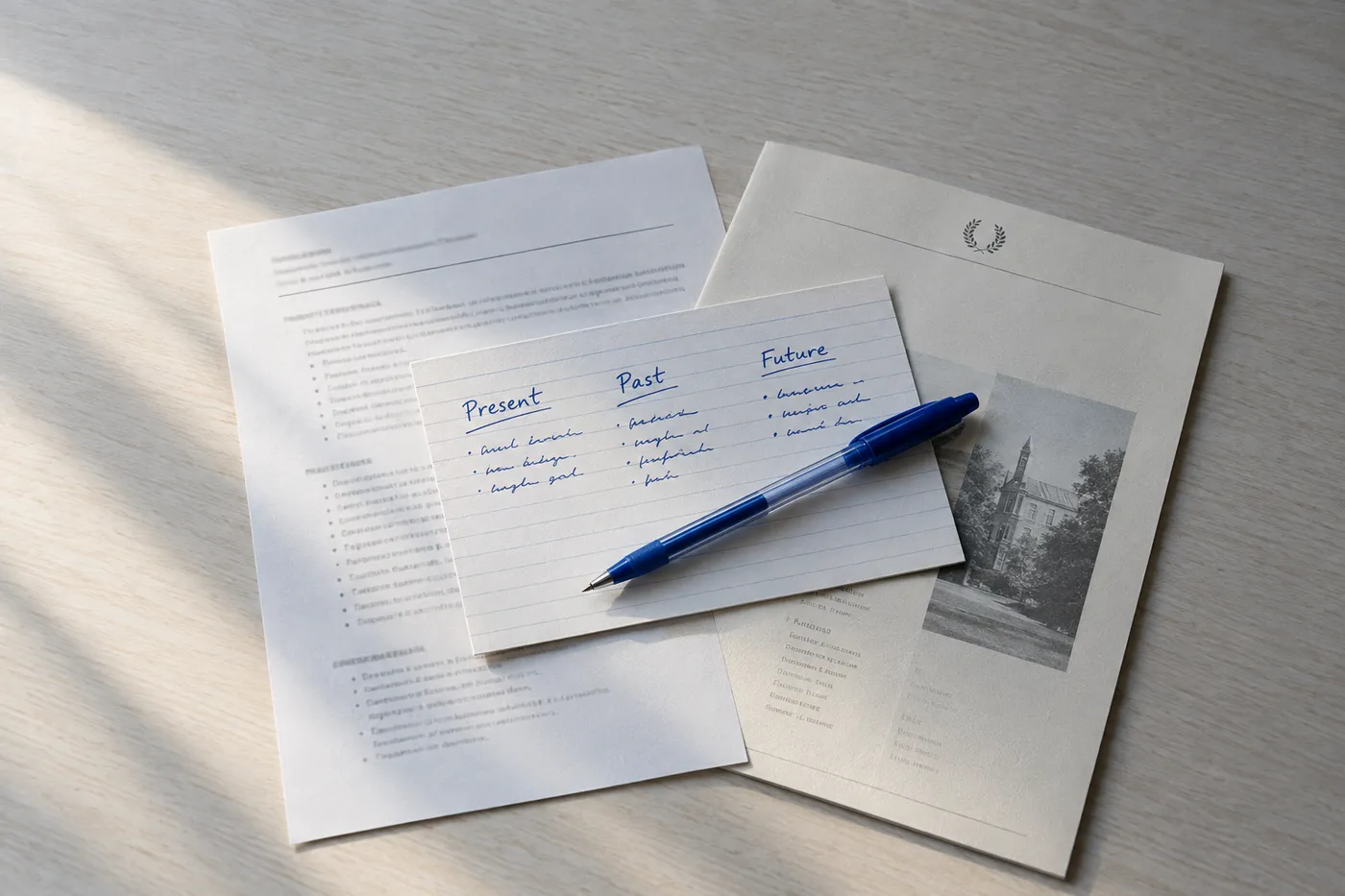
The most reliable structure is present, then past, then future. It works because it front-loads relevance (what you do now), grounds it in proof (what you've done), and ends on the note the interviewer cares about most (why you're here).
- Present (20-30 seconds): Your current role, your core responsibility, and one thing you're known for. "I'm a marketing coordinator at a B2B software company, where I own our email program and webinar pipeline."
- Past (20-30 seconds): The one or two experiences that explain how you got here, with a concrete result attached. Pick achievements that map to the job posting, skip the rest. This is not a chronological walk through your resume.
- Future (15-20 seconds): Why this role, specifically. Name something about the job that connects to what you've just said. "This role is heavier on lifecycle marketing, which is exactly the direction I've been building toward."
The whole thing should run 60 to 90 seconds. That's roughly 150 to 250 words spoken at a natural pace. Shorter and you seem unprepared; longer and you're rambling, no matter how good the content is. Time yourself out loud, because a script that reads as 90 seconds often speaks as three minutes once you add pauses and asides.
Your answer should mirror your resume summary
Here's the shortcut most candidates miss: a well-written professional summary is already the answer to this question. Both are two or three sentences that name your role, your strongest proof points, and your direction. If your resume summary is tailored to the job, your spoken answer is that summary expanded to 90 seconds with one story added.
This alignment isn't cosmetic. The interviewer read your summary minutes before you spoke. When your opening answer matches it, you sound consistent and self-aware. When it contradicts it, when the resume says "data analyst" and the pitch is about wanting to move into design, the interviewer starts wondering which version of you is real.
So write them together. When you tailor the summary at the top of your resume for a specific posting, you're simultaneously drafting your interview opener. One piece of work, two uses. If you haven't written a summary yet, or you're deciding between a summary and an objective, sort that out first; the interview answer falls out of it almost for free. The summary vs. objective question has a clear answer for most experience levels.
What not to say: the pitfalls that sink this answer
- Starting at the beginning of time. "Well, I grew up in Ohio and went to State for undergrad..." The interviewer wanted 90 seconds of relevance and is now bracing for ten minutes of biography.
- Reciting your resume line by line. They have it in front of them. Repeating it verbatim adds nothing and signals you don't know what matters.
- Getting personal too early. Marital status, kids, health, religion. None of it belongs here, and it can put the interviewer in an awkward legal position they didn't ask for.
- Trash-talking your current employer. Even a mild "I'm just done with the dysfunction there" reads as a preview of how you'll talk about them next year.
- Ending with a shrug. Trailing off with "...so, yeah, that's me" wastes the most valuable slot in the answer. End on the future: why this role, stated with intent.
- Memorizing it word for word. A recited answer sounds recited. Know your three beats and the key phrases, then say it slightly differently every time.
- Underselling with hedges. "I've only been doing this for two years" and "I'm not really an expert, but" do the interviewer's rejecting for them. State what you did; let them weigh it.
Example answer: career switcher
Career switchers face the hardest version of this question because the obvious chronology argues against them. The fix is to lead with the transferable skill, not the old job title, and to treat the switch as a decision with evidence behind it rather than a whim. Here's a teacher moving into customer success:
"I've spent six years teaching high school science, and the part of the job I was best at looks a lot like customer success: taking a complicated subject, figuring out where each person is stuck, and getting them to a result they can see. Last year I led our district's rollout of a new learning platform. I trained forty teachers, handled the pushback, and got adoption to the point where the district renewed. That project is what made the switch official for me. Since then I've completed a customer success certification, and I'm looking for a CS role at a company where onboarding is the hard part, which is exactly how this position reads."
Notice the structure: present frames the old career in the new career's language, past supplies one concrete proof story, future names the specific match with the posting. The switch is never apologized for. If you're making a move like this, your resume needs the same treatment; the approach in our career change resume guide is the written version of this answer.
Example answer: recent graduate
With no work history to lean on, your "past" is coursework, projects, internships, and part-time jobs, and the trick is treating them with the same seriousness as jobs. Here's a graduate applying for a junior data analyst role:
"I graduated in May with an economics degree, and I spent most of it on the quantitative side: statistics, SQL, and a capstone project analyzing ridership data for our city's transit authority. That project ended with a recommendation their planning team actually used, which taught me that analysis only matters if someone acts on it. Alongside school I worked in the registrar's office, where I built the reporting spreadsheets the office still runs on. I'm looking for an analyst role where I can do that kind of work full-time, and this one stood out because it pairs junior analysts with a senior mentor, which is how I learn fastest."
Two things carry this answer. First, every item has an outcome attached: a recommendation that got used, spreadsheets still in use. Second, the future beat shows the candidate read the posting closely enough to name a detail. If you're writing the resume side of this, our summary examples for candidates with no experience cover the same move in written form.
Example answer: experienced professional
With ten-plus years of history, the danger flips: too much material, not too little. Pick the two or three data points that map to this job and let the rest of your career live on the resume. Here's a senior project manager:
"I'm a senior project manager with nine years in healthcare IT, currently running implementations for hospital systems. For the last two years I've led our largest account, a twelve-hospital records migration that finished on schedule, which almost never happens in this space. Before that I spent four years on the vendor side, so I've seen these projects from both chairs, and that's made me much better at anticipating where they go wrong. I'm talking to you because this role is about building out a PMO, and turning one-off wins into repeatable process is the part of my job I most want to do full-time."
Nine years compressed into four sentences, and nothing feels missing, because every sentence does work: scale, a differentiating result, a perspective advantage, and a forward-looking reason that matches the role. The interviewer now has three hooks for follow-up questions, all in territory the candidate chose.
How to tailor your answer to the specific job posting
A generic pitch fails for the same reason a generic resume does: the interviewer can't tell why you want this job instead of any job. Tailoring takes about twenty minutes per posting once you have a system.
- Pull the top three requirements from the posting. Not the full wish list, the three things the first paragraph and the first bullets keep repeating. That's what the interviewer was told to screen for.
- Map one achievement of yours to each. If the posting hammers "stakeholder management," your past beat becomes the story where you managed difficult stakeholders, told with a result.
- Rewrite your resume summary and your spoken answer together. Same claims, same vocabulary as the posting, one written and one spoken. When the interviewer's screening notes, your resume, and your opening answer all use the same terms, you register as an obvious fit.
- Say the future beat with the company's name in it. "This role at [company]" forces you to have an actual reason, and interviewers can hear the difference immediately.
Step two is where most people stall, because it's hard to see your own resume through a recruiter's eyes. This is the part Roleframe was built for: paste the posting, and the fit report shows how your resume scores against it, which keywords the role screens for that you're missing, and a prioritized plan of what to emphasize. Those missing keywords are exactly the requirements your interview answer should address, so the report doubles as a prep sheet for this question. You make the edits yourself, which matters here more than anywhere: you have to be able to say every claim out loud to a person's face.
Practice your pitch out loud (and get honest feedback)
A pitch that exists only in your head falls apart in the room. Say it out loud at least five times before the interview, and time it. If you're past 90 seconds, cut the weakest story, not the ending.
Recording yourself on your phone works, though most people can't hear their own filler words. A sharper option: Remi, the career copilot inside Roleframe, runs interview practice built from your actual resume and, on a tailored version, the posting you're applying to. It asks a question, you answer, and it scores the answer against what's on your resume and tells you where it was thin. That scoring measures your answer against your own material, not how a specific interviewer will react, but "your answer never mentioned the migration project, which is your strongest proof point" is exactly the feedback a friend is too polite to give.
Then let it go slightly loose. The goal is a pitch you know in beats, not in sentences, so that on the day it comes out as conversation rather than performance.
Frequently asked questions
- How long should my answer to "tell me about yourself" be?
60 to 90 seconds, which is roughly 150 to 250 words spoken at a natural pace. Under a minute feels unprepared; past two minutes, you've lost the room. Time yourself out loud, because written scripts run much longer when spoken with normal pauses.
- How do you introduce yourself at the start of an interview?
One sentence of present, then let the conversation start: "I'm a supply chain analyst with five years in retail, currently at [company], focused on demand forecasting." Save the full present-past-future answer for when they ask "tell me about yourself." If the introduction and that question happen back to back, don't repeat yourself; expand instead.
- How is this different from answering "Why should we hire you?"
"Tell me about yourself" is your story with the role as the destination; "why should we hire you" is the destination argued directly. In practice, your future beat is the seed of the second answer: take the match you named there, add your two strongest proof points, and state it as a claim. "You need someone who can build process from scratch; I've done it twice, most recently the PMO rollout I mentioned."
- What strengths should I mention in my answer?
The ones the posting asks for, backed by evidence. Scan the job description for the three capabilities it repeats, pick the ones you can prove with a specific result, and work those into your past beat. A strength without a story ("I'm a strong communicator") is filler; a story that demonstrates the strength doesn't even need the label.
- How do I answer "tell me about yourself" with no work experience?
Use the same present-past-future structure, but your "past" becomes coursework, projects, internships, volunteering, and part-time work, each told with an outcome. "My capstone analysis was used by the client" beats "I studied data analysis." Students and freshers who treat projects as jobs, with responsibilities and results, consistently sound more prepared than those who apologize for a short history.
- How do I answer if I'm currently unemployed?
State it in one plain sentence and move forward: "My role was eliminated in a restructuring in March, and since then I've completed a PMP certification and consulted on two short projects." No apology, no long explanation. Interviewers penalize discomfort with the gap far more than the gap itself, so the calmer and shorter your account, the better it lands.
- Should I include hobbies or personal details?
At most one closing line, and only if it adds a memorable, relevant dimension: "Outside work I coach a youth robotics team, which is where I get my patience for debugging." Skip anything about family status, health, age, or religion. It doesn't help you, and it puts the interviewer in territory they're trained to avoid.



Ready when you are
Send the tailored resume, not the generic one.
Paste a job posting and Roleframe scores your resume against it, then helps you close the gaps one approved edit at a time, so you apply while the role is still fresh.