Student Resume Examples: High School to Final Year
by Larbi SahliLast Updated
Four student resume examples from one timeline: high school, first year, internship, and final year. See exactly which lines appear and which disappear.

Users have landed jobs at
- 1Password
- OpenAI
- Notion
- justworks
On this page
Most student resume guides hand you one generic sample and wish you luck. The problem is that "student resume" describes four different documents. The resume that gets a high school junior a lifeguard job would sink a junior-year internship application, and the internship resume would look absurd on someone who has never held a campus job.
So this page does something different. It follows one student, a marketing major we'll track from high school through final year, and shows you the four resumes she actually needs along the way. You'll see exactly which lines appear at each stage, which lines get cut, and why. Babysitting earns a full entry at 16 and disappears by 19. A course project that would be filler on a high school resume becomes the lead section on an internship application. The full internship version is rendered below as a complete example you can copy the structure of.
Find your stage, see what belongs on your page right now, and skip everything else.
One student, four resumes: what appears and what disappears
Here is the whole timeline in one table. Our student babysat and played varsity soccer in high school, worked the dining hall and tutored in her first year of college, ran a real campaign for a local business as a course project in her second year, and landed a marketing internship before her final year. Each column is a resume she actually sent.
| Line on the resume | High school | First year | Internship applicant | Final year |
|---|---|---|---|---|
| Babysitting / neighborhood jobs | Full entry with bullets | One stacked line, if space | Cut | Cut |
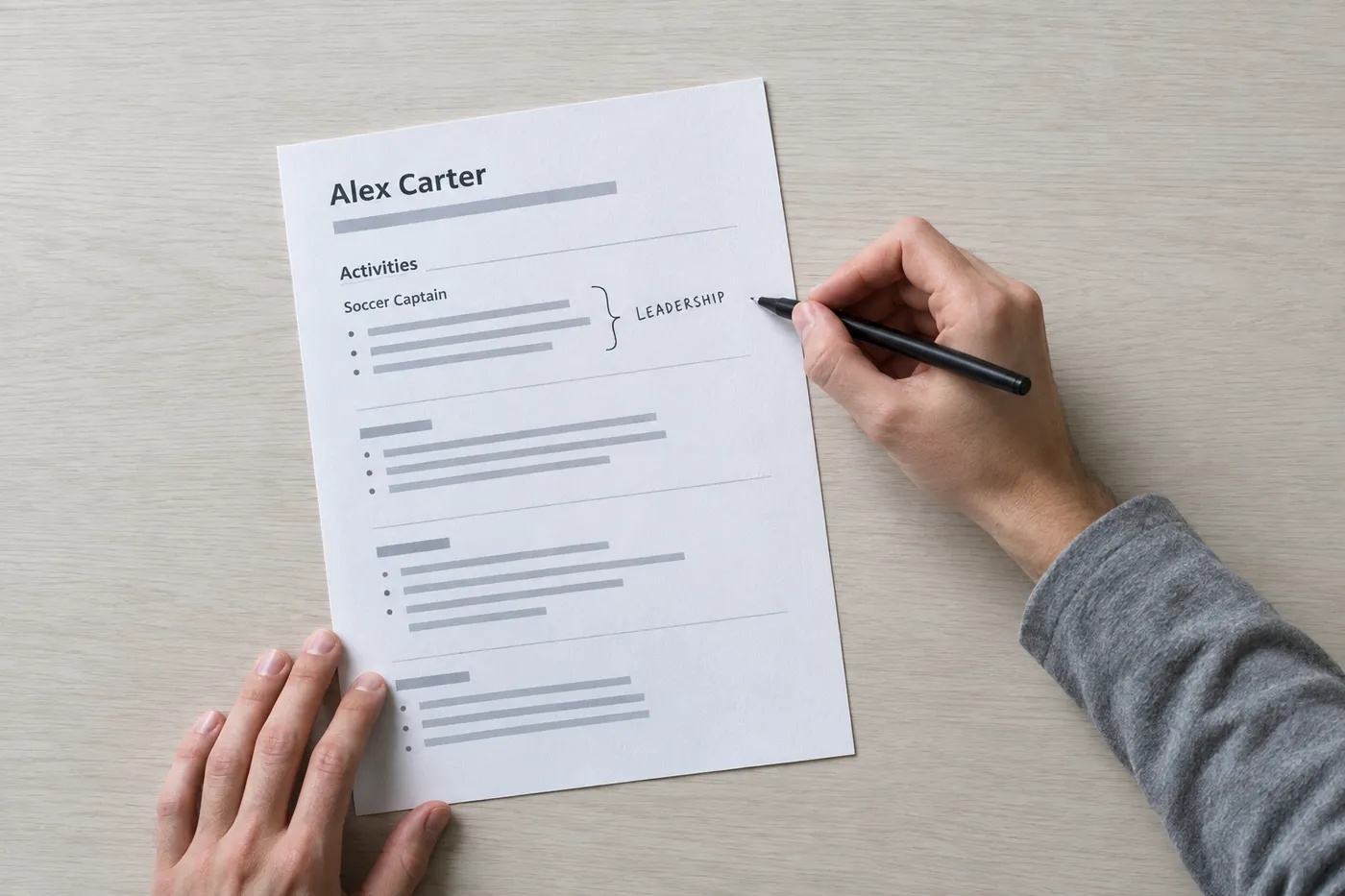
| Varsity soccer, team captain | Full entry with bullets | One line under Activities | Cut | Cut |
| National Honor Society | Honors line under Education | Cut | Cut | Cut |
| Food bank volunteering (weekly) | Full entry with bullets | Keep if still active | Cut | Cut |
| Relevant high school coursework | Listed under Education | Cut | Cut | Cut |
| High school as an education entry | The lead Education entry | Gone (college replaces it) | Gone | Gone |
| Dining hall / work-study job | — | Lead Experience entry | Stacked with other part-time work | One stacked line |
| Peer tutoring | — | Full entry with bullets | Full entry, results added | Trimmed to two bullets |
| Course project (real-client campaign) | — | — | Lead Projects entry | Kept, with outcomes |
| Summer retail job | — | — | Stacked entry | Stacked line |
| Marketing internship | — | — | — | Lead Experience entry |
| GPA | Include if 3.5 or above | Include if 3.5 or above | Include if 3.5 or above | Include if strong, cut otherwise |
| Graduation line | Expected diploma date | Expected May 2028 | Expected May 2028 | May 2028, drop "expected" in final semester |
Two patterns are worth naming. First, high school content has a shelf life of roughly one year of college. By the internship application, nothing from high school survives except the degree in progress it led to. Second, the resume's center of gravity moves. It starts on Education, shifts to campus work in first year, shifts again to projects for the internship, and finally lands on the internship itself. That movement is the entire skill of writing a student resume, and it's why one static template fails you.
The right section order at each stage is its own decision, and it changes as the strongest material changes. If you want the general rule, we've written up the best resume section order by experience level; for students it almost always means Education first until real experience outweighs it.
High school student resume example: no paid work yet
A high school student resume with no experience is a myth. You have experience; you have no job titles. The resume's job is to convert what you've actually done, coursework, sports, babysitting, service hours, into entries an employer can read the way they'd read work history.
Structure for this stage: contact info, Education (your high school, expected diploma date, GPA if it's strong, two or three relevant courses), then an Experience section that treats informal work as real work, then Activities and Volunteering, then Skills. One page, always. If you're wondering how strict that rule is, one page vs. two has a clear answer by experience level, and at this stage it isn't close.
The move most high schoolers miss is writing babysitting like employment. "Babysitter" with no bullets reads like filler. "Provided after-school and weekend care for three families, managing schedules, meals, and homework for kids aged 4 to 11" reads like someone an employer can trust with a register and a closing shift. Same facts, different resume.
- Coursework: list 2-3 courses only if they connect to the job. AP Statistics matters for an office job; sophomore English does not.
- Sports: name the commitment, not just the sport. Season length, practice hours per week, and any leadership role (captain, section leader) are the substance.
- Babysitting, lawn care, tutoring a neighbor: give each a title, a rough date range, and one or two bullets about scope and reliability.
- Service hours: name the organization and the recurring commitment. "120 hours over two years at the county food bank" beats "community service."
- Skip: an objective statement, references, your middle school anything, and a photo.
What this resume is for: a first job as a student, a part-time retail or food service role, a summer program application. The employer reading it wants evidence you show up, follow through, and can be trusted unsupervised. Every bullet should feed one of those three.
First-year college student resume: campus jobs carry it
The first year of college is the awkward stage. Your high school material is aging fast, and your college material is thin. The fix is a hard cut plus a promotion: cut most of high school, and promote whatever campus work you have, however unglamorous, to the top of Experience.
Campus jobs are better resume material than students believe. A dining hall shift is food service under real volume with real shift discipline. A work-study desk job is customer service plus whatever systems you touched. Resident advisor (RA) roles are genuine leadership: conflict resolution, event budgets, being the accountable adult on a floor of eighteen-year-olds. Peer tutoring is the strongest of the lot because it has measurable outputs, sessions per week, students served, and subjects covered.
What survives from high school at this stage: one line for a serious ongoing commitment (you still play club soccer, you still volunteer at the same food bank), and nothing else. The high school itself comes off Education the moment you have a college entry to replace it. Your first-year Education entry leads with the college, the degree in progress, and the expected graduation year.
What this resume is for: a part-time job during term, a summer job back home, early club leadership applications. It is deliberately modest, and that's fine. Its successor, the internship version, is where the ambition goes.
The internship version: coursework, projects, and a named employer
The internship resume is the stage where most students hit a wall, because internships ask for relevant experience and a second-year student has almost none by job title. The answer is to stop leading with job titles. On a strong internship resume, a Projects section does the work that an Experience section does for a professional: it shows the actual skills of the actual field, with outcomes.
Here is our student's internship version in full. She's a second-year marketing major applying for a summer marketing internship. Notice where the weight sits: Education with relevant coursework at the top, then a Projects section led by a course project with a real client, then Experience, where her tutoring job gets full treatment and her dining hall and retail work is compressed into a single stacked block.

Maya Ellison
Marketing Student | Social Media Campaigns & Analytics
Summary
Second-year marketing major (GPA 3.8) with coursework in consumer behavior, statistics, and digital marketing. Ran a live social campaign for a local bakery, growing its Instagram audience 42% in ten weeks, and tutor peers in marketing analytics. Seeking a summer marketing internship.
Professional Experience
Peer Tutor, Marketing & Statistics
Tutor 15+ students weekly in Marketing Principles and Business Statistics, lifting average tutee midterm grades from a C+ to a B range.
Built one-page study guides in Google Docs on the 4 Ps and regression basics, shared with 60+ classmates each semester.
Averaged 4.9/5 across 40 post-session feedback surveys for clarity and patience.
Dining Services & Retail Associate
Served 400+ students per shift on the dining hall line, keeping stations stocked and cutting wait times during peak lunch rushes.
Reached 120% of a summer sales target at Maplewood Outfitters by upselling loyalty sign-ups to 30+ customers each week.
Balanced 18 work-study hours weekly with a full course load while holding a 3.8 GPA.
Education
Ridgeline University
BBA
Bachelor of Science in Physics from Harvard University, Cambridge, Massachusetts, United States.
Languages
Skills
Marketing Tools
Analytics & Data
Content & Social
Foundations
Certifications
Google Analytics Individual Qualification
Projects
Real-Client Social Campaign — Bloom & Batter Bakery
Team Lead
mayaellison.myportfolio.com/bloom-batter
Managed a $300 ad budget and content calendar in Later, growing Instagram followers 42% and post engagement 68% across a ten-week campaign.
Awards
Dean's List (two consecutive semesters)
Ridgeline University
Recognized for building a cloud-native AI productivity tool.
Walk through the example above section by section and the logic shows.
Education first, with coursework doing keyword duty. The internship posting names skills the student hasn't held a job in yet. Relevant coursework is the legitimate place to plant those terms: a course in consumer behavior or digital analytics is honest evidence of exposure. Three or four courses, chosen against the posting, no more.
Projects before Experience. This is the single structural decision that separates internship resumes that work from ones that don't. A campaign run for a real local business, even inside a course, is closer to the internship's actual work than any number of dining hall shifts. Give it a project name, a date, and bullets with numbers: reach, growth, budget managed, deliverables shipped. If your program has a capstone, the same logic applies; here's how to list a capstone project on a resume so it reads like work rather than homework.
Experience, honest and compressed. The tutoring job keeps full bullets because it demonstrates communication and measurable results. The unrelated jobs get stacked (more on that format below) because their function on this resume is reliability, not skills. Cutting them entirely would be a mistake; an internship reviewer reading two years of steady part-time work sees someone who manages time under load.
No summary paragraph. At this stage a summary either restates the resume or inflates it. Space is better spent on a fourth project bullet. If you're set on writing one anyway, at least make it specific; these resume summary examples for candidates with no experience show the difference between a summary that adds information and one that repeats the page.
One more thing before you send it: internship postings are keyword-screened like any other job. Paste the posting into Roleframe and its fit report will show your ATS score against that specific posting and name the keywords you're missing, which for students usually turn out to be coursework and tool names you have but forgot to write down.
Final year: the internship takes the top and "student" framing fades
Once the internship is done, the resume flips. The internship becomes the lead Experience entry with the fullest bullets on the page, written with outcomes: what shipped, what grew, what you owned by the end versus the start. The course project that carried the internship application stays, but moves below the internship and gets trimmed.
Education still sits high for a final-year student, recruiters for new-grad roles look for the degree and date immediately, but it slims down. Coursework goes unless a posting demands a specific competency you can only evidence that way. The expected graduation line becomes just the graduation line: in your final semester, "May 2028" alone is fine, and after graduation "expected" on a past date is an error that gets noticed.
The stacked part-time block shrinks to a single line or disappears, depending on space. By this stage the resume should read like a junior professional's document that happens to end in a degree, because that's what a new-grad recruiter is pattern-matching for.

Where education goes, and how to write the expected graduation line
For every stage on this page, Education sits above Experience. The crossover point, where experience moves up, is roughly your first full-time role after graduation, not before. A student resume with Experience on top signals that the writer copied a mid-career template.
The graduation line trips people up more than it should. The clean formats:
- In progress: "B.A. in Marketing, Expected May 2028" (or "Anticipated May 2028"; both are standard, pick one).
- Final semester: "B.A. in Marketing, May 2028" reads fine; the date is close enough to stand alone.
- High school: "High School Diploma, Expected June 2026" plus the school name and city.
- Transfer students: list the school you'll graduate from with the expected date; the previous school gets one line only if credits or coursework there are relevant.
- Never: a start date range like "2024-2028" without a degree named, or "graduating soon." Parsers and recruiters both want a month and year.
Put the degree name before the school if the degree is the selling point (a B.S. in Computer Science applying to software internships), and the school first if the school is (a well-known university applying broadly). Either parses fine in an applicant tracking system (ATS), the software that reads your resume before a human does; what breaks parsing is burying the date inside a sentence.
GPA, honors, and dean's list: which ones earn a line at each stage
The rule that holds across all four stages: a strong GPA earns its line, a middling one costs you nothing by its absence. Around 3.5 is the conventional include threshold, and some competitive fields (finance, consulting, big-firm law pipelines) effectively require it on the page. Below that, leave it off and let no one ask; omitting a GPA is normal, not suspicious. The full decision tree is in should I put my GPA on my resume.
Honors are stage-specific in a way most guides skip:
- National Honor Society: high school resume only. It dies the day you enroll in college.
- Dean's list: worth a line from first year onward, written with the terms covered ("Dean's List, Fall 2024 - Spring 2026"), not as a bare phrase. One repeated semester is a line; every semester is a stronger line, same amount of space.
- Departmental awards and scholarships: include them at every college stage, with the award name and year. A named merit scholarship is third-party evidence of exactly the kind a thin resume needs.
- Latin honors (cum laude and up): final semester onward, once it's confirmed rather than projected.
- Class rank: high school only, and only if it's genuinely impressive.
Formatting note: honors live inside the Education entry as a sub-line, not in a separate Honors section, until you have three or more. A one-item section is a flag that you're stretching.
The translator: turning clubs, sports, volunteering, and a summer job into bullets
Students don't lack material. They lack translation. A club role, a course project, and a summer job all contain resume bullets; the raw label just hides them. The pattern is always the same: name the action, add the scope (how many, how often, how much), and end with what changed because you did it. Here's the translator applied to the most common student raw material.
Club role. Raw: "Treasurer, Marketing Club." Translated: "Managed a $3,000 annual budget for a 40-member club, tracking spend per event and cutting catering costs enough to fund one additional speaker night per semester." The title alone says you were elected; the bullet says you can handle money and make trade-offs.
Sport. Raw: "Varsity soccer, 4 years." Translated: "Competed four varsity seasons while maintaining a 3.7 GPA; as captain, ran warm-ups and drills for 22 players and coordinated schedules with coaching staff." The employer reading this isn't hiring a midfielder. They're hiring the time management and the willingness to be accountable for a group.
Volunteering. Raw: "Volunteer, county food bank." Translated: "Sorted and packed donations in weekly four-hour shifts for two years; trained new volunteers on intake procedures during peak holiday drives." Duration and recurrence are the point. A one-off service day is a fact; a two-year weekly commitment is a character reference.
Summer job. Raw: "Sales associate, Old Navy." Translated: "Handled register transactions and nightly closing counts during peak summer traffic; resolved returns and sizing issues on a floor serving several hundred customers a day." Even an unrelated job proves throughput and customer composure, which is precisely what an internship supervisor worries about with a first-time hire.
Notice every translated bullet starts with a verb that claims something specific. If your bullets all start with "helped" and "assisted," swap them using this list of action verbs sorted by what they prove; "managed," "ran," and "trained" are claims, "helped with" is an apology.
Stacking short jobs into one block with one date range
By second year, our student has three unrelated jobs: dining hall, summer retail, and a stint at a campus coffee cart. Listed separately, they eat a third of the page and make the resume read like a job-hopper's, which is unfair to a student whose "hopping" is just the academic calendar. The fix is one grouped entry.
The format: a single heading such as "Part-Time & Seasonal Work" with one combined date range ("2024 - 2026"), the employers named inside, and two or three bullets that describe the through-line rather than each job. Something like: worked 10 to 15 hours weekly through every term across dining services, retail, and food service roles while carrying a full course load; trusted with closing procedures and cash handling at two of the three employers.
Why this works: the reviewer gets the signal (sustained, reliable work under load) in three lines instead of twelve, and the page space goes to projects and coursework, which carry the actual keywords. One caveat on the ATS side: parsers expect one employer per entry, so a stacked block won't map each employer cleanly into the system's work-history fields. That's an acceptable cost here, because these jobs aren't where your keyword matches live; your projects and coursework are. Don't stack the one job that IS relevant to the application. If the internship is in retail operations, the retail job gets its own entry back, with full bullets.
Work authorization and availability: the lines international students need
International students face a resume question domestic students never think about: whether to state work authorization. The practical answer depends on what you're applying for.
For internships in the US, a short line helps when it removes a recruiter's ambiguity: "Eligible for summer 2026 internship employment under CPT" (Curricular Practical Training, the F-1 visa's internship authorization) tells a hiring manager the hire is straightforward. The same goes for OPT (Optional Practical Training) on a final-year resume: "Eligible for 12 months of full-time employment under OPT beginning June 2028" answers the question before it's asked. Put the line at the bottom of the resume or in the header area, one line, no elaboration; the details belong in a conversation, not on the page.
What not to do: don't write "visa sponsorship required" on the resume itself. Application forms ask the sponsorship question directly and you should answer it honestly there, but volunteering it as a resume headline invites a reflexive screen-out before anyone reads your projects. There's a real difference between answering a question and leading with it.
For on-campus and part-time jobs, the useful line is availability rather than authorization. F-1 students are typically capped at 20 hours a week while classes are in session, and campus employers know it, so "Available 15-20 hours weekly during term; full-time during breaks" is the line that gets a manager scheduling you in their head. Domestic students applying for term-time work should borrow this line too; stating availability up front is the single cheapest edge in a part-time job resume for students, because scheduling is the manager's first and biggest question.
Formatting rules that hold at every stage
Four resumes, one set of mechanics. One page, no exceptions before graduation. Reverse-chronological order within each section. A simple single-column layout with standard section names (Education, Experience, Projects, Skills, Activities) so ATS parsers map everything correctly; decorative templates with sidebars and icons are where student resumes go to get mangled. Save and submit as PDF, which locks your formatting so the recruiter sees exactly what you built; a .docx can reflow on someone else's machine. If a specific employer's form explicitly demands another format, follow their instruction, and everywhere else default to PDF.
Skip photos, skip "References available upon request," and skip hobbies unless one is genuinely relevant to the job. Every line you cut buys white space, and on a student resume white space reads as confidence.
Frequently asked questions
- What should a student with no work experience put on a resume?
Education with expected graduation date and relevant coursework, then everything you've done that involved responsibility: babysitting or neighborhood jobs written as real entries, sports with the time commitment and any leadership role, club positions with scope (budget, members, events), volunteering with duration and frequency, and school or personal projects with outcomes. The material exists; the work is translating labels into bullets with numbers, as shown in the translator section above.
- What is the best format for a student resume?
One page, single column, reverse-chronological, with Education at the top. Use standard section names so applicant tracking systems parse them correctly, and submit as a PDF so the layout can't shift on the recruiter's screen. Skip photos, sidebars, and skill-rating bars; they add parsing risk and no information.
- How do I write a simple student resume fast?
Work top down: contact info, Education (school, degree or diploma, expected date, GPA if 3.5+), then three to five entries across Experience, Projects, and Activities, each with one to three bullets that state an action and a number. Write the bullets before worrying about design; a plain resume with specific bullets beats a designed one with vague ones every time. Budget an hour for the first draft and fifteen minutes of tailoring per application.
- Should a student resume include a GPA?
Include it if it's roughly 3.5 or above, and always include it where the field expects it, such as finance or consulting internships. Below that, leave it off; omitting a GPA is completely normal and no reviewer treats the absence as an admission. Update or remove it each year as it moves.
- Do I need an objective or summary on a student resume?
Usually no. On a one-page resume, a summary either repeats what's below it or inflates it, and the space is better spent on an extra project bullet. The exception is when you need to explain a target the resume doesn't make obvious, like a biology major applying to marketing internships; then two specific lines can do real work.
- Can I use the same resume for a part-time job and an internship?
You shouldn't, and the four-stage table above shows why: the two applications reward different material. A part-time job resume leads with reliability and availability; an internship resume leads with projects and coursework matched to the posting. Keep one master version with everything on it, then cut down a copy per application rather than rewriting from scratch each time.
- When should I remove high school from my resume?
Remove the high school Education entry as soon as you have a college entry to replace it, which means your first semester. Individual high school activities can survive about a year longer, but only as single lines for commitments that are still active or genuinely exceptional. By the time you apply for internships, nothing from high school should remain.


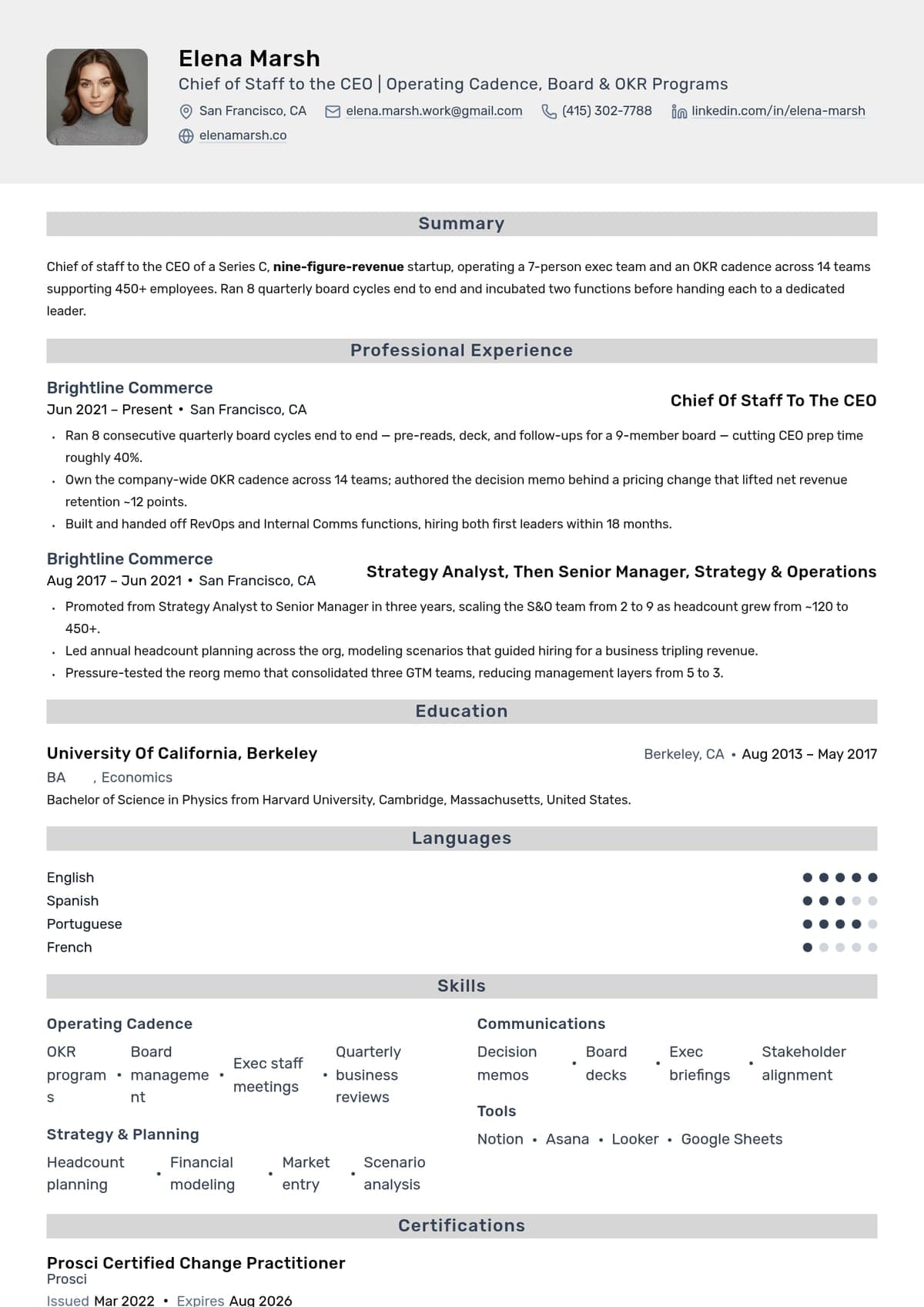
Build yours on the same template.
Every example here is built on a template you can open in the editor. Start from the same layout and write your own experience into it, then download the PDF free, with no watermark.


