Transferable Skills: Examples and How to Show Them on a Resume
What transferable skills are, 10 examples with resume bullets, and how to translate teaching, retail, military, and caregiving experience for a new role.

On this page
Transferable skills are abilities such as communication, problem solving, and planning that carry from one job, industry, or setting into the next. Unlike a certification or a piece of software, they don't expire when you change fields: the project management you learned running a school fundraiser works the same way in a marketing department.
They matter more than they used to, and there is data behind that. The World Economic Forum estimates that 39% of workers' current skill sets will change or become outdated by 2030. When the tool-specific half of your resume has a shelf life, the portable half is what keeps you employable across the shift.
The problem is that most advice stops at a list of nice words. "Communication, teamwork, leadership" on a resume proves nothing, and recruiters have read that exact line thousands of times. This guide covers what transferable skills actually are, which ones employers screen for right now, how to find yours in your real history, and, the part almost every list article skips, how to place and prove them on a resume when your background doesn't match the posting.
Transferable skills vs. job-specific skills
The fastest way to tell them apart: ask whether the skill survives a change of employer, industry, and job title. "Negotiating with vendors" survives all three. "Operating the Epic EHR system" survives none of them unless the next job also runs Epic.
| Transferable skills | Job-specific skills | |
|---|---|---|
| What they are | Abilities that apply across roles and industries | Knowledge tied to one role, tool, or field |
| Examples | Problem solving, writing, planning, training others, data analysis | A nursing license, Salesforce administration, Python, forklift certification |
| Where they come from | Any job, plus volunteering, caregiving, school, side projects | Formal training, credentials, on-the-job practice in that field |
| How employers check them | Behavioral interview questions and the evidence in your bullets | Certifications, portfolios, technical screens, keyword filters |
One correction to a common assumption: transferable does not mean soft. Data analysis, budgeting, technical writing, and spreadsheet modeling are hard skills that transfer across most industries. The useful split is portable versus non-portable, and the strongest resumes for a career move lead with portable hard skills backed by soft-skill evidence. If you want the full breakdown of that distinction, see our guide to hard skills vs. soft skills on a resume.
10 transferable skills employers screen for, with resume bullets
These aren't picked at random. The World Economic Forum's 2025 outlook puts analytical thinking at the top of employers' core-skill list, with seven in 10 companies calling it essential, and shows resilience, flexibility, and leadership rising sharply since its 2023 assessment. LinkedIn's 2026 talent analysis points the same direction: as AI absorbs more repetitive work, demand grows for problem solving, adaptability, and collaboration. For each skill below, the bullet shows what evidence looks like, because the skill name alone is worth nothing.
1. Analytical thinking
The ability to break a messy situation into parts, find the pattern, and decide what matters. Employers rank it first for a reason: it's the skill AI tools amplify rather than replace.
- Analyzed six months of customer return data, identified two products driving 40% of returns, and presented findings that led to a packaging change.
2. Problem solving
Analytical thinking finds the issue; problem solving fixes it under real constraints. The bullet should name the constraint, because "solved problems" without one is filler.
- Resolved a chronic Friday staffing shortfall by redesigning the shift-swap process, cutting last-minute callout coverage from weekly to under once a month.
3. Communication
The most-claimed and least-proven skill on resumes. Specify the mode and the audience: wrote for executives, explained technical material to non-technical people, de-escalated angry customers.
- Translated engineering release notes into customer-facing announcements read by 12,000 subscribers, reducing support tickets after each release.
4. Collaboration
Working across functions, not just alongside teammates. The strongest evidence involves people who didn't report to you and didn't share your goals.
- Coordinated between the kitchen, front-of-house, and events team to run 30+ private functions per year with zero double-bookings.
5. Leadership
You don't need the title to claim it
Leadership means someone's outcome improved because you took responsibility for it. Training a new hire, running a project, or owning a decision all count, with or without direct reports.
- Onboarded and trained 8 new associates over two years; 6 were still with the company at the 12-month mark, above store average.
6. Adaptability and resilience
Per the World Economic Forum, resilience, flexibility, and agility have risen substantially in importance since 2023. Evidence means a change you absorbed: a system migration, a reorganization, a doubling of volume.
- Maintained full patient caseload through a records-system migration, becoming the unit's go-to trainer for the new software within a month.
7. Organization and planning
Managing competing deadlines, resources, and dependencies. Quantify the moving parts: how many projects, people, or dollars were in play at once.
- Managed scheduling, supplies, and appointments for a household of five including two family members with complex medical needs, coordinating 15+ providers.
8. Digital and data literacy
LinkedIn's 2026 data shows digital and data literacy becoming baseline expectations in technical and non-technical roles alike, and U.S. jobs requiring AI-literacy skills grew 70% year over year. You don't need to be an engineer; you need to show you pick up tools fast and can work with numbers.
- Built a spreadsheet dashboard tracking weekly sales by category, replacing a manual report and saving the manager 3 hours per week.
9. Customer focus
Understanding what someone needs, often before they say it clearly, and acting on it. Every client-facing, patient-facing, student-facing, or public-facing role builds this.
- Resolved escalated guest complaints without manager involvement in 9 of 10 cases, contributing to the location's highest satisfaction score in the region.
10. Creative thinking
Also on the WEF's list of skills expected to grow in importance alongside AI adoption, together with curiosity and lifelong learning. Evidence is an approach nobody handed you: a process you invented, a workaround that stuck.
- Designed a peer-review rotation for lesson plans that the department adopted school-wide the following year.
How to identify your transferable skills in four steps
The usual advice here is a worksheet: brainstorm your skills, circle your favorites. That produces a list of adjectives with no connection to any real job. This process ends in a result instead: a matched list of what a specific posting asks for and what your history already proves.
- Inventory what you actually did, not what your title says. For each role, paid or unpaid, write down the recurring situations: deadlines you hit, conflicts you settled, systems you learned, people you trained, numbers you moved. Ignore job-description language; describe it the way you'd tell a friend.
- Name the skill behind each situation. "Handled the schedule when two people quit" is adaptability plus planning. "Explained the treatment plan to worried families" is communication under pressure. One situation often proves two skills; note both.
- Pull the skill terms from a real target posting. Print the job description and mark every ability it names, in the exact words it uses: "stakeholder management," "cross-functional collaboration," "prioritization." Requirements sections and repeated terms carry the most weight, because those are the words recruiters and applicant tracking system (ATS) filters search for.
- Match your inventory against the posting, and grade the evidence honestly. For each skill the posting names, ask two questions. Does my resume use this term or a close synonym? And does at least one bullet demonstrate it? A skill that appears once in your skills section with no supporting bullet is weak evidence, and a recruiter reads it as padding. A skill you can demonstrate but never named is a missing keyword, and it needs a placement: usually a rewritten bullet in the most relevant role, or a line in your summary.
Step 4 is the one people skip because doing it by hand is tedious. It's also the step Roleframe automates: duplicate your base resume for a job, paste the posting, and the fit report lists the exact skill terms the posting names, marks which ones your resume already covers, and flags the gaps with a prioritized plan for where each fix belongs. You make the edits yourself, with Remi, the career copilot, suggesting rewrites you approve line by line. If you'd rather run the audit manually first, our guide to using a resume keyword scanner walks through the whole process.
Translating common backgrounds into transferable skills
The skill was always there; the vocabulary is what's stopping the recruiter from seeing it. A hiring manager for an operations role will not translate "classroom management" into "managing competing priorities under pressure" for you. These translations do it explicitly, in language the target industry uses.
Transferable skills from teaching
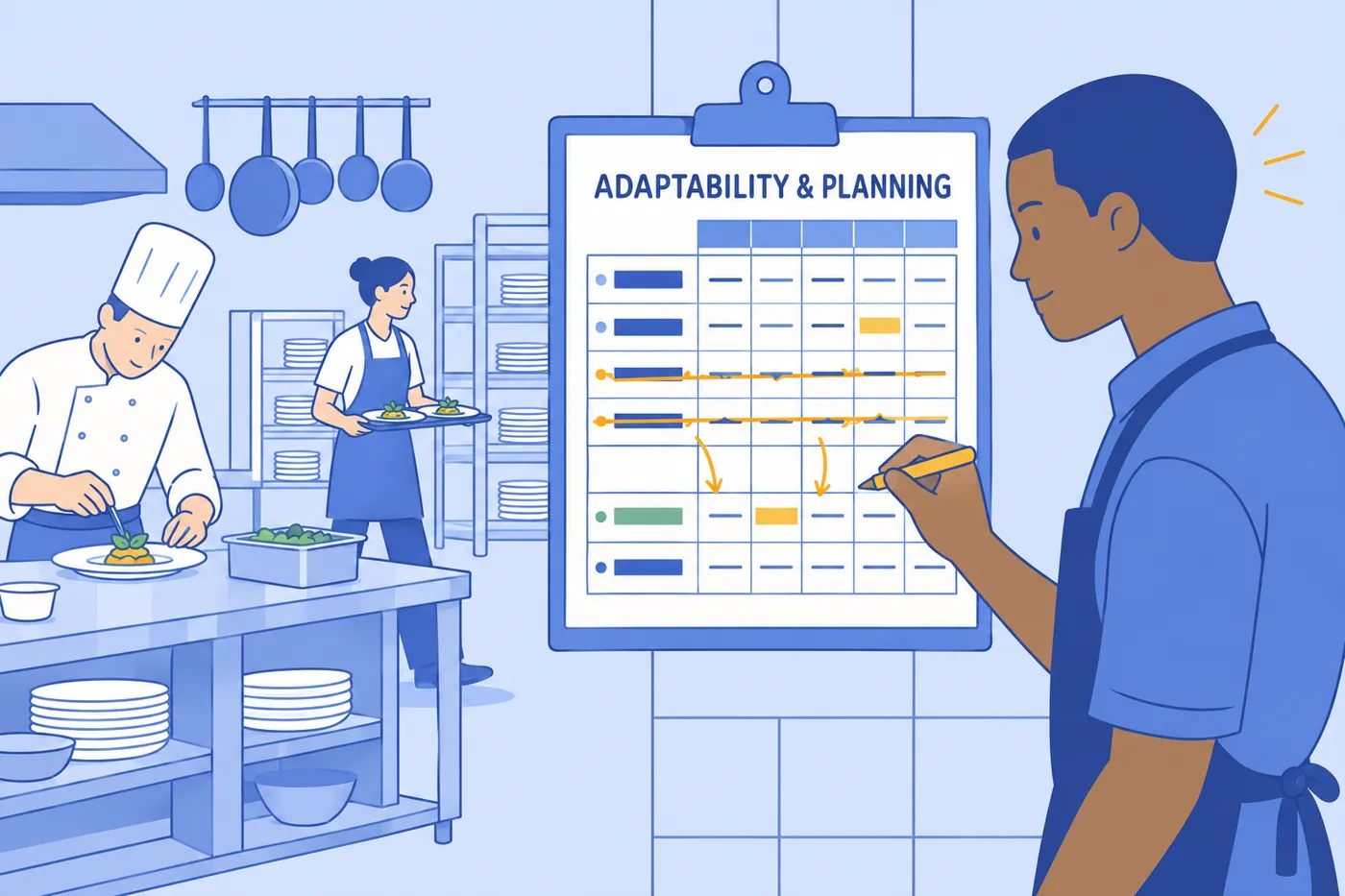
Teachers are the most systematically undersold candidates I see. A teacher plans and delivers to a tough audience daily, manages 25+ stakeholders with conflicting needs, analyzes performance data, and reports to multiple oversight layers. The translation problem is that education vocabulary sounds domestic to corporate ears.
- Curriculum design → instructional design, content development, program development
- Differentiated instruction → adapting communication and delivery to different audiences
- Classroom management → facilitation, managing competing priorities, de-escalation
- Parent-teacher communication → stakeholder management, client communication
- Data-driven instruction → data analysis, performance tracking, iterating on results
- IEP coordination → cross-functional coordination, compliance documentation
Rewritten bullet: instead of "Taught 5th grade math to three class sections," write "Designed and delivered a year-long program for 85 learners at three ability levels, using assessment data to adjust pacing and raising proficiency rates year over year." Same job, different resume.
Transferable skills from retail
Retail builds commercial skills most office workers never develop: live sales, inventory logic, loss prevention, and performance against visible daily targets. Lead with the numbers, because retail generates them constantly.
- Hitting sales targets → revenue ownership, KPI accountability, upselling and cross-selling
- Handling returns and complaints → conflict resolution, customer retention
- Opening/closing the store → operational responsibility, cash handling, key-holder trust
- Managing stock → inventory management, supply coordination, shrink reduction
- Covering shifts and training seasonal staff → team leadership, onboarding
Transferable skills from hospitality and bar work
Hospitality proves performance under pressure better than almost any office role. A busy service is a live operations problem: limited capacity, unpredictable demand, quality standards that can't slip, and customers watching in real time.
- Working a full section or bar on a peak night → prioritization and multitasking under sustained pressure
- Recovering a bad table experience → service recovery, de-escalation, judgment calls without a manager
- Cash and till reconciliation → accuracy, accountability, basic financial controls
- Coordinating with the kitchen during a rush → real-time cross-team communication
- Responsible-service rules and age checks → regulatory compliance and enforcing policy with difficult customers
Transferable skills from the military
Veterans usually have the opposite problem from teachers: the skills are obviously senior, but the acronyms hide them. Write every bullet so a civilian recruiter with zero military exposure understands the scope on first read. Spell out unit sizes as headcounts, budgets as dollars, and operations as projects with outcomes.
- Leading a squad or platoon → team leadership with headcount, training, and accountability for outcomes
- Logistics and supply roles → operations management, procurement, asset tracking at stated dollar values
- Mission planning → project planning, risk assessment, contingency design
- Standard operating procedures → process documentation and quality control
- Operating in changing conditions → adaptability with the highest stakes there are
Transferable skills from caregiving
Caregiving, paid or unpaid, is coordination work: scheduling providers, managing medications and budgets, advocating with institutions, and responding to emergencies with no backup. If you left the workforce to care for someone, you can present that period as skill-building rather than a blank. Frame it factually, and pair it with our guide on explaining an employment gap without apologizing for the cover-letter side.
- Coordinating doctors, insurers, and services → case management, vendor coordination, persistent follow-up
- Managing medications and appointments → attention to detail with real consequences for error
- Dealing with insurance and benefits systems → administrative problem solving, appeals, documentation
- Managing a care budget → financial planning and cost control
- Handling medical emergencies → crisis response and calm decision-making
Where transferable skills go on a resume
Three placements, three different jobs. The summary frames the skill, the skills section names it in the posting's exact words, and the experience bullets prove it. A skill that appears in only one of the three is undersold; a skill that appears in the skills section but nowhere else reads as a keyword you typed in.
The summary: frame the transfer
For a career change, the summary is where you connect the dots before the recruiter has to. Name your background, name the two or three portable skills that map to this role, and anchor at least one with evidence: "Former secondary teacher with 6 years designing programs for 100+ learners, moving into instructional design; built assessment-driven content that raised proficiency rates three years running." More patterns for different situations are in our resume summary examples.
The skills section: use the posting's words
ATS keyword filters and skimming recruiters both search for the posting's terms, so match them. If the job says "stakeholder management," write "stakeholder management," not "relationship building." Keep the section tight: the skills this posting asks for that you can prove, plus your portable hard skills. Our skills-by-role guide covers what belongs there for 120 job titles.
The bullets: carry the proof
Every transferable skill you claim needs at least one bullet demonstrating it, following situation, action, result. This is where the audit from step 4 pays off: for each skill the posting names, you know whether a bullet backs it, and if none does, you know which role in your history is the natural home for a rewritten one. When you finish, export as PDF, which preserves your formatting through whatever system reads it next.
Several jobs, gaps, or unrelated roles: the non-linear history
A patchwork history isn't a defect to hide; it's an editing problem to solve. The mistake is presenting each role on its own terms, which forces the recruiter to find the thread. Your job is to pick the thread first and cut everything that isn't on it.
Stay with reverse chronological format. Recruiters trust it, and a functional resume that hides your dates raises more suspicion than any gap. Do the transferable-skill work inside the structure instead:
- Pick one thread before you write anything. Decide which two or three transferable skills this specific application turns on, and state them in your summary. Every role below then exists to prove that thread.
- Give each role one job. From a five-year retail stint, keep only the bullets that feed the thread: maybe the training bullet and the KPI bullet, nothing about stocking. Three strong bullets beat seven complete ones.
- Compress the unrelated. Roles that contribute nothing to the thread get one line, or get grouped under a single heading like "Earlier experience" with no bullets at all.
- Treat gaps as chapters, not confessions. A caregiving period, a return to school, or freelance stretch gets a dated entry with skill evidence, exactly like a job. Unexplained white space invites the worst assumption; a labeled chapter doesn't.
- Re-pick the thread per application. The same history supports different threads for different jobs, which is why one resume can't serve them all.
If the non-linear history is a full career change rather than a varied path, the structure decisions get bigger, from section order to whether you need an objective. Our career change resume guide covers that end to end.
How to prove transferable skills in an interview
The resume gets you into the room; the interview tests whether the skills are real. Interviewers probing transferable skills almost always use behavioral questions ("tell me about a time you..."), and the honest preparation is one specific story per skill you claimed, structured as situation, task, action, result. The STAR method exists for exactly this.
Three things separate a convincing transfer story from a weak one. First, tell it in the target industry's vocabulary: the teacher interviewing for a project coordinator role says "stakeholders," not "parents," without hiding where the story happened. Second, bring the number, because "it went well" is forgettable and "complaints dropped by half" is not. Third, close the loop yourself: end the story with one sentence on how the same skill applies to their problem. Interviewers hiring across industries are doing that translation in their heads; the candidate who does it for them looks like a safer bet.
Mistakes that turn transferable skills into filler
Transferable skills have a credibility problem on resumes precisely because they're so easy to claim. These are the patterns that make recruiters skim past yours.
- Listing skill names with no evidence. "Strong communicator, natural leader, detail-oriented" in a skills section, with no bullet demonstrating any of it, reads as padding. Every claimed skill needs a proving bullet or it comes out.
- Adjective stacking in the summary. "Motivated, results-driven team player" says nothing a recruiter can verify. Replace three adjectives with one fact.
- Copying the posting's skill list verbatim into your skills section. Recruiters recognize their own job description, and an ATS match with no supporting experience fails at the human stage anyway. Match the terms you can prove; skip the ones you can't.
- Claiming a skill your history contradicts. "Excellent prioritization" on a resume with three formatting inconsistencies undercuts itself. The document is a work sample.
- Ignoring the job-specific requirements entirely. Transferable skills carry a career change, but they don't excuse missing a stated hard requirement. If the posting requires a certification you lack, address it (in progress, planned, or equivalent experience) rather than hoping soft skills paper over it.
- Using the same transferable framing for every application. The retail manager applying to operations roles and account management roles needs a different thread for each. One generic "transferable" resume is just a generic resume with extra steps.
Frequently asked questions
- What are 10 transferable skills?
A strong core ten: analytical thinking, problem solving, communication, collaboration, leadership, adaptability, organization and planning, digital and data literacy, customer focus, and creative thinking. Analytical thinking tops employer demand, with seven in 10 companies calling it essential per the World Economic Forum's 2025 outlook. On a resume, pick the three or four your target posting actually names rather than listing all ten.
- What are the 7 transferable skills?
Career frameworks that use seven categories typically group them as: communication, teamwork, problem solving, leadership, organization, adaptability, and technology skills. The grouping matters less than the evidence: whichever framework you use, each skill you claim needs a resume bullet or interview story demonstrating it in a specific situation with a result.
- What are the most in-demand skills right now?
Analytical thinking leads the World Economic Forum's employer rankings, and the WEF names AI and big data, networks and cybersecurity, and technological literacy as the fastest-growing skill areas through 2030, with resilience, flexibility, and leadership rising sharply. On the transferable side, LinkedIn's 2026 analysis shows growing demand for problem solving, adaptability, and collaboration as AI takes over more repetitive work, and reports that U.S. jobs requiring AI-literacy skills grew 70% year over year.
- Are transferable skills the same as soft skills?
No. All soft skills are transferable, but plenty of hard skills transfer too: data analysis, budgeting, spreadsheet modeling, and technical writing work in almost any industry. The useful question is whether the skill survives a change of employer and field, not whether it's technical. Our guide to hard vs. soft skills covers how to balance both on one page.
- What are transferable skills from bar work?
Bar work proves multitasking under sustained pressure, cash handling and reconciliation, conflict de-escalation with difficult customers, upselling against sales targets, and regulatory compliance through age checks and responsible-service rules. Quantify where you can: covers per shift, till accuracy, or peak-night volume all translate directly into operations and customer-facing roles.
- How many transferable skills should I list on a resume?
Claim only what the posting asks for and your bullets can prove, which usually means three to five transferable skills woven through the summary and experience section, alongside your job-specific hard skills. A skills section stuffed with ten soft-skill names and no supporting evidence reads as filler and weakens the skills you genuinely have.
- How do I show transferable skills with no work experience?
Pull evidence from coursework, group projects, volunteering, clubs, sports, and part-time or informal work, and write it in the same situation-action-result format a job bullet uses. Organizing a fundraiser proves planning and budgeting; captaining a team proves leadership; a group project with a deadline proves collaboration. The source of the evidence matters far less than its specificity.


Turn your skills into proof.
A skills section helps most when your experience backs it up. In the editor, write each skill into a bullet about real work, then check the page against the posting before you send it.


