Resume Summary Examples for 20 Roles and Career Stages
Twenty resume summary examples by role and career stage, each annotated with the move that makes it work, plus a ten-minute method for writing your own.


On this page
A resume summary is the three or four lines at the top that a recruiter reads before deciding whether to read anything else. Most candidates spend those lines on adjectives. Results-driven professional with a proven track record describes every other applicant in the pile, which means it describes no one.
The twenty examples below do the opposite. Each one is built from specifics a hiring manager can check in an interview, and each is annotated with the structural move that makes it work, so you can copy the move rather than the sentence. After the examples, you get the words to cut, a ten-minute method for writing yours from a resume you already have, and a way to check the result against the actual posting.
What a resume summary is for
The summary has one job: make the reader want the next thirty seconds. A recruiter skimming a stack decides fast, and the summary is the one block they reliably read in full. It should answer, in the reader's language, who you are, what you have done that this role needs, and why you are pointed at this job. It is a pitch for the interview, and a good one names things the rest of the resume then proves.
A summary is for people with evidence. If you have no work history at all, an objective can serve better, and the line between the two matters more than most guides admit. I've broken that down in resume summary vs. objective. For almost everyone with even a year of experience, an internship, or a serious project, the summary wins.
The three-line structure that works for almost everyone
Nearly every strong summary I've seen in a real pipeline follows the same shape. Three lines, each with a distinct job:
- Line 1, identity: your title (or target title), years of experience, and domain, phrased the way the posting phrases it. If the job says "Project Manager" and your last title was "Delivery Lead," line 1 is where you bridge that.
- Line 2, proof: your two strongest role-relevant results, with numbers. A before-and-after beats a raw figure, and a raw figure beats an adjective.
- Line 3, direction: what you bring to this role specifically, or where you are pointed. This is the line you rewrite per application; the first two mostly hold.
Why this shape works: recruiters and screening software both scan for the same things first, the job title and the top skills. A summary that mirrors the posting's title and names two or three of its high-priority skills, in natural sentences rather than a keyword pile, gives both readers what they scan for. Modern screening reads context, so a skill dropped into a sentence about a real result counts for more than the same skill listed cold.
Keep it under roughly 60 words. Every example below fits that budget, and you'll notice none of them needed an adjective to do it.
Twenty resume summary examples, annotated
Steal the structure, never the sentences. The numbers in these examples are illustrative; yours will come from your own bullets, and the ten-minute method further down shows you how to find them. Fourteen examples here cover common roles, then three cover career stages and three cover senior and executive levels.
1. Software engineer (mid-level)
Software engineer with 5 years building payment and billing systems in Java and Go. Cut checkout API p95 latency from 900ms to 210ms and led the extraction of a monolith's billing module into services handling 2M transactions a day. Looking to bring that reliability focus to a platform team operating at scale.
The move: domain before language. "Payment and billing systems" tells a hiring manager more than a stack list ever will, and the before-and-after latency number is the kind of claim an interviewer can probe, which is exactly why it reads as true.
2. Data analyst
Data analyst with 3 years in e-commerce, working daily in SQL, Python, and Tableau. Built the returns-rate dashboard that surfaced a sizing defect costing $400K a year, then worked with merchandising to fix it within a quarter. Strongest at turning messy event data into decisions non-technical teams actually act on.
The move: a finding-to-outcome story in one sentence. Most analyst summaries stop at "built dashboards." This one shows the dashboard changed a decision, which is the whole job.
3. DevOps engineer
DevOps engineer with 4 years running AWS infrastructure for a 60-person product organization. Took deploys from weekly to 30+ a day on a GitHub Actions pipeline and cut mean time to recovery from 4 hours to 25 minutes. Terraform, Kubernetes, and Datadog are the daily stack.
The move: the two metrics DevOps hiring actually turns on, deploy frequency and recovery time, stated as swings. The stack gets one plain sentence at the end instead of being smeared across all three lines.
4. IT support specialist
IT support specialist handling 40+ tickets a day for a 500-employee company, resolving 85% on first contact. Administer Google Workspace, Jira Service Management, and Intune, and wrote the onboarding runbook that cut new-hire setup from two days to three hours.
The move: volume plus a quality rate. "40 tickets a day" alone could mean chaos; "85% resolved on first contact" turns it into competence. The runbook line shows initiative without saying the word.
5. Project manager
PMP-certified project manager who has delivered 12 software implementations for healthcare clients: all under budget, 10 of 12 on schedule. Managed budgets to $2.4M and cross-functional teams of up to 15. Known for the status report executives actually read.
The move: the certification leads because recruiters filter on it, and "10 of 12 on schedule" is more credible than "consistently on time." A fraction admits reality, and admitting reality is what makes the rest believable.
6. Product manager
Product manager with 4 years owning activation and onboarding for a B2B SaaS product with 40K accounts. Ran 30+ A/B tests that lifted trial-to-paid conversion from 11% to 16%, and shipped a self-serve migration flow that cut related support tickets 35%.
The move: owning a metric, then moving it. PM summaries that list responsibilities read like job descriptions; this one reads like a scoreboard.
7. Marketing manager
Marketing manager who grew organic traffic from 90K to 310K monthly sessions in 18 months and built a paid program returning 4.2x on $60K monthly spend. Hands-on in GA4, HubSpot, and Ahrefs; managed a team of three.
The move: two channels, one number each. Marketing postings almost always ask for both organic and paid literacy, so the summary proves both instead of claiming "full-funnel expertise."
8. Account executive
Account executive selling mid-market SaaS, 118% of quota over the last two years on an $850K number. Full-cycle: self-sourced roughly a third of pipeline, ran my own demos, closed 40+ new logos. Salesforce and Outreach daily.
The move: quota attainment first, everything else in support. Sales hiring managers read the first number and decide; the summary respects that by putting it in the first line.
9. Customer success manager
Customer success manager owning a $3.2M book of 45 mid-market accounts. Held gross revenue retention at 94% and grew net retention to 112% through expansion plays built into quarterly business reviews. Comfortable being the escalation point when an account wobbles.
The move: retention numbers, because retention is the CSM scoreboard. The last line is a personality claim made specific enough to believe.
10. Registered nurse
Registered nurse with 6 years on a 30-bed medical-surgical unit, carrying a 5-patient assignment. Charge nurse two shifts a week; precepted 9 new graduate nurses. Epic-proficient, ACLS and BLS current.
The move: unit type, ratio, and credentials with zero adjectives. Clinical recruiters screen on exactly these facts, and "compassionate patient advocate" has never survived a screen that "5-patient assignment" failed.
11. Medical assistant
Certified medical assistant (CMA) with 3 years in a high-volume family practice, rooming 25+ patients a day. Handle vitals, injections, EKGs, and prior authorizations in eClinicalWorks. Patients ask for me by name at follow-ups.
The move: the credential spelled out and abbreviated, because filters search both forms. The closing line is soft evidence, and it works because it describes a behavior rather than a trait.
12. Administrative assistant
Administrative assistant supporting two VPs and a 20-person department. Manage calendars across four time zones, book 60+ trips a year, and cut invoice processing time in half by moving the team to a shared tracker. Advanced Excel; full Google Workspace.
The move: scope stated as numbers. "Supporting two VPs" and "four time zones" tell the reader the level of trust already earned, which is what admin hiring is really assessing.
13. Teacher
High school biology teacher, 7 years, with a record I can show: 88% of my AP Biology students scored 3 or higher last year against a school average of 61%. Lead the science department's curriculum alignment work and coach the robotics team.
The move: a comparative statistic. 88% alone is good; 88% against a 61% school average is a story. Whenever you can put your number next to a baseline, do it.
14. Retail store manager
Store manager running a $4.8M location with a team of 22. Grew comparable sales 9% last year, cut shrink to 0.8%, and reduced turnover by promoting six associates into keyholder roles. Selected to open two new locations for the district.
The move: the retail metric chain: revenue, shrink, people. "Selected to open two locations" lets someone else's judgment vouch for you, which beats vouching for yourself.
Summaries for a first job, a career change, and a return to work
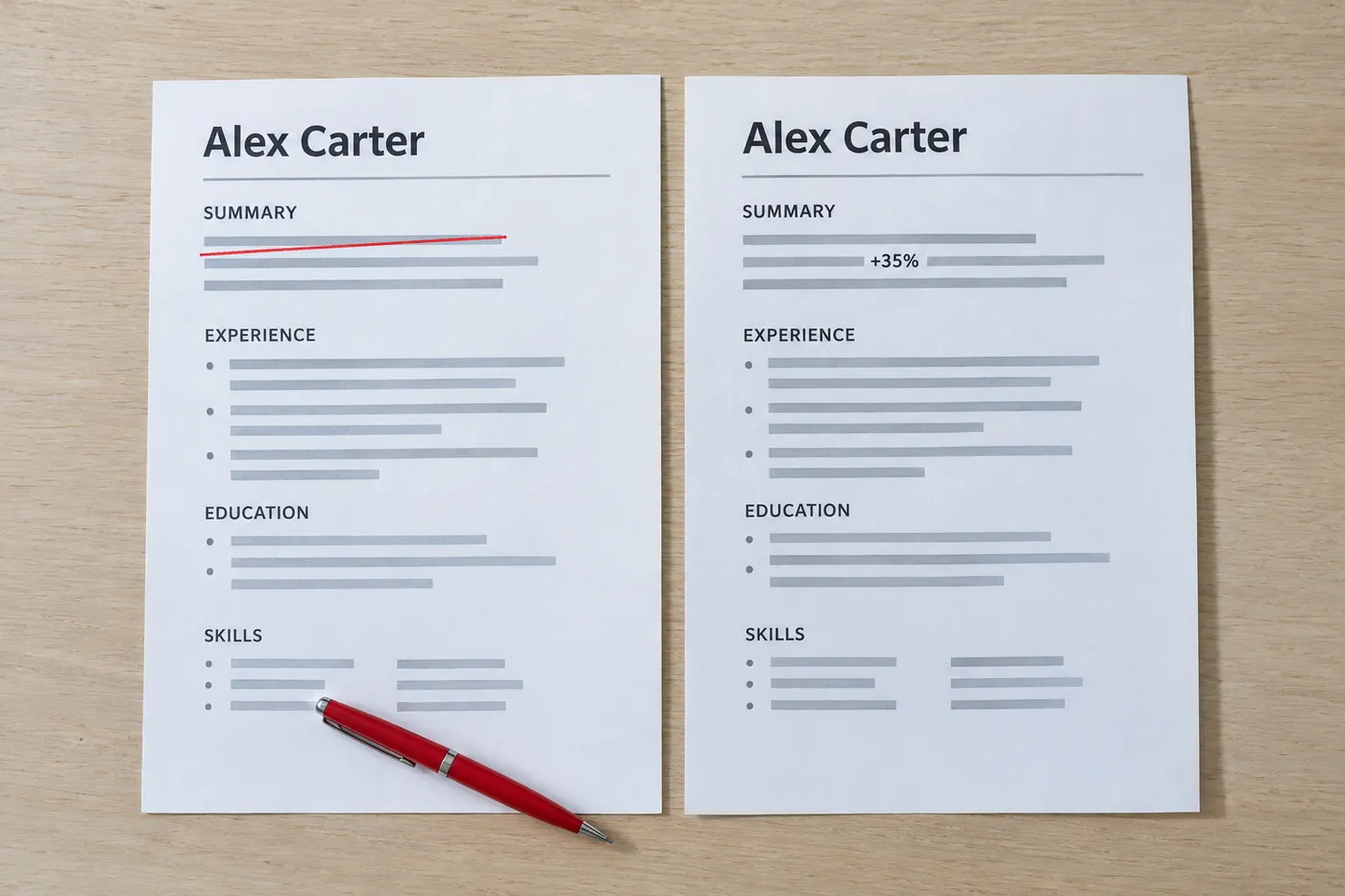
These three situations share a problem: the most obvious reading of your resume is the wrong one. A blank work history reads as "nothing to offer," a career change reads as "wrong background," a gap reads as "rusty." The summary exists to install the right reading before the recruiter forms the wrong one. In all three cases it is the most important four lines on the page.
15. First job or recent graduate
Finance graduate (B.S., 3.7 GPA) with two FP&A internships, where I built the variance-analysis workbook the team still uses. President of a 120-member investment club; grew membership 40% in a year. Seeking an analyst role where Excel modeling and clean reporting matter from day one.
The move: borrowing evidence. With no job history, proof comes from internships, projects, and leadership, and "the workbook the team still uses" is a durability claim that outlasts the internship itself. If this is your situation, there are 18 more no-experience summary examples here.
16. Career changer
Operations coordinator moving into data analysis after two years of doing it unofficially: built the SQL reports my team ran weekly, automated inventory reconciliation in Python, and completed the Google Data Analytics Certificate. I bring the supply-chain domain knowledge most junior analysts spend a year acquiring.
The move: leading with the target identity, then reframing the old job as evidence for it. The last line flips the perceived weakness; the "wrong" background becomes the asset competing candidates lack. The full playbook is in how to write a career change resume.
17. Returning after a career break
Marketing manager returning from a three-year career break, previously 6 years running demand generation for a fintech, including campaigns that sourced $2M in annual pipeline. Recertified in Google Ads and HubSpot this year; currently running paid social for a local nonprofit.
The move: the break gets one clause, no apology, and the rest of the summary is evidence, half of it recent. "Recertified this year" answers the rust question before anyone asks it.
Senior and executive summaries: what changes
Above a certain level the summary stops proving you can do the work and starts proving the size of the work you've been trusted with. Three things change. First, a scope line appears: headcount, budget, revenue, sites, whatever measures the organization you ran. Second, the results shift to outcomes only a leader can claim, retention, spend, exits, rather than tasks a strong individual contributor could also list. Third, the vocabulary moves to what a board or an executive committee cares about.
What doesn't change is the ban on adjectives. "Visionary leader" is the executive version of "results-driven," and it fails for the same reason. For a full worked document at this level, see the executive resume examples, which show one 24-year history cut four different ways.
18. Engineering manager / director
Engineering leader managing four teams (28 engineers) across platform and payments. Cut infrastructure spend 22% while doubling deploy frequency, and built the promotion framework that took senior-engineer retention from 71% to 90%. Hired 15 engineers in 18 months, including three managers.
The move: org shape first, then outcomes that require an org to achieve. "Hired three managers" quietly signals second-level leadership, which is the actual bar for director roles.
19. Director of operations
Operations director for a three-site manufacturer: $60M revenue, 240 employees. Led the lean program that raised OEE from 61% to 78% and freed $3.1M in working capital by cutting inventory days from 74 to 49. Report to the COO; own the S&OP process.
The move: a scope line that reads like a briefing, and results stated in the language a P&L owner uses. "Own the S&OP process" is one clause that tells an operations executive precisely where this person sits.
20. Chief financial officer
CFO with 15 years across two PE-backed exits. At the most recent, scaled the finance function from 4 to 18, took monthly close from 15 days to 5, and led sell-side diligence to a successful exit at 8x. Operator's finance: pricing, unit economics, and the numbers a board actually decides on.
The move: two or three career-defining outcomes instead of a career narration. At this level the reader already assumes competence; the summary's job is to say which kind of CFO you are.
The words to cut from every summary
Each of these phrases costs a few of your sixty words and buys nothing, because a recruiter has read it a thousand times this month and it filters no one in. The fix is always the same: replace the claim with the evidence the claim was gesturing at. There is a longer teardown in 30 resume buzzwords to cut, but these are the ones I see most in summaries specifically.

| Cut this | Why it fails | Write instead |
|---|---|---|
| Results-driven / results-oriented | Claims a result exists without naming one | The result itself: "grew renewals 12%" |
| Proven track record | The record is the proof; the phrase is filler | The record: "8 launches, all on schedule" |
| Passionate | Unverifiable and universal | The thing you did that only a motivated person would: a side project, a certification earned on your own time |
| Detail-oriented | A trait claim a typo can destroy | An error rate, a passed audit, a reconciliation record |
| Dynamic / motivated self-starter | Describes every applicant in the pile | Something you started without being asked, named |
| Responsible for | Describes the duty, hides the outcome | What changed on your watch, with the number |
| Team player | Soft and unfalsifiable | A cross-functional result with the other team named |
| Seasoned / extensive experience | Vague tenure | The years and the domain: "9 years in claims processing" |
| Hardworking | Every resume claims it | Volume: tickets closed, patients roomed, deals run |
| Excellent communication skills | Your writing is being judged as they read it | Nothing. Let the summary's own writing carry it |
Write yours from your own resume in ten minutes
The raw material for your summary already exists in your bullets. This method extracts it. Set a timer; the constraint is the point, because summaries written slowly accumulate adjectives.
- Minutes 0-2: read only your bullet points, nothing else. Mark the three that contain a number and would be hardest for a competitor to copy. These are your proof candidates.
- Minutes 2-3: write the identity line. Your title or target title, years, domain. If the posting's title differs from yours, use the posting's phrasing and let your work history show the real titles.
- Minutes 3-6: compress your two strongest marked bullets into one sentence each. Keep the number, drop the context you'd explain in an interview anyway.
- Minutes 6-8: write the direction line for the role you're targeting. What does this specific job need that your two proof points set up? One sentence.
- Minutes 8-9: cut every adjective and adverb. Then count words; if you're over 60, cut the weakest clause, and it will usually be in the direction line.
- Minutes 9-10: read it aloud. Any sentence that could describe a stranger in your field gets rewritten or deleted. If all three survive, you're done.
Two quality checks before you move on. First, someone who knows your work should read the summary and say "yes, that's you" rather than "that sounds impressive." Second, every claim in it must be defensible in an interview, because the summary is the first thing an interviewer will probe. If a number is an estimate, round it down.
Check it against the posting before you send
A summary is tailored or it is wasted. The identity line should mirror the posting's job title, and line 2 or 3 should carry two or three of the skills the posting repeats, in natural sentences. Screening software increasingly evaluates context around a term rather than counting occurrences, so a skill woven into a real result beats the same skill stuffed in cold, and a pile of comma-separated keywords can actively hurt. If you're pulling those terms by hand, here's how to extract resume keywords from a job description in a few minutes.
The faster version: duplicate your base resume for the job in Roleframe and the fit report shows the exact keywords recruiters filter on, which ones your resume already covers, and what to change first. Then Remi, the career copilot in the editor, can propose a tighter summary line grounded in that report, with a word-by-word diff you approve or discard. It never rewrites anything without your sign-off, which matters here more than anywhere: the summary is the part of the resume you will be asked to say out loud.
Frequently asked questions
- How should I write a professional summary on my resume in 2026?
Use the three-line structure: identity (title, years, domain, phrased like the posting), proof (two quantified results relevant to the role), and direction (what you bring to this job). Keep it under about 60 words, mirror the posting's job title, and work two or three of its top skills into natural sentences. Screening tools now read context, so keyword-stuffed summaries perform worse than plainly written ones with the same terms.
- What's a good opening statement for a resume?
The strongest opening line states who you are in the reader's language: "Customer success manager owning a $3.2M book of 45 mid-market accounts" or "PMP-certified project manager who has delivered 12 healthcare implementations." A good test: if the first line could open a stranger's resume, it isn't your opening line yet. Lead with the fact about you that the posting is searching for.
- How long should a resume summary be?
Two to four lines, roughly 40 to 60 words. Shorter is almost always stronger, because every extra line dilutes the two proof points that do the persuading. Executives sometimes run slightly longer to fit a scope line, but even a CFO summary rarely earns a fifth line.
- Do I need a resume summary at all?
In three situations it's close to mandatory: a career change, a return after a gap, and any senior role, because in each case the summary installs the right reading of your history before the recruiter forms the wrong one. For a straightforward application where your last title matches the posting exactly, you can survive without one, but a sharp three-liner still buys you the recruiter's next thirty seconds, so I'd write it anyway.
- Should a resume summary be written in first person?
Implied first person, without the pronoun: "Built the returns-rate dashboard" rather than "I built" or "She built." Third person on your own resume reads oddly, and repeating "I" wastes words. An occasional "my" is fine when dropping it would make the sentence awkward.
- What should I put in a summary if I have no work experience?
Borrow evidence from what you do have: internships, coursework projects with real outputs, certifications, and leadership in clubs or volunteering, each with a number where you can find one. "Built the variance-analysis workbook the team still uses" is proof even when the job was unpaid. Close with a direction line naming the role and the two skills you'd apply on day one.
- Can I use the same summary for different jobs?
The first two lines usually carry over between similar postings; the direction line should change per application, and the skills you name should match what each posting repeats. If you're applying across genuinely different role types, keep a base resume per target role and adjust the summary from there, rather than stretching one summary until it fits nothing well.


Ready to start your new resume?
Writing a resume takes time, and even a polished one can miss what a hiring manager is looking for. Roleframe helps you build a clear, ATS-safe resume in minutes and tailor it to the job you want.


