Executive Resume Examples: One 24-Year History, Four C-Suite Versions
by Larbi SahliLast Updated
Executive resume examples built from one 24-year history: COO, CFO, CRO, and CIO versions with scope tables, folded promotions, and a 3-line early career block.
Users have landed jobs at
- 1Password
- OpenAI
- Notion
- justworks
On this page
A 24-year career produces more strong material than three pages can hold. That is the actual executive resume problem: not writing, compression. Which of your thirteen roles get full bullets, which promotion ladder collapses into one employer block, and which eleven years shrink to three lines depends entirely on the mandate you are chasing.
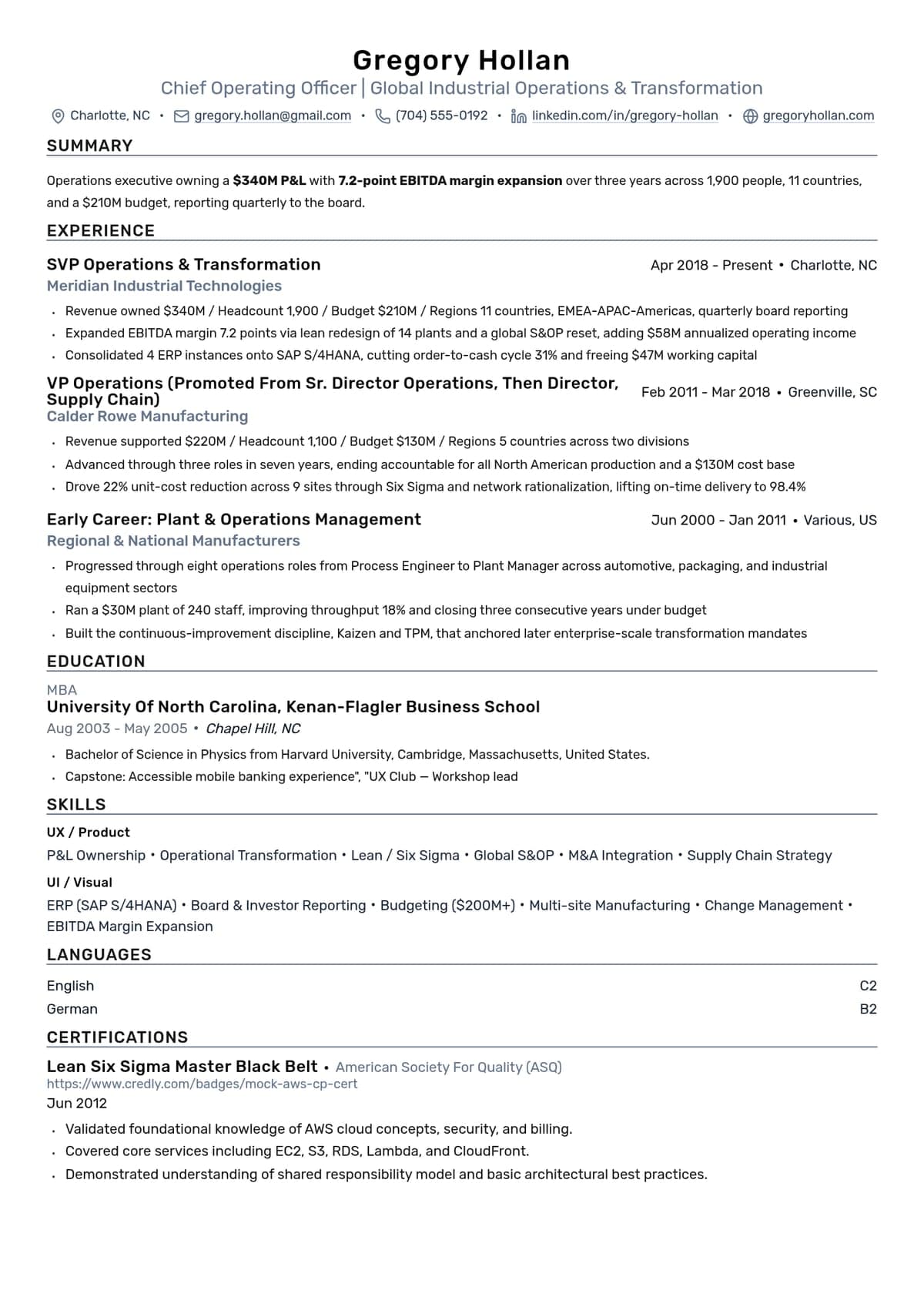
Most executive resume examples online dodge this. They show one polished COO sample and one polished CFO sample, as if the difference between them were wording. It is not. The useful comparison is how a single long history gets cut differently for different mandates, because that is the decision you are facing. This page works through exactly that: one 24-year source history, compressed four ways, for COO, CFO, CRO, and CIO searches. The COO version is rendered in full below; the other three are shown as the specific changes you would make to it.
What a good executive resume looks like
Before the examples, the standard they meet. A resume that survives a retained search screen has five features, and they are structural, not cosmetic:
- A five-line summary that opens with the two largest numbers you own. P&L, revenue, budget, or headcount. A recruiter running a search with a scale threshold decides in the first two lines whether you clear it.
- A scope line under every senior role. Revenue owned, headcount, budget, regions, and reporting line, stated as facts before any achievement bullet. Scope is the qualifier; achievements are the differentiator. Order matters.
- Promotion ladders folded into single employer blocks. Three titles at one company is one block with the ladder visible, not three entries that make nine years look like job hopping.
- An early career block. The oldest roles compressed to titles, companies, and years. Three lines covering a decade is normal and expected.
- Three pages, plain formatting, PDF. Reverse chronological, single column, standard headings. Executive submissions still pass through applicant tracking systems (ATS) and search-firm databases, and a two-column design with graphics parses badly in both.
Everything below is a technique for producing those five features from a history that has too much material.
The source history behind all four examples
Our candidate has 24 years, thirteen roles, and five employers. The most recent role is SVP of Operations & Transformation at a $900M industrial technology company: a $340M P&L, 1,900 people across 11 countries, a $210M operating budget, and quarterly board exposure. Before that, nine years at one company with a three-title promotion ladder from Director of Operations to VP of Supply Chain to SVP of Operations. The first eleven years are eight roles across plants, analyst seats, and a first management job.
The breadth that makes four cuts possible is typical at this tenure, even if it does not feel that way from inside the career. A two-year general manager stint came with full revenue ownership of a $120M region. A $40M ERP and digital operations program came with technology delivery accountability. Two years running division financial planning and analysis (FP&A) came with forecast and budget ownership. Almost every 20-year operator has equivalents; they just sit buried in role six of thirteen until a specific mandate pulls them forward.
Here is how the four versions cut the same material:
| Version | The mandate it answers | What moves to page one | The two numbers the summary opens with |
|---|---|---|---|
| COO | Run and scale global operations | Operations P&L, site network consolidation, EBITDA margin expansion | $340M P&L; EBITDA margin 9% to 15% |
| CFO | Own capital allocation, forecast, and cost | Division FP&A ownership, the cost program, working capital work | $210M budget authority; 600 bps of margin captured |
| CRO | Own revenue and commercial growth | The GM stint, the commercial turnaround inside it, pricing work | $120M revenue owned; the region's growth rate |
| CIO | Deliver technology and transformation | The $40M ERP program, the digital ops platform, adoption and uptime | $40M program delivered; system adoption across 11 countries |
One honest note before you copy this move: the four cuts are not equally credible, and pretending otherwise is how executive resumes fail. For this candidate, the COO version is the natural one and the CRO version is defensible because the GM stint was real revenue ownership with a quota-carrying org underneath it. The CFO version is the stretch: two years of division FP&A supports a VP Finance conversation, not a public-company CFO search, and the resume should be honest about which finance decisions the candidate actually made versus supported. Your own history probably supports two of the four mandates well. Cut for those two.
The line between a director resume and an executive one
The difference is ownership language backed by scope, and you can see it in a single bullet. Directors describe what they managed and improved. Executives describe what they owned and what it did to the enterprise numbers. Here is the same real work, written both ways:
Director version: "Managed a team of 45 across three distribution centers and improved on-time delivery from 89% to 96% through process standardization."
Executive version: "Owned the $340M North America operations P&L (1,900 people, 9 sites); consolidated the distribution network from 14 sites to 9, taking EBITDA margin from 9% to 15% over three years while holding on-time delivery above 96%."
Notice what changed. The subject moved from the team to the P&L. The improvement metric (on-time delivery) got demoted from headline to guardrail, because at the executive level the operational metric is table stakes and the financial outcome is the point. And the scale facts arrived before the achievement, because a retained recruiter checks scale first.
One more pair, from the promotion ladder years:
Director version: "Led supplier negotiations that reduced raw material costs by 8% annually."
Executive version: "Restructured the $180M direct spend portfolio across 240 suppliers; the resulting 8% annual cost takeout funded the automation program the board had declined to budget separately."
The second version does two executive things the first cannot: it states the size of what was owned, and it connects the win to a capital decision at board level. If your bullets cannot do that yet, the fix is usually not better verbs. It is going back to each role and writing down what you actually owned, in dollars, people, and geography, then rebuilding the bullets on top of that. The full COO resume writing guide works through this bullet by bullet.
Folding a promotion ladder into a single employer block
Three titles at one company is a selling point that most executives format into a liability. Listed as three separate entries, a nine-year climb reads on a fast skim like three short jobs. Folded into one employer block, it reads as what it was: an organization that kept promoting you.
The fold works like this. One employer header carries the company name and the full date range. Directly under it, one line names the ladder: "Promoted twice in nine years: Director of Operations (2011–2014), VP Supply Chain (2014–2017), SVP Operations (2017–2020)." Then the bullets follow, weighted heavily toward the most senior title. The Director years might keep one bullet; the SVP years keep four or five.
Two rules keep the fold honest. First, every claim sits under the title where it happened. Attributing a VP-level win to your SVP years is the kind of inflation a reference call surfaces immediately. Second, the scope line reflects the final title, with growth stated explicitly if it strengthens the story: "Scope grew from 3 sites and 200 people to 14 sites and 1,100 people across the ladder" is one of the strongest lines an executive resume can carry, because it shows the organization repeatedly re-scoping the role around you.
Deciding which roles stay on page one
Thirteen roles, three pages. The allocation for our candidate: the current SVP role gets a third of page one, the folded promotion ladder gets the rest of page one and the top of page two, the GM stint and one earlier role get short entries, and the eight oldest roles collapse into the early career block. That allocation came from three tests, applied per role, per version:

- Does the role prove the mandate? The GM stint is two lines on the COO version and half a page on the CRO version, because revenue ownership is the CRO mandate's core evidence and merely useful context for a COO search.
- Does the role add scale the later roles already prove? A $30M plant role adds nothing once a $340M P&L is on page one. It goes to the early career block regardless of how proud you are of it.
- Is the role inside the window a recruiter actually reads? Detail earns its space in the last 10 to 15 years. Beyond that, presence matters (the career length is a credential) but detail does not. The general rule on how far back a resume should go bends at the executive level: the years stay, the bullets go. See the fuller reasoning on how far back a resume should go.
The practical output of the three tests is different on each version, and that is the point. Page one of the CIO cut gives the $40M ERP program a full entry with its own scope line (program budget, vendor count, countries deployed, steering committee chaired) while the network consolidation that headlines the COO cut shrinks to one bullet. Same history, different page one.
Proving scope: the line every senior role needs
Retained recruiters screen on scope before they read a single achievement, because the client brief states scope as thresholds: "has run a P&L of at least $250M," "has managed 1,000+ people," "has operated across EMEA and North America." If those facts are scattered across your bullets, a skimming recruiter may miss them and screen you out on a search you clear comfortably.
The fix is a scope line: one dense factual line directly under each senior title, before the bullets. Five dimensions, stated plainly:
| Dimension | Weak (buried or vague) | Strong (stated as a scope fact) |
|---|---|---|
| Revenue owned | "Responsible for significant P&L" | "$340M P&L (full revenue and cost ownership)" |
| Headcount | "Led large global team" | "1,900 people; 6 direct reports, all VP-level" |
| Budget | "Managed departmental budgets" | "$210M operating budget; $45M annual capex authority" |
| Regions | "International experience" | "11 countries across North America, EMEA, APAC" |
| Board exposure | Not mentioned | "Present operations review to the board quarterly; audit committee twice yearly" |
Board exposure is the dimension executives most often forget, and it is the one that separates a strong VP resume from a C-suite candidacy. If you present to the board, sit on a subsidiary board, or own a committee relationship, that belongs in the scope line, not in an interview anecdote you hope to reach.
The numbers each mandate is judged on
Every C-suite mandate has a short list of metrics the hiring conversation will orbit, and the resume version for that mandate should carry them by name. Writing "improved profitability" on a CFO resume when the search brief says EBITDA is leaving a keyword match, and a credibility signal, on the table.
| Mandate | Judged primarily on | Also expected | What our candidate's version leads with |
|---|---|---|---|
| COO | EBITDA margin, cost per unit, on-time delivery | Working capital, safety record, network footprint | EBITDA margin 9% to 15%; 14 sites to 9 |
| CFO | EBITDA, free cash flow, forecast accuracy | Cost of capital, cash conversion cycle, audit outcomes | 600 bps margin capture; forecast accuracy of the FP&A years |
| CRO | ARR growth, net revenue retention (NRR) | Pipeline coverage, CAC payback, quota attainment | $120M region revenue and its growth rate; pricing yield |
| CIO | Uptime, transformation delivery, run-vs-change spend | Security posture, cost per user, adoption rates | $40M ERP delivered on schedule; adoption across 11 countries |
Two of those need defining because they gate real searches. Annual recurring revenue (ARR) is the subscription revenue base, and net revenue retention (NRR) measures how much existing customers grow or shrink; any CRO search at a software company will filter on both terms explicitly. If your revenue experience predates subscription models, translate honestly: "repeat revenue," "contract renewals," and the retention rate you actually tracked, rather than borrowing ARR language your history cannot support.
This table is also your keyword map. Search firms and corporate recruiters run database queries on exactly these terms, so each version should carry its mandate's vocabulary in the summary and the bullets, naturally, where the work actually happened.
The five-line executive summary
The summary is where compression pays off or fails. Five lines, and line one opens with the two largest numbers you own, because that is the threshold check happening in the reader's head. The structure that works:

- Line 1: Title-level claim plus the two biggest owned numbers. "Operations executive running a $340M P&L and 1,900 people across 11 countries."
- Line 2: The mandate sentence, matching the search. "Builds and scales global manufacturing and supply chain organizations through consolidation and margin expansion."
- Line 3: The signature win, with its number. "Took EBITDA margin from 9% to 15% in three years while consolidating a 14-site network to 9."
- Line 4: Breadth that de-risks the hire. "Promoted twice in nine years at Meridian-scale industrial businesses; two years of full revenue ownership as regional GM."
- Line 5: Board and direction. "Quarterly board presenter; seeking a COO mandate in industrial or B2B technology at $500M to $2B scale."
Now watch it change per mandate. The CRO version rewrites line one as "Commercial and operations executive who owned a $120M region P&L and returned it to double-digit growth" and swaps line three for the pricing and retention story. The CIO version opens on the $40M program and 11-country deployment. Lines four and five flex least; lines one and three flex most. That is the general pattern: the top of the summary belongs to the mandate, the bottom to the career.
What kills executive summaries is adjectives doing the work numbers should do. "Visionary, results-driven leader" tells a recruiter nothing a threshold check can use, and it reads as filler from a candidate whose numbers presumably could not carry the opening. If you want more worked patterns, the guide to writing a professional summary has sixteen across levels.
Three pages, and the early career block that covers eleven years in three lines
Three pages is the right length for a 20-plus-year executive resume. Two pages forces cuts that hide scope; four signals you cannot prioritize, which is a poor trait to advertise for a role that is mostly prioritization. The one-page rule you remember from earlier in your career stopped applying around the director level.
The instrument that makes three pages possible is the early career block. Our candidate's first eleven years, eight roles across two employers, become this at the bottom of page three:
Early Career (1998–2009)
- Plant and supply chain leadership roles of increasing scope, Titan Manufacturing (2003–2009): Plant Manager, Production Manager, Continuous Improvement Lead
- Operations analyst and engineering roles, Corvex Industrial (1998–2003)
No bullets, no metrics, no city names. The block exists to make the arithmetic of the career visible (24 years, not 13) and to close the timeline so nothing looks hidden. Anything in those years that still matters to the mandate has already been promoted out of the block: the candidate's first turnaround, if it seeds the COO story, appears as one clause in the summary or a bullet under a later role where the pattern repeated at scale.
Resist the urge to keep one favorite bullet per old role. Eight roles at one bullet each is half a page spent proving things your last five years prove better. If the length question is still nagging you, the data on resume length by experience level settles it.
The final check: score each version against a real search brief
A retained COO search does not start with a job posting. It starts with a brief the search firm writes with the client, and that brief is a checklist: scale thresholds ("has operated a P&L above $250M"), situational fit ("has led a site consolidation" or "has scaled through acquisition"), structural requirements ("has managed a multi-country footprint," "has presented to a board"), and disqualifiers ("no candidates without direct manufacturing exposure"). The public posting, when one exists, is a compressed version of that brief. Your resume gets read against the full checklist whether you have seen it or not.
So test each version the way the researcher will. Take the most representative posting you can find for the mandate and go item by item: is each threshold answered by a stated fact on page one, or does it require inference? "Has run 1,000+ people" should be answerable by pointing at a scope line, not by adding up team sizes across three bullets. Any requirement that needs inference is a requirement a seven-second skim will miss.
This is also where keeping four versions gets operationally hard, because a fix made to the COO version quietly ages the other three. This is the workflow Roleframe was built around: one base resume per mandate in its own workspace, and when a live search appears you duplicate the right base, paste the posting, and get a fit report showing the score, the exact keyword gaps against that brief, and a prioritized plan, then make the edits yourself with Remi suggesting rewrites you approve line by line. The method for reading a posting against your resume is worth internalizing regardless of tooling; the walkthrough on checking your resume against a job description covers it step by step. And whatever you edit in, submit as PDF, so the document the committee prints matches the one you approved.
Frequently asked questions
- What does a good executive resume look like?
Three pages, reverse chronological, single column, PDF. A five-line summary opening with your two largest owned numbers, a scope line (revenue, headcount, budget, regions, board exposure) under every senior role, promotion ladders folded into single employer blocks, and the oldest roles compressed into a three-line early career block. Formatting stays plain because executive submissions still pass through ATS and search-firm databases that parse simple layouts best.
- What are the 5 P's of a resume?
It is a coaching mnemonic, and the list varies by coach; common versions include some mix of positioning, presentation, proof, personalization, and proofreading. At the executive level the useful translation is narrower: position for one specific mandate, present scope facts before achievements, and prove every claim with a number you owned. A resume that does those three things has covered whatever the mnemonic was trying to teach.
- What is the best format for an executive resume in 2026?
Reverse chronological, three pages, single column, standard section headings, exported as PDF. Skip graphics, charts, headshots, and two-column layouts; they parse unreliably in applicant tracking systems and search-firm databases, and they signal style over substance to search committees. The differentiation should come from your scope lines and numbers, never from the layout.
- What is a good executive summary for a resume?
Five lines: your title-level claim with the two biggest numbers you own, the mandate sentence matching the search, your signature win with its metric, the breadth that de-risks the hire, and your board exposure plus target. For example, opening line: "Operations executive running a $340M P&L and 1,900 people across 11 countries." Cut every adjective that a number could replace; "visionary" and "results-driven" read as filler in a search screen.
- How far back should a 20-year executive resume go?
Cover the full career, but detail only the last 10 to 15 years. The earliest decade compresses into an early career block of two or three lines with titles, employers, and years, no bullets. The career length is itself a credential, so hiding old years creates a suspicious gap; giving them bullets wastes space your recent scope needs.
- Do executive resumes really go through an ATS?
Yes. Direct applications hit the company's applicant tracking system like any other, and retained firms load every resume into their own candidate databases and query them by keyword, scale, and industry. That is why scope facts and mandate vocabulary (EBITDA, NRR, uptime) need to appear as searchable text, and why plain formatting matters even when a human relationship got your resume in the door.
- Should I make a different resume for COO and CFO roles?
Yes, if your history genuinely supports both mandates. The versions differ in what page one carries, which numbers open the summary, and which roles get full bullets versus one line, far more than in wording. But be honest about credibility: most 20-year histories support two mandates well, and stretching a resume toward a mandate your scope facts cannot back is the fastest way to fail a reference check.


Ready when you are
Send the tailored resume, not the generic one.
Paste a job posting and Roleframe scores your resume against it, then helps you close the gaps one approved edit at a time, so you apply while the role is still fresh.