Chief of Staff Resume Example With Real Scope Lines
by Larbi SahliLast Updated
A full chief of staff resume example, plus a conversion table that turns board cycles, exec support, and handed-off projects into figures a CEO reads as scope.
Users have landed jobs at
- 1Password
- OpenAI
- Notion
- justworks
On this page
The chief of staff resume problem is simple to state and hard to solve: you spent years doing consequential work under someone else's authority, and now you have to prove it on a page that rewards ownership. You ran board cycles, but the CEO presented. You planned headcount, but the CFO signed. You incubated three functions, but each one now has someone else's name on it. A hiring manager skimming your resume sees "supported," "coordinated," and "facilitated," and files you under executive assistant with a fancier title.
The fix is not inflating your title or claiming credit you can't defend in an interview. The fix is writing scope lines: the same kind of figures a P&L owner writes, translated for a role that owns cadence and decisions instead of budget and headcount. Board cycles run end to end. Size of the exec team you operated. Functions you built and handed off. Decision memos that turned into real changes. This page shows a complete example built that way, then gives you a conversion table for turning your own borrowed-authority work into lines a CEO recognizes as seniority.
The chief of staff resume example
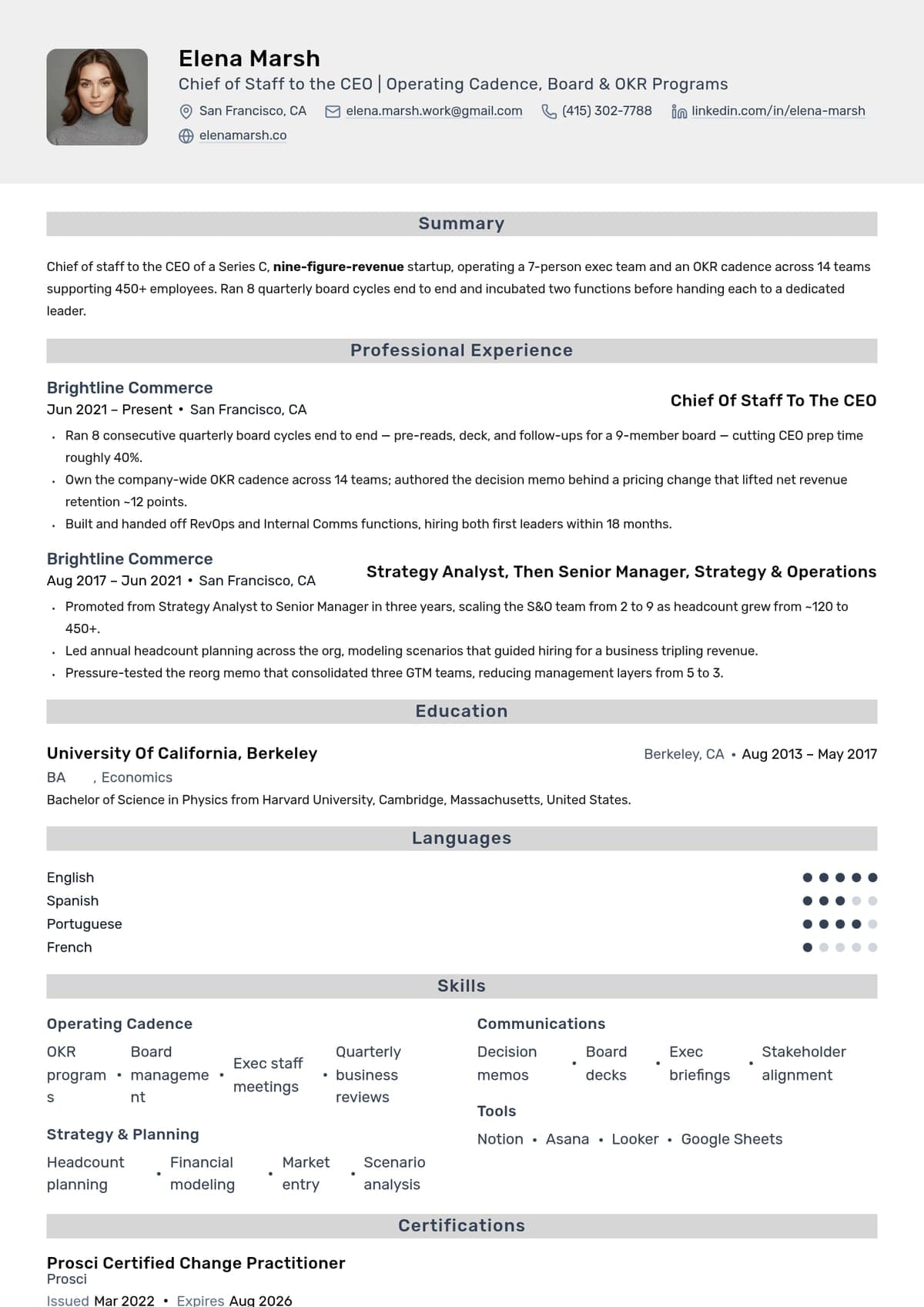
The example below is a chief of staff to the CEO at a venture-backed company, promoted internally through three roles. Read the summary first. It carries a scope line, meaning concrete numbers about the size of what this person operated, before a single bullet appears. That is deliberate. A recruiter who has never worked with a chief of staff cannot infer your seniority from the title, so the summary has to state it in units they already understand: people, teams, cycles, and dollars in generalized form.

Elena Marsh
Chief of Staff to the CEO | Operating Cadence, Board & OKR Programs
Summary
Chief of staff to the CEO of a Series C, nine-figure-revenue startup, operating a 7-person exec team and an OKR cadence across 14 teams supporting 450+ employees. Ran 8 quarterly board cycles end to end and incubated two functions before handing each to a dedicated leader.
Professional Experience
Chief of Staff to the CEO
Ran 8 consecutive quarterly board cycles end to end — pre-reads, deck, and follow-ups for a 9-member board — cutting CEO prep time roughly 40%.
Own the company-wide OKR cadence across 14 teams; authored the decision memo behind a pricing change that lifted net revenue retention ~12 points.
Built and handed off RevOps and Internal Comms functions, hiring both first leaders within 18 months.
Strategy Analyst, then Senior Manager, Strategy & Operations
Promoted from Strategy Analyst to Senior Manager in three years, scaling the S&O team from 2 to 9 as headcount grew from ~120 to 450+.
Led annual headcount planning across the org, modeling scenarios that guided hiring for a business tripling revenue.
Pressure-tested the reorg memo that consolidated three GTM teams, reducing management layers from 5 to 3.
Education
University of California, Berkeley
BA
Bachelor of Science in Physics from Harvard University, Cambridge, Massachusetts, United States.
Languages
Skills
Operating Cadence
Strategy & Planning
Communications
Tools
Certifications
Prosci Certified Change Practitioner
Projects
EU Market Entry Program
Program Lead
https://github.com/username/project
Ran the cross-functional launch into three EU markets, aligning legal, finance, and GTM to open the region six weeks ahead of plan.
Awards
Operator of the Year
Brightline Commerce
Recognized for building a cloud-native AI productivity tool.
Three things to lift from this example even if your situation looks different. First, the single stacked company entry with three role headers, so the promotion story reads at a glance instead of looking like job hopping. Second, every bullet names the artifact and the outcome, never just the activity: not "supported board meetings" but the number of cycles, what a cycle included, and what came out the other end. Third, sensitive numbers are generalized into bands and multiples rather than deleted, so the bullet keeps its weight without violating anything you signed.
Chief of staff means five different jobs. Say which one you held
The title carries almost no information on its own. At one company a chief of staff is an executive assistant with a strategy garnish. At another it is a proto-COO running half the operating cadence. A recruiter reading your resume does not know which one you were, and if you make them guess, they guess low. Your summary's first sentence should settle it.
In practice the role collapses into five archetypes, and most people held one primary with a secondary:
- The operator: owns the company operating cadence, from OKRs and exec staff meetings to planning cycles. Closest to a future VP of Operations.
- The right hand: extends the CEO's reach on decisions, drafting memos, pressure-testing plans, and representing the principal in rooms they can't be in. Closest to strategy and BizOps.
- The project owner: runs the cross-functional initiatives that have no natural home, such as a market entry, a systems migration, or a reorg. Closest to program leadership and GM tracks.
- The org builder: stands up functions that don't exist yet, hires their first leader, and hands them off. The strongest signal for GM and startup leadership roles.
- The gatekeeper: manages the principal's time, communications, and information flow. Real work, but if this was most of your job, the executive assistant framing may serve you better, and the bar for proving otherwise is higher.
Name your archetype in plain functional language, not in the archetype's label. "Chief of Staff to the CEO of a 600-person Series C fintech; ran the company operating cadence and incubated two functions to their first dedicated leader" tells a recruiter which job you held in one line. If most of your work was gatekeeper-shaped and you are moving toward operations anyway, look at how strong executive assistants frame strategic work in our executive assistant resume example. The distance between those two resumes is smaller than the titles suggest, and honesty about which side you sit on reads better than a stretch.
Proving scope when you own no budget and no direct reports
This is the core problem, so here is the core tool. A P&L owner writes "grew revenue from $40M to $65M" and the number does the arguing. You don't have that number, but you have equivalents: the size of the machine you operated, the volume of cycles you ran, the decisions you moved, and the things you built that outlived your involvement. The table below converts the most common chief of staff work into that second kind of figure. The numbers are illustrative; the structure is the point.
| What you actually did | The weak line most people write | The scope line a CEO reads |
|---|---|---|
| Prepared and ran board meetings | Supported quarterly board meetings and prepared materials | Ran 10 consecutive quarterly board cycles end to end for a 7-member board: agenda, pre-reads, CEO prep, minutes, and follow-through on 40+ tracked action items |
| Kept the exec team functioning | Coordinated the executive leadership team | Operated the weekly cadence for an 8-person exec team leading a 600-person org; restructured the meeting system and cut standing exec meeting hours by a quarter |
| Ran the OKR process | Managed the company OKR process | Ran 6 company-wide OKR cycles across 14 teams; drove on-time draft submission from roughly half of teams to nearly all, and cut cycle setup time from weeks to days |
| Wrote analysis the CEO acted on | Prepared strategic analyses and presentations for the CEO | Drafted 30+ decision memos for the CEO; three moved directly to execution, including a pricing restructure and a go-to-market reorg affecting 120 roles |
| Planned headcount without owning it | Assisted with annual planning and budgeting | Built the annual headcount plan covering 240 roles across 6 departments; board-approved, and the org landed within single-digit variance of plan |
| Stood up functions and handed them off | Led special projects across the organization | Incubated RevOps and internal communications from zero, hired the first dedicated leader for each, and transitioned both within 18 months |
| Ran a fundraise or diligence workstream | Supported the company's Series C fundraise | Ran the internal Series C workstream: data room, diligence responses across 5 functions, and model inputs, through to a closed round |
Notice what the strong column measures. Never the outcome the executive owns, always the machine you ran and the volume it processed. "10 consecutive quarterly cycles" is a claim only you can make and only you would have to defend. That is exactly what makes it credible. The verbs matter too: ran, built, operated, drafted, incubated. If you need more options that carry ownership without overclaiming, our list of action verbs sorted by what they prove has a section for exactly this problem.
One caution. Do not convert every bullet into a scope line, because a resume of pure machinery reads like a project manager. Two or three bullets per role should show judgment: a decision you shaped, a call you got right, a conflict you resolved between functions. Scope lines earn you the seniority read; judgment lines earn you the interview.
Analyst to senior manager to chief of staff: write one company as one entry
The typical chief of staff got there by escalating inside one company: strategy analyst, then senior manager of strategy or BizOps, then chief of staff. Written as three separate entries, this looks like three jobs. Written correctly, it is one of the strongest signals on the page, because internal promotion into a trust role is something no external hire can fake.
Stack the roles under a single company header. Company name and total tenure on the top line, then each role with its own dates and its own bullets underneath. Weight the bullets heavily toward the most recent role: most of your space goes to the chief of staff years, a few lines to the senior manager role, and one or two to the analyst role, or none if you are tight on space. The earlier roles exist mostly to show the slope.
Two refinements make the stack work harder. First, give the company header one line of context, because "Series B, 90 people when I joined, 600 at Series C" tells the growth story that explains why your role kept expanding. Second, make each role's first bullet show the scope increase explicitly: the analyst bullet covers one workstream, the senior manager bullet covers a function, the chief of staff bullets cover the company. A reader should be able to trace the widening circle without reading a word twice. If the roles were genuinely different jobs rather than an escalation, separate entries are fine, but that is the exception for this career path.
Which rotations and special projects to keep, and which to drop
Every chief of staff accumulates a junk drawer of one-off projects: the office move, the offsite, the ESG report, the culture survey, the CEO's speaking calendar. Listing all of them is the most common way this resume fails, because ten small projects read as ten small projects, and the reader averages instead of summing.
Apply three filters, in order:
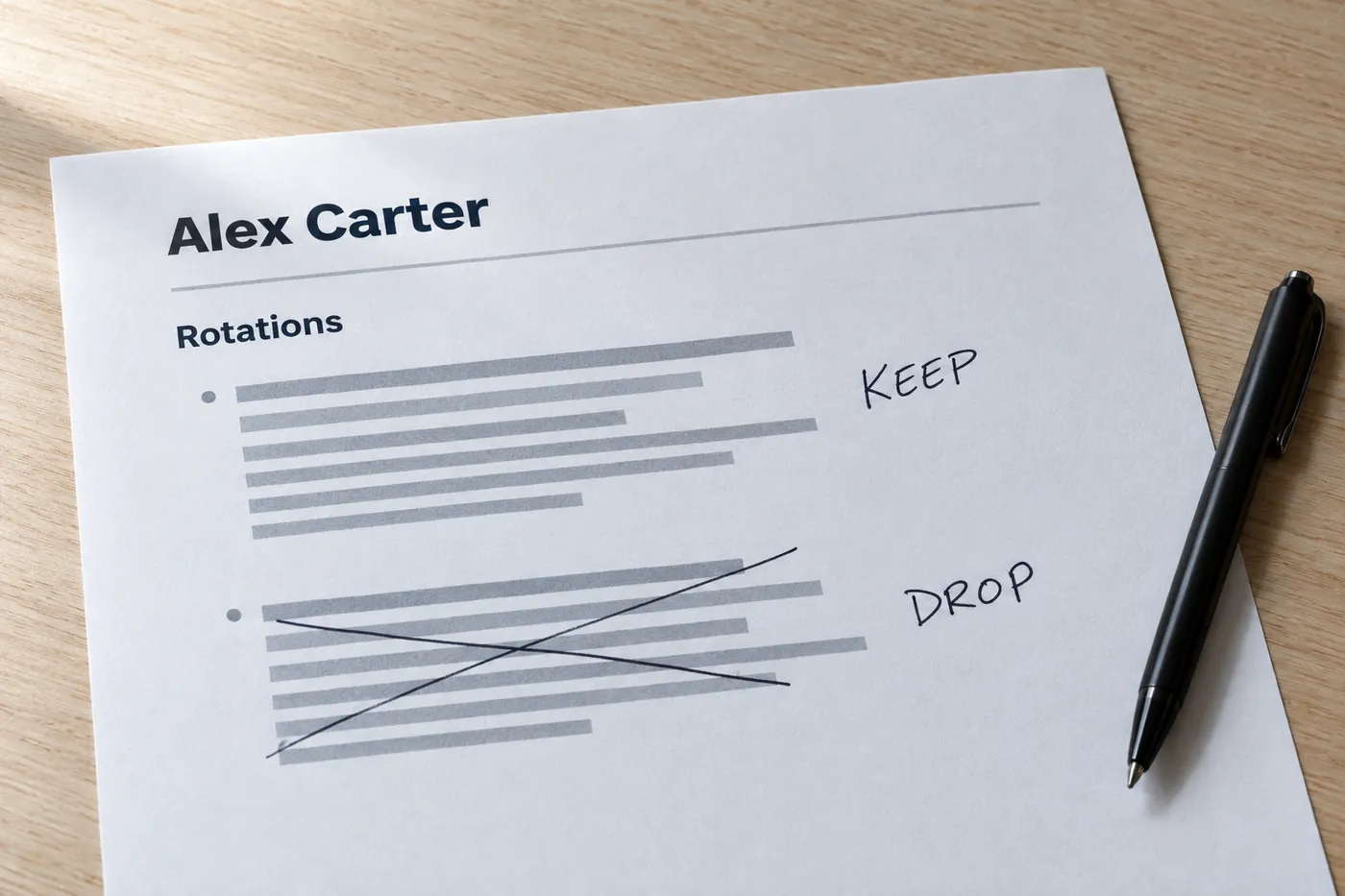
- Does it point at the job you want next? A pricing project stays if you're targeting BizOps or GM roles. The all-hands redesign stays only if you're selling operating-cadence ownership. Everything else is a candidate for cutting no matter how hard it was.
- Did it change something measurable, or did it produce an artifact? A project that ended in a decision, a reorg, a launched function, or a number that moved is a bullet. A project that ended in a deck is not, unless the deck moved a decision, in which case the decision is the bullet.
- Would you tell the story in an interview? Confidential or politically messy projects that you can't discuss for three minutes without squirming should come off the page. A bullet you can't expand on is a liability.
What survives the filters gets consolidated, not listed. Three related projects become one bullet: "Ran the three highest-priority cross-functional initiatives of FY24, including a pricing restructure and a systems migration affecting all 600 employees, each delivered on the committed timeline." The count does the work the individual names would have done, at a third of the space. Drop the rest entirely. A shorter resume that reads senior beats a complete one that reads busy, and if you're unsure how much room you have to spend, here is the data on one page versus two by experience level. For most chiefs of staff with eight-plus years of total experience, two pages is right.
Board prep, OKR cadence, and exec staff bullets that don't break confidentiality
The instinct when work is confidential is to delete the specifics, which produces exactly the vague bullets that sink this resume. The better move is to generalize: keep the shape and magnitude of the number, remove the precision that makes it sensitive. Nobody's NDA is violated by "a nine-figure revenue business" or "an org that tripled during my tenure," and those phrases carry nearly all the weight of the exact figures.
Four generalization techniques, roughly in order of how much signal they preserve:
- Bands instead of points: "600-person org" instead of the exact headcount, "a board of 7" instead of naming directors, "revenue in the low nine figures" instead of the number in the board deck.
- Multiples and deltas instead of absolutes: "headcount tripled," "cut cycle time from weeks to days," "reduced exec meeting load by a quarter." Relative change is usually less sensitive than the base number and often more impressive.
- Counts of cycles and artifacts: the number of board cycles, memos, planning rounds, and diligence workstreams is yours to state. It reveals nothing about company performance and everything about your throughput.
- Descriptors instead of names: "a top-3 strategic account," "a market entry into a new region," "an acquisition target in an adjacent category." The category proves the stakes; the name is what's confidential.
Board bullets specifically should show the full loop, because most candidates only show the front half. Materials and pre-reads are table stakes; the differentiating half is what happened after the meeting: minutes, tracked action items, and follow-through to closure. "Closed out 40+ board action items across 10 cycles with zero carried over more than one quarter" is a bullet very few people can write, and it says more about your actual function than any strategy language. The same logic applies to OKR bullets: the cadence itself is commodity, so quantify what your operation of it changed, like submission rates, cycle time, or the share of goals with real metrics attached.
Scope lines a CEO recognizes: decisions moved, cycles run, org size supported
When the person reading your resume has worked with a good chief of staff, certain phrasings pattern-match instantly. These are the formulas worth building your summary and top bullets around:
- Org supported: "Chief of Staff to the CEO of a [stage/size] company; the exec team of [N] and org of [N] I supported grew [X]x during my tenure."
- Cycles run: "[N] board cycles, [N] annual planning rounds, [N] company OKR cycles, run end to end."
- Decisions moved: "[N] decision memos drafted for the CEO; [N] executed, including [generalized example]."
- Functions handed off: "Built [function] and [function] from zero to their first dedicated leader."
- Time returned: "Restructured the CEO's operating rhythm, returning roughly [N] hours a week to external and strategic work."
- Cross-functional reach: "Ran initiatives spanning [N] departments with no direct authority over any of them."
Your summary should combine two or three of these into three sentences at most, and it should be the most rewritten paragraph on the page. A recruiter's first pass is fast, and for an ambiguous title like this one, the summary is where the seniority verdict gets made. If yours currently opens with "dynamic, results-oriented professional," start over; our guide to writing a professional summary shows the structure, and the example on this page shows it applied to this exact role.
Write the resume for what comes next: VP Operations, BizOps, or GM
Almost nobody's second chief of staff job is the goal. The resume you're writing is really an argument for the next role, and the three common destinations want different evidence from the same history.
VP Operations readers want the operator archetype: cadence ownership, planning cycles, systems you built that ran without you. Lead with the OKR and planning bullets, and make the headcount-plan line prominent, because it's the closest thing you have to budget ownership. BizOps and strategy readers want the analytical spine: decision memos, market analyses, the fundraise workstream, anything where your thinking changed the company's direction. GM track readers want the org builder: functions incubated, first leaders hired, P&L-adjacent work like the pricing restructure. The closer the target sits to general management, the more your resume should resemble a COO resume in structure, with breadth of function stated explicitly.
The practical consequence is that one resume can't serve all three targets well, and reordering bullets by hand for every application is how people end up sending the generic version. This is the workflow Roleframe was built for: keep one base chief of staff resume, duplicate it per application, and paste the posting to get a fit report showing your ATS score, the exact keywords the role filters on that you're missing, and a prioritized plan of what to reorder and rewrite. You make the edits yourself, with Remi, the career copilot, proposing rewrites bullet by bullet that you approve or discard. The mechanics of running a base resume plus tailored versions are covered in our guide to base resumes and tailored variants.
One more tailoring note: chief of staff postings themselves vary as much as the role does, so pull the language of each posting before you assume your bullets match. A posting that says "operating rhythm" and a resume that says "meeting cadence" describe the same work and fail the same keyword filter.

Carrying consulting, military, or political staff experience into a startup read
The other common route into a chief of staff role is lateral: management consulting, military staff officer work, or political and government staff roles. All three carry real chief of staff substance and all three fail the startup read in predictable ways.
From consulting, the failure mode is engagement-shaped bullets: client, problem, recommendation. Startups discount recommendations because nothing shipped. Rewrite around implementation wherever it existed: the workstream you ran inside the client, the operating model that got adopted, the team you effectively managed on the ground. Translate firm jargon completely, so "workstream lead on a large-scale transformation" becomes "ran one of four teams executing a company-wide reorg at a [size] client." Our management consultant resume example covers this translation in depth.
From the military, the substance is often the strongest of the three: staff officers genuinely run operating cadences, planning cycles, and commander's decision processes at scale. The failure mode is vocabulary. Battalion, S3, OPORD, and battle rhythm mean nothing to a startup recruiter. Convert every term to its civilian equivalent and every unit to headcount: "executive officer of an 800-person organization; ran the weekly operating cadence and the annual planning cycle for a leadership team of 12." Keep the scale numbers, because they're usually bigger than anything your startup competitors can claim.
From political and government staff work, the assets are stakeholder management under pressure and drafting for a principal, both directly transferable. The liability is that outputs were often positions rather than operations. Emphasize the operational fraction: the events run, the office managed, the legislative or policy process driven to a concrete outcome. And generalize partisan specifics the same way you'd generalize confidential revenue, since you don't control the politics of your reader.
In all three cases, the summary carries extra load: it has to pre-translate before the reader hits unfamiliar bullets. One sentence stating the equivalence, "military staff officer experience equivalent to chief of staff for an 800-person organization," spends its space well.
Formatting: get the mechanics out of the way
Nothing about this role changes the formatting fundamentals, so handle them fast. Reverse-chronological format, standard section headings, no tables or text boxes in the layout, and save as PDF, which preserves your formatting exactly and parses cleanly in every modern applicant tracking system (ATS). If you want to verify how yours parses before you rely on it, run a free ATS test on your resume first. Two pages is appropriate at this seniority; a skills section is optional and short, because a chief of staff's skills are demonstrated in bullets or not at all.
Frequently asked questions
- What is the 7 second rule for resumes?
It's shorthand for how briefly a recruiter skims a resume on the first pass before deciding whether to read properly. Treat it as a design constraint rather than a precise measurement: your title, your summary's first sentence, and your most recent role's first bullet have to carry the seniority argument on their own. For a chief of staff, whose title is ambiguous, that means a scope line with real numbers in the summary, because the title alone won't survive the skim.
- What are the responsibilities of a chief of staff?
The core set is running the executive operating cadence (staff meetings, OKRs, planning cycles), preparing and following through on board cycles, drafting decision materials for the principal, running cross-functional initiatives that have no natural owner, and incubating new functions until a dedicated leader takes over. The mix varies enormously by company, which is exactly why your resume must state which mix you held instead of relying on the title.
- What are the 5 P's of a resume?
There's no single canonical version; the framework usually covers something like purpose, positioning, proof, presentation, and proofreading. The useful translation for a chief of staff resume: know which next role the resume argues for (purpose), name your archetype in the summary (positioning), quantify borrowed-authority work with scope lines (proof), keep the format clean and parseable (presentation), and cut every project that doesn't serve the target (the discipline part). The mnemonic matters less than doing those five things.
- What qualities make a good chief of staff?
Judgment under ambiguity, the ability to run things without authority, discretion, and the discipline to build systems and then hand them off. On a resume, each of these needs evidence rather than assertion: authority-free execution shows in cross-functional scope lines, judgment shows in decision memos that moved to execution, and discretion shows, somewhat paradoxically, in how skillfully you generalize confidential figures instead of either leaking or deleting them.
- How do I write a chief of staff resume summary?
Three sentences. First: title, principal, and company context ("Chief of Staff to the CEO of a 600-person Series C fintech"). Second: your archetype stated functionally, with your two strongest scope numbers ("ran the company operating cadence, including 10 board cycles and 6 OKR rounds"). Third: the throughline pointing at your target role ("built RevOps and internal comms from zero to their first dedicated leaders"). No adjectives about yourself; the numbers make the argument.
- Should a chief of staff resume be one page or two?
Two pages for most people in this role, since the typical candidate has eight or more years spanning several roles and needs room for scope lines that actually contain numbers. One page is right only if you're a junior chief of staff with under five or six years total. Whichever you choose, the first half of page one must carry the whole seniority argument, because that's all the first skim reads.
- How do I write a junior chief of staff resume with limited experience?
Same structure, smaller numbers, and no apology for it. A junior chief of staff supporting a division president or a startup founder still runs cycles, drafts memos, and coordinates across functions, so write those as scope lines at whatever scale is true: "ran the weekly cadence for a 5-person leadership team over an 80-person division" is a legitimate line. Avoid a vague objective statement; a one-sentence summary stating the scope you held beats any statement of aspiration.


Ready when you are
Send the tailored resume, not the generic one.
Paste a job posting and Roleframe scores your resume against it, then helps you close the gaps one approved edit at a time, so you apply while the role is still fresh.