Chief Operating Officer (COO) Resume Example & Writing Guide
by Larbi SahliLast Updated
A full chief operating officer resume example, plus how to write an executive summary, show P&L scale, and structure a two-page COO resume that gets read.
Users have landed jobs at
- 1Password
- OpenAI
- Notion
- justworks
On this page
A COO resume is not a longer version of a director's resume. It is read by different people, for a different question. A recruiter screening a marketing manager asks "can this person do the job?" A board member or CEO reading a chief operating officer resume asks "can this person run the company's engine, and do I trust them with the P&L?" Every line on the page either answers that question or wastes one of the few seconds you get.
This guide shows you a complete chief operating officer resume example, then walks through the decisions behind it: the leadership keywords that get an executive operations resume past the first screen, how to write a summary that reads like a board bio rather than a job application, how to present P&L responsibility and scale honestly, and how to structure two pages so the second page actually gets read.
What Makes an Executive Resume Different
Three things separate an executive resume from everything below it: altitude, evidence, and audience.
Altitude. A COO resume describes outcomes at the company level, not the task level. "Managed daily operations across three departments" is a plant manager's line. "Restructured operations across manufacturing, logistics, and customer service, taking gross margin from a drag to a growth driver" is an executive's line. If a bullet describes something you did with your own hands rather than something you made happen across an organization, it is pitched too low.
Evidence. At this level, everyone claims strategic vision and operational excellence. The resumes that get interviews back every claim with a number the reader can weigh: revenue under management, headcount led, sites or regions, margin points recovered, integration timelines beaten. A COO resume without scale indicators reads like a candidate hiding something, even when they are not.
Audience. Executive hires are usually screened by a retained search firm, a CHRO, or the CEO directly, and often reviewed by board members before an offer. These readers skim first and read second. Recruiters famously give a resume only a handful of seconds on the first pass, and that pass is even more brutal for executive roles because a search partner may be triaging a long list of plausibly qualified people. Your top third has to carry the whole argument: title trajectory, scale, and one or two achievements a board would repeat to each other.
One more difference worth naming. Executive resumes are almost always two pages, and that is correct. Ten to twenty years of P&L-level work does not compress honestly onto one page, and no serious search consultant expects it to. What they do expect is that both pages earn their space. If you want the general rule, we cover it in should a resume be one page or two, but for a COO the answer is settled: two pages, ruthlessly edited.
Chief Operating Officer Resume Example
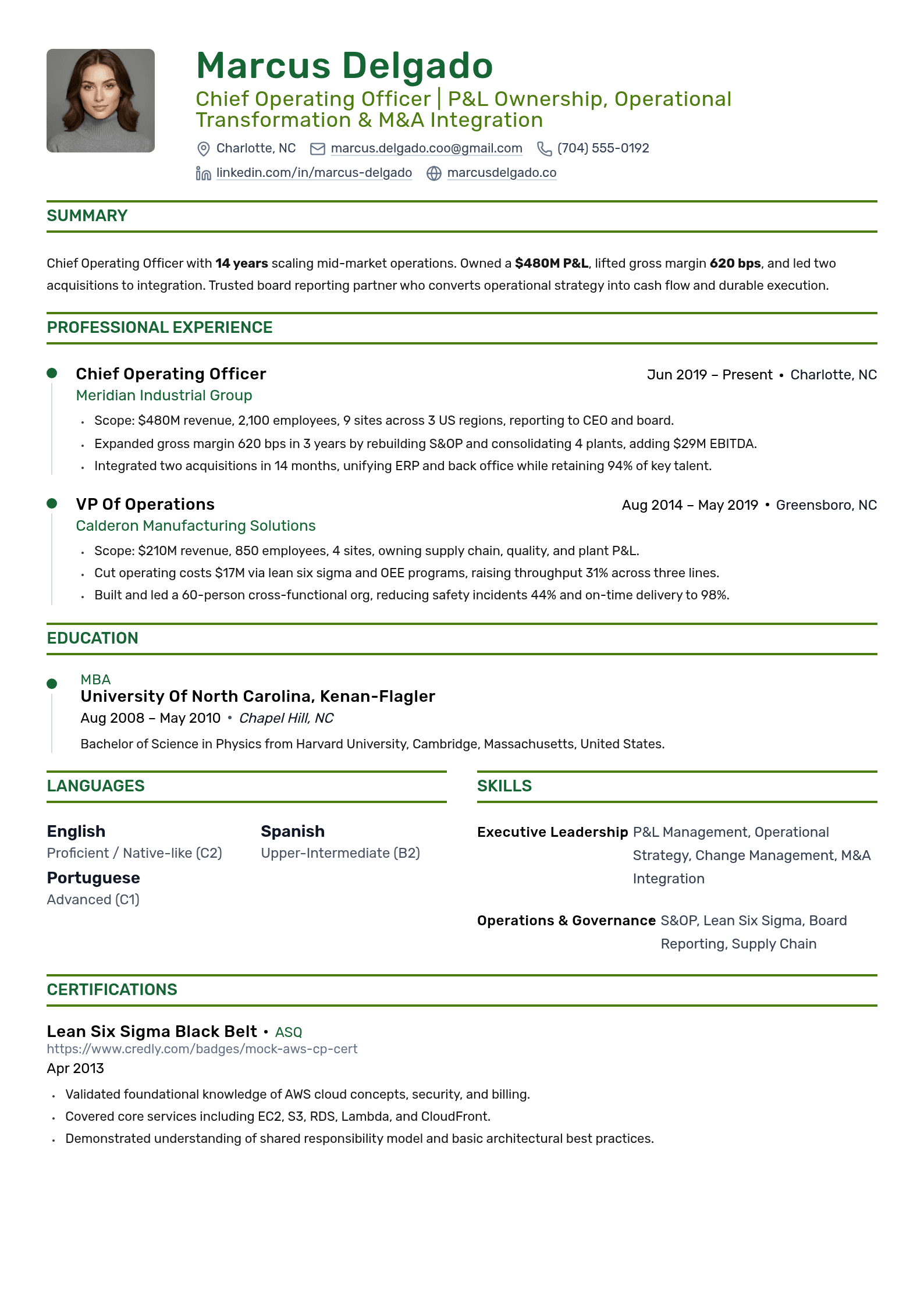
Here is a complete COO resume built the way this guide recommends. Notice the order of information: the summary makes a claim, the achievements under each role prove it with numbers, and board and strategic work is visible without being buried in a job description. Read it once as a recruiter would, top third only, then come back for the section-by-section reasoning below.

Marcus Delgado
Chief Operating Officer | P&L Ownership, Operational Transformation & M&A Integration
Summary
Chief Operating Officer with 14 years scaling mid-market operations. Owned a $480M P&L, lifted gross margin 620 bps, and led two acquisitions to integration. Trusted board reporting partner who converts operational strategy into cash flow and durable execution.
PROFESSIONAL EXPERIENCE
Chief Operating Officer
Meridian Industrial Group
Scope: $480M revenue, 2,100 employees, 9 sites across 3 US regions, reporting to CEO and board.
Expanded gross margin 620 bps in 3 years by rebuilding S&OP and consolidating 4 plants, adding $29M EBITDA.
Integrated two acquisitions in 14 months, unifying ERP and back office while retaining 94% of key talent.
VP of Operations
Calderon Manufacturing Solutions
Scope: $210M revenue, 850 employees, 4 sites, owning supply chain, quality, and plant P&L.
Cut operating costs $17M via lean six sigma and OEE programs, raising throughput 31% across three lines.
Built and led a 60-person cross-functional org, reducing safety incidents 44% and on-time delivery to 98%.
EDUCATION
MBA
University of North Carolina, Kenan-Flagler
Bachelor of Science in Physics from Harvard University, Cambridge, Massachusetts, United States.
LANGUAGES
SKILLS
CERTIFICATIONS
Lean Six Sigma Black Belt
Validated foundational knowledge of AWS cloud concepts, security, and billing.
Covered core services including EC2, S3, RDS, Lambda, and CloudFront.
Demonstrated understanding of shared responsibility model and basic architectural best practices.
PROJECTS
Enterprise Transformation Office
Executive Sponsor
Chartered a company-wide transformation PMO tracking 40+ initiatives, delivering $52M in cumulative run-rate savings and standardizing operating cadence across all nine sites.
AWARDS
Operations Executive of the Year
Carolinas Manufacturing Council
Why this example works
Four decisions in the example above do most of the work, and they are the ones to copy.
- Every role opens with scope, not duties. Before a single achievement bullet, the reader knows the size of the machine: revenue, headcount, footprint. That single line converts every bullet that follows from a claim into a data point.
- Achievements are separated from responsibilities. A board reader wants to know what changed because you were there, not what the org chart says you owned. The example leads each role with outcomes and keeps scope to one line.
- Board exposure is visible on page one. Presenting to a board, sitting on one, or advising one is a distinct qualification for a COO role. It does not belong in the fourth bullet of a job entry.
- The formatting is quiet. No columns fighting for attention, no graphics, no skill bars. Executive resumes are conservative documents because the reader is conservative. The design's only job is to make the numbers easy to find in seven seconds.
Top Leadership Keywords for COO Roles
Executive searches still pass through software. Retained firms run keyword searches across their candidate databases, and companies hiring directly push even VP-and-above applications through an applicant tracking system (ATS), the software that parses and filters resumes before a human reads them. The keywords that matter for a COO are not tools or certifications; they are the vocabulary of scope. Read five COO postings and the same terms repeat.
| Category | Keywords to work in | Where they belong |
|---|---|---|
| Financial ownership | P&L management, EBITDA improvement, budget ownership, cost optimization, margin expansion, capital allocation | Summary and the scope line of each role, always paired with a figure |
| Operational leadership | operational strategy, operational excellence, process improvement, supply chain, KPI development, scaling operations | Achievement bullets, attached to a measurable outcome |
| Transformation | change management, digital transformation, restructuring, turnaround, post-merger integration, M&A integration | One dedicated bullet per role where true; never listed bare in skills |
| People and org | executive leadership, cross-functional leadership, organizational design, succession planning, talent development | Summary plus one bullet showing headcount or leadership-team scope |
| Governance | board reporting, board of directors, corporate governance, stakeholder management, investor relations | Summary, a Board section, or the top of the relevant role |
Two rules keep this honest. First, a keyword only counts if the sentence around it proves it: "change management" in a skills list is noise, while "led change management for a 400-person consolidation of two distribution networks" is evidence that also happens to match the filter. Second, mirror the posting's exact phrasing. If the job description says "P&L ownership" and your resume says "full financial accountability," a keyword filter may not connect them even though they mean the same thing. The mechanics of matching phrasing without stuffing are covered in our guide to ATS resume keywords.
Writing an Executive Summary That Commands Attention
The summary is the most-read and worst-written section on most executive resumes. The failure mode is always the same: a paragraph of adjectives. "Dynamic, results-driven operations executive with a proven track record of driving excellence." That sentence contains zero information. A search partner has read it a thousand times and it tells them nothing they could repeat to a client.
A COO summary should read like the first paragraph of a board bio: who you are in one clause, the scale you have operated at, and the two or three outcomes that define your career. Three to five lines, no first person, no adjectives that a number could replace.
The structure that works:
- Line one, identity and scale. Title-level, industry, and the size of the P&L or organization you have run.
- Lines two and three, proof. Your two strongest career outcomes, each with a figure. Pick the ones that match the target role: margin work for a turnaround, integration work for an acquisitive company, scaling work for a growth-stage business.
- Line four, the differentiator. Board experience, an industry-specific credential, or the specific kind of transformation you are known for.
Rewrite the summary for every serious application. A COO candidate for a private-equity-backed manufacturer and the same candidate for a healthcare system should lead with different proof points, because the reader's anxiety is different. The general craft of summaries, with worked examples, is in our guide to writing a professional summary; at the executive level, treat it as the single highest-return paragraph you will edit.

Showcasing P&L Responsibility and Scale
P&L responsibility is the load-bearing claim of a COO resume, and vague versions of it actively hurt you. "Responsible for P&L" invites the question "how big?" and an unanswered question at the executive level reads as an evasion.
State scale as a scope line at the top of each role, before the bullets. Revenue or budget under management, total headcount and direct reports, and physical or geographic footprint. Then let the achievement bullets show what you did with that scope. The pattern for each bullet is verb, action, quantified outcome: what you changed, and what it was worth.
A few judgment calls that come up constantly:
- If your revenue figures are confidential, use honest ranges or relative figures: "a nine-figure P&L," "grew revenue 40% over three years." A range is credible; a blank is not.
- If your title lagged your scope, say so in the scope line. Plenty of strong COO candidates ran operations company-wide as an SVP. "SVP Operations (de facto COO scope: all operations, 1,200 FTE)" is a legitimate framing as long as it is true and you can defend it in the interview.
- Distinguish owning a P&L from influencing one. If you managed costs but revenue sat with a commercial leader, write "owned the cost side of a $200M P&L" rather than implying full ownership. Executive references get checked, and an inflated scope claim is the kind of thing that surfaces.
- Percentages beat absolutes for improvement claims. "Cut logistics cost 18%" travels across company sizes; "saved $2M" means different things at a $50M company and a $2B one. Where you can, give both.
Structuring a Multi-Page Executive Resume
Two pages is the format; the question is what goes where. The governing principle: page one must stand alone, because for many readers it is the only page.
The order that serves a sitting or aspiring COO:
- Header. Name, target title if it clarifies ("Chief Operating Officer | Manufacturing & Distribution"), city, phone, email, LinkedIn. No street address; city and state are enough.
- Executive summary. The board bio paragraph from the section above.
- Selected achievements (optional but powerful). Three to four career-best outcomes as standalone bullets, each with a number. This section exists for the seven-second reader.
- Professional experience. Reverse chronological. Current and previous role in full detail on page one if they fit; earlier executive roles with two to three bullets each; pre-executive career compressed to a single "Earlier career" block with titles and companies only. Fifteen to twenty years of detail is plenty; the reasoning is in how far back a resume should go.
- Board experience and strategic initiatives. Its own section, covered below.
- Education, plus executive credentials. Degrees, executive education, relevant certifications. Bottom of page two. No graduation years if they date you unhelpfully, and no GPA.
- Skills, kept short. Eight to twelve executive-level keywords from the table above, as a compact line or two. This section exists for search and parsing, not for the human reader.
This order is an argument, and it changes with the story. A candidate whose board work is the differentiator should pull that section up under the summary. A turnaround specialist might replace "Selected achievements" with "Turnarounds led." This is exactly where most resume builders fail executives: they lock the section order, so restructuring means retyping. In the Roleframe editor every section is a block you drag to a new position, into a column, or onto the other page, and it keeps its content and formatting when it moves. Testing "board section on page one" against "board section on page two" takes a minute instead of an evening. The broader logic of ordering by experience level is in our guide to resume section order.
One formatting note that matters more at two pages: repeat your name and page number in a footer, keep margins and font size readable (nothing below the range covered in our font size guide), and never let a role split awkwardly across the page break with its scope line orphaned. And submit as PDF. A PDF renders identically on the CEO's laptop and the search firm's ATS, and a two-page executive document with drifting formatting in a word processor file undercuts the exact impression you are paying for.
Board Experience and Strategic Initiatives
Board exposure answers the question behind the question. A CEO hiring a COO wants an operator; the board approving the hire wants someone who can sit across from them and hold the room. If you have that experience, make it findable in three seconds.
Give it a dedicated section, "Board & Advisory Experience" or similar, rather than scattering it through job bullets. Include, in this order of value:
- Board seats, fiduciary or advisory, with the organization, its size, and your committee work if any.
- Board reporting, if you presented operating results, strategy, or transformation plans to a board regularly. "Presented quarterly operating review to the board of a PE-backed company" is a real credential, not filler.
- Nonprofit and industry boards. Weaker than corporate seats but still evidence of governance fluency, especially for candidates without a corporate seat yet.
Strategic initiatives deserve the same treatment when they are company-defining: an ERP replacement, a post-merger integration, a market entry, a restructuring. If one initiative is the centerpiece of your candidacy, consider naming it as a sub-heading inside the relevant role with two or three bullets of its own. The signal you want to send is that you did not just run operations while strategy happened elsewhere; you built and executed the plans the board bet on.
If you have no board exposure at all, do not fake proximity to it. Lead with transformation and P&L work instead, and start building governance experience now; an advisory seat or a nonprofit finance committee is attainable for most operations executives within a year.

How to Analyze Your Resume Against a COO Job Description
No two COO roles are the same job. One posting is really "integrator for a founder CEO," another is "margin fixer for a PE sponsor," a third is "scale the machine from 200 to 1,000 people." Sending the same executive operations resume to all three wastes your strongest asset, which is that you have probably done at least one of those things exceptionally well.
Read the posting the way a search consultant briefs a client, and score your resume against it:
- Identify the role archetype. Turnaround, scaling, integration, professionalization, or succession. The verbs in the posting tell you: "stabilize," "scale," "integrate," "build out," "partner with the CEO."
- List the posting's explicit requirements and mark each one covered, partially covered, or missing on your current resume. Be harsh; "I did that but it's not on the page" counts as missing.
- Check keyword phrasing. Where the posting says "EBITDA improvement" and you wrote "profitability gains," adopt their term.
- Reorder for the archetype. Pull the matching achievement into your summary and your Selected Achievements section. The turnaround bullet leads for the turnaround role.
This is the workflow Roleframe automates the honest way. Duplicate your base resume for the job, paste the posting, and the fit report scores the match: an ATS score, the exact keywords the posting asks for that your resume misses, and a prioritized plan of what to rewrite and reorder for this specific role. Then you make the edits yourself, with Remi, the built-in career copilot, proposing rewrites bullet by bullet that you approve or discard word by word. Nothing gets rewritten for you, which matters more at the executive level than anywhere else: a claim you cannot defend across the table from a board member is worse than a weak resume. The base-and-variants system behind this is worth understanding on its own; see why you need a base resume and tailored versions.
Try Our Free Document-Grade Resume Builder
Executive resumes punish sloppy tooling. A two-page document with a footer, a Selected Achievements block, and a board section needs an editor that gives you real control over layout and typography, and an export where the PDF matches what you built exactly. Roleframe's editor is free to use with no account: every template, full drag-and-drop section control, and an unwatermarked PDF download with no trial and no card. Import your current resume as a PDF and it comes back as editable blocks with an analysis already run, so you start from a scored document rather than a blank page.
Frequently asked questions
- What is a typical COO salary?
It varies too much to give a single figure honestly. COO compensation depends on company size, industry, ownership structure, and how much of the package is equity or bonus rather than base salary; a COO at a PE-backed mid-market company and one at a public enterprise are in different markets entirely. For real numbers, use compensation surveys for your industry and company size, and talk to the retained search firms working your sector, since they see live offer data. On the resume itself, never list salary expectations; that conversation belongs in the process, and we cover how to handle it in answering the salary expectations question.
- What is the 7-second rule in resumes?
It refers to the common finding that recruiters spend only a few seconds on a first-pass skim before deciding whether to read further. For a COO resume the practical implication is concrete: your name, current title, company scale, and one board-worthy achievement must all be visible in the top third of page one. If the skim reaches the bottom of your summary without hitting a number, you have likely lost the pass.
- What are the 5 P's of a resume?
It is a coaching mnemonic, with slight variations by source, usually given as preparation, personalization, presentation, proofreading, and professionalism. For an executive resume, two of the five do the heavy lifting: personalization, meaning the document is rebuilt around the specific role archetype, and presentation, meaning conservative, flawless formatting exported as a PDF so it renders identically everywhere.
- What are the typical duties of a chief operating officer?
A COO owns the company's operating engine: day-to-day operations across functions, execution of the strategy the CEO and board set, the operating budget and often the full P&L, organizational design and senior operational hires, and performance management through KPIs. In practice the job flexes to complement the CEO; at a founder-led company the COO is often the integrator who turns vision into process, while at a PE-backed company the mandate is usually margin and efficiency. Your resume should reflect the version of the job the posting describes.
- Should a COO resume be one page or two?
Two. An executive with over a decade of P&L-level work cannot compress it onto one page without cutting the evidence that makes the case, and search consultants expect two pages at this level. The discipline is not length, it is density: page one must stand alone, and everything before your executive roles gets compressed into a brief early-career block. The full breakdown by experience level is in our one-page-or-two guide.
- Should I send my COO resume as a PDF or a Word document?
PDF, in essentially every case. A two-page executive resume with a footer and careful spacing will drift in a word processor file depending on the reader's fonts and version, and modern ATS platforms parse PDFs cleanly. The only exception is an employer or search firm that explicitly requests another format, and even then, send the PDF alongside it if you can.
- How do I write a COO resume if my title was SVP or VP of Operations?
Lead with scope, not title. If you ran all operations company-wide, say so in the scope line of the role: revenue, headcount, functions owned, and board reporting if you did it. A framing like "SVP Operations, company-wide operational scope" is legitimate as long as it is accurate and you can walk through it in an interview. Then make sure your summary claims the COO-level identity your evidence supports, since the summary is where the reader decides what level you are.
- Do I need to list every job from early in my career?
No. Compress everything before your executive or senior leadership roles into a short "Earlier career" block with titles, companies, and dates only, or drop the oldest roles entirely. Detail from twenty years ago dilutes the page and adds nothing a board reader needs. Roughly the last fifteen years carry the argument; see how far back a resume should go for the edge cases.


Ready when you are
Send the tailored resume, not the generic one.
Paste a job posting and Roleframe scores your resume against it, then helps you close the gaps one approved edit at a time, so you apply while the role is still fresh.