Lawyer Resume Example for Firm and In-House Moves
by Larbi SahliLast Updated
A lawyer resume example built for an in-house move, plus the same three career bullets written twice so you can see exactly what changes for a GC reader.

Users have landed jobs at
- 1Password
- OpenAI
- Notion
- justworks
On this page
The resume that earned you a firm offer will read as noise to a general counsel. Firms hire for pedigree, practice depth, and billable capacity. In-house teams hire for judgment, speed, and whether the business will actually call you before signing something dangerous. Those are different questions, and a resume that answers the first one leaves the second one blank.
This page gives you a complete lawyer resume example built for an in-house counsel application, then does something most example pages skip: it takes three real firm bullets and rewrites each one for a general counsel audience, side by side, so you can see precisely what changes and why. If you are moving firm to firm instead, the same mechanics apply in reverse, and I flag where.
The example: a lawyer resume built for an in-house application
The example below is a mid-level corporate associate, roughly six years across two firms, applying for a first in-house counsel role. Read it before the analysis. Notice three things: every bullet ends in a business outcome, not a task; scope numbers (deal count, aggregate value, budget managed) appear even though the candidate never held a management title; and the bar admissions block takes four lines, not a quarter of the page.
Why a firm resume and an in-house resume are not the same document
A firm hiring partner reads your resume asking one question: can this person do sophisticated work in my practice area, at my clients' level, starting Monday. So a firm resume rewards depth. Named deal types, specific document ownership, the caliber of counterparties, the complexity of the matters. "Drafted disclosure schedules for a cross-border carve-out" is a strong firm bullet because the reader knows exactly how hard that is.
A general counsel reads the same resume asking a different question: will this person make my legal function faster and my business safer without me supervising every judgment call. A GC running a lean team does not care that you drafted disclosure schedules. They care that deals closed on time, that disputes got resolved for less than they would have cost to litigate, and that you can talk to a VP of sales without a partner in the room.
The consequence is blunt: an in-house resume that lists firm work as firm work reads like an associate looking for a softer schedule. The one that translates the same work into cost, speed, and risk outcomes reads like a future business partner. Same facts, different document.
The same three bullets, written twice
This is the core of the page. Below are three bullets from a real-shaped firm career, each written once for a lateral firm reader and once for a general counsel. The underlying facts never change. Only the frame does.
| Firm version (for a hiring partner) | In-house version (for a general counsel) |
|---|---|
| Drafted and negotiated primary transaction documents for sponsor-side M&A, including purchase agreements, disclosure schedules, and ancillaries, across 14 closed deals totaling $1.2B in aggregate value. | Negotiated and closed 14 acquisitions worth $1.2B in aggregate, owning purchase agreements end to end and coordinating tax, IP, and employment specialists so deal teams got one answer instead of five. |
| Second-chaired a five-day AAA arbitration arising from a $45M supply agreement dispute; drafted dispositive motions and directed an eight-person document review team. | Resolved a $45M supply dispute through arbitration at roughly a third of projected litigation spend, managing the review budget and preserving a commercial relationship the business renewed the following year. |
| Advised clients on commercial contracting, including MSAs, SaaS agreements, and data processing agreements; developed a negotiation playbook adopted across the practice group. | Built a contract playbook with pre-approved fallback positions that let client procurement teams close routine MSAs without legal review, cutting turnaround from weeks to days. |
Read the pairs closely and the pattern jumps out. The firm versions lead with the legal work product: documents drafted, motions filed, teams staffed. The in-house versions lead with what the business got: deals closed, money saved, cycle time cut, a relationship preserved. The legal craft is still visible, but it moved from subject to supporting evidence.
Three specific shifts, worth applying to every bullet you rewrite:
- Verb choice changes the actor. "Drafted" and "advised" describe service to someone else's decision. "Negotiated," "resolved," and "built" describe ownership. In-house, you are the decision-maker's first line, so the verbs should claim ownership wherever the facts support it.
- The outcome replaces the artifact. A hiring partner values the disclosure schedule; a GC values the closed deal. Every in-house bullet should survive the question "and what did the business get?"
- Cost and speed become first-class facts. Firms bill time; companies buy it. "A third of projected litigation spend" and "weeks to days" are the numbers a GC repeats to their CFO. Firm resumes almost never contain them, which is exactly why yours should.
Walking through one rewrite, step by step
Take the arbitration bullet and do the translation slowly, because this is the move you will repeat across your whole experience section.
Start with the honest raw material: you second-chaired, you drafted motions, you ran a review team. Now ask the GC's questions in order. What was at stake? A $45M contract dispute, so the number stays. What did it cost to resolve versus the alternative? If you know the litigation budget the client avoided, that comparison is the single most persuasive fact you own; even a defensible "roughly a third of projected spend" beats silence. What happened to the relationship? If the counterparty is still a supplier, say so, because a GC's real job is keeping commerce moving, not winning arguments.
Then cut what the GC cannot use. "Second-chaired" is firm status vocabulary; outside a firm it signals that someone else was in charge. "Dispositive motions" is craft detail a non-litigator hiring you for a generalist seat will skim past. Keep the eight-person team if headcount supervised is otherwise thin on your resume, drop it if your other bullets already prove you can direct people.
One warning: translation is not inflation. Every rewritten bullet must describe work you actually did and can defend for ten minutes in an interview. If you supported the negotiation rather than led it, "drove negotiation of" is fine and "led" is a lie that a competent GC will find in the first behavioral question.
Stacking two firms and six years into a readable experience block
Six years across two firms usually means one lateral move and a title that barely changed. Do not let that flatten into two identical-looking entries. Structure each firm entry as a one-line scope statement followed by four to six bullets, and make the two entries argue different things.
The current firm gets the outcome bullets: the translated, GC-facing lines from the table above, ordered by relevance to the posting rather than chronology. The earlier firm gets two or three bullets that establish trajectory: increasing deal responsibility, first direct client contact, the moment you stopped being supervised on routine matters. A GC reading top to bottom should see a lawyer who grew, not a lawyer who repeated year one six times.
The scope line under each firm name does quiet work. "Corporate associate, M&A and commercial group; primary drafting responsibility on sponsor-side deals from $20M to $400M" tells the reader your altitude in one pass, which frees the bullets to carry outcomes instead of context. If you clerked or did a stint in government before the firms, keep it to two lines unless the posting rewards it. For how much older history to keep at all, the standard guidance on how far back a resume should go applies to lawyers the same as everyone else.
Which practice areas stay and which drop after a pivot
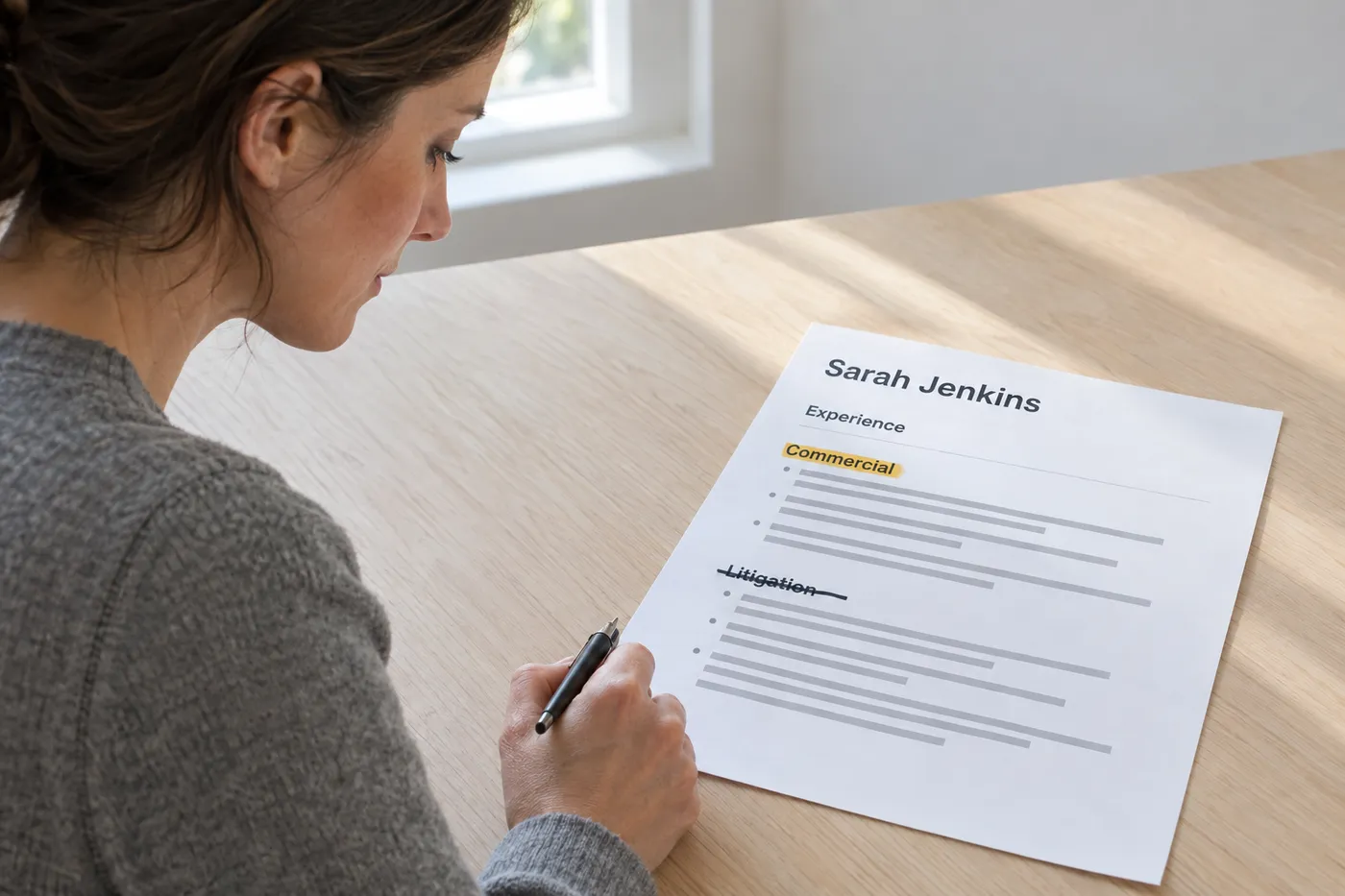
The instinct after six years is to list everything you have touched, because dropping a practice area feels like burning credential. Resist it. An in-house posting names the work the seat actually contains, usually commercial contracts plus one or two specialties, and every unrelated practice area you list dilutes the match.
The rule: a practice area stays if the posting names it or if the company's business obviously requires it. It drops to a single skills-line mention if it merely proves range. It disappears entirely if it points your story in the wrong direction.
- Almost always stays for a generalist counsel seat: commercial contracts (MSAs, SaaS, NDAs, DPAs), M&A if the company acquires, employment advice, and anything touching data privacy.
- Stays if the company's sector demands it: regulatory work matching their industry, IP licensing for a product company, real estate for anyone with physical footprint.
- Usually drops to one line: capital markets, funds work, niche litigation specialties. Real skills, wrong seat.
- Drops entirely: a practice area you did for eight months in year two and would refuse to be quizzed on.
This pruning is why one lawyer resume cannot serve a firm lateral search and an in-house search at once. Keep a master version with everything on it and cut per application. The mechanics of maintaining a master resume plus tailored versions matter more for lawyers than most professions, because the same career genuinely supports two or three different documents.
Proving scope: matter value, deal size, headcount, budget
Associates routinely tell me they have no numbers because they never had a title. Wrong. A firm career is full of scope numbers; they are just attached to matters instead of org charts. Mine these four categories before you decide your resume has to stay qualitative:
- Matter value: the amount in controversy, the contract value, the exposure you helped cap. Litigation associates almost always know this number and almost never write it down.
- Deal size and count: aggregate value closed, number of transactions, range from smallest to largest. A range ("$20M to $400M") often says more than a single headline deal.
- Headcount directed: review teams, junior associates you supervised, local counsel you coordinated across jurisdictions. Direction without a title is still direction.
- Budget: outside counsel or vendor spend you managed on a matter, e-discovery budgets, settlement authority you operated within. For in-house readers this is the most persuasive category, because managing outside counsel spend is a core part of the job you are applying for.
Confidentiality is the standard objection, and it has a standard answer: round aggressively and anonymize. "A Fortune 500 industrial client" and "a $45M supply dispute" breach nothing while "represented a client in a contract dispute" says nothing. If a specific matter is genuinely sealed, describe the category and keep the number approximate. No GC expects deal names; every GC expects magnitudes.
Litigation and transactional bullets a non-lawyer can read
Here is the screening reality most attorney resume guides ignore: in-house, the first human to read your resume is often a recruiter or an HR generalist, not a lawyer. If a bullet requires a JD to parse, it fails at that gate regardless of how impressive it would be to a partner.
The fix is not dumbing down. It is stating the stakes before the procedure. "Won summary judgment" means little to a non-lawyer; "ended a $12M claim before trial, on the briefs" means exactly what it says. "Negotiated reps and warranties" is opaque; "negotiated the terms that determine who pays when a deal goes wrong" is not, though on a resume you would compress it to "negotiated risk allocation terms across 14 acquisitions."
A quick test for every bullet: read it to a smart friend who is not a lawyer and ask what happened. If they can answer "the company saved money," "the deal closed," or "the lawsuit went away," the bullet works. If they shrug, you have written a description of legal procedure and the stakes are still in your head. This is also where strong verbs earn their keep; the sorted list of resume action verbs by what they prove is worth ten minutes when you are rewriting a dozen bullets in one sitting.
Firm laterals, note the reverse: for a hiring partner, keep the procedure. "Won summary judgment" is precisely the fact a litigation partner wants, and translating it away costs you credibility with that reader. Which document you are writing decides which register wins.
Bar status, CLE, and admissions in four lines
Bar information is a pass/fail check, not a selling point, and it should take the space of a pass/fail check. Four lines, near the bottom of the page, under a heading like "Bar Admissions":
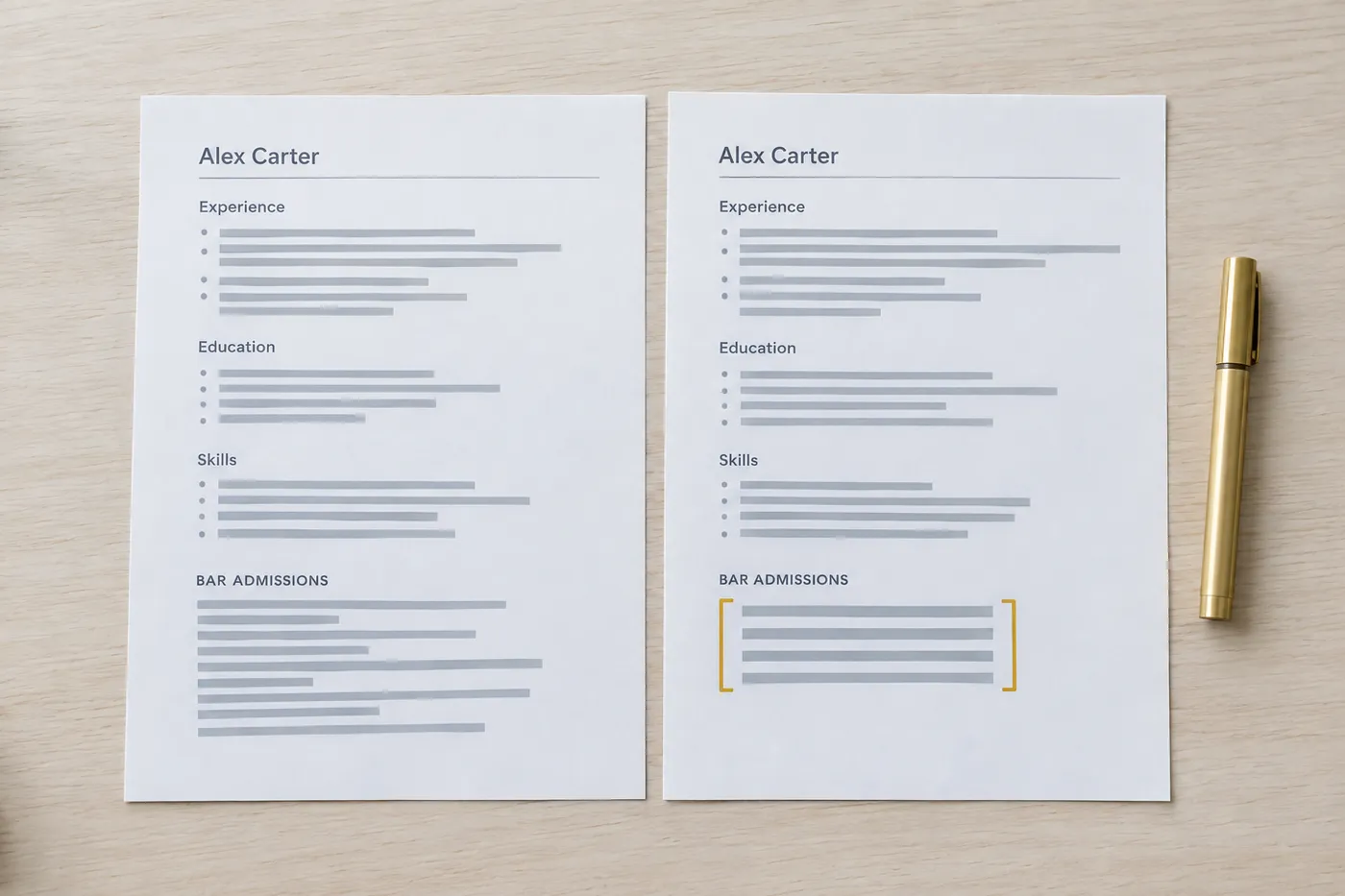
- Admissions with years: "New York (2019); California (2022)."
- Standing: "Active and in good standing in both jurisdictions."
- Federal courts, only if you litigate: "S.D.N.Y.; E.D.N.Y."
- CLE or in-house registration status where relevant: "CLE current; eligible for in-house registered counsel status in [state]."
Two situations earn more prominence. If the posting requires admission in a specific state, that admission also belongs in your summary or header, because a screener should confirm it in two seconds. And if you would need in-house registered counsel status to practice in the company's state, saying you have researched it signals seriousness that most candidates skip. Everything else, including individual CLE courses, stays off the resume. The general rules on where certifications go on a resume apply: placement follows what the job requires, not what you are proud of.
The keywords this role is screened on, and where each one goes
In-house counsel applications usually pass through an applicant tracking system (ATS), the software that parses your resume into a searchable record, and then through a recruiter keyword scan. Neither reader is a lawyer. Both are matching your text against the posting's text, so the vocabulary of the posting has to appear on your resume, literally, not as an elegant paraphrase.
These are the phrase categories that recur across counsel postings, and where each belongs:
| Keyword or phrase | Why it gets screened | Where it goes on your resume |
|---|---|---|
| Commercial contracts / MSA / SaaS agreements / NDA / DPA | The daily workload of most counsel seats; recruiters search these acronyms verbatim | Skills section as exact terms, plus one experience bullet showing volume or turnaround |
| M&A / due diligence / post-closing integration | Signals deal capability for companies that acquire | Experience bullets with deal count and aggregate value |
| Outside counsel management | The budget-side half of the in-house job | One bullet with a spend figure or a matter where you directed firm resources |
| Regulatory compliance (named regime: GDPR, CCPA, HIPAA, etc.) | Postings name their regimes; generic "compliance" does not match a search for "CCPA" | Skills section with the exact regime names you have actually advised on |
| Risk management / risk assessment | GC shorthand for judgment; appears in nearly every counsel posting | Summary line, backed by a bullet where you capped or avoided a quantified exposure |
| Cross-functional / business partner | Screens for lawyers who can work outside a legal department | One bullet naming the functions: sales, procurement, product, finance |
| Bar admission (specific state) | Hard requirement; screened first | Header or summary, plus the admissions block |
| Employment law / corporate governance | Common secondary duties in generalist seats | Skills line; a bullet only if you have real depth |
Placement matters as much as presence. A keyword in a skills list proves you typed it; a keyword inside a bullet with a number attached proves you did it. Aim for both on the terms the posting emphasizes hardest. And pull the terms from the actual posting rather than a generic list; the process in how to pull resume keywords from a job description takes fifteen minutes and beats any static keyword table, including this one.
One thing not to do: paragraph-length skills sections stuffed with every practice area and statute you can spell. Recruiters recognize stuffing instantly, and an ATS gains nothing from the twentieth term. Cover the posting's language, then stop.
Scan your draft against a real posting before you send it
The gap between a firm resume and an in-house resume is exactly the kind of thing you stop seeing in your own document. You know what "second-chaired" means and what the deal was worth, so your brain fills in what the page leaves out. A GC's brain will not.
The reliable fix is to check the draft against the specific posting, mechanically. In Roleframe, you duplicate your master resume for the job and get a fit report: an ATS score against that posting, the exact keywords it screens on that your resume is missing, and a prioritized plan of what to rewrite. Then you make the edits yourself, with Remi, the career copilot, proposing bullet-level rewrites you approve or discard one at a time. Nothing lands on the page without your sign-off, which matters more in law than anywhere: a resume claim you cannot defend in an interview is a credibility problem, and for a lawyer it is a character-and-fitness problem. If you want the manual version first, the walkthrough on checking your resume against a job description covers the same checks by hand.
Export and submit as PDF. It preserves your formatting exactly, modern ATS software parses it cleanly, and it is what a GC will forward to the CEO if things go well.
Frequently asked questions
- Should a lawyer resume be one page or two?
One page through roughly six to eight years of practice, two pages after that or when you carry substantial publications, clerkships, or a long matter history the role genuinely values. Law schools push one page hard, and for associate-level moves they are right: a hiring partner or GC decides in the first half page anyway. The general evidence on one page versus two by experience level applies to lawyers without much adjustment.
- Should I list representative matters on my resume?
For firm lateral moves, often yes, as a short "Representative Matters" block or a separate deal sheet, because practice-area depth is exactly what a hiring partner is buying. For in-house applications, fold the matters into outcome bullets instead. A GC wants to know what the work achieved, and a list of matter names reads like a bill. Either way, anonymize anything confidential: describe the client by category and the matter by magnitude.
- Do in-house counsel applications really go through an ATS?
At most companies of any size, yes. In-house legal roles post through the same careers page and the same applicant tracking system as every other corporate job, and the first screen is often a recruiter searching parsed text, not a lawyer reading prose. That is why exact keyword matches from the posting matter. If the mechanics are new to you, how an ATS works explains what the software actually does with your file.
- How do I show business impact when I only did firm work?
Translate the matter into what the client got: the deal that closed, the exposure that got capped, the dispute resolved for less than litigation would have cost. Firm associates always have these facts; they are just used to reporting the work product instead of the result. Mine four number categories: matter value, deal size and count, headcount you directed, and budget you managed. Rounded, anonymized figures are fine and expected.
- Should I put GPA, law review, or class rank on an experienced lawyer resume?
Keep law review and a genuinely strong class distinction (Order of the Coif, magna cum laude) as one line under education for firm lateral moves, where academic pedigree still carries weight. For in-house moves five or more years out, they can stay as a single line but should never take space from an outcome bullet. Raw GPA comes off after your first few years in nearly every case; the trade-offs in whether to put GPA on a resume hold for JDs too.
- How is a criminal or litigation lawyer resume different from this example?
The translation principle is identical; only the numbers change. Instead of deal value, litigators quantify caseload, amounts in controversy, trial and hearing counts, and win or resolution outcomes. "First-chaired 12 bench trials" and "resolved a docket of 60 active matters" are the litigation equivalents of deal count and aggregate value. For an in-house reader, add what the resolutions cost relative to the exposure, because that is the metric a legal department runs on.
- Should I send my lawyer resume as PDF or Word?
PDF, unless a specific employer explicitly instructs otherwise. PDF locks your formatting so the document a GC opens is the document you built, and modern ATS software parses well-structured PDFs cleanly. A Word file can reflow, expose tracked changes, and display differently on every machine, which is a bad look for a profession that lives on document control.

Ready when you are
Send the tailored resume, not the generic one.
Paste a job posting and Roleframe scores your resume against it, then helps you close the gaps one approved edit at a time, so you apply while the role is still fresh.