Resume Keyword Scanner: Find the Gaps and Fix Your Bullets
What a resume keyword scanner checks, how to read your keyword gap report, and how to work missing terms into bullets you can defend in an interview.

On this page
Recruiters rarely read every application. They search. Inside an applicant tracking system (ATS), a recruiter types the skills the hiring manager cares about, and the resumes containing those exact terms surface first. A resume keyword scanner tells you, before you hit submit, whether your resume would show up in that search or sit in the database unread.
Most scanners stop at the diagnosis. You get a match score and a list of missing words, and then you're on your own. The list is the easy part. The hard part is working those keywords into bullets that describe work you actually did, in language you can repeat in an interview. This guide covers both halves: what scanners actually check, and how to close the gaps without turning your resume into a word salad.
What a Resume Keyword Scanner Actually Looks For
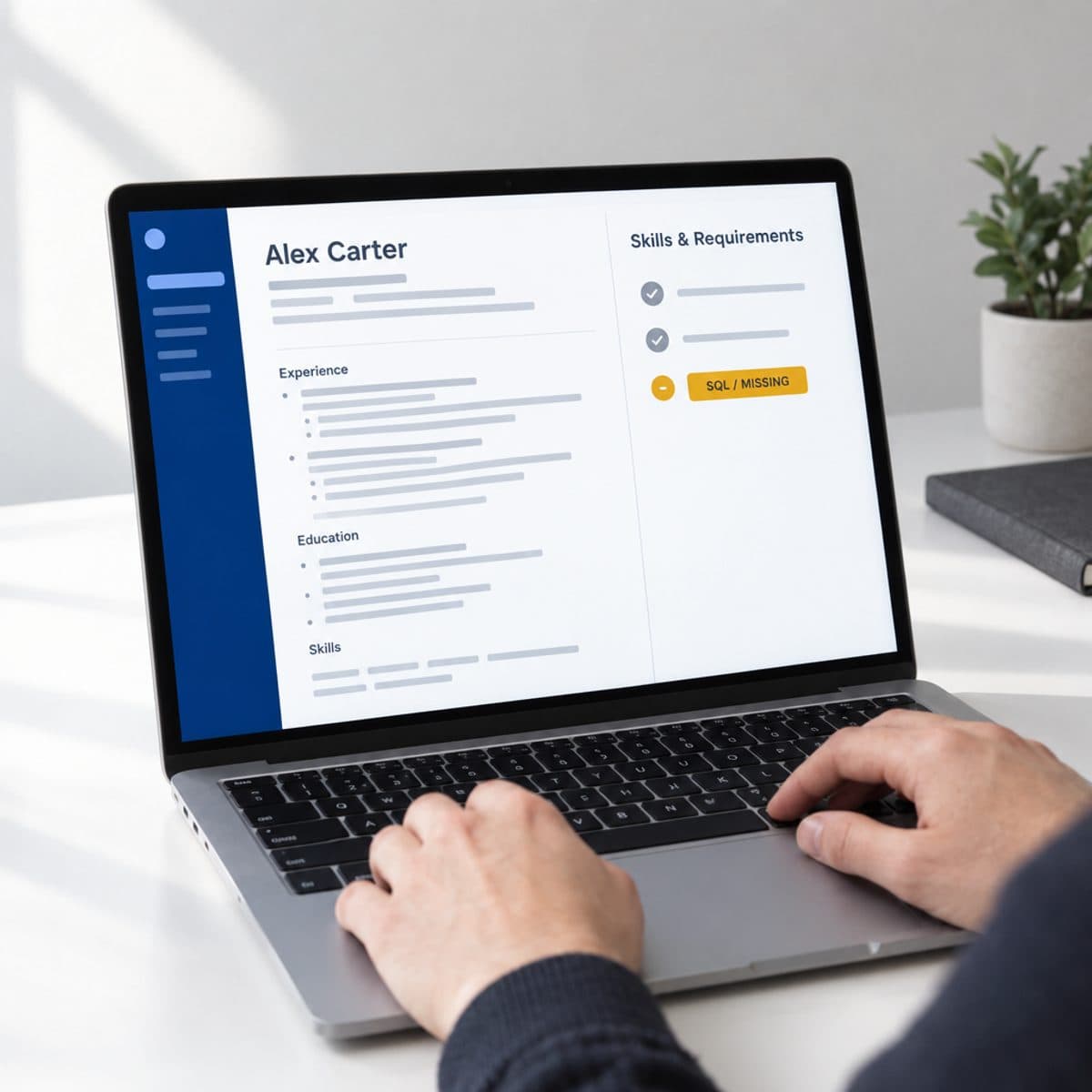
A resume keyword scanner compares the text of your resume against the text of a job description and reports the overlap. It returns a match score along with two lists: terms you already cover and terms you're missing. Better tools add a third bucket for weak keywords, terms that appear once, buried in a fine-print skills list with no evidence around them.
Modern scanners do more than count words. They parse your document the way an applicant tracking system does, normalizing the layout and extracting structured facts from the text. In practice, a good scan is checking several distinct things at once.
- Tools and platforms named in your bullets, like SQL, Salesforce, HubSpot, or Google Analytics
- Certifications, like PMP, CPA, AWS credentials, or a state license
- Methodologies and frameworks, like Agile or GAAP
- Job titles, both the ones you've held and how closely they match the posted role
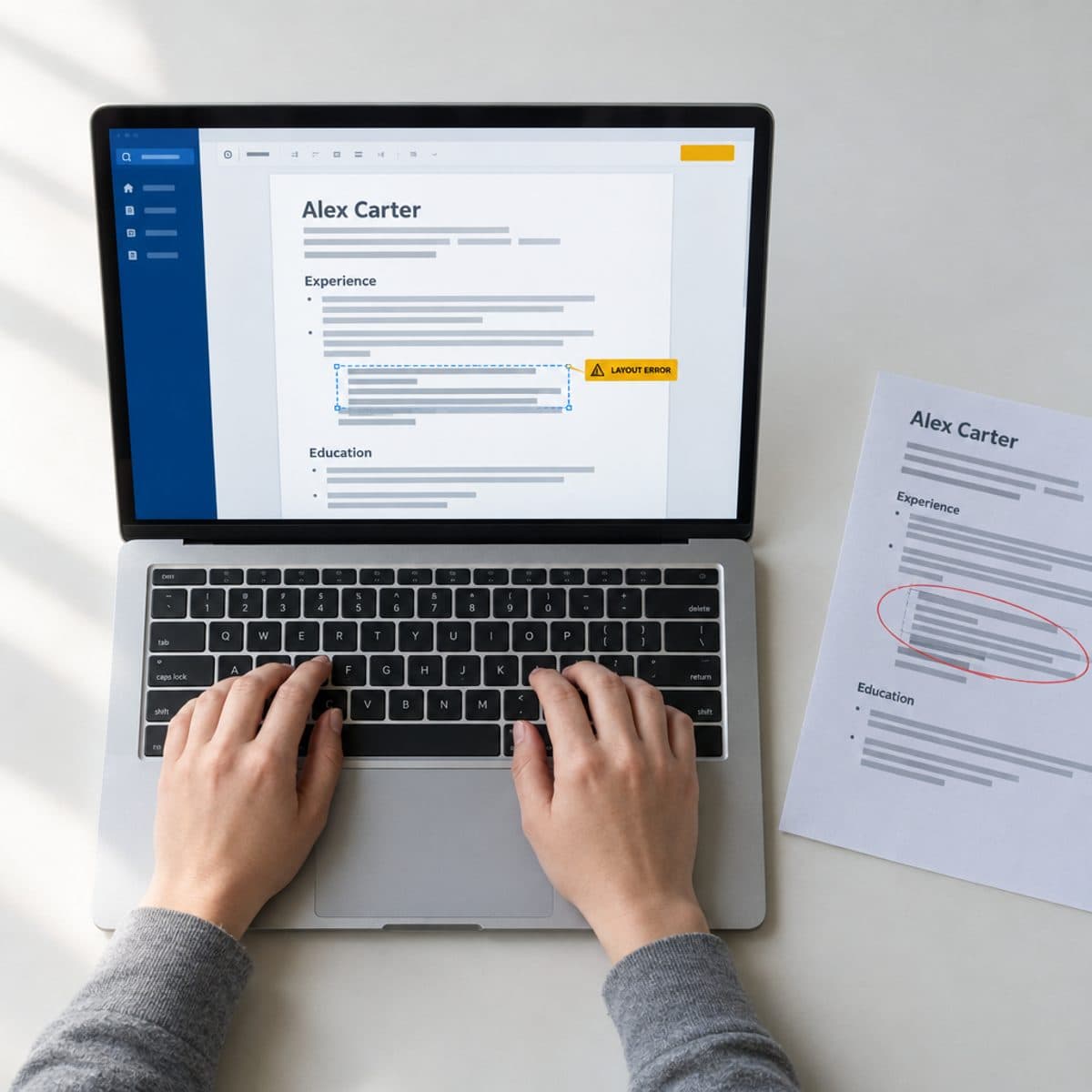
- Parsing health, meaning whether your sections and dates extract cleanly or whether tables and multi-column layouts break the read
Two shifts are worth knowing about in 2026. Some tools now offer role-standard scoring, where you pick a target role and get graded against a keyword set built for that role instead of one pasted posting, with each term graded from fully covered down to missing. And on the employer side, the major ATS platforms, including Greenhouse, Lever, Workday, and Bullhorn, now promote built-in resume scoring that ranks candidates by keyword alignment before a recruiter reads anything. The scan you run at home is a rehearsal for a scan that will happen either way.
Hard Skills vs. Soft Skills in ATS Parsing
Hard skills carry almost all the weight in keyword screening. A recruiter filtering candidates in an ATS searches for concrete, indexable terms: a certification, a tool name, a methodology, a title. Nobody runs a search for 'team player.'
Soft skills still matter, just not at this stage. They get read by a human later, and a bare list of adjectives does nothing for you there either. The evidence lives in outcomes. A project you led across four departments says 'leadership' better than the word ever will.
| Signal type | Examples | How screening treats it | Your move |
|---|---|---|---|
| Hard skills | SQL, HubSpot, Salesforce, GAAP | Indexed and searched directly; the most common recruiter filter | Mirror the posting's exact terms inside your experience bullets |
| Certifications | PMP, CPA, AWS Solutions Architect, RN license | Often a hard requirement, sometimes a dedicated ATS field | List in a certifications section, and in your summary if the posting requires it |
| Job titles | Marketing Manager, Data Analyst | Feeds recruiter searches and title-match scoring | Align your headline with the posted title, as far as honesty allows |
| Soft skills | Leadership, communication, stakeholder buy-in, adaptability | Rarely searched; evaluated by humans reading your results | Show them through outcomes instead of listing them as bare words |
For a deeper breakdown of which skills belong where on the page, see our guide to hard skills vs. soft skills on your resume.
Why Keyword Stuffing Gets You Rejected
The white-text trick is dead. Pasting invisible keywords into a footer worked against crude parsers a decade ago; modern systems normalize the document text before indexing it, so the hidden block shows up as visible gibberish in the parsed profile a recruiter reviews. You've flagged yourself as a cheater on the very first screen.
The subtler failure is the keyword dump: a skills section with forty comma-separated terms, half of them added the night before. This one actually passes the scan. It dies in the human read that follows, because a recruiter searching for 'demand generation' finds the phrase floating in a list with no role or result attached, and discounts it immediately.
Even if a stuffed resume survives to the interview, every keyword on the page is a promise of a question. A term you added but can't speak to for two minutes is worse than a gap. A gap looks like a fit issue; an unsupported claim looks like dishonesty. Coverage beats density at every stage of this pipeline, and one clear, honest mention of a skill inside a recent role does more than five repetitions ever will.
How to Scan Your Resume Against a Specific Job
A scan is only as good as its input. The biggest mistake people make with a resume keyword optimization tool is scanning against a job title instead of the actual job. Here's the process that works.
- Copy the entire posting, requirements and responsibilities included, plus any 'preferred qualifications' section, where filter keywords often hide.
- Scan a tailored copy, never your master resume. Keep one base version per target role and spin off a copy for each application, so edits for this job never contaminate the next one.
- Read the missing-keyword list before the score. The score is a summary; the list is the work.
- Fix, then rescan. Keyword reports are built to be rerun after edits, and the second pass usually catches phrasing you thought you'd already covered.
This is exactly how Roleframe structures the work. You keep a master resume per target role, duplicate it for a specific job, and paste the posting. The fit report reads that posting the way a senior recruiter would, then returns your ATS score for this document against this job, along with the exact keywords the posting asks for and which ones you're missing. It also hands you a plan ordered by impact, so you know which gap to close first instead of fixing things alphabetically. If keeping tailored versions is new to you, our guide to base resumes and tailored variants covers the setup.
Reading Your Keyword Gap Analysis
A gap report is a triage list, and triage means some findings get ignored. Here's how to sort what an ATS keyword finder hands back to you.
| What the report flags | What it usually means | What to do |
|---|---|---|
| Missing hard skill you actually have | The most common finding, and the most valuable. You did the work but described it in different words. | Rewrite one bullet in a relevant role so the skill appears in context, next to a result. |
| Missing hard skill you don't have | A fit signal, not a wording problem. | Don't add it. Decide whether the role is a reachable stretch or a pass; a cover letter can address a stretch, a fake bullet can't. |
| Weak keyword (skills list only) | The term exists but carries no evidence. Search finds it; the human read discounts it. | Move it into an experience bullet. The skills section should confirm keywords, never introduce them. |
| Title mismatch | Your headline says 'Content Marketer', the posting says 'Marketing Manager', and title alignment feeds most match scores. | Adjust your headline or summary toward the posted title, as far as honesty allows. |
| Acronym or spelled-out form missing | You wrote one form of a term and the posting uses the other. | Cover both forms once each; see the variations section below. |
Work through the posting's must-have requirements before touching the nice-to-haves, and favor edits in your most recent roles. A keyword sitting in a job you held eight years ago reads as stale to a recruiter, and scanning tools now commonly suggest moving key terms into more recent experience for exactly that reason.
How to Naturally Add Missing Keywords to Your Experience
A keyword belongs inside the story where the work happened. Most of your experience bullets are compressed STAR stories (situation, task, action, result), and fixing a missing keyword almost always means retelling one of those stories in the posting's vocabulary. If the structure is new to you, our STAR method guide walks through it.
Take a marketing example, since marketing postings are keyword-dense and a marketing resume keyword scanner will typically surface a long gap list. Say the posting repeats 'lifecycle marketing', 'marketing automation', 'HubSpot', and 'attribution', and your resume covers none of them. Your current bullet reads:
Before: "Ran email campaigns that improved customer engagement and retention."
After: "Built lifecycle email programs in HubSpot, using multi-touch attribution to find drop-off points and lift 90-day retention by double digits."
Same work, same person. Four keywords closed, nothing invented; only the vocabulary changed. That is the entire craft. The keyword sits next to evidence, inside a sentence you'd say out loud in an interview. Notice what didn't happen, too. No keyword landed in the summary as a bare adjective, and none went into the skills list as its only appearance. The skills section is where a term shows up a second time, confirming something your experience already proves.

Using Remi to Rewrite Bullets with Target Keywords
Retelling bullets is the slow part of tailoring, and it's the part Roleframe built Remi for. Remi is a career copilot that sits inside the editor, next to the document you're about to send. On a tailored version it has already read the job posting and the fit report, so when you ask it to rework a bullet, the rewrite starts from a named gap, the missing 'attribution' keyword, say, rather than from a guess about what you meant.
Every proposal arrives as a word-by-word diff showing what gets removed and what gets added, and nothing touches the document until you accept it. That's a deliberate design choice, the same trust position behind the whole product. Remi never rewrites your resume for you. It suggests and you approve, which means every line stays something you wrote and can defend across the table from a hiring manager. Its rewrites draw on the roles and facts already on your document, so a gap gets closed with work you did instead of work a model invented.
In practice this turns a gap report into a working session. A finding says your third bullet is vague; Remi jumps you to that bullet and proposes a fix; you accept, adjust, or discard, then rescan.
Tracking Keyword Variations and Acronyms
Keyword matching is more literal than most people assume. Current guidance for applicants still stresses exact mirroring of the posting's terms, because ATS matching and the AI scoring layered on top primarily reward term overlap rather than synonyms. A recruiter who searches 'SEO' may never see the resume that only says 'search engine optimization', and the reverse holds too.
The fix is a simple habit. On first use, write the full term with the acronym in parentheses, 'search engine optimization (SEO)', then use whichever form the posting favors for the rest of the document. One line covers both search behaviors.
| The posting says | Also cover | Why it matters |
|---|---|---|
| SEO | Search engine optimization | Recruiters search either form, and automated matching is often exact |
| CRM | The named platform (Salesforce, HubSpot) | 'CRM experience' filters frequently look for the specific tool |
| PMP | Project Management Professional | Certification fields and recruiter searches use both forms |
| CI/CD | Continuous integration | Engineering filters vary team to team |
| A/B testing | Experimentation, split testing | Marketing and product teams use different house terms |
Variations go beyond acronyms. 'Stakeholder management' and 'cross-functional collaboration' describe overlapping work, and 'managed' versus 'led' signal different scopes. When two phrasings are equally honest, use the posting's. Our full guide to ATS resume keywords digs into matching behavior in more detail.
Scan Your Resume for Free
You don't need to pay to run a first scan. Plenty of browser-based scanners now take a copy-pasted resume and posting with no signup and return a workable gap list. Our roundup of the best ATS resume scanners compares the options honestly, including where each one stops helping.
Roleframe's version of free goes further than most. The resume editor is free with no account, and a free account, no card required, includes importing your existing PDF resume, which comes back as editable blocks with an analysis already run, plus a starter credit balance for trying the AI. When you're ready to scan against a specific job, the fit report shows the keyword gaps and Remi helps you close them, and the finished document exports as a clean PDF that matches the editor exactly.
Start with whichever scan you like. Just don't stop at the list of missing words. The scan is the diagnosis; the bullets are the cure.
Frequently asked questions
- What is the 7 second rule for resumes?
It's shorthand for how quickly a recruiter skims a resume on the first pass, a few seconds rather than a careful read. Whatever the exact number, the lesson holds: your headline and your strongest, most relevant evidence need to sit in the top third of the page. Keywords are what get you into that skim at all, since recruiters often search the ATS before they read anything.
- Is 80% a good ATS score?
Scores aren't comparable across tools, and no employer's ATS publishes a passing grade, so treat any percentage as a direction rather than a verdict. What matters is whether you honestly cover the posting's must-have hard skills. A slightly lower score with every claim defensible beats a near-perfect score built on padded skills, because the padded resume collapses in the interview.
- Which resume keyword scanner is best?
It depends on what happens after the scan. Jobscan popularized the match report, and several free copy-paste tools produce a decent gap list. Where most tools stop is the rewrite; you get the list and a blank page. Roleframe pairs the scan, a per-job fit report, with a real editor and Remi, so the gap and the fix live in the same place and you can rescan the moment you've edited.
- How do you pass an ATS checker?
Mirror the posting's exact terms for skills you genuinely have, keep the layout simple so every section parses, use standard headings like 'Experience' and 'Skills', and submit as a PDF. Avoid tables and text embedded in images, both of which can break parsing. Our guide to ATS-friendly resume formatting walks through the details without forcing an ugly design.
- Do ATS systems automatically reject resumes?
Rarely in the way people imagine. Most systems rank and surface candidates rather than delete them; a resume missing the searched keywords simply never comes up when the recruiter filters the pile. The outcome feels like rejection, but the real problem is visibility, which is exactly what a keyword scan measures. Knockout questions, such as work authorization or a required license, are the main true auto-reject mechanism.
- Do I need to rescan my resume for every application?
If the postings differ meaningfully, yes. Two 'marketing manager' jobs can filter on entirely different terms, one on demand generation and paid channels, the other on brand and content. Keep a base resume and scan a tailored copy per job; our piece on using one resume for different jobs explains where the single-resume approach breaks down.


Ready when you are
Send the tailored resume, not the generic one.
Paste a job posting and Roleframe scores your resume against it, then helps you close the gaps one approved edit at a time, so you apply while the role is still fresh.