Nursing Skills for a Resume: Examples by Specialty and Unit
Nursing skills for a resume, by unit: license and certifications, clinical skills, charting systems like Epic, and bullets that prove each one.

On this page
A nurse recruiter reads the license line first, then the certifications the posting requires, then the clinical skills that match the unit being staffed. Everything else on the page waits. A skills section built for that read is short and specific. It names your RN license with its state and compact status, spells out certifications with their issuers, lists the hands-on skills you performed on your last unit, and names the charting system you documented in.
Most pages ranking for this search are countdowns of soft skills. Communication and empathy, adaptability and teamwork. All real, none of them a screen, because every applicant claims them and no applicant tracking system (ATS) filters on them. This guide covers the skills that get screened, unit by unit, plus where each belongs on the page and how to defend it in the interview.
What nursing skills to put on a resume
Four categories, screened in roughly this order.
- Your RN license, listed with the issuing state board of nursing and your Nurse Licensure Compact (NLC) status
- The certifications the posting requires, with issuer and expiration, starting with American Heart Association (AHA) Basic Life Support (BLS) and, for most acute-care roles, Advanced Cardiovascular Life Support (ACLS)
- The clinical skills of your target unit, such as patient assessment and medication administration everywhere, triage in the emergency department, or fetal monitoring in labor and delivery
- The systems you chart and dispense in, such as Epic, Oracle Health, Meditech, barcode medication administration (BCMA) and automated dispensing cabinets like Pyxis or Omnicell
Soft skills earn a place only inside a bullet that shows one working. 'Strong communicator' in a skills list filters nothing and convinces no one. 'Ran situation-background-assessment-recommendation (SBAR) handoffs for a six-patient assignment and caught a missed anticoagulant order during shift report' does both jobs at once. For the full split between what gets filtered and what gets read, see the nursing skills list with credentials and proof for each.
Your license and certifications come first
Your license is the most searchable line on the page, so make it exact. You passed the NCLEX-RN, the national exam administered through the National Council of State Boards of Nursing (NCSBN), but the license itself is issued by a state board of nursing, and that board is what you name. If your state belongs to the Nurse Licensure Compact, write 'multistate' so a recruiter hiring across state lines knows you can start without waiting on endorsement. Employers verify licenses through Nursys, NCSBN's verification system, so the number itself is optional on the resume; add it if the application form asks.
Certifications follow the same rule. Name the credential in full, the issuer, and the expiration.
- Registered Nurse (RN), Texas Board of Nursing, multistate (Nurse Licensure Compact), active, expires 06/2027
- Basic Life Support (BLS), American Heart Association, expires 03/2026
- Advanced Cardiovascular Life Support (ACLS), American Heart Association, expires 03/2026
- Critical Care Registered Nurse (CCRN), American Association of Critical-Care Nurses (AACN)
- Certified Emergency Nurse (CEN), Board of Certification for Emergency Nursing (BCEN)
Three rules keep this section honest. Never present an expired certification as current; mark it expired or drop it. A certification in progress does belong on the page with its scheduled date, because 'CCRN exam scheduled November 2026' is a real signal to an ICU manager. And keep the section near the top of the resume whenever the posting names required certifications, since a recruiter who cannot find ACLS within a few seconds assumes you do not have it. There is a longer breakdown of placement in where to put certifications on a resume.
Clinical nursing skills, defined in one line each
List a clinical skill only if you can perform it and answer a scenario question about it. Everything below appears constantly in acute-care postings, and each definition is the level of specificity an interviewer expects when they ask.
| Clinical skill | What it means in practice |
|---|---|
| Patient assessment | Head-to-toe and focused assessments, plus recognizing deterioration early enough to escalate before a rapid response is needed |
| Medication administration | The rights of administration across scheduled, PRN and high-alert medications, documented through BCMA |
| IV therapy | Peripheral line insertion and maintenance, infusion pump programming, and recognizing infiltration or phlebitis |
| Wound care | Staging pressure injuries, performing dressing changes per order, and documenting healing progress |
| Telemetry monitoring | Reading cardiac rhythms, telling artifact from arrhythmia, and escalating true changes |
| Triage | Sorting patients by acuity, in the emergency department usually with the Emergency Severity Index (ESI) |
| Patient and family education | Teaching medications, disease management and discharge instructions, verified with teach-back |
| Discharge planning | Coordinating a safe transition with case management, pharmacy and family before the order is written |
| Infection control | Isolation precautions, sterile technique, and prevention bundles for central-line and catheter infections |
| Care coordination | Interdisciplinary rounds, structured handoffs, and closing the loop on pending orders and results |
| Pain management | Assessment with age-appropriate scales, intervention, and reassessment documented on time |
| Code and rapid response | BLS and ACLS applied under pressure, including holding a defined role during a code |
Resume bullets that show each skill inside a patient-care result
A skills list gets you past the filter. Bullets get you the phone call, and the formula is the skill inside an outcome, sized at the unit level. Ratios, bed counts, shift volumes and audit results are all fair game because they describe your workload rather than a person in your care.
- Carried a 5:1 assignment on a 34-bed med-surg unit, administering scheduled and PRN medications through Epic BCMA with scanning compliance above the unit target for three straight audit cycles
- Titrated vasoactive drips per protocol for ventilated patients in a 16-bed MICU and escalated early signs of sepsis twice in one quarter, before rapid response criteria were met
- Triaged high walk-in volumes per 12-hour shift in a Level II trauma ED using ESI, including chest pain presentations moved straight to bed placement
- Taught insulin self-administration to newly diagnosed patients using teach-back and documented every session in Meditech before discharge
- Precepted three new graduate nurses through a 12-week orientation on nights, with all three released to independent practice on schedule
- Audited hourly rounding for the unit's falls-reduction project and presented compliance results at the monthly quality council
Two guardrails. First, no patient identifiers, ever. A name is the obvious one, but a rare diagnosis plus a date, or a room number plus an outcome, can identify a patient just as surely, so quantify the unit and never the person. Second, use your real numbers. A hiring manager who ran a med-surg floor knows what plausible looks like, and an interview unravels fast when a bullet claims a compliance figure you cannot explain. When you have no number, the bullet still works with the skill and the outcome alone.
Charting systems and equipment employers screen for
Electronic health record (EHR) experience is a hard filter in nursing recruitment because retraining a nurse on a new system costs orientation weeks the unit does not have. Recruiters search for the system by name, so name yours exactly, and only if you have actually charted in it.
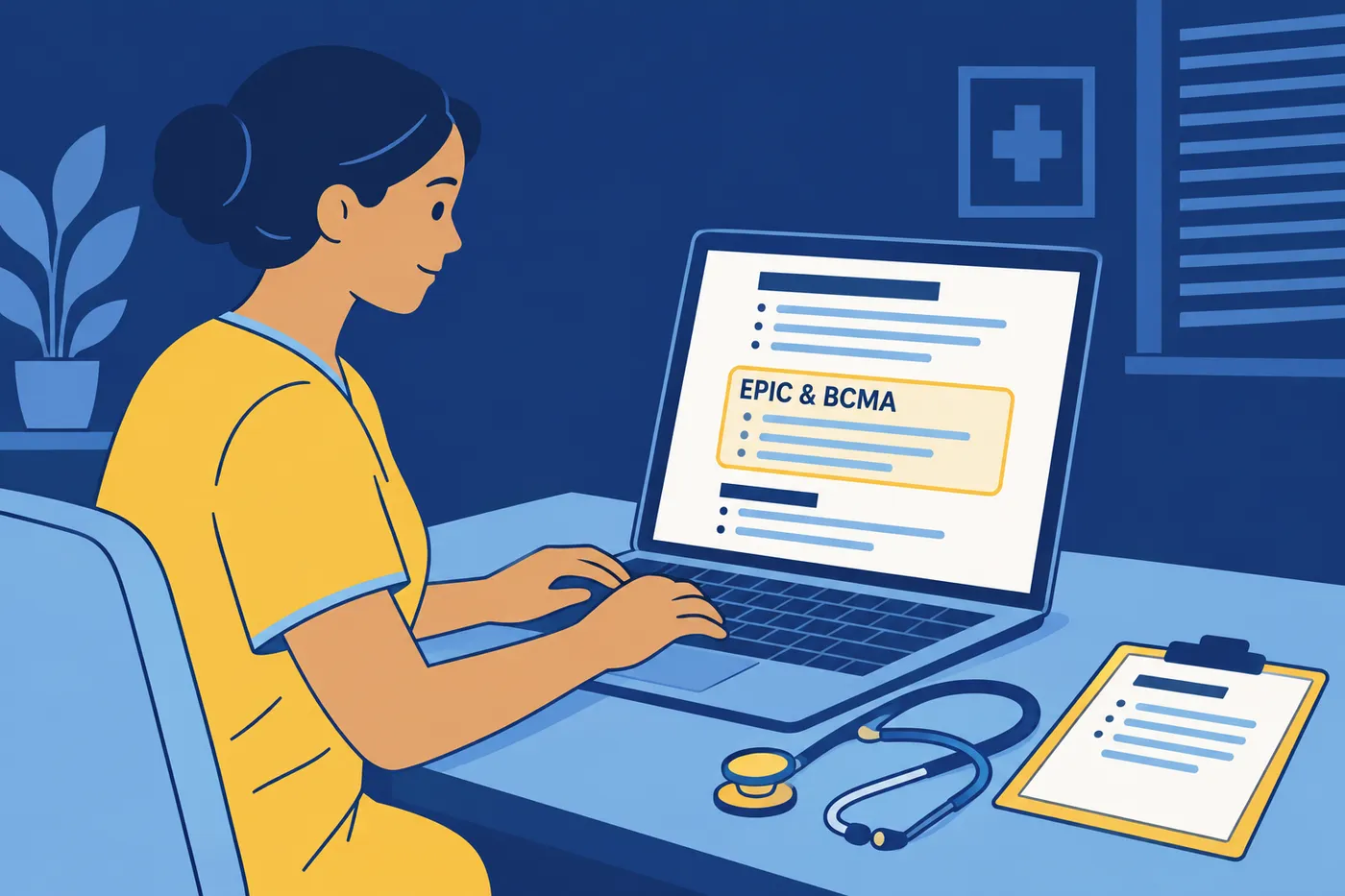
- Epic, the most common hospital EHR, including unit modules if you used them, such as ASAP in the emergency department or Stork in labor and delivery
- Oracle Health, which many postings still call Cerner or PowerChart, so mirror the wording the posting uses
- Meditech, including the newer Meditech Expanse, common in community hospitals and smaller health systems
- Barcode medication administration (BCMA), the scan-the-patient, scan-the-med workflow that pairs with any of the above
- Automated dispensing cabinets, usually Pyxis or Omnicell, worth their own line because medication workflow is a screening topic
- Smart infusion pumps such as Alaris, plus telehealth or remote patient monitoring platforms if you have worked virtual or home-health visits
Write both the full term and the abbreviation the first time each appears, for example 'Emergency Department (ED)' or 'electronic health record (EHR)', because you cannot know which form the recruiter's filter uses. The same logic applies to unit names and job titles in your experience section.
Skills and certifications by unit
Generic skill lists are exactly what this section replaces. A med-surg posting and a labor and delivery posting share almost no screening keywords beyond the license and BLS, so build your skills section for the unit you are applying to, in the posting's own vocabulary.
| Unit | Clinical skills to name | Certifications employers screen for |
|---|---|---|
| Med-surg / telemetry | Patient assessment across large assignments, medication administration, wound care, discharge planning, telemetry monitoring | BLS, often ACLS; CMSRN through the Medical-Surgical Nursing Certification Board as the specialty credential |
| ICU / critical care | Vasoactive drip titration, ventilator management, hemodynamic monitoring, sedation assessment, CRRT if trained | BLS and ACLS; CCRN through AACN, frequently listed as preferred |
| Emergency department | Triage with ESI, rapid assessment, trauma response, procedural sedation support, stroke and STEMI workflows | BLS, ACLS, PALS; TNCC, NIHSS stroke scale certification, CEN through BCEN |
| Labor and delivery | Electronic fetal monitoring, labor support, postpartum hemorrhage response, newborn transition care | BLS and NRP; EFM certification and RNC-OB through the National Certification Corporation |
| Pediatrics | Weight-based dosing, pediatric assessment, family-centered care, IV access in small veins | BLS and PALS; CPN through the Pediatric Nursing Certification Board |
Two patterns worth knowing. Specialty credentials like CCRN and CEN double as proof of bedside hours, since their eligibility rules require real time in the specialty, which is why ICU and ED managers treat them as more than letters after a name. And 'preferred' in a posting usually means the hiring manager will interview the candidate who has it before the one who does not, so if yours is scheduled rather than earned, say so on the resume.
Where each skill goes on a nurse resume
| Resume section | What belongs there |
|---|---|
| Name line | Credentials after your name in standard order, for example Jane Rivera, BSN, RN, CCRN |
| Summary | Two or three lines naming your specialty, your years on that unit type, and one headline credential or result |
| License and certifications | The license with state and compact status, then each certification with issuer and expiration, placed above experience when the posting names required certs |
| Skills section | Eight to twelve hard skills and systems matched to the posting, grouped so clinical skills and EHRs are separable at a glance |
| Experience bullets | Each major skill shown inside a unit-level outcome, with ratios and shift volumes |
| Clinical rotations (new grads) | Each rotation with unit type, facility, hours completed and the skills performed under supervision |
Order matters less than findability, but the default that works is summary, then license and certifications, then experience, with the skills list beside or below the summary. Save and send the finished resume as a PDF so the layout you built is the layout the recruiter sees; modern applicant tracking systems parse PDFs cleanly, and a required certification buried by a broken layout might as well be missing.
Match the posting, not a ranked list
Here is the problem with every 'top 10 nursing skills' article, including the ones published by nursing schools. They rank skills in the abstract, and no recruiter screens in the abstract. The posting in front of you names an EHR, one or two required certifications, a patient population and usually a handful of unit-specific skills, and the screen is built from those exact words.
So work from the posting. Read it with a highlighter, or paste it into Roleframe and duplicate your base resume for the job. The fit report shows which of the posting's exact terms your resume already covers and which are missing, whether that is ACLS and Epic or a phrase like discharge planning, along with an ATS score and a prioritized plan. You then make the edits yourself, with Remi, the career copilot, suggesting a rewrite for any bullet you point it at while you approve every change. The manual version of the same process is covered in how to use a resume keyword scanner.
New grads, travel contracts, float pools and second-career nurses
New graduates
With no staff-RN experience yet, your clinical rotations are your experience section, so format them like jobs. Give each rotation its own entry with the unit type, the facility, the hours completed and the skills you performed under supervision. Your capstone or preceptorship deserves a fuller entry with real bullets, since it is the closest thing to independent practice on the page. New grad nurse resume skills also include work many candidates undersell. Time as a certified nursing assistant or patient care tech is real patient care with real clinical content; the CNA skills guide shows how to write it so it reads as experience rather than a side job.
Travel nurses
List each contract as its own entry, either grouped under the agency or standalone with the agency named. What screens well per contract is the facility type and size, the trauma level if relevant, the unit, and the EHR you charted in at that site, because a traveler who has run both Epic and Meditech across contracts is advertising a skill staff nurses cannot. Keep the dates honest. Recruiters expect short contract blocks with gaps between them, and dressing contracts up as one long role reads worse than the truth.
Float pool nurses
Breadth is the product, so sell it as one. Name the units you float to in a single line, then build the skills section from what carries across them, which mostly means assessment and medication administration plus the ability to absorb an unfamiliar unit's workflow within one shift. A float nurse's certification set often spans units too, and holding both ACLS and PALS is worth stating plainly because it is what makes you deployable.
Second-career nurses
Lead with nursing, even when the earlier career is longer and grander. Education and license go first, rotations or your first nursing role next, and the prior career after that, compressed to the parts a charge nurse would value. A former teacher's patient education and a former project manager's coordination habits both translate, but only when the bullet says how each was used in a care setting. The pattern is the same one laid out in transferable skills on a resume.
How to prove nursing skills in the interview
Every skill you list is a question you have invited, and nursing interviews test them two ways. Clinical scenario questions hand you a deteriorating patient and watch your sequence, so the strong answer starts with assessment and ends by naming the escalation point out loud, with the checks you would run stated in order between them. Behavioral questions ask for a time you actually did the thing, and the STAR structure, situation, task, action, result, keeps the answer from wandering into a shift-long story.
Prepare one story per major skill on your resume before the call. If your skills section says triage, have the triage story ready with the acuity call you made and what happened next. Worked answers to the common questions, including the conflict-with-a-provider question and the mistake-you-made question, are in nursing interview questions and answers.
Frequently asked questions
- What are the 5 basic nursing skills?
If you have room for only five on a resume, pick the five an employer verifies in the first week on the unit.
- Patient assessment
- Medication administration
- IV insertion and maintenance
- Wound care
- Documentation in the unit's EHR
These are the floor. Every unit adds its own on top, triage in the ED or fetal monitoring in labor and delivery.
- What are the top nursing skills employers look for?
The ones the posting names, in the posting's own words. Recruiters filter on the license, the required certifications, the EHR and the unit's clinical skills before any judgment about you as a candidate happens. Among the judgment skills, clinical reasoning and patient education come up most often in acute-care postings, and both land better inside an experience bullet than claimed in a list.
- How do I list my nursing license on a resume?
Give it a dedicated line at the top of a License and Certifications section. Write the license type, the issuing state board, compact status if you hold a multistate license, and the expiration, for example 'Registered Nurse (RN), Ohio Board of Nursing, multistate, expires 09/2027'. The license number is optional because employers verify through Nursys, though include it when an application form asks for it.
- Should I put BLS on my resume even though every nurse has it?
Yes. If the posting requires it and the filter cannot find it, your resume can be rejected before a human reads a word. List it with the issuer and expiration, 'Basic Life Support (BLS), American Heart Association, expires 05/2026', and do the same for ACLS and any specialty certification the posting names.
- What nursing skills can I list with no experience?
Everything you performed in clinical rotations counts; under supervision is still performed. List each rotation with its unit and hours and name the skills you carried out. Your preceptorship deserves its own entry with bullets, since it is your closest approximation of independent practice. CNA or patient care tech work belongs in the experience section as real patient care, and your BLS certification and NCLEX status round out the credentials.
- Should I send my nursing resume as a Word file or a PDF?
PDF. It preserves your layout on every screen, and modern applicant tracking systems parse it cleanly, so the certification section you placed carefully stays exactly where you put it. Send a different format only if a specific employer's system explicitly demands one.


Turn your skills into proof.
A skills section helps most when your experience backs it up. In the editor, write each skill into a bullet about real work, then check the page against the posting before you send it.


