Nurse Resume Example for Experienced RNs (Staff and Travel)
by Larbi SahliPublished
A complete registered nurse resume with the ratio, charge and precepting lines hiring managers screen for, plus the travel RN format recruiters expect.

Users have landed jobs at
- 1Password
- OpenAI
- Notion
- justworks
On this page
Most nurse resume advice online is written for new graduates. Search the term and you get clinical rotation formatting, GPA questions, and objective statements, none of which helps a nurse who has held a license for six years, run charge twice a week, and precepted a third of the unit's newer staff.
Hiring managers screening experienced registered nurse (RN) resumes look for a short list of specifics: the unit and patient population, the nurse-to-patient ratio, charge and precepting responsibility, and the quality measures the unit tracked. A resume that states those in plain numbers gets read. A resume that says "responsible for patient care" gets skimmed and set aside, no matter how strong the nurse behind it is.
This page shows a complete nurse resume built on exactly those proof lines, then walks through the travel RN format contract recruiters expect, the credential and license rules that trip people up, and the bullets worth rewriting before your next application.
A complete registered nurse resume example
The example below is a BSN-prepared RN with six years of acute care experience, currently on a 32-bed medical-surgical telemetry unit in a 300-bed community hospital, applying to a larger hospital. Notice what the document leads with: license and credentials in the header, then experience organized by unit, with the ratio, charge scope, precepting count, and a falls-reduction result stated as numbers rather than adjectives.
Rachel Donovan
Rachel Donovan, BSN, RN, CMSRN | Medical-Surgical Telemetry Charge Nurse & Preceptor

Summary
BSN-prepared Registered Nurse, Ohio (multistate compact) with six years of acute care experience on a 32-bed medical-surgical telemetry unit. Charge nurse two shifts weekly and preceptor to nine new hires, sustaining a 1:5 day ratio while cutting unit falls to 1.9 per 1,000 patient days.
Experience
Staff RN & Charge Nurse, Medical-Surgical Telemetry
Hold a 1:5 day-shift assignment on a 32-bed med-surg telemetry unit, managing post-surgical, cardiac, and stroke patients on continuous monitoring in Epic.
Run charge two shifts weekly, directing bed flow and assignments for 11 staff and cutting ED-to-floor hold times by 25%.
Precepted 9 new-graduate and transfer nurses through 12-week orientation and led a fall-prevention bundle that reduced falls from 3.1 to 1.9 per 1,000 patient days.
Registered Nurse, Medical-Surgical Unit
Cared for 5-6 medical-surgical patients per shift, managing IV therapy, wound care, and post-op recovery on a 28-bed unit using Cerner.
Served on the CAUTI reduction workgroup, standardizing catheter rounds that lowered device days by 18% over four quarters.
Responded as first-responder on rapid response and code calls, completing SBAR handoffs that raised HCAHPS communication scores to the 82nd percentile.
Registered Nurse (Nurse Residency)
Completed a 12-month accredited nurse residency on a 24-bed telemetry step-down floor, carrying a full 1:5 assignment by month six.
Monitored cardiac rhythms and titrated drips per protocol, escalating 40+ dysrhythmia events to the care team without adverse outcomes.
Delivered discharge teaching on heart failure and anticoagulation, contributing to a 12% drop in 30-day readmissions on the unit.
Education
BSN
The Ohio State University
Bachelor of Science in Physics from Harvard University, Cambridge, Massachusetts, United States.
Skills
Clinical Skills
Technology & Systems
Leadership & Safety
Projects
Unit Fall-Prevention Bundle
Falls Prevention Champion
https://github.com/username/project
Led hourly rounding, bed-alarm audits, and mobility scoring across 32 beds, reducing patient falls from 3.1 to 1.9 per 1,000 patient days.
Certifications
Certified Medical-Surgical Registered Nurse (CMSRN)
Medical-Surgical Nursing Certification BoardValidated foundational knowledge of AWS cloud concepts, security, and billing.
Basic Life Support (BLS) — expires 2026-04
American Heart AssociationValidated foundational knowledge of AWS cloud concepts, security, and billing.
Advanced Cardiovascular Life Support (ACLS) — expires 2026-02
American Heart AssociationValidated foundational knowledge of AWS cloud concepts, security, and billing.
Awards
DAISY Award Recipient
Maple Grove Community Hospital
Recognized for building a cloud-native AI productivity tool.
Languages
Nothing in this document is decorative. Every line answers a question a nurse manager or recruiter is silently asking: what unit, how many patients, can she run the floor, can she train my new hires, and did the unit's numbers move while she was there. That is the whole trick of an experienced rn resume: it is a stack of verifiable claims, not a personality statement.
The travel RN version: one entry per assignment
A travel resume is a different document with a different reader. Agency recruiters and facility managers match candidates to contracts on a fixed set of fields, and they scan for them in seconds because they place dozens of nurses a week. If a field is missing, they either call to ask or move to the next submission, and during a fast-moving needs list they do not call.
Format it as one entry per assignment, with the staffing agency named once as the employer and each facility listed beneath it. Every entry carries the same fields in the same order, so a recruiter can read down the page like a table.
| Field | Why recruiters match on it | How it looks in an entry |
|---|---|---|
| Facility type and bed count | A 900-bed academic center and a 90-bed rural hospital are different jobs; managers want nurses who have worked their scale | Regional Medical Center, 420-bed community teaching hospital |
| Trauma level | Trauma designation is a proxy for acuity; some contracts require Level I or II experience | Level II trauma center |
| Unit and patient population | Contracts are unit-specific; "med-surg" and "med-surg tele" are different requisitions | 32-bed medical-surgical telemetry |
| Ratio | Managers need to know you have carried their load, especially in high-ratio states versus California's mandated ratios | 1:5 days, 1:6 nights |
| EHR used | Facilities want minimal orientation time; Epic, Cerner (now Oracle Health), and Meditech experience are searched as keywords | Epic (charting, barcode med administration) |
| Contract dates and extensions | Extensions are the strongest signal on a travel resume: the facility chose to keep you | Jan 2025 – Jul 2025 (13-week contract, extended twice) |
Keep one or two achievement bullets per assignment at most. On a travel resume the fields above do the heavy lifting, and a manager filling a crisis contract cares far more about "Epic, 1:5, tele, extended twice" than about a paragraph of accomplishments. Note extensions explicitly. "Extended twice" says more about your work than any adjective could.
What a nursing resume should include: the short answer
An experienced RN resume needs six things, in roughly this order.
- Your name with credentials in the order the American Nurses Credentialing Center (ANCC) recommends: highest earned degree, then licensure, then state designations, then national certifications. For example: Maria Delgado, BSN, RN, CMSRN.
- A license line written the way your state board lists it: Registered Nurse, the state, and multistate status if you hold a compact license under the Nurse Licensure Compact.
- A three-line summary naming your specialty, years of experience, and one number (ratio, precepting count, or a quality result).
- Experience organized by unit, with ratio, population, charge, precepting, and quality measures in the bullets.
- Certifications with the issuing body and expiry month.
- Education last, degree and school only. No clinical rotations once you have RN experience.
The ANCC ordering deserves a sentence of explanation, because nurses get conflicting advice on it. The logic is permanence: the degree is listed first because it cannot be taken away, the license second because it is renewable, certifications after that because they lapse. Write BSN, RN rather than RN, BSN, and list a specialty certification like CMSRN after the license.
On the license line, precision matters because recruiters verify it. Every RN license is checkable through the state board and through Nursys, the National Council of State Boards of Nursing (NCSBN) verification database, so write exactly what the board shows: license type, state, and compact status. If you hold a multistate license, say so. It is a genuine advantage for any employer with facilities in more than one compact state, and for travel work it is close to mandatory. You can include the license number or leave it off; recruiters will verify either way, and some nurses prefer to provide it only when asked.
The proof lines hiring managers actually screen for
An experienced nurse's resume competes on evidence. Here is what each category of proof looks like and why it works, using the example above as the reference.
Ratio and patient population
The ratio is the single most information-dense number on a nurse resume. "1:5 on day shift, medical-surgical telemetry, post-cardiac-cath and PCI patients" tells a manager your acuity, your workload, and your monitoring competence in one line. Without it, "med-surg experience" could mean almost anything. State the ratio for each unit you list, and if it differed by shift, say which shift you worked.
Charge and precepting
Charge and precepting are leadership evidence, and they are countable. "Charge nurse two shifts per week for a team of 11 RNs, PCTs, and unit secretary" beats "demonstrated leadership skills" in every screening pass, because the first is a fact a reference can confirm and the second is a claim anyone can type. Same with precepting: "precepted nine new-graduate and transfer RNs through orientation" tells a manager you can absorb their next cohort of hires, which on a chronically short-staffed unit is a hiring criterion in itself.
Quality measures your unit tracked
Every inpatient unit tracks falls, catheter-associated urinary tract infections (CAUTI), central line-associated bloodstream infections (CLABSI), and patient experience scores. If you sat on the committee, ran the audits, or championed the protocol that moved one of those numbers, that is a resume bullet with a before and after. The example resume's falls line, from 3.1 to 1.9 per 1,000 patient days, works because it names the metric in the unit hospitals actually use. If you do not know your unit's numbers, ask your manager or educator before you leave; they are reported internally and most managers will share unit-level figures.
Rapid response, codes, and committees
Code team membership, rapid response experience, and committee work (falls, skin, shared governance, unit-based council) each earn a line. Keep them factual: the team, the role, roughly how often. These lines matter most when you are moving up in acuity, say from med-surg tele to step-down, because they show you already function in emergencies.
Three duty lines, rewritten
Most nurse resumes are built from job-description language, which describes the job rather than the nurse. Here is how the three most common duty lines convert into proof lines.
| Duty line (before) | Proof line (after) |
|---|---|
| Responsible for patient care | Carried a 1:5 day-shift assignment on a 32-bed med-surg telemetry unit, managing continuous cardiac monitoring and post-procedure care for cardiac cath and PCI patients |
| Trained new staff members | Precepted nine new-graduate and transfer RNs through a structured orientation, with all nine passing off orientation on schedule |
| Participated in quality improvement initiatives | Co-led the unit falls committee; falls dropped from 3.1 to 1.9 per 1,000 patient days after we implemented hourly rounding audits |
The pattern in every rewrite is the same: name the unit, attach a number, and claim only what you did. For more bullet patterns organized by specialty, see the guide to nursing skills for a resume by specialty and unit.
Certifications: write them the way the board issues them
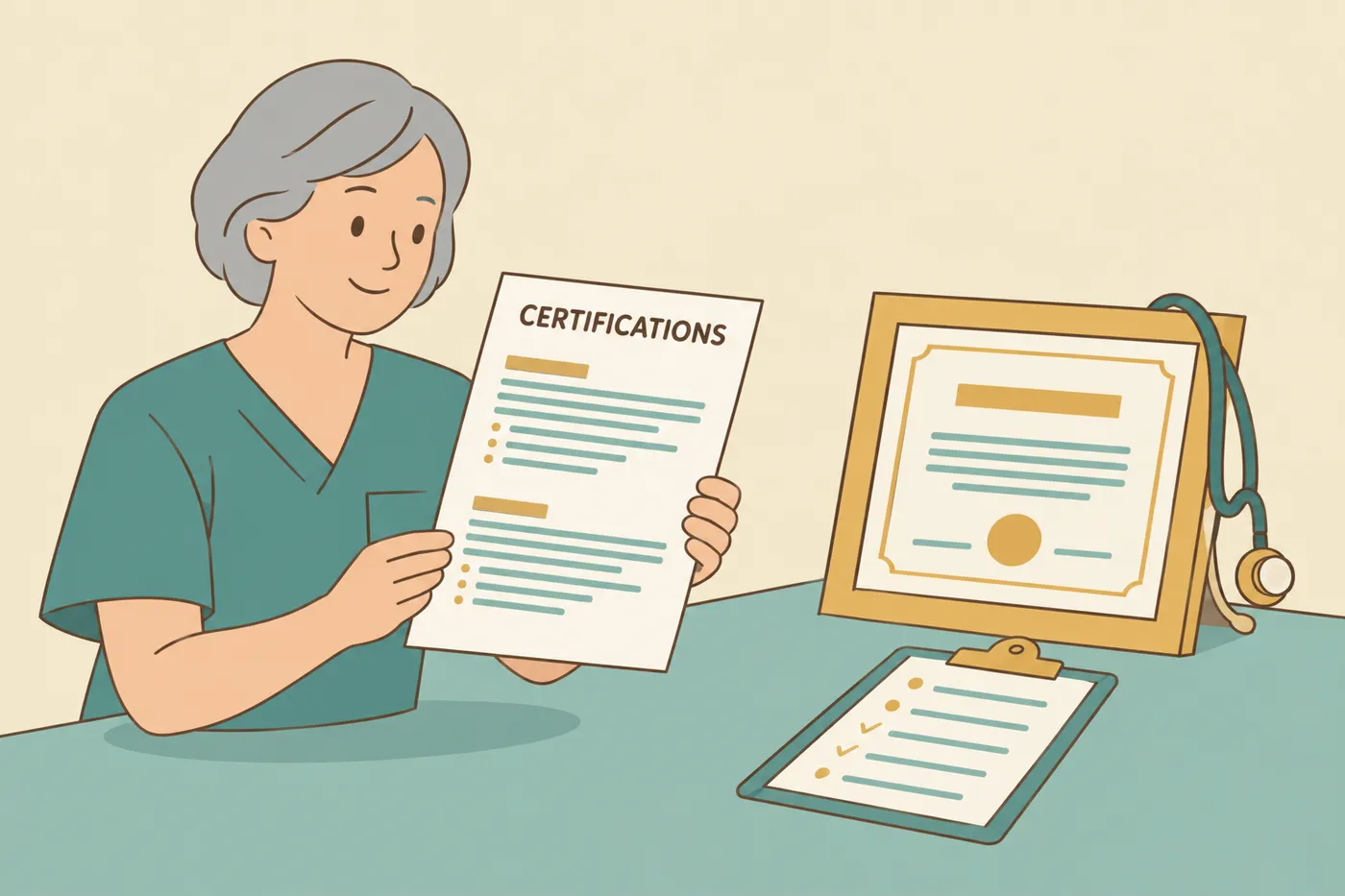
Certifications on a nurse resume are checked, so format them for the person checking. Each line needs three parts: the credential as the issuing board writes it, the issuing body, and the expiry month.
- BLS, American Heart Association, expires 06/2027
- ACLS, American Heart Association, expires 06/2027
- CMSRN (Certified Medical-Surgical Registered Nurse), Medical-Surgical Nursing Certification Board, expires 03/2028
Two details separate a clean certifications section from a sloppy one. First, copy the credential exactly as the board issues it: CMSRN comes from the Medical-Surgical Nursing Certification Board (MSNCB), PCCN and CCRN come from the American Association of Critical-Care Nurses (AACN), and a hiring manager who holds the credential notices when it is written wrong. Second, always show the expiry, because an undated ACLS forces the recruiter to ask, and every question a resume forces is friction.
If you are pursuing a specialty certification, list it only once you hold it, and check the issuing board's own site for current eligibility rules on practice hours rather than relying on a blog's summary; boards update those requirements. For placement questions, the rule is simple: if the posting requires the certification, it belongs near the top, and there is a full breakdown in where to put certifications on a resume.
What to leave off a nurse resume
Cutting the wrong content sinks more nursing resumes than missing content does. Five things to remove today:
- Anything that could identify a patient. No ages plus diagnoses plus dates, no memorable case details. A HIPAA problem on a resume ends the application instantly, and "cared for a 34-year-old post-transplant patient in March" is closer to identifiable than most nurses assume.
- School clinicals, once you have RN experience. Six years on a tele unit makes your OB rotation from nursing school noise. Clinicals belong on new-grad resumes only.
- Expired certifications. An expired ACLS reads worse than no ACLS line at all, because it makes the reader wonder what else is out of date.
- A photo. US employers do not want them, and some recruiting teams discard photographed resumes to avoid discrimination exposure.
- A generic objective. "Seeking a challenging position where I can grow" spends your most valuable real estate saying nothing. Replace it with a three-line summary: specialty, years, one number.
On the "seven second rule" nurses keep hearing about: the phrase comes from recruiter eye-tracking research measuring how briefly a resume gets looked at on the first pass, and whatever the exact count, the first look is a skim, not a read. The fix is placement, not persuasion: your license, unit, and ratio belong in the top third of page one, where the skim actually lands.
Tailoring the resume for each posting
Hospitals name things differently, and their applicant tracking system (ATS) filters on their names, not yours. If the posting says "progressive care unit" and your resume says "step-down," say both. If the posting requires Epic and you have charted in Epic for four years, Epic belongs in your summary and your skills section, not buried inside a bullet. Mirror the posting's unit name, EHR, and required certifications in the summary and skills before you submit, every time.
Changing specialty, say med-surg tele to step-down or to outpatient, usually means swapping two bullets rather than rewriting the document. Promote the bullets closest to the target unit's work (titration experience and monitoring for step-down, throughput and patient education for outpatient) and demote the ones that no longer argue your case.
The honest difficulty is doing this for every application without the versions drifting apart. This is the specific problem Roleframe is built around: you keep one base RN resume, duplicate it per posting, and a fit report scores it against that job, listing the exact keywords the posting uses that your version is missing, with an ATS score and a prioritized plan. You make the edits yourself, with Remi, the career copilot, proposing rewrites bullet by bullet that you approve or discard. Nothing changes without your sign-off, which matters on a document a hospital will verify line by line.
Two next steps once the resume is done. Work through nursing interview questions with real STAR examples, since the proof lines you just wrote are exactly the stories interviewers will ask you to expand. And if this move is part of a longer plan, the rundown of the highest paying nursing careers shows which certifications and units the better-paid paths run through.
Frequently asked questions
- What should a nursing resume include?
Six things: your name with credentials in ANCC order (degree, then licensure, then certifications, for example BSN, RN, CMSRN), a license line with state and compact status, a three-line summary with one number in it, experience organized by unit with ratios and patient populations, certifications with issuing body and expiry month, and education last. Experienced RNs should cut clinical rotations, objectives, and photos entirely.
- How long should an RN resume be?
One page for most staff RN applications with under ten years of experience; two pages is fine once charge roles, committees, and certifications genuinely fill it. Travel resumes run longer by nature, since each assignment needs its own entry with facility, unit, ratio, and EHR fields. Length is not the risk. Padding is: a tight page of proof lines beats two pages of duty statements.
- What is the 7 second rule in a resume?
It is shorthand for how briefly recruiters look at a resume on the first pass, based on recruiter eye-tracking research. The practical takeaway for nurses: the first look is a skim, so your license, unit type, and ratio need to sit in the top third of page one where that skim lands, not in paragraph three.
- What are the 5 qualities of a good nurse, and do they belong on a resume?
The qualities hiring managers name most often are clinical judgment, communication, compassion, attention to detail, and adaptability. None of them belongs on a resume as a word. Listed as adjectives they are unverifiable and every applicant claims them. Prove them instead: a falls reduction shows attention to detail, nine precepted nurses show communication, charge shifts show judgment under load.
- Should I include my license number on my resume?
Optional. Recruiters verify every RN license through the state board or Nursys, NCSBN's verification database, whether or not you print the number. What is not optional is the license line itself: license type, state, and multistate status if you hold a compact license. Write it exactly as your state board lists it.
- Do travel nurses list the agency or the hospital as the employer?
List the agency as the employer and each facility as an assignment beneath it, since the agency held your contract. Every assignment entry should carry the same fields in the same order: facility type and bed count, trauma level, unit, ratio, EHR, and contract dates. Always note extensions; "extended twice" is the strongest endorsement a travel resume can carry.
- Should clinical rotations stay on my resume after I have RN experience?
No. Clinical rotations are new-graduate content, and keeping them after a year or more of licensed practice signals a thin resume. The one exception is a rotation directly relevant to a specialty change you cannot otherwise evidence, and even then a certification or float experience in that specialty argues the case better.

Build yours on the same template.
Every example here is built on a template you can open in the editor. Start from the same layout and write your own experience into it, then download the PDF free, with no watermark.


