What Does a Cover Letter Look Like? A Full Labeled Example
by Larbi SahliPublished
See what a cover letter looks like: one complete, labeled example, every part explained, a weak version beside it, and the same letter as an email.

Users have landed jobs at
- 1Password
- OpenAI
- Notion
- justworks
On this page
A cover letter looks like a one-page business letter. Your name and contact details at the top, the date, the employer's details, a greeting, three or four short paragraphs, and a sign-off with your name. Left aligned, plenty of white space, done in under a page.
Most pages answering this question describe that layout in prose and stop. Describing a document is a poor way to show one, so this page does it the other way around: a complete cover letter first, with every part numbered, then the explanation of each part against that letter. Further down you'll see the same paragraphs written badly for comparison, and the same letter reshaped as an email and as a form-box entry, because those are the two other places your letter will actually live.
A complete cover letter, with every part labeled
The example below is a project coordinator with four years at an architecture firm, applying for a project coordinator opening on a hospital network's facilities team. It's a realistic mid-level application: same job title, adjacent industry, and a letter that has to explain why construction-side coordination transfers to healthcare facilities. The numbers in the margin match the numbered breakdown that follows.
Marcus Ellery
Project Coordinator | Architecture & Facilities Delivery

Dear Hiring Manager,
I am applying for the Project Coordinator role on your facilities team, where I would bring the same rigor that let me keep schedules for 12 active projects at once without a single missed milestone at Halverson & Reid Architects.
Over four years there, I cut submittal review turnaround from ten working days to six by restructuring our review checklist and routing, and I built the shared project tracker that 40 staff now rely on daily for status and deadlines. Coordinating consultants, permits, and closeout on tight timelines became second nature.
Your hospital network appeals to me because architecture-side coordination maps directly onto facilities work: the same drawing sets, RFIs, and phasing constraints, now with occupied buildings and patient safety at stake. I want to apply that discipline where it matters most.
I would welcome the chance to walk you through my tracker and turnaround improvements in an interview.
Sincerely,
Marcus Ellery
The short answer
A cover letter looks like a one-page business letter: the same header as your resume, the date, the employer's details, a greeting to a named person where you can find one, three or four short paragraphs, and a sign-off with your name. Everything is left aligned, in the same font as your resume, with a blank line between blocks so the page breathes. If it runs past one page, it's too long. That's the whole visual answer; the rest of this page is about what goes inside those blocks, which is where letters are actually won or lost.
The parts of a cover letter, label by label
Nine parts, in the order they appear on the page. Each one has a job, and the example above shows what doing that job well looks like.
- Header. Your name, phone, email, city, and any relevant link, formatted to match your resume header exactly. The match matters: when a recruiter has both documents open, identical headers read as one application, not two files from different eras.
- Date. The date you send it, on its own line. Small detail, but its absence is one of the tells of a letter recycled from a previous application.
- Employer block. The hiring manager's name if you have it, the company name, and the address or at least the city. In the example, naming the facilities team shows the letter was written for this opening, before a single paragraph is read.
- Greeting. "Dear" plus a named person beats "Dear Hiring Manager," which beats "To Whom It May Concern" by a mile. Ten minutes on the company site or LinkedIn usually finds a name.
- Opening paragraph. Names the exact job title and gives the single strongest reason to keep reading. The example leads with the scale of what she coordinates today, not with how excited she is.
- Proof paragraph. The core of the letter: two or three specific results that match what the posting asks for. The example uses the twelve concurrent project schedules, the submittal turnaround cut from ten working days to six, and the tracker forty staff adopted. Numbers, not adjectives.
- Why-this-employer paragraph. The one paragraph a resume cannot hold: why this organization, in terms the reader recognizes. The example connects consultant-heavy architecture coordination to the contractor-and-clinician juggling of hospital facilities work, which is the exact translation the hiring manager needs made.
- Closing with the ask. One or two sentences restating the fit and asking plainly for a conversation. Confident, not grovelling, and no "I know you're busy, but."
- Sign-off and name. "Sincerely" or "Best regards," a blank line, your name. A scanned signature is optional and nobody has ever been hired because of one.
What a good cover letter looks like next to a weak one
Layout is the easy part. The difference between a letter that gets read and one that gets skimmed and closed is in the sentences, so here is the same applicant's opening and first body paragraph written the way most people write them:
"I am writing to express my interest in the Project Coordinator position at your organization. I am a hard-working, detail-oriented professional with excellent communication skills and a proven track record of coordinating projects. I believe my background makes me a strong fit for this role, and I would welcome the opportunity to contribute to your team's continued success."
Nothing in that paragraph is false. It's also completely interchangeable: swap the job title and it applies to any coordinator opening in any industry, and every recruiter has read it a thousand times. Here's what separates it from the version in the example, difference by difference.
| The weak version | What the example does instead | Why it matters |
|---|---|---|
| "At your organization", no names anywhere | Names the hospital network, the facilities team, and the exact job title | A recruiter can tell a mail merge from a written letter in one line, and treats them differently |
| Claims traits: "detail-oriented", "excellent communication skills" | Proves them: schedules held for 12 active projects, a tracker 40 staff use daily | Anyone can claim a trait. A specific result can only belong to someone who did the work |
| No numbers at all | Submittal review turnaround cut from ten working days to six | A number survives a seven-second skim; an adjective doesn't |
| Repeats what the resume already says, in vaguer words | Adds what the resume can't hold: why architecture coordination transfers to hospital facilities | A letter that restates the resume gives the reader a reason to skip it. This one earns its page |
| Could be sent to fifty employers unchanged | Could only have been written for this one opening | Written-to-one-job is the single strongest signal a cover letter sends |
Can an AI tool write it, and will anyone notice?
An AI chat tool can produce a competent draft in seconds, and there's nothing wrong with using one to get past the blank page. The problem is what those drafts contain: the tool doesn't know your submittal turnaround number or the tracker your office adopted, so it fills the space with exactly the kind of paragraph in the weak version above. Smooth, grammatical, and specific to nobody.
Readers notice, and not because they're running detection software. A letter that names nothing only you could name reads as generic regardless of who typed it, and generic is the failure. The fix isn't hiding the tool; it's feeding it proof only you have. Write down your three strongest specifics first, the way the example carries its three, then let a tool help with sentence-level polish. The cover letter prompt guide covers how to structure that if you go the chat-tool route.
What the same letter looks like as an email or a form entry
The full business-letter layout is for the PDF you attach or upload. Paste that whole thing, address block and all, into an email or an application form and it looks like exactly what it is: a document dumped somewhere it doesn't belong. The paragraphs stay; the furniture changes.
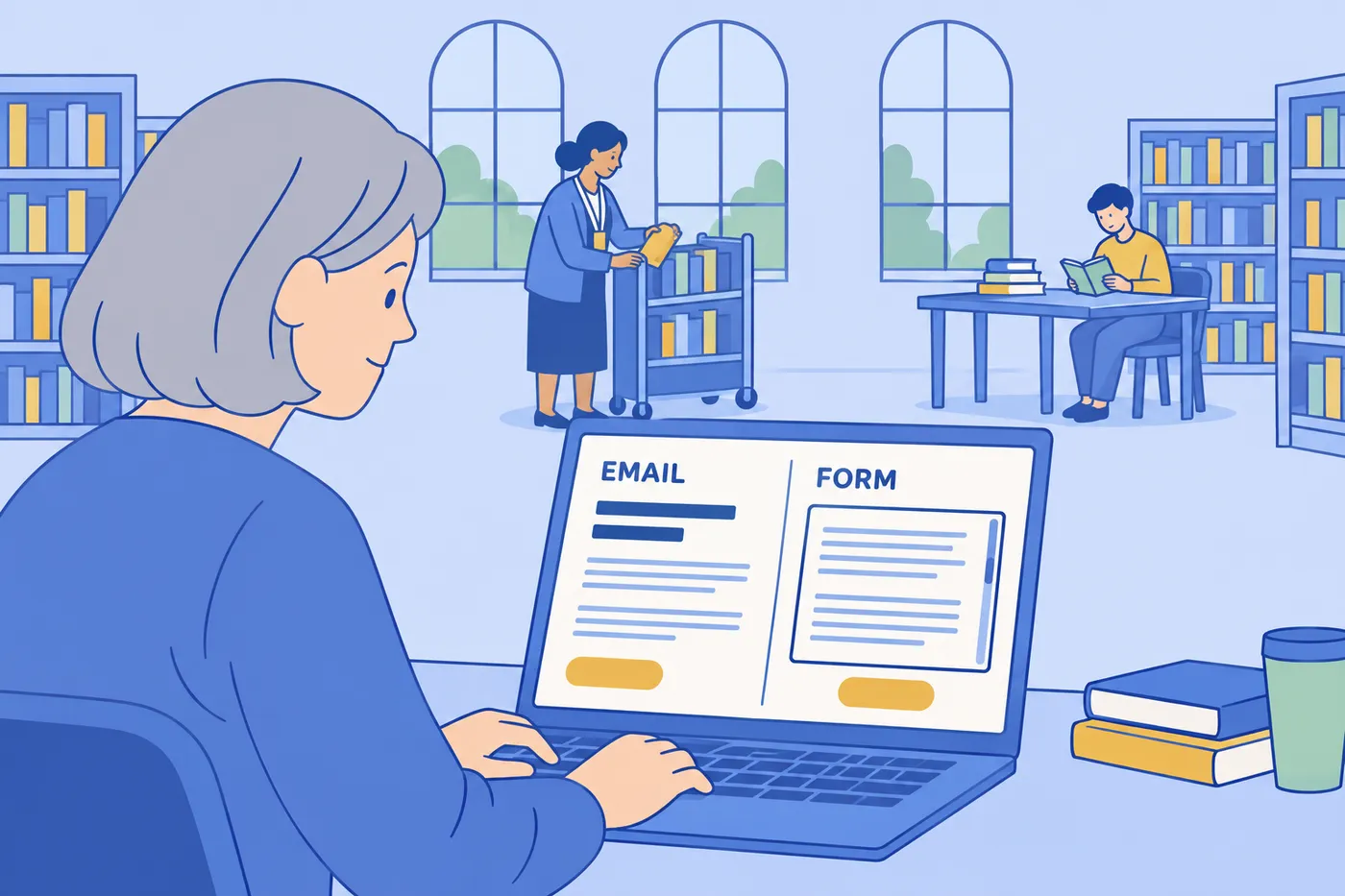
As an email
When the letter is the email, the email's own fields replace the letterhead:
- Subject line: the job title and your name, plus the requisition number if there is one. "Application: Project Coordinator, Facilities – [Your Name]".
- No address block, no date. The email client already stamps both. Keeping them in the body is the most common giveaway of a pasted letter.
- Greeting and the same three or four paragraphs, unchanged.
- Sign-off, your name, then your phone number and email under the name, where the PDF's header used to carry them.
If you're attaching the letter as a PDF instead, the email itself needs only two or three lines saying what's attached and for which role.
In an application form text box
Form boxes strip formatting and the applicant tracking system (ATS) already has your contact details, so the letter reduces to its core: greeting, the three or four paragraphs, sign-off, name. No header, no date, no employer block. Paste it, then read it once in the box, because line breaks sometimes vanish in transit and a wall of unbroken text undoes the white space you worked for.
| Part | PDF letter | Email body | Form text box |
|---|---|---|---|
| Header with contact details | Yes, matching your resume | No; contact details go under your name at the bottom | No |
| Date | Yes | No | No |
| Employer address block | Yes | No | No |
| Greeting | Yes | Yes | Yes |
| Three to four paragraphs | Yes | Yes, identical | Yes, identical |
| Sign-off and name | Yes | Yes, plus phone and email beneath | Yes |
The four things and the three golden rules, checked against the example
Two questions people ask constantly, and the example answers both by existing. The four things every cover letter should include, with the label where each appears above: the specific job you're applying for (label 5, the opening), proof you can do what the posting asks (label 6, the proof paragraph), why this employer rather than any employer (label 7), and a clear ask for the next step (label 8, the closing).
The three golden rules are behaviors, not parts:
- Write it to one job. Everything from the employer block to the why-this-employer paragraph should fail if pasted into a different application. That failure is the point.
- Prove, don't claim. Every adjective you're tempted to write has a result that demonstrates it better. "Organized" is the twelve concurrent schedules; "process improver" is ten working days cut to six.
- One page, always. The example fills roughly two thirds of a page, and that's the healthy range. A letter that needs a second page is a letter that hasn't been edited.
What a good opening sentence looks like
A good opening sentence does two jobs in one breath: it names the job and hands over your strongest fact. The example's first line works because it leads with the scale of what the applicant coordinates today rather than with enthusiasm about the opportunity. Two alternate openings the same applicant could use:
- "Cutting submittal review turnaround from ten working days to six is the kind of coordination problem I'd like to bring to the Project Coordinator role on your facilities team."
- "For the last four years I've kept twelve active architecture projects on schedule at once, and your Project Coordinator opening asks for exactly that kind of juggling."
Both name the job. Both carry a number. Neither says "I am writing to apply," which spends your most-read sentence stating the obvious.
Make yours look like this
You now know what the page should look like and, more usefully, what should be on it. The fastest path: write your three proof lines first, the specifics only you can claim, then build the letter around them in the order the labels above lay out. Pair it with a resume that carries the same header and the same evidence; the project coordinator resume example shows what that looks like for this same role.
Roleframe can draft a job-specific cover letter for you to edit, with your resume open beside it so the letter inherits the resume's theme and the headers match without any fiddling, and the finished PDF downloads free. If your situation needs a specific angle, the career change cover letter and the post-layoff cover letter show how the same structure flexes for harder stories.
Frequently asked questions
- What does a good cover letter look like?
Visually: one page, left aligned, the same header and font as your resume, three or four short paragraphs with white space between blocks. In substance: it names the exact job, proves the posting's requirements with two or three specific results, says why this employer, and asks for a conversation. If it could be sent to a different company unchanged, it isn't good yet, however clean the layout is.
- What are the three golden rules of writing a cover letter?
Write it to one job, prove instead of claim, and keep it to one page. The first means naming the employer, team, and role specifically. The second means replacing adjectives like "organized" with results like schedules held across twelve concurrent projects. The third is non-negotiable; a second page signals you couldn't decide what mattered.
- What are four things a cover letter should include?
The specific job you're applying for, evidence that you meet its main requirements, a reason this employer in particular interests you, and a clear request for the next step. In the labeled example above, those are the opening, the proof paragraph, the why-this-employer paragraph, and the closing.
- Can I use ChatGPT to write a cover letter?
For a first draft, yes, and it will save you the blank page. The risk is that a chat tool doesn't know your specifics, so it produces smooth, generic paragraphs that read like everyone else's letter. Feed it your real numbers and outcomes before you ask for a draft, and rewrite anything you couldn't say in your own voice across an interview table.
- What's a good opening sentence for a cover letter?
One that names the job and delivers your strongest fact in the same sentence. "For the last four years I've kept twelve active projects on schedule at once, and your Project Coordinator opening asks for exactly that" beats "I am writing to express my interest" because it spends the most-read line on proof instead of preamble.
- How long should a cover letter be?
One page maximum, and half to two thirds of a page is the sweet spot: three or four paragraphs, roughly 250 to 350 words. Hiring managers skim, and a shorter letter built on specifics gets read in full more often than a dense full page.
- Should my cover letter match my resume?
Yes. Use the same header, the same font, and the same margins so the two documents read as one application. Recruiters often view them side by side, and mismatched headers make a tailored application look assembled from spare parts.
- Should I send a cover letter as a PDF or in the email body?
Follow the posting's instructions first. If the application asks for an attachment or an upload, send a PDF, which locks your formatting in place. If you're emailing a person directly and no attachment is requested, put the letter in the email body with the subject line carrying the job title and your name, and drop the address block and date, since the email supplies both.
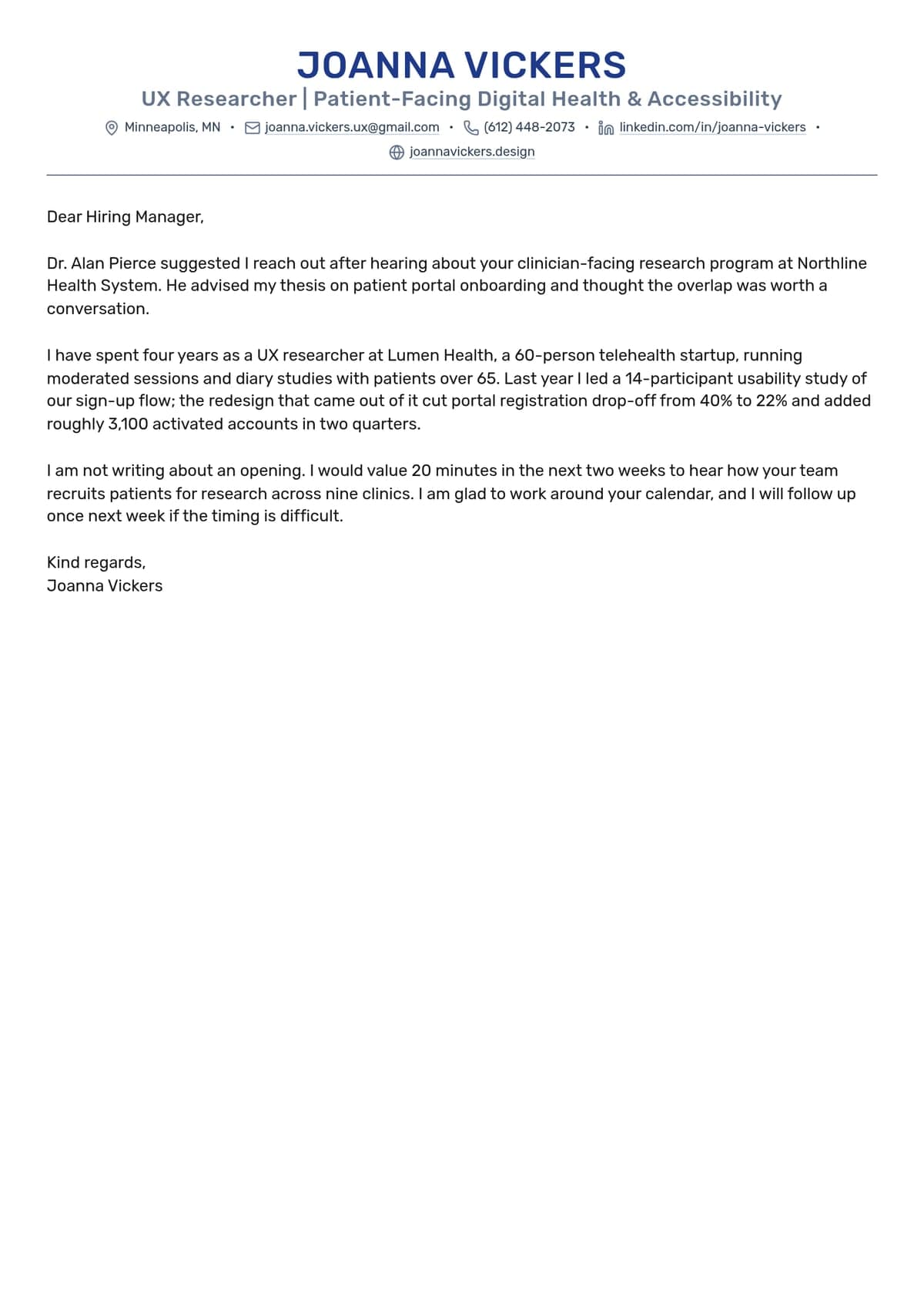

Write yours on the same template.
Every example here is built on a template you can open in the editor. Keep the structure that works and put your own story in it, or let Roleframe draft a first version from your resume and the job posting.


