Project Coordinator Resume Examples (Entry to Mid-Level)
by Larbi SahliLast Updated
A full project coordinator resume example, the ATS keywords junior project roles screen for, and how to turn admin tasks into project wins.
Users have landed jobs at
- 1Password
- OpenAI
- Notion
- justworks
On this page
Project coordinator is the on-ramp into project management, and the resume problem is specific to that. Most people applying for the role are coming from administrative, operations, or customer-facing work. Their experience is real, but it is written in the language of tasks: scheduled meetings, ordered supplies, answered emails. Recruiters screening for a coordinator role are reading for a different language: timelines, stakeholders, budgets, deliverables.
That translation is the whole job of this resume. You are not inventing project experience; you almost certainly have it, buried in bullets that describe activity instead of outcomes. An office move you kept on schedule is a project. A vendor invoice process you tracked to month-end is budget management. The candidates who get interviews are the ones who name these things the way a project manager would.
This page gives you a complete project coordinator resume example, the keywords applicant tracking systems (ATS) scan for in junior project roles, and a section-by-section method for rewriting task-language into project-language without stretching the truth.
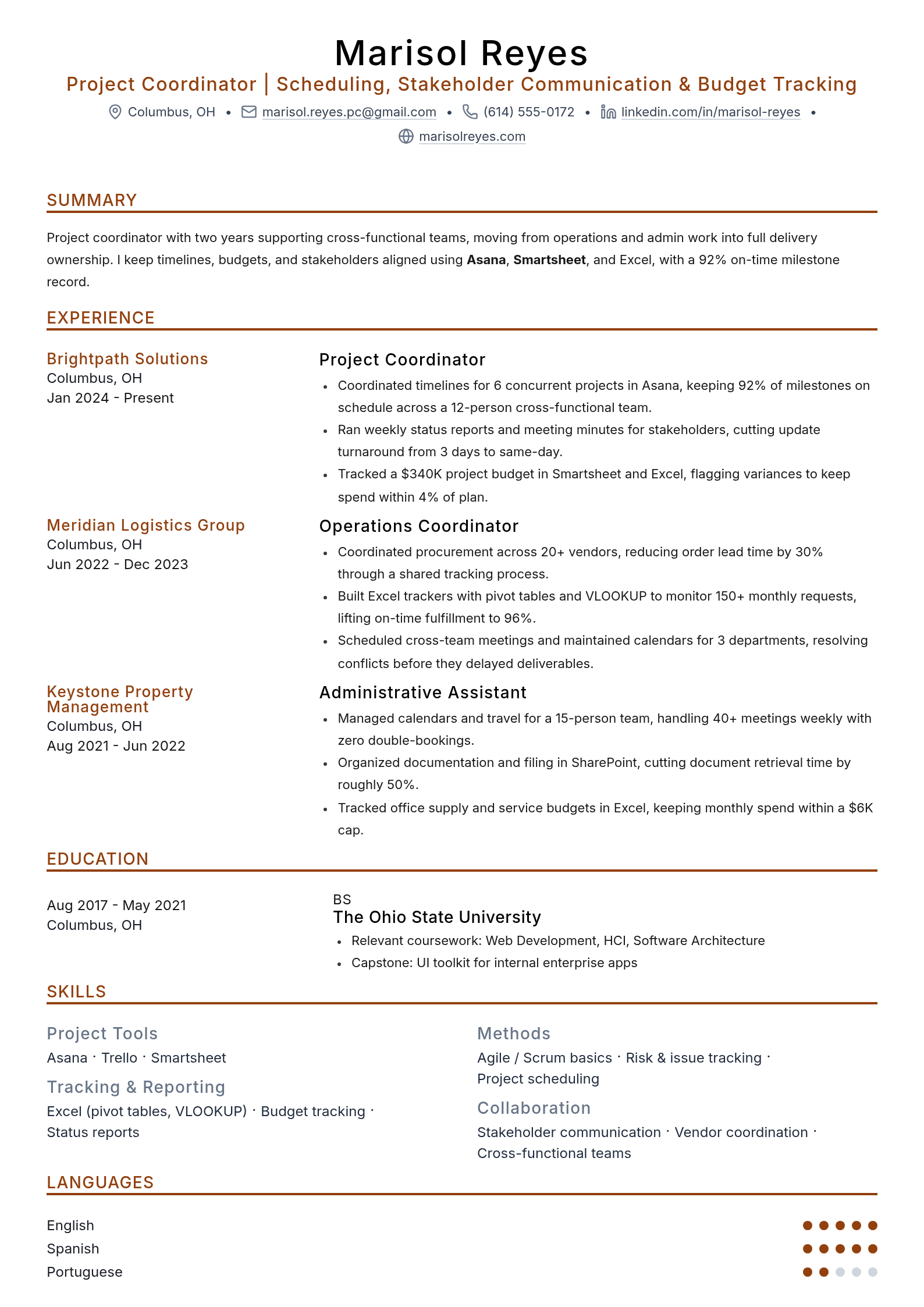
Project Coordinator Resume Example
Here is what the finished translation looks like. This example is an entry-to-mid-level candidate: a couple of years of experience, some of it administrative, none of it with a project title. Notice three things as you read it. The summary claims a scope, not a passion. Every experience bullet has a verb that implies ownership (coordinated, tracked, ran) rather than assistance (helped, supported, assisted). And the numbers are small but concrete, which reads as more credible at this level than big round figures would.
Nothing in that document is exotic. The candidate did ordinary work; the resume just accounts for it the way a hiring manager for project roles thinks: what was the goal, who was involved, what did you personally track or move, and did it land on time. The rest of this guide shows you how to do the same with your own history.
Top Keywords for Junior Project Roles
Most companies hiring coordinators run applications through an ATS, and recruiters search and filter within it using terms lifted straight from the job description. If the posting says "stakeholder communication" and your resume says "talked to different departments," a human would connect the two. The search filter will not. Matching the posting's exact vocabulary is not gaming the system; it is describing your work in the terms the employer already chose. For the mechanics of doing this well, see our guide to ATS resume keywords.
These are the terms that show up again and again in junior project role postings, and where each one belongs on your resume:
| Keyword or skill | Why employers screen for it | Where to put it |
|---|---|---|
| Project scheduling / timelines | The core of the job: keeping work sequenced and dated | Experience bullets, ideally with a named tool |
| Stakeholder communication | Coordinators sit between teams; this word signals you know it | Summary and experience bullets |
| Status reports / meeting minutes | Proof you can run the documentation rhythm of a project | Experience bullets with cadence (weekly, biweekly) |
| Budget tracking | Even small dollar responsibility separates you from pure admin | Experience bullets with a figure |
| Risk and issue tracking | Shows you think ahead, not just react | Experience bullets or a project entry |
| Asana, Jira, Trello, Monday.com | Tool filters are common and unforgiving; name what you know | Skills section, plus one bullet showing real use |
| Microsoft Project / Smartsheet | The scheduling tools of more traditional and construction-adjacent teams | Skills section |
| Excel (pivot tables, VLOOKUP) | Still the default tracker in half of all project teams | Skills section, specific about what you can do |
| Cross-functional teams | Signals you have coordinated beyond your own department | Summary or experience bullets |
| Vendor coordination / procurement | Common in operations-heavy and construction coordinator roles | Experience bullets |
| Agile / Scrum (basics) | Frequent in tech and product postings, even at coordinator level | Skills section, or certifications if you hold one |
| CAPM / Google Project Management Certificate | The two credentials that most often appear in junior postings | Certifications section, near the top if the posting asks |
One caution: put a tool on your resume only if you could survive five minutes of questions about it. "Familiar with Jira" followed by a blank stare in the interview does more damage than the missing keyword would have. If a posting keeps asking for a tool you lack, spend an evening in the free tier of that tool building a mock project. Then the line is honest.
Construction project coordinator postings deserve a note of their own, because they screen for a different cluster: submittals, RFIs (requests for information), change orders, punch lists, and often Procore. If that is your target, those terms belong in your bullets, and generic project vocabulary alone will not get you through the filter.
Writing a Summary When You Have Limited Experience
The summary is where thin-experience resumes usually fail, because candidates use it to express enthusiasm instead of scope. "Motivated self-starter seeking to grow in project management" tells the recruiter nothing they can act on. A working summary at this level makes three claims in two or three sentences: what you have coordinated, what tools you run it with, and one outcome.
Compare these two, written for the same person:
- Weak: "Detail-oriented professional passionate about project management, seeking a project coordinator role where I can apply my organizational skills and grow with a dynamic team."
- Strong: "Operations assistant with 2 years coordinating schedules, vendors, and budgets for a 15-person team. Ran weekly status reporting in Asana and tracked a $40K supplier budget with zero missed payment deadlines. Google Project Management Certificate, 2025."
The weak version could be pasted onto any resume in the pile. The strong one carries a team size, a tool, a dollar figure, and a credential, which gives the recruiter four reasons to keep reading in the same seven seconds they were going to spend anyway. If summaries are a struggle for you, our full guide to writing a professional summary has sixteen worked examples across experience levels.
If you have genuinely no work history at all, skip the summary-of-experience framing and write an objective built on coursework and projects instead: name the certificate, the capstone or class project you coordinated, and the tools you used to do it. Specificity is what you are selling either way.
How to Frame Administrative Tasks as Project Milestones
This is the section that decides whether your resume reads "admin who wants a promotion" or "coordinator who lacked the title." The method is a repeatable rewrite, and it works on almost any support-role bullet.
Take each task bullet and ask four questions: Who was involved (team size, departments, vendors)? What did I personally track or own? What was the deadline or cadence? Did it land? The answers become the bullet. Here it is applied three times:
- Before: "Scheduled meetings and took notes for the operations team." After: "Ran the weekly status meeting for a 12-person operations team; published minutes and action items within 24 hours and followed up until every item closed."
- Before: "Ordered supplies and handled vendor invoices." After: "Tracked a $40K annual budget across 6 vendors, reconciling invoices monthly and flagging overruns before close."
- Before: "Helped with the office move." After: "Coordinated a 40-person office relocation: built the timeline in Smartsheet, tracked 30+ tasks across IT, facilities, and two vendors, and hit the move date with zero downtime."
Notice what changed. The verb moved from assistance to ownership. A number appeared in every line: people, dollars, tasks, hours. And each bullet now contains at least one keyword from the table above (status meeting, budget, timeline, vendors) doing double duty for the ATS.
Two rules keep this honest. First, every number must be defensible in an interview; "about 30 tasks" you actually tracked beats "50+" you rounded up to. Second, do not claim ownership you did not have. "Coordinated the relocation" is fine if you built and chased the task list, even though your manager made the decisions. "Led the relocation" is not.
The rewriting itself is where most people stall, staring at "answered phones and filed documents" with no idea what a coordinator-shaped version looks like. This is what Remi, the career copilot inside Roleframe's editor, is built for: select the bullet, ask for a rewrite, and it proposes a version with a word-by-word diff of what changes. You approve or discard each suggestion, so every line that ends up on the page is one you chose and can defend. It suggests; the claims stay yours.

Highlighting Education and Relevant Coursework
At entry level, education pulls real weight, so give it more than two lines. A relevant degree (business, management, communications, engineering for construction roles) goes with graduation year and, if it strengthens your case, coursework: project management, operations management, business statistics. A capstone or group project you coordinated deserves its own bullet under the degree, written exactly like an experience bullet, with team size and outcome.
Certifications matter more here than at almost any other level, because they are the cheapest credibility a junior candidate can buy. The two that appear most often in coordinator postings are the CAPM (Certified Associate in Project Management, from PMI) and the Google Project Management Certificate. If the job description names one you hold, move your certifications section above education so it survives the first skim; our guide on where to put certifications on a resume covers the placement logic.
Once you have two or more years of relevant work, flip the order: experience first, education compressed to degree, school, and year. Coursework earns its space only while it is your strongest evidence.
Using a Fit Report to Find Missing Requirements
A project coordinator resume that works for a tech company's Jira-and-sprints posting will miss for a construction firm asking about submittals and RFIs. Sending one base resume with a tailored version per job is the fix, and the hard part is knowing what each posting actually requires beyond the obvious.
This is what Roleframe's per-job fit report does. Duplicate your base resume for a specific posting, paste the job in, and the report scores the match: an ATS score, the exact keywords the posting uses that your resume is missing, and a prioritized plan of what to rewrite or reorder for this role. For a junior candidate the keyword-gap list is the most useful part, because it catches the requirements you skimmed past. A posting that mentions "risk log" twice is telling you what the interviewer will ask about; if your resume never says it and you have done it, that is a bullet you write today. Then you make the edits yourself, with Remi helping line by line. Roleframe never rewrites the document for you, which is exactly why you can stand behind it in the interview.
One more benefit of tailoring per job: it forces you to read postings closely enough to notice which "project coordinator" roles are actually admin roles with a nicer title. If a posting is 80% calendar management and expense reports, the title will not turn it into project experience. Aim for roles where scheduling, tracking, and stakeholder work dominate the description.
Formatting Tips for a Clean, One-Page Resume
At entry to mid level, one page is the right call. A recruiter deciding in seconds does not reward a second page of thin material; they reward a dense, scannable single page. Practical rules that get you there:
- Single column, standard section headings (Summary, Experience, Skills, Education, Certifications). ATS parsers handle this layout reliably; text boxes, icons, and skill-rating graphics are where parsing breaks.
- A common font at 10 to 12 points, with your name larger. Legibility beats personality here.
- Three to five bullets per role, each one line where possible. If a bullet wraps to three lines, it is two bullets or it is padded.
- Dates right-aligned, format consistent ("Jan 2024 – Present" everywhere, not a mix).
- Cut the "References available upon request" line and any hobbies that do not involve organizing people or events. The space is worth more than the content.
- Save and submit as a PDF. It locks your formatting on every machine, and modern ATS platforms parse text-based PDFs cleanly. Send another format only if an employer explicitly demands it.
The order of sections is an argument about your strengths. If your certifications are stronger than your experience, they go higher. If a class project is your best project evidence, it sits near the top of education rather than buried at the bottom. Nothing about the default order is sacred.
One last thought on trajectory: the coordinator resume you write today becomes the skeleton of your project manager resume in two or three years. The habits you build now, ownership verbs, numbers in every bullet, per-job tailoring, are the same ones that carry a project manager resume. You are not writing a one-off document; you are starting a record.
Try Our Free Resume Builder Without Signing Up
You can build this resume right now in Roleframe's free resume builder. It is the full document-grade editor, not a stripped demo: every template, drag-and-drop section ordering, live preview, and a free PDF download with no watermark, no trial, and no account required. If you already have a resume, upload the PDF and it comes back as editable blocks with an analysis of its weak sections, so you start from a scored document instead of a blank page. A free account keeps your draft permanently and includes a starter credit balance to try the AI, and a paid plan makes the everyday AI unlimited, with no meter to watch.
Frequently asked questions
- How do I write a good resume for a project coordinator position?
Lead with a summary that states scope, not enthusiasm: what you have coordinated, which tools you use, and one outcome. Rewrite every task bullet to answer four questions: who was involved, what you personally tracked, what the deadline was, and whether it landed. Mirror the posting's exact vocabulary (project scheduling, stakeholder communication, budget tracking) so both the ATS filter and the recruiter recognize your experience, and keep it to one clean, single-column page saved as a PDF.
- What is the 7-second rule for resumes?
It is recruiting shorthand for how briefly a recruiter skims a resume on the first pass before deciding to read on or move on. The practical consequence: your title, summary, and the first bullet of your most recent role have to carry your case, because that is all the first pass reliably covers. Put a number and a keyword in each of those spots and the skim works in your favor.
- What are the responsibilities of a project coordinator?
A project coordinator keeps a project's moving parts on schedule for the project manager: maintaining timelines and task lists, scheduling meetings and publishing minutes and action items, tracking budgets and vendor invoices, keeping risk and issue logs current, and chasing team members so deliverables land on time. The manager owns the decisions; the coordinator owns the follow-through. Your resume should show that follow-through with cadence and numbers.
- What are 5 good skills to put on a project coordinator resume?
Project scheduling, stakeholder communication, budget tracking, risk and issue tracking, and at least one named project tool such as Asana, Jira, or Microsoft Project. List them in your skills section, but prove each one in an experience bullet too, since a skill that appears only in a list is easy for a recruiter to discount.
- Can I get a project coordinator job with no experience?
Yes, because almost nobody has coordinator experience before their first coordinator title. What you need is coordination evidence: an event you organized, a class capstone you kept on schedule, a volunteer effort where you tracked tasks across people. Write those exactly like work bullets, add a credential such as the Google Project Management Certificate or CAPM, and target postings where scheduling and tracking dominate the description.
- Should a project coordinator resume be one page or two?
One page at entry and mid level. Recruiters skim fast, and a tight single page reads as stronger than a padded second page. You earn a second page when you have several years of genuinely project-heavy roles with distinct outcomes, which for most coordinators means after the step up to project manager.
- What's the difference between a project coordinator resume and a project manager resume?
Ownership level. A coordinator resume proves you can track, schedule, document, and chase; a manager resume proves you can plan, decide, own a budget, and answer for the outcome. Write your coordinator bullets with honest ownership verbs (coordinated, tracked, ran) and concrete numbers, and the document naturally grows into a manager resume as your responsibility does.
- Should I submit my project coordinator resume as a PDF or a Word document?
PDF, by default. It preserves your formatting on any system, and modern applicant tracking systems parse text-based PDFs without trouble. Send a different format only when an application explicitly requires it, and even then keep the PDF as your canonical version.


Ready when you are
Send the tailored resume, not the generic one.
Paste a job posting and Roleframe scores your resume against it, then helps you close the gaps one approved edit at a time, so you apply while the role is still fresh.