The Best Claude Cover Letter Prompt (Copy and Paste)
Copy a Claude cover letter prompt, map job requirements to your resume, and check facts, relevance, tone, and length before sending.


On this page
A useful Claude cover letter prompt starts with evidence: the job description, your relevant experience, and a reason you want this employer. The prompt below asks Claude to map requirements to your resume before drafting, then gives you a checklist for checking the result.
Claude can help organize and rewrite that material, but fluent prose is not proof that every claim is true or every important requirement was covered. Treat the output as a draft. Check its facts, length, and relevance yourself before submitting it.
What to Check When Comparing Claude and ChatGPT
You can use the prompt below with Claude or adapt it for ChatGPT. Output depends on the model version, your inputs, and the instructions you give it. This guide does not present a controlled comparison proving that one model follows word limits or avoids invented facts better than the other.
For your own comparison, give both tools the same resume, posting, and prompt. Record the model and date, then check the draft for factual support, employer relevance, word count, and wording you would actually use. Choose the version that needs fewer corrections for your application.
An instruction such as “do not invent facts” helps communicate the task; it cannot guarantee accuracy. Anthropic’s guidance on reducing hallucinations describes ways to reduce this risk. Keep the source material beside the draft and verify every claim yourself.
| What to check | How to assess either model | When to revise |
|---|---|---|
| Tone | Read the draft aloud and compare it with your own writing | Replace boilerplate and wording you would not use |
| Length | Count words and check the employer’s instructions | Trim repeated resume details or add missing context |
| Factual accuracy | Trace each claim to your resume or verified notes | Remove invented metrics, skills, dates, or company claims |
| Requirement coverage | Compare the evidence grid with the full posting | Add only relevant skills and experience you actually have |
| Employer relevance | Identify the specific reason for applying | Replace a generic company paragraph with verified detail |
The checks above apply to either tool. A requirement-to-evidence grid can make omissions easier to spot, but you still need to compare it with the full posting. If you also use AI for your resume, our guide to using ChatGPT to tailor your resume explains how to review individual rewrites against your original facts.
The Anatomy of a Prompt That Actually Works
A vague request such as “write a cover letter for this job” gives the model little evidence to work with. Give it the posting, relevant experience, and specific instructions instead. The five parts below help you build a draft you can inspect rather than relying on confident wording alone.
- A reviewer’s task. Ask Claude to check whether the letter is specific to this employer, rather than simply praising the applicant.
- Source material. Provide the full posting, relevant resume details, a genuine reason for applying, and an accomplishment with a real measurable or concrete qualitative result. Remove confidential information you are not allowed to share.
- Clear constraints. Set a concise word range, paragraph structure, and tone. Follow the employer’s instructions when they differ from the defaults.
- An anti-invention rule. Ask the model to flag missing facts and request clarification instead of filling gaps. Verify the result because this instruction cannot guarantee accuracy.
- An evidence map before drafting. Ask it to quote the resume evidence for the posting’s main requirements, then check the map against the full posting yourself.
The source-mapping step helps you see which requirements the model selected and which resume lines support them. Read that map yourself: a quoted line can be misunderstood, and a top-five list may omit another requirement you consider important. Add or correct the mapping before accepting the draft.
The Exact Claude Cover Letter Prompt to Copy
Paste the prompt below into Claude and replace the bracketed sections with your material. Follow any employer rule about AI assistance. Remove confidential information you are not permitted to share. The suggested length is a default; change it when the employer gives different instructions.
Act as a cover letter editor. Help me draft a specific, evidence-based letter for the role below.
I will give you four inputs: the full job description; relevant details from my resume; my own reason for applying to this company; and a relevant accomplishment with a real measurable or concrete qualitative result.
Use only facts in these inputs. Do not invent achievements, dates, qualifications, tools, numbers, or company details. If useful evidence is missing, flag the gap and ask me for it. Distinguish facts from assumptions.
Before drafting, list the posting’s main requirements and quote the resume or note that supports each one. Mark requirements with no supporting evidence. Ask me to check this map, including any requirement it may have omitted.
Unless the employer specifies otherwise, aim for 250–320 words in three or four paragraphs. Open with a verified reason for applying or a relevant problem named in the posting. Use the employer’s terminology only for skills I actually have. Keep the tone plain and specific; avoid filler such as “passionate” and “dynamic.” Close with a concise invitation to discuss the role.
After drafting, list any claim I should verify and report the word count. I will check the facts, the evidence map, and the final wording myself.
[Paste the job description here]
[Paste relevant resume details here]
[Why this company, in my own words]
[My strongest relevant accomplishment, with a real result]
Write the “why this company” notes yourself. Use a genuine reason, such as a product you have used or a problem named in the posting. Verify any company detail before putting it in the letter.
Choose an accomplishment that supports a priority of this role. Include a number only when it is real and you can explain how it was measured. If there is no defensible number, give the model a concrete qualitative result instead.
Where a Strong Prompt Still Needs Review
A well-specified prompt can produce a useful draft, but it cannot guarantee a complete or accurate letter. Long requirement lists, ambiguous language and missing source details make manual review especially valuable.
A short cover letter should select the most relevant evidence rather than repeat every requirement. Confirm that it addresses the employer’s main priorities and that essential qualifications are clear in the application materials where requested.
Use the employer’s terminology for skills you genuinely have. For example, naming a specific tool is clearer than calling it “a leading platform.” Search and matching behavior varies across hiring systems, so an exact wording match does not guarantee an employer score or an interview.
Ask Claude to show a requirement-to-source checklist and review it yourself. You can also run a separate check, but both checks can make mistakes. Our keyword guide explains how to choose relevant terms without adding unsupported skills.
Add a Requirement-to-Evidence Check
Build a simple checklist from the posting: requirement, supporting evidence in your resume, and whether the draft uses that evidence accurately. Mark genuine gaps plainly. You can create this manually, ask a model to help, or use a dedicated fit-report workflow.
Disclosure: Roleframe is our product. Its fit report compares your resume with a job posting and suggests areas to review. The score is Roleframe’s own assessment, not a score from the employer’s ATS. Use the findings to prioritize edits and verify each suggestion against your actual experience.
Roleframe can also draft a cover letter from your resume and the posting for you to edit. A separate report gives you another view of the application; it does not guarantee that every requirement is captured or every claim is correct. Our resume-based cover letter guide describes that workflow.
Choose Relevant Evidence From Your Career
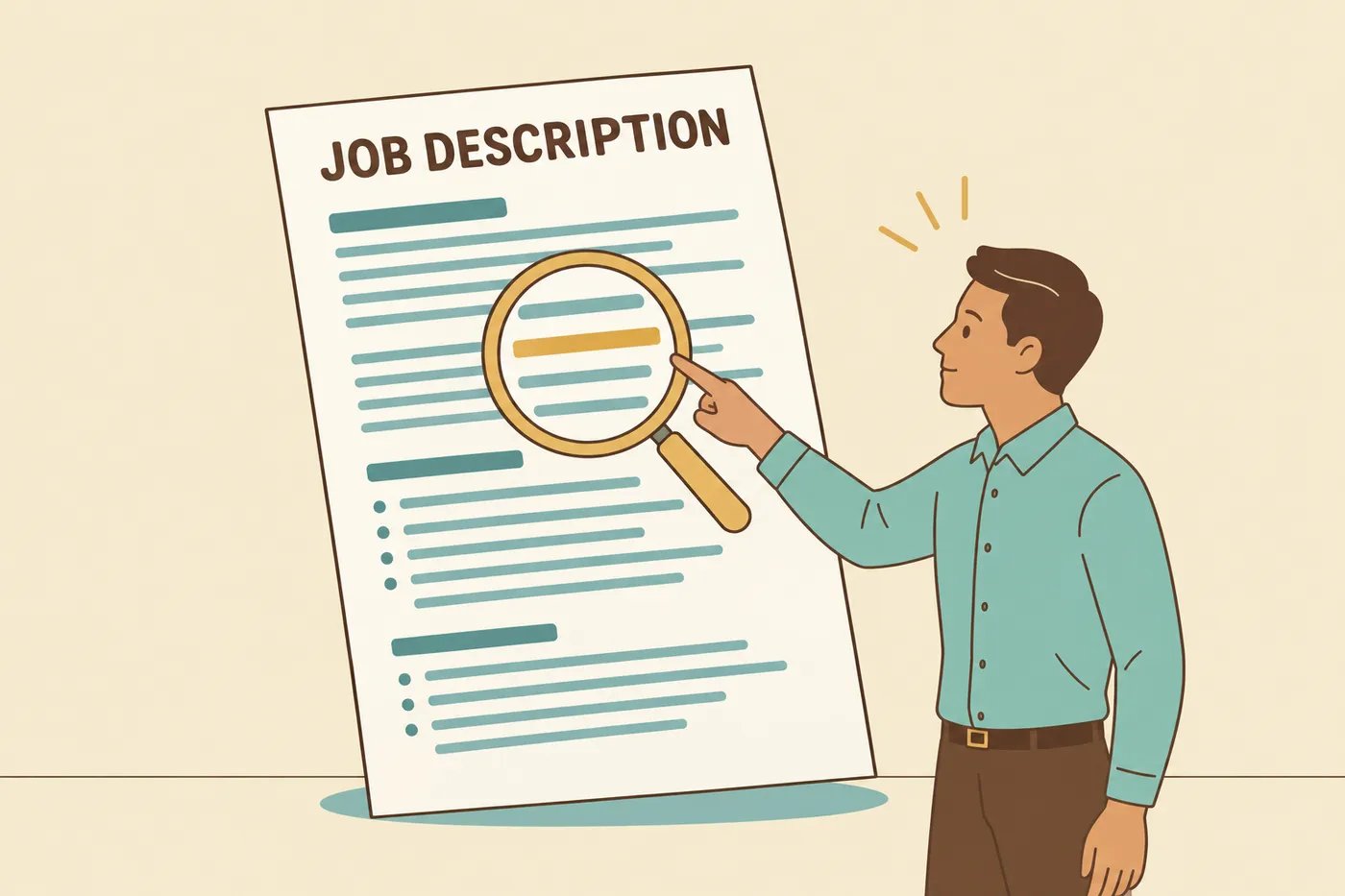
The challenge is often choosing evidence, rather than fitting a resume into the model’s context window. A large record can contain useful details and unrelated material; ask the model to explain which evidence it selected and check that choice against this posting.
Keep a master resume as your complete record, then identify the experiences most relevant to the role. Give Claude enough context to preserve the facts. If you provide the full record, ask it to quote the source passages behind the examples it proposes. Add missing relevant evidence yourself.
How to Review and Edit Claude's Output
Treat the draft as material to review, not a finished application. Check the facts, relevance, wording and final file before sending it. The time needed depends on the draft and the employer’s requirements.
- Verify every factual claim against your resume and notes. Remove or correct achievements, numbers, tools, dates, and outcomes you cannot support.
- Test the opener. If it could introduce a letter to any company in your industry, use a verified detail about this employer or posting instead.
- Check the evidence map against the full posting. Choose the most relevant requirements, and name skills you genuinely have. Do not add a qualification just to improve keyword coverage.
- Remove repetition. Use the letter to add context and motivation rather than copying every resume bullet.
- Read it aloud and revise wording you would not naturally use. This is a style check, not proof of AI authorship.
- Follow the employer’s requested file type. Open the downloaded document and check the text, spacing, and page breaks before sending it.
From Raw Prompts to a Tailored Cover Letter Workflow
Working job by job means keeping track of the posting, the evidence you selected and the draft you sent. A saved prompt and a requirement-to-evidence checklist can make that process easier to repeat.
In Roleframe, you can keep a base resume, create a version for a job and use the fit report to guide your edits. A cover letter draft uses your resume and the posting as inputs. Review the report, verify the letter and approve wording you can defend. The workflow organizes the work; it does not guarantee complete requirement coverage on the first pass.
You can compare manual drafting options in our guide to free cover letter builders without sign-up. Keep the prompt above as a reusable starting point and review every application before sending it.
Frequently asked questions
- What is a good prompt for writing a cover letter on ChatGPT?
You can adapt the prompt in this article: provide the full posting, your resume and your own notes; specify tone and length; ask for a requirement-to-source checklist; and instruct the model to flag missing facts. Check every claim and revise the draft before sending it. The employer’s instructions take priority over the prompt’s defaults.
- Is Claude or ChatGPT better for cover letters?
There is no universal winner established here. Results vary with the model version, prompt and source material. Compare drafts for factual accuracy, relevance, natural wording and compliance with the employer’s instructions. Both need review; a fluent letter is not proof that its claims are true.
- Are cover letters outdated in 2026?
Follow the employer’s instructions. A requested letter deserves attention; an optional one can help explain relevant context that your resume does not convey, such as a career change or a specific reason for joining the company. Keep it concise and specific rather than assuming every recruiter will read it.
- How do I prompt Claude to tailor my resume?
Give it the posting and source evidence, then ask for suggestions that preserve every fact. Working on one bullet at a time can make review easier. Ask it to identify missing evidence instead of filling gaps, and verify every proposed skill, achievement and number before accepting a change.
- How long should a Claude cover letter be?
Use the length requested by the employer. When none is specified, the prompt’s 250–320-word range and three or four paragraphs are a practical starting point. Adjust them for your situation and inspect the final document; a model may not follow the requested limit exactly.
- Can recruiters tell when Claude wrote a cover letter?
You cannot reliably infer authorship from a letter’s tone alone. Generic wording can weaken the application regardless of who wrote it. Follow any employer rule about AI assistance, verify the facts and rewrite the draft so it explains your own interest and evidence clearly.



Ready to write your cover letter?
Writing a cover letter takes time, and a generic one is easy to spot. Pick a letter template that matches your resume, or let Roleframe draft a first version from the job posting using only what your resume backs up.


