Letter of Introduction for a Job: Introduce Yourself or Others
by Larbi SahliPublished
A full letter of introduction for a job, the email a contact sends to introduce you, and the 80-word blurb to hand them, plus openers and follow-up timing.
Users have landed jobs at
- 1Password
- OpenAI
- Notion
- justworks
On this page
Most referrals start with a short email, and most short emails that work follow the same pattern. A letter of introduction for a job names a shared connection in the first sentence, says who you are in one line, offers a single piece of proof, and asks for something small, usually a short call. It is how job seekers reach a hiring manager who would never open a cold application.
There are two of these letters, and almost every guide shows only one. You write the first kind yourself, to a person a mutual contact pointed you toward. A contact writes the second kind for you, putting you and someone they know in the same email thread. This page covers both, along with the piece that makes the second one happen, the short blurb you hand your introducer so they can forward it without writing a word themselves.
Example one: the letter where you introduce yourself
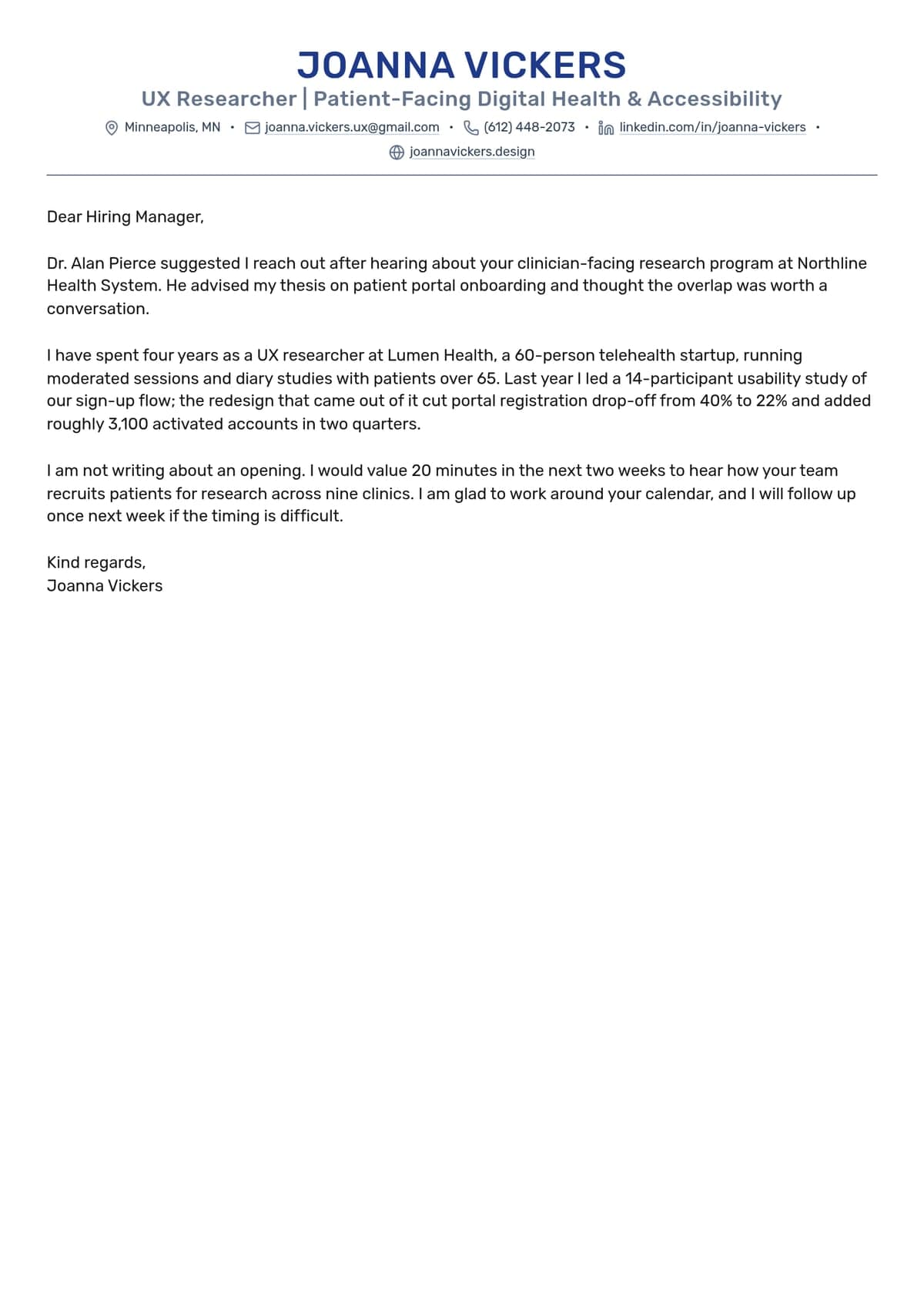
Here is the scenario behind the example below. Nadia Brooks has spent four years as a UX researcher at a health-tech startup. Her former professor, Dr. Alan Pierce, mentioned that a research director at a regional hospital system is building out a patient-experience team, and he suggested she write. Nadia has never met the director.
Three choices make her letter work. Pierce's name sits in the first sentence, because his name is the only reason a stranger keeps reading. One proof line carries her credibility, a usability study that cut patient portal sign-up drop-off from 40% to 22%, and she resists the urge to add two more. And the ask is a 20-minute call, something a busy director can say yes to without checking headcount or talking to HR.
Notice what the letter refuses to do. No resume walk-through, no list of research methods she knows, no hint that she expects a job to materialize. The whole document exists to make one small yes easy. If the call happens, her resume and portfolio get their turn; sending them now would turn a warm note into an application the director never asked for.
The time frame on the ask matters more than people think. "A 20-minute call in the next two weeks" gives the reader a box to put you in. An open-ended "I'd love to connect sometime" gives them nothing to schedule and usually gets nothing back.
Example two: the letter where someone introduces you
The second letter is shorter, and you don't write it. Nadia's former manager, Grace Liu, knows Omar Haddad, a design lead at a fictional insurance company that is investing in research. Grace asked Omar first whether he'd take an introduction, and he said yes. Only then did she send the email. That double opt-in is the etiquette that separates a welcome introduction from an ambush, and skipping it burns the introducer's credibility rather than yours.
Grace's email runs five lines, and each line has exactly one job.
- A subject line that names both people, "Introduction: Nadia Brooks and Omar Haddad". Omar knows what the email is before he opens it, and it stays findable in his inbox a month later.
- Two sentences on Nadia. Who she is, what she has done, and the single number that proves it, pulled straight from the blurb Nadia gave her.
- Two sentences on Omar, so Nadia has context too. What he leads and why Grace rates him.
- One sentence on why they should talk. Grace names the overlap: Omar's team is building clinician-facing research and Nadia has spent four years doing exactly that work.
- A closing line where Grace steps out, something like "I'll let you two take it from here." The thread now belongs to Nadia and Omar.
If you are the person being introduced, reply fast. Within a day, thank the introducer briefly, move them to BCC so the thread stops filling their inbox, and make the same small ask from letter one. Their reputation rides on you following through, which is why slow replies quietly end future introductions.
The 80-word blurb you hand your introducer
Introductions die of friction. Grace wants to help, but writing two accurate sentences about Nadia's work takes effort she will put off for a week and then forget. So Nadia removes the writing. When she asks for the introduction, she includes a short blurb, about 80 words, written in third person so Grace can paste it into her email untouched.
The blurb carries four things. One line on who Nadia is and where she has worked. One line on what she is exploring, research roles in insurance and health systems. Then the same proof line from her letter, the drop-off number, and finally the ask, a short call to compare notes on how Omar's team runs research.
The message that carries the blurb is two lines on its own. The first asks the favor plainly, "Would you be open to introducing me to Omar Haddad at Meridian Insurance?" The second removes the work, "I've put a short blurb below that you can forward as is, and no pressure at all if the timing is wrong." An introducer who can say yes in ten seconds usually does.
What is a letter of introduction for a job?
A letter of introduction for a job is a short letter or email, usually under 200 words, that introduces you, or someone you vouch for, to a person who can help with a job search. It almost always travels through a shared connection, and it asks for something small, a conversation or advice, rather than a job or an interview. Think of it as the written version of "you two should talk."
It is not a cover letter wearing a different name. A cover letter answers a specific posting and asks for an interview. A letter of introduction opens a relationship before any posting exists, which is exactly why it works: you reach the hiring manager while the generic applicants are still waiting for a job ad to appear.
Letter of introduction vs. letter of interest vs. cover letter
| Letter | Who gets it | What prompts it | What it asks for |
|---|---|---|---|
| Letter of introduction | A person who can help, reached through a shared connection | A mutual contact, a shared school, an event, or genuine admiration for their work | A short conversation or advice |
| Letter of interest | A company you want to work for | No matching posting exists yet | To be considered when a role opens |
| Cover letter | The hiring team for one posting | A live job ad | An interview for that specific job |
One wrinkle trips people up. Some applications, especially for teaching jobs, ask for a "letter of introduction" as part of the packet. That is not a networking note; districts use the phrase to mean a cover letter for that posting that opens with who you are. Write it as you would any strong cover letter, lead with your certification and the grade levels you've taught, and don't send them a request for a 20-minute call. The teacher cover letter examples show that structure in full.
Good opening lines, by situation
Never open with "My name is." Your name is in the signature and the email address; spending the first sentence on it wastes the only line a busy reader is guaranteed to see. Open with the connection or the reason instead, and let your name arrive on its own.
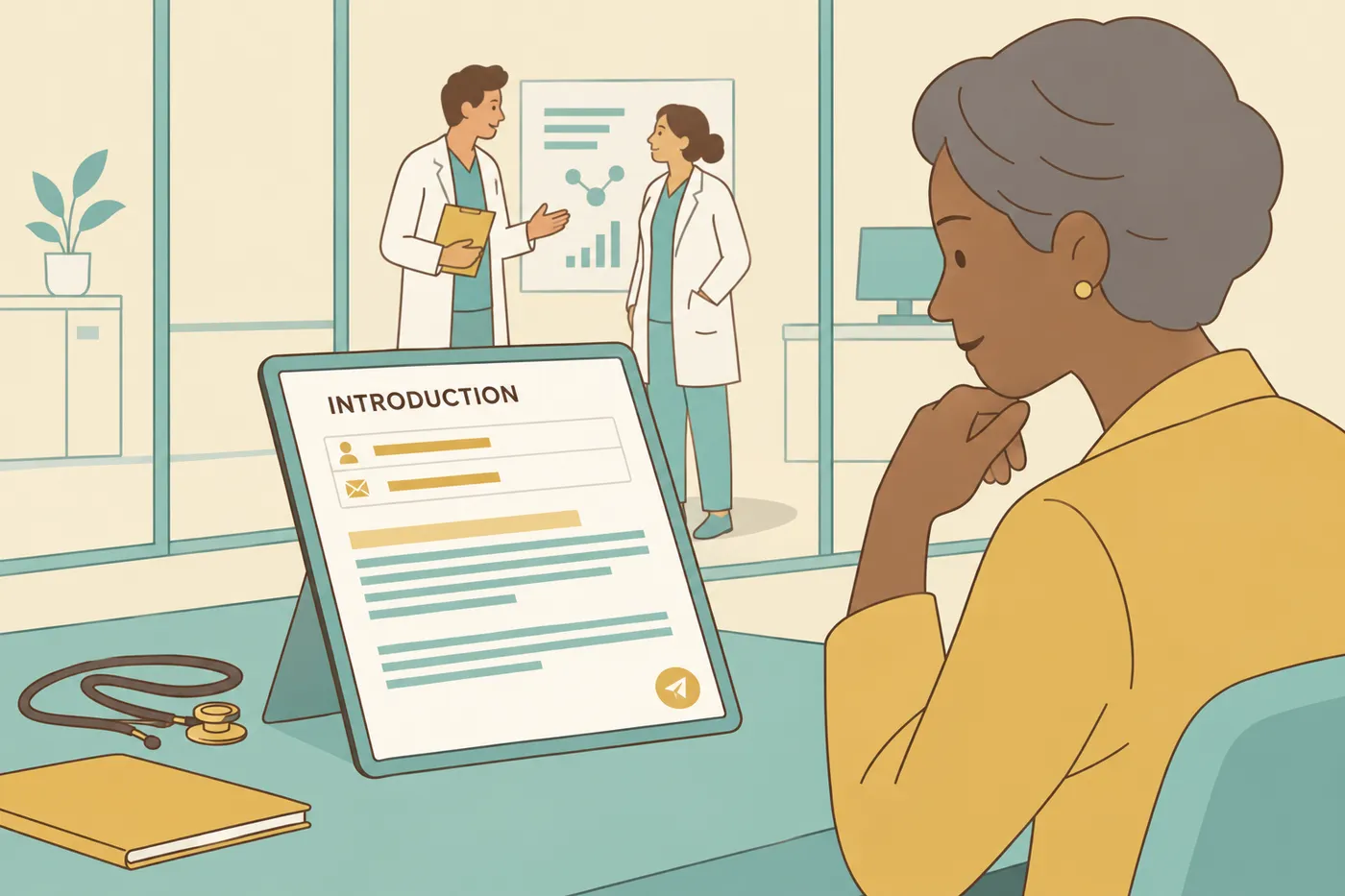
- When a mutual contact suggested it. "Dr. Alan Pierce suggested I reach out; he thought my patient-portal research would be relevant to the team you're building."
- After meeting at an event. "We spoke briefly after your panel at the Chicago health design meetup last month, and your point about consent flows has stayed with me."
- Through a shared school. "As a fellow Michigan alum, I'm hoping you'd be open to a short conversation about moving from agency research into a hospital system."
- When you're moving to their city. "I'm relocating to Denver in March and mapping out the health-tech teams doing serious user research there, and yours keeps coming up."
- When you're changing fields. "After four years running usability studies in health tech, I'm exploring a move into insurance, and two people this month have pointed me to your team."
- When you admire a project. "Your team's redesign of the claims-filing flow is the clearest piece of plain-language design I've seen this year, and I'd love to hear how it came together."
- When you're applying to a posted job. "I'm writing about the UX Researcher opening on your careers page; its focus on clinician-facing tools matches the last four years of my work."
The pattern holds across all seven. Connection or reason first, you second, and a specific detail that proves the line was written for this person. If an opener would survive a find-and-replace on the recipient's name, it isn't done yet.
What goes in, and what stays out
A letter of introduction earns a reply by being easy to act on. Six elements belong in it, and everything else is weight.
- The connection, named in the first sentence
- Who you are, in one line, with your current role and years of experience
- What you're exploring, so the reader knows what kind of help is useful
- One proof line with a number, like Nadia's drop-off result
- A small ask with a time frame, such as 20 minutes in the next two weeks
- Your contact details, plus one link to your work if it's relevant
Leave out the rest. Your full work history belongs in the call, if it comes up at all. A skills inventory reads like an application, which is the one thing this letter must not resemble. Unrequested attachments trip spam filters and signal that you skipped the "small ask" part. And "are you hiring?" converts a warm note into a cold query the reader can answer with one word, usually no.
Sending it and following up
Email is the default. A mailed letter is a curiosity in most industries now, and LinkedIn messages get buried; an email with a clear subject line gets read, or at least triaged. For the self-introduction, put the connection in the subject, "Alan Pierce suggested I reach out." When someone introduces you, the subject follows the pattern from example two, both names after the word "Introduction."
Silence is normal and usually means busy, so follow up exactly once, about a week later. Keep it to two sentences and restate the small ask, with no guilt attached. A second nudge starts to cost you goodwill; let it go and spend the energy on the next introduction. The same discipline applies to applications, and the templates in how to follow up on a job application transfer directly.
Close the loop with your introducer no matter what happened. A two-line note, "Omar and I spoke Tuesday, hugely helpful, thank you again," tells Grace her introduction landed and makes her glad to write the next one. An introducer who hears nothing assumes the worst and quietly stops introducing.
The student version
Students run the same play through the alumni network, with the shared school standing in for the mutual contact. Nadia's opening paragraph, rewritten for a senior writing to an alum, looks like this: "As a current Michigan senior studying cognitive science, I found your profile through the alumni directory and saw you moved from our HCI program into health-tech research. I'm trying to understand what that path looks like in practice, and I'd be grateful for 15 minutes of your time before the semester ends." The proof line can be a class project or an internship result; the mechanics don't change.
When the introduction turns into a real opening
A good intro call often surfaces an actual role, sometimes one that isn't posted yet. At that point the letter of introduction has done its job, and the application deserves a real cover letter aimed at that specific opening. The Roleframe cover letter builder drafts one from your resume for you to edit, with the document open beside it so the two never contradict each other.
Track the people, too. Add both your introducer and the new contact to the contact tracker, tagged and linked to the job they led to. Six weeks into a search with 40 applications, "who opened this door" is a question you will otherwise answer from memory, badly.
Frequently asked questions
- What's a good opening line for a letter of introduction?
Name the connection or the reason before you name yourself. "Dr. Alan Pierce suggested I reach out" beats "My name is" every time, because the shared contact is the reason a stranger keeps reading. With no mutual contact, lead with the specific reason you chose this person, an event, a shared school, or a project of theirs you can name.
- What is an example of a good letter of introduction for a job?
The letter on this page is a complete example. It names the mutual contact in the first sentence, states who the writer is in one line, offers a single quantified proof point, and asks for a 20-minute call rather than a job. Under 200 words, one small ask, one time frame.
- What should I put in a letter of introduction?
Six things. The connection named in the first sentence, one line on who you are, what you're exploring, a single proof line with a number, a small ask with a time frame, and your contact details. Everything else, the full work history, the skills inventory, the attachments, waits for the conversation you're asking for.
- Is a letter of introduction the same as a cover letter?
No. A cover letter answers a specific posting and asks for an interview, while a letter of introduction opens a relationship through a connection and asks for a conversation. The exception is applications, often for teaching jobs, that request a "letter of introduction" as part of the packet. There, write a cover letter for that posting that opens with who you are.
- How long should a letter of introduction be?
Under 200 words, or one screen of email without scrolling. The reader should see the connection, the proof, and the ask without effort. If you have to cut, cut proof before you cut the ask; one strong number is enough.
- Should I attach my resume to a letter of introduction?
Not with the first note. An attachment makes the email read like an application and can trip spam filters. Offer to send it instead, and when someone asks, send a PDF so the layout arrives exactly as you built it.
- Can I ask about job openings in a letter of introduction?
Ask for a conversation instead. "Are you hiring?" is a yes-or-no question that is usually answered no, and the exchange ends there. A 20-minute call lets the other person volunteer openings and referrals you'd never think to request, which is how most introductions actually turn into jobs.


Write yours on the same template.
Every example here is built on a template you can open in the editor. Keep the structure that works and put your own story in it, or let Roleframe draft a first version from your resume and the job posting.


