Teacher Cover Letter Examples: Elementary, Secondary, and Career Change
by Larbi SahliLast Updated
Teacher cover letter examples for elementary, secondary, and career changers, with certification wording, growth evidence, and district application tips.

Users have landed jobs at
- 1Password
- OpenAI
- Notion
- justworks
On this page
Principals read cover letters. That makes teaching unusual. In corporate hiring the letter is often skipped; in a school district, the person screening your application is frequently the building leader who will sit across from you at the interview, and the letter is her first look at how you think about kids and instruction.
The problem with most teacher cover letter examples online is that one generic letter is supposed to cover three different candidates: the elementary generalist, the secondary subject teacher, and the career changer coming out of industry. Those three letters make different arguments, lead with different credentials, and fail for different reasons. This page covers all three, plus the two things almost every example skips: how to state your certification so district HR can verify it in your state's public educator lookup, and how to check your draft against the actual posting before you hit submit in Frontline or TalentEd.
What a strong teacher cover letter does in one page
A hiring principal is trying to answer four questions fast. Can you legally teach this assignment on day one? Can you actually teach, with evidence beyond a philosophy statement? Can you run a room? And did you write this letter for my school or for two hundred schools?
A strong letter answers all four in under a page. The certification sentence handles the first question in the opening paragraph, because a principal who can't confirm your license stops reading. The middle paragraphs handle teaching evidence and management with specifics: a unit you built, an intervention you ran, a routine you use, one incident you resolved. The close names something about the school itself, which is the only proof the letter wasn't recycled.
Here is what that looks like assembled, for the most common of the three situations. The section-by-section breakdown below refers back to it.
Marisa Delgado
Elementary Teacher | EC–6 Generalist & ESL | Small-Group Literacy Intervention

Dear Mr. Alvarado,
When I saw Cedar Hollow Elementary's third-grade posting on the district's Frontline site, I applied that evening. I hold a Texas Standard Certificate, EC–6 Generalist with an ESL Supplemental endorsement, and five years in self-contained elementary classrooms.
Last year I built a six-week measurement unit anchored in hands-on stations, and ran a small-group reading intervention using LLI that moved eight striving readers an average of 1.4 reading levels in one semester.
My room runs on predictable routines: students enter to a posted soft-start task and settle within two minutes. When two boys nearly came to blows over a lost pencil, I used our reset corner and a brief check-in to defuse it before it escalated. Consistency, not volume, keeps the class calm.
I currently serve four students with IEPs, three on 504 plans, and six ELLs, differentiating through tiered tasks and visual supports. Cedar Hollow's dual-language program is exactly where I want to keep growing.
Sincerely,
Marisa Delgado
One search, three different letters
Elementary, secondary, and career-change letters share a skeleton but not an argument. If you copy an elementary teacher cover letter example into a high school chemistry application, the mismatch shows immediately: the principal wants depth in your subject and you gave her warmth across subjects.
| Elementary generalist | Secondary subject teacher | Career changer from industry | |
|---|---|---|---|
| Lead credential | Certificate grade band and elementary endorsement | Subject endorsement, plus any second endorsement that makes you cheaper to schedule | Alternative-route or provisional status, stated exactly, plus the industry credential behind it |
| Core evidence | A unit that spans subjects, a reading or math intervention, growth on a benchmark | Depth in the discipline: a course you taught or redesigned, results on the state or AP assessment | Real-world application of the subject, plus any classroom hours you already have |
| Management proof | Routines and relationships, one incident | Routines that survive five different periods a day | Honest acknowledgment plus transferable evidence: training, mentoring, leading teams |
| Biggest risk | Sounding interchangeable with every other generalist | Sounding like a subject expert who tolerates teenagers | Sounding like someone fleeing a layoff rather than choosing a classroom |
The elementary letter
The rendered example above is the elementary version, and its structure is the one to steal. Elementary hiring is where letters look most alike, because every applicant loves children and believes in the whole child. The way out of the pile is specificity: which reading intervention, which routine, which unit, which measurable result. A principal reading forty letters for one second-grade opening remembers the candidate who named her small-group structure and the growth it produced, and forgets everyone who wrote about passion.
The secondary letter
A high school teacher cover letter earns its interview on subject depth and schedulability. Lead with the endorsement printed on your certificate, then any second endorsement, because a candidate who can cover both biology and chemistry solves a master-schedule problem the principal has every August. The evidence paragraph should show you teaching the discipline, not just knowing it: a course you built or reworked, how students performed on the state end-of-course exam or an AP or IB assessment, and one example of making hard content land with students who arrived below grade level.
Skip the paragraph about your love of the subject. Every applicant for the physics opening loves physics. What separates letters is evidence that students learned it from you.
The career-change letter
A career change teacher cover letter has to do one extra job: convert your industry years from a liability into the reason to interview you. The move is to connect what you did to what you'll teach. Ten years as a chemical engineer is a credential for teaching chemistry if the letter says so plainly; a decade in accounting is an argument for teaching business or math. Name your route into the classroom exactly, whether that's an alternative certification program, a residency, or a provisional certificate, and say where you are in it, because the principal needs to know whether she can legally staff you in August.
Then get ahead of the obvious doubt. You have not run a classroom for 180 days, and pretending otherwise reads as naive. Point instead to the closest things you have done: training new hires, presenting to hostile rooms, mentoring interns, plus any student teaching, substitute days, or coaching hours already banked. The same logic applies to your resume, and the approach in our guide to writing a career change resume carries over directly.
No experience yet? Write about the classroom hours you do have
A teacher cover letter with no experience is never actually written from zero. You student taught, and student teaching is a semester of real instruction: you planned units, graded work, ran routines, and handled at least one hard parent conversation. Write about it the way a veteran writes about a school year, with the grade level, the content, one lesson that worked, and one thing your cooperating teacher would confirm about you. Add practicum hours, tutoring, camp counseling, or coaching, and name your certification status and expected issue date in the first paragraph so HR isn't left guessing.
Address the principal and name the school, not the district
District postings are usually school-specific even when the job board makes them look generic, and the same posting text gets reused across buildings. "Dear Hiring Committee" tells the principal you didn't check which building you applied to. Find the school in the posting, then find the principal's name on the school's website, and open with both: the principal by name, the school by name, and the exact posting title in the first sentence.
This matters more than it would in corporate hiring because the letter often travels. In many districts the screener forwards strong applications to the building, and a letter that says "your school" forty times survives that forwarding worse than one that says "Lincoln Elementary." If you genuinely cannot find the principal's name, "Dear Lincoln Elementary Hiring Team" beats "To Whom It May Concern" by a wide margin.
The certification sentence: write it so HR can verify it
District HR verifies every certification claim in the state's public educator lookup before an offer goes out, and often before an interview. So write the sentence the way the lookup will display it: the exact certificate title your state department of education issued, the grade band printed on it, and the subject endorsements. "I hold a Professional Educator License with an Elementary Education endorsement covering grades K through 5" is verifiable in thirty seconds. "I am a certified teacher" is not, and it forces a busy HR coordinator to do your work.
Three statuses need extra care, because vagueness here looks like concealment:
- Pending: you've completed requirements and the certificate is in processing. Say so with the expected issue date: "my initial certificate, with an endorsement in secondary mathematics, is in processing with an expected issue date of June." Districts hire on pending status all the time; they just need the date.
- Provisional or initial: this is a real certificate with conditions attached. Name it exactly as issued and, if relevant, note what converts it to the standard certificate and when. Don't dress it up as the full credential; the lookup will contradict you.
- Alternative route: name the program and where you sit in it, such as "I am completing an approved alternative certification program and hold the intern certificate it confers, which authorizes me to teach secondary science while I finish coursework." Principals staff alt-route candidates every year, but only when the legal status is clear.
One more habit worth building: put the certificate number in your application profile, not the letter. The letter carries the plain-language claim; the district's form fields carry the verifiable detail. The same certification line belongs near the top of your resume too, and our teacher resume examples show where it sits and how districts search for it.
Out-of-state applicants: reciprocity, what you can claim, and fingerprints
Moving states does not reset your career, but it does change what your letter can honestly say. Most states participate in the NASDTEC Interstate Agreement, which smooths recognition of an out-of-state certificate; it is not automatic transfer, and states routinely add conditions such as their own tests or coursework. Until the new state issues your certificate, you hold the old one, and the letter should say exactly that: "I hold a valid standard certificate in Ohio with a 7-12 English endorsement and have applied for the equivalent certificate here through reciprocity, with my application under review."
That sentence works because it gives the principal everything she needs: a real, currently valid credential, the specific endorsement, and an honest status on the new one. What sinks out-of-state letters is the opposite: claiming the new state's certificate before it exists, or hiding the transition entirely and letting HR discover it in the lookup.
Fingerprint clearance is the timeline item people forget. Most states require their own background check even if you cleared one elsewhere, and processing takes weeks in the spring rush. Start it the moment you file the reciprocity application, and if it's already done, say so in the letter. "My fingerprint clearance for this state is complete" removes one of the two administrative reasons a principal might pass on an otherwise strong out-of-state candidate.

Evidence that reads like teaching: a unit, an intervention, a number
The middle of the letter is where philosophy statements go to die. "I believe every child can learn" appears in nearly every application a principal reads, and it screens for nothing. Replace belief with three pieces of evidence, one sentence to three sentences each:
- One unit you built. Not "I create engaging lessons" but the actual unit: the grade, the content, the anchor task, and why you built it that way. A fourth-grade fractions unit built around a bake-sale budgeting project tells a principal more about your instruction than a paragraph of adjectives.
- One intervention you ran. Small-group reading, a math lab, a lunch-hour re-teach cycle, an attendance intervention for a specific student. Name the structure, who it served, and how long you ran it. Interventions prove you notice which kids the whole-group lesson missed.
- One growth number you can defend in the interview. The share of your readers who met their benchmark growth target, the movement on the state assessment relative to the prior year, the before-and-after on a course pass rate. The test is whether you can explain, in the interview, how the number was measured and what your part in it was. A number you can't defend is worse than no number, because the interview is exactly where it will come up.
If you're early-career and short on numbers, one honest data point from student teaching beats a borrowed district statistic. "By the end of my placement, every student in my guided reading group had moved up at least one level" is small, real, and defensible.
Classroom management in three sentences
Management paragraphs fail in two directions: the philosophy essay ("I believe in building a community of mutual respect") and the fortress ("I maintain firm, consistent discipline"). Neither tells the principal what your room actually looks like at 9:40 on a Tuesday. Three sentences do the job.
Sentence one names your routines: how students enter, how transitions run, what your attention signal is, how you use whatever framework the school runs, such as PBIS or restorative practices. Sentence two describes one real incident and what you did, briefly and without naming the student. Sentence three says what the incident taught you or what the room looks like as a result. That structure proves you have systems, you've been tested, and you reflect, which is the whole rubric a principal is scoring you against.
Differentiation, IEPs, 504s, and ELL support: the paragraph administrators look for
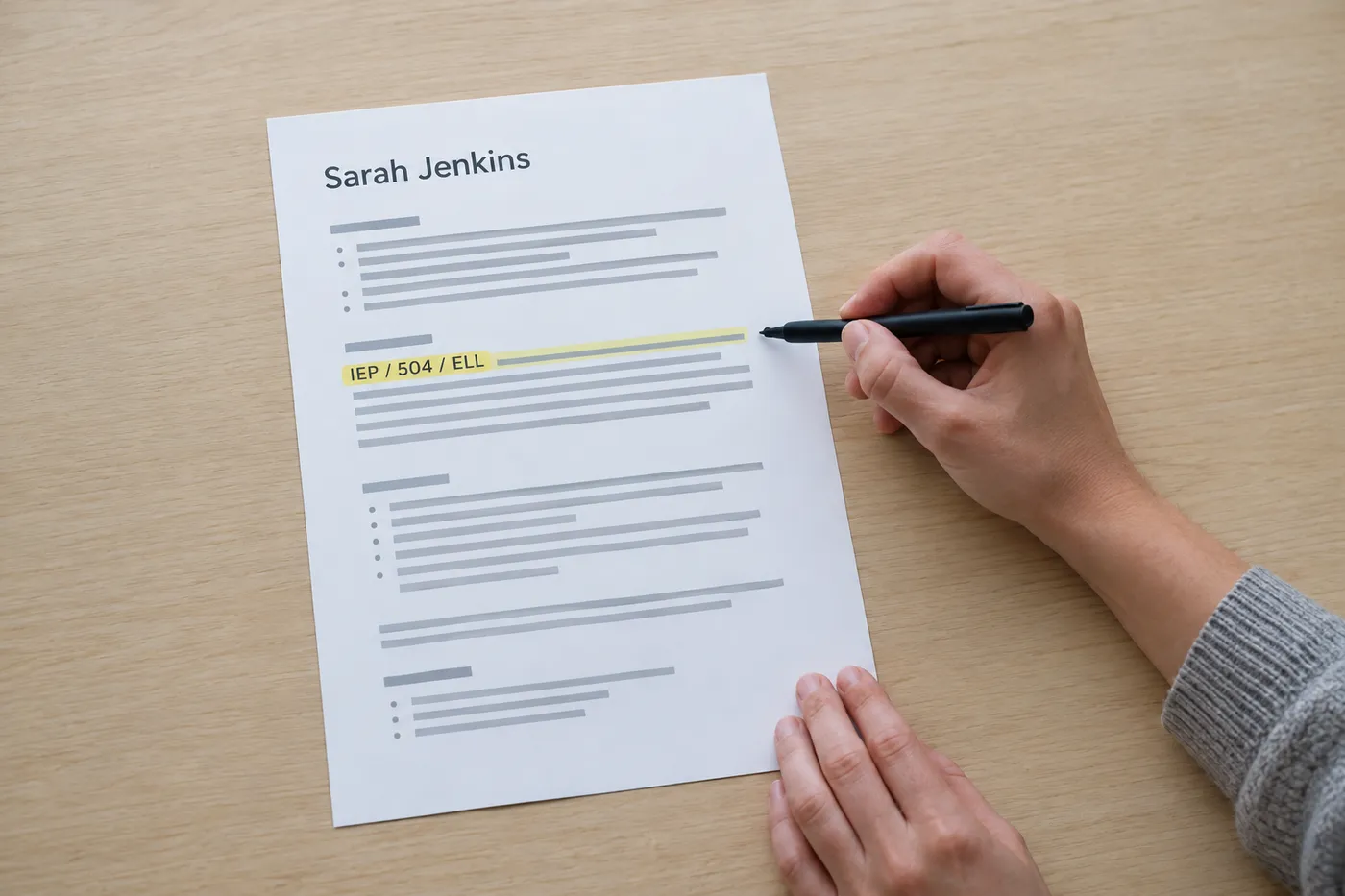
Administrators scan for this paragraph because it's a compliance and culture signal at once. Every classroom carries students with Individualized Education Programs (IEPs), 504 plans, and English language learners (ELLs), and the district is legally accountable for serving all three. A candidate who never mentions them either hasn't taught a real caseload or doesn't think about it, and both are disqualifying.
Write it from your actual caseload, not from a textbook. Roughly how many students on IEPs and 504s you served, how you worked with the special education case manager and implemented accommodations, and one concrete example: extended time paired with chunked directions for a student with a processing disorder, sentence frames and visual supports for newcomers, co-planning with the ELL specialist. Two to four sentences is enough. If special education is your actual role rather than part of your caseload, that's a different letter with a different center of gravity, and our special education teacher cover letter examples cover it properly.
Substitute, para, and long-term sub experience: show range, not a list of stays
A history of substitute placements, paraprofessional work, and long-term sub assignments looks fragmented on paper, and the instinct to list every school makes it worse. Fold it into one paragraph organized around range: how many buildings, which grade bands, and what stayed constant in how you ran a room across all of them. "Across two years of substitute and long-term assignments in six schools, from kindergarten to eighth grade, I learned to establish routines with a class in the first ten minutes" is a capability statement. A list of six short stays is a red flag doing its own paperwork.
Give a long-term sub placement its own two or three sentences, because it's your strongest card: you carried a real class for a real stretch, planned instruction rather than delivering someone else's, and handled report cards or parent conferences. If subbing is the job you're applying for rather than the bridge you're crossing, the framing changes, and our substitute teacher cover letter examples handle that version.
Where the letter actually goes: Frontline, TalentEd, and the spring calendar
Most districts run applications through Frontline (formerly AppliTrack) or TalentEd, and both change how your letter gets read. Two practical consequences:
- Your letter often lands in a field, not just a file. Many district applications include a cover letter text box alongside or instead of an upload. Keep a plain-text version of your letter ready, because pasting from a formatted document into these boxes mangles spacing and drops characters. Write the letter, then read the pasted version before submitting.
- Uploads have caps and slots. These systems enforce file-size limits and a fixed set of document slots, and some districts want one combined file. Export as PDF so the formatting survives, keep the file lean, and name it so a screener can find it in a stack: LastName-FirstName-CoverLetter-SchoolName.pdf.
- One application, many postings. Districts often let you apply once and attach yourself to multiple postings. Your letter still needs to name a school. If you're applying broadly, write one district-level letter for the general pool and a school-specific letter for any posting you actually want.
Timing decides more than most candidates realize. Teacher resignations and retirements are declared in early spring, districts confirm staffing budgets shortly after, and the heavy posting season runs spring into early summer. A letter submitted the week a posting opens gets read by a principal with an open mind and an open calendar; the same letter in late July competes with a pipeline that's already interviewing. Openings do appear in August and even after the year starts, usually from late resignations, and those hire fast, so a ready-to-adapt letter matters most exactly then.
The paste-the-posting check: find what your draft hasn't mentioned
Before you submit, run one mechanical check that most applicants skip. Paste the posting into a document, split out every listed requirement and preferred qualification into its own line, then go down the list and mark which lines your draft addresses. District postings are unusually literal: if the posting lists a specific certification, experience with a named curriculum, ELL endorsement preferred, and experience with PBIS, the screening rubric almost certainly mirrors those lines, and a requirement your letter and resume never mention is a point you never scored.
You don't need to answer every line in the letter itself. The letter carries the three or four strongest matches; the resume and application fields carry the rest. What you're hunting for is the listed requirement that appears nowhere in your materials at all, which happens constantly when a letter written for one posting gets reused for the next.
Roleframe automates the resume half of this check. Duplicate your base resume for the job, paste the posting, and the fit report maps every requirement against your document, names the keywords the posting asks for that you haven't covered, and gives you a prioritized plan. It also drafts a job-specific cover letter for you to edit, built from the posting and your actual experience, so the certification line and the school's name are yours to confirm rather than yours to retype from scratch.
Frequently asked questions
- What should a cover letter include for a teacher?
Five things: the principal's name and the specific school and posting; your certification stated exactly as your state issued it, with grade band and endorsements; concrete teaching evidence, ideally a unit you built, an intervention you ran, and one growth result you can defend; a short classroom-management passage with a named routine and one real incident; and a paragraph on differentiation covering IEPs, 504s, and ELL students from your actual caseload. Keep it to one page.
- What is the rule of 3 in a cover letter?
It's the three-part structure most strong letters follow: a hook that names the role and your strongest qualification, a proof section with two or three concrete pieces of evidence, and a close that connects you to this specific school and asks for the interview. For teachers it maps cleanly: certification and fit up top, teaching evidence in the middle, the school-specific close at the end. Three main paragraphs, one page, done.
- What are the most common teacher cover letter mistakes?
The five that come up most: addressing the district instead of the principal and school; writing a philosophy statement instead of evidence, so the letter proves beliefs rather than results; leaving the certification vague when HR will verify it in the state lookup anyway; reusing one letter across postings so listed requirements go unmentioned; and running past one page. Every one of them is fixable in a single revision pass against the posting.
- How long should a teacher cover letter be?
One page, and closer to three-quarters of it. Principals screening dozens of applications reward letters they can read in under a minute. If yours runs long, cut the philosophy sentences first; the evidence paragraphs are the ones doing the work.
- Do I need a different cover letter for each school in the same district?
Yes, if you're serious about a specific posting. Districts reuse posting text across buildings, but the principal reading your letter leads one building, and a letter naming her school and something real about it reads differently from a district form letter. Keep one base letter and swap the opening and closing paragraphs per school; the certification and evidence sections stay the same.
- Should I submit my teacher cover letter as a PDF?
Yes. PDF preserves your formatting through Frontline and TalentEd uploads, which have file-size caps and sometimes a single document slot. Also keep a plain-text version ready, because many district applications include a cover letter text box, and pasting formatted text into it breaks spacing. Read the pasted version before you submit.
- Can I apply for a teaching job before my certificate is issued?
Usually yes, and districts do it every hiring season. State the status precisely: pending with an expected issue date, provisional with the conditions named, or an alternative-route intern certificate with the program identified. What kills applications isn't the pending status; it's vagueness that HR then contradicts in the state's public educator lookup. For out-of-state moves, say which certificate you currently hold and that reciprocity is under review, and start fingerprint clearance immediately.


Write yours on the same template.
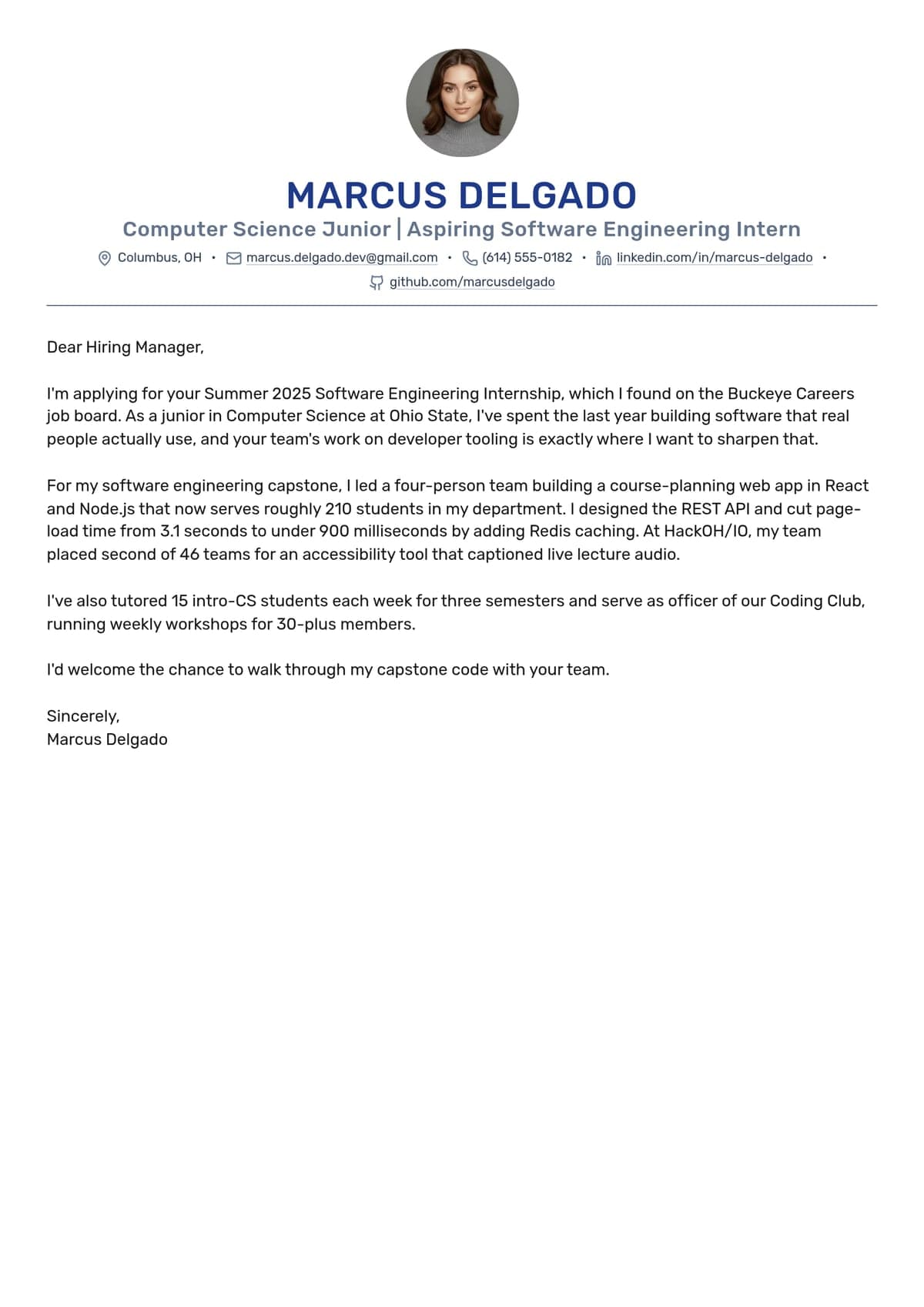
Every example here is built on a template you can open in the editor. Keep the structure that works and put your own story in it, or let Roleframe draft a first version from your resume and the job posting.


