Job Application Letter: Format and a Full Labeled Sample
by Larbi SahliPublished
See a full fictional job application letter, a labeled format table, graduate examples and practical instructions for email, portals and formal sign-offs.
Users have landed jobs at
- 1Password
- OpenAI
- Notion
- justworks
On this page
A job application letter introduces your application, connects your experience to a specific vacancy and explains your interest in the work. Employers may call it a cover letter or letter of application. Use the notice to establish what they want: a brief letter, a supporting statement addressing criteria, or answers in an application form.
This guide includes a full fictional letter, a part-by-part format table, examples for a graduate, and ways to submit the document. If a letter is optional, use it when it adds relevant context; if the employer asks you not to include one, follow that instruction.
A full job application letter for an advertised vacancy
This fictional letter is dated 18 August 2025. Amara Obiora is an accounts officer with four years at an illustrative hospital group, applying for a Finance Officer vacancy at a fictional health foundation, reference FIN/07. Names, organizations, figures and the vacancy are teaching examples, not a real application. Replace the placeholder addresses and contact details before using the format.
The opening identifies the job. The body explains three relevant areas of work: a month-end process change, fund reconciliations and audit schedules. The closing gives interview availability. Read the letter as a whole, then use the format table to adapt it to your notice.
Amara Obiora
Accounts Officer | Month-End Close, Donor-Restricted Fund Accounting & Audit Preparation
[Sender street address, if requested]
Lagos, Nigeria
18 August 2025
The Human Resources Manager
Brightwell Health Foundation
[Recipient postal address]
Subject: Application for Finance Officer (Ref: FIN/07)
Dear Hiring Manager,
I am applying for your Finance Officer vacancy, reference FIN/07. Its emphasis on timely month-end reporting, restricted fund accounting and audit preparation matches my four years as Accounts Officer at St. Mercy Hospital Group. I would welcome the opportunity to apply that experience in your foundation’s finance team.
I rebuilt our close checklist and introduced a weekly supplier-accrual review with the finance team. Over the next three monthly cycles, close was completed in five working days, compared with nine in the preceding three. My responsibilities included tracking outstanding items and preparing Sage 300 reports for review.
I also reconcile 14 donor-restricted funds each month and prepared supporting schedules for our last two external audits. I worked with the finance manager to document reconciliations and respond to requests for supporting records.
I would welcome an interview and am available on weekday afternoons. My CV is enclosed as requested. Thank you for considering my application.
Yours faithfully,
Amara Obiora
Enclosure: CV

The format, part by part
The table breaks a formal letter into eleven possible parts. An email or portal response may omit postal addresses, an enclosure line or other elements. Keep the information the employer asks for and avoid duplicating fields already supplied in the application.
| Part | What it does | What to write |
|---|---|---|
| Sender details | Identifies you and provides a reply route | Name, city, email and phone; include a street address if requested or appropriate to a postal letter |
| Date | Records when the letter was written | Write out the month if a numeric date could be ambiguous |
| Recipient block | Identifies the intended person or team | Use a verified name and role, or the named recruitment team; add a postal address for a formal mailed letter |
| Subject line | Identifies the vacancy | Use the exact job title and reference where provided, for example Application for Finance Officer, Ref. FIN/07 |
| Greeting | Opens the letter professionally | Use the contact’s verified name or a role such as Dear Hiring Manager; do not guess a title |
| Opening paragraph | Explains why you are writing | Name the vacancy and give a concise relevant introduction |
| Body paragraph one | Connects experience to a key requirement | Explain an actual task, contribution and supported scope or result |
| Body paragraph two | Adds another relevant example and motivation | Choose evidence for another requirement and explain your interest in this work |
| Closing paragraph | Makes the next step clear | Thank the reader and express interest in discussing the application; include availability if useful or requested |
| Sign-off and signature | Closes the letter | Use one appropriate sign-off and typed name; add a signature when requested or suitable for a printed letter |
| Enclosure or attachment line | Identifies supporting documents | List the documents actually included, such as Enclosure: CV; follow the requested document list |
A concise one-page letter is a useful default for many non-academic applications. A supporting statement or academic application may need a different length. Oxford’s Careers Service advises following specific employer instructions about structure, length and content.
Use readable text, clear paragraph breaks and enough space around the letter. The displayed sample uses a sidebar template; inspect the final export rather than assuming a design is compatible with every portal. Check that the text, contact details and reference number remain readable after upload.
Subject lines and sign-offs: follow the notice first
The subject line. Include the exact role and reference if the notice provides them. A formal letter can place that line above or below the greeting; consistency and the requested format matter more than a supposed rule for every country. For an email, put the requested reference in the email subject as well.
The sign-off. In traditional British correspondence, a named recipient is paired with “Yours sincerely,” while “Dear Sir or Madam” is paired with “Yours faithfully.” The UK National Careers Service explains this convention. “Sincerely” or “Kind regards” can suit other professional contexts. Use the organization’s requested style where it has one, and do not infer someone’s title or gender from their name.
If the vacancy asks for no more than 400 words, a particular addressee and a reference in the subject, use those requirements as your final checklist.
How to write yours in five steps, starting from the vacancy notice
- Identify the requirements labeled essential or emphasized in the notice. For the fictional Finance Officer vacancy, the letter addresses reporting, restricted funds and audit preparation.
- Match each relevant requirement with evidence from work, a project, study or volunteering. Explain what you did and its scope; include a figure only when you can substantiate it.
- Use the exact vacancy title and reference. Describe relevant skills using the notice’s terminology when it accurately describes your experience.
- Select one or two examples that add context to the CV. A brief reminder of a role is useful when it introduces your contribution, rather than retelling the entire work history.
- Close professionally and verify your contact details. Give interview availability when requested or useful, without promising times you cannot attend.

For the fictional finance example, the process change and comparison period matter more than an adjective: “I introduced a weekly supplier-accrual review with the finance team. Close was completed in five working days in the next three monthly cycles, compared with nine in the preceding three.” That identifies a contribution and observation without claiming that one person caused every part of the improvement.
The fresh graduate version: same format, different proof
A graduate can use the same basic structure with evidence from an internship, coursework, a student organization or volunteering. Follow the actual notice rather than assuming every application has eleven required parts or a one-page limit.
Illustrative internship wording: “During a ten-week customer-operations internship, I processed about 40 files weekly and handled routine returns queries after training, escalating exceptions to my supervisor.” The tasks, training and scope make the experience concrete. Use your own figures and responsibility level.
Illustrative student-role wording: “As volunteer treasurer of the business society, I introduced a reimbursement checklist and tracked outstanding receipts for committee approval.” A defined deliverable is useful even when you do not have a measured time saving.
Explain your interest in one verifiable feature of the opportunity, such as the duties or training described in the vacancy. Do not invent a recent expansion or program because it sounds persuasive.
Sending it the way the notice asks
Use the submission route and file type in the notice.
Email with attachments. If no format is specified, a text-based PDF is a practical option, but DOCX is appropriate when requested. Use clear filenames such as Amara-Obiora-Application-Letter.pdf and Amara-Obiora-CV.pdf. A short illustrative email is enough: “Dear Hiring Manager, please find attached my application letter and CV for the Finance Officer position, reference FIN/07. Thank you for considering my application. Kind regards, Amara Obiora.” Check that the attachments are present before sending.
Portal text box. Follow its prompt and word or character limit. If contact information is already collected, you may be able to omit the postal header. Check paragraph breaks after pasting and use the preview if available.
Printed letter. Follow the delivery instructions, use readable printing and include only the requested supporting documents. Add a signature when appropriate. Handwrite the letter only if requested; keep a copy of whatever you submit.
Can ChatGPT write your application letter?
If the employer permits AI assistance, use accurate inputs: the vacancy, your experience and your genuine reason for applying. Ask the tool to identify missing information rather than fill gaps with invented results. Keep confidential information out of the prompt and inspect the returned wording yourself.
For this sample, the evidence is the applicant’s contribution to a reporting process, the 14 funds and the audit schedules. Those details are fictional here; your letter needs evidence from your own history. A draft that merely repeats the vacancy requirements needs more information about what you have actually done. Oxford’s cover-letter guidance also advises checking the employer’s position on AI use and verifying generated references.
Final checks before submitting
- Correct vacancy details. Check the role, reference, organization and recipient against the notice. Remove details left over from another application.
- Appropriate greeting. Use a verified contact name when provided, or the relevant team or role.
- Requested length. Respect word, character and page limits. Cut repetition before useful evidence.
- Consistent history. Check dates, titles and responsibilities against your CV. Explain a translation or clarified title rather than making the documents appear contradictory.
- Readable file. Inspect the export and portal preview, including the subject line, contact information and paragraph order.
- Accurate evidence. Make sure each result, qualification and statement of interest is something you can explain and support.
Read the final letter aloud to find awkward sentences, then check details separately: names, dates, reference, links, attachments and contact information. Keep a copy of the submitted version so you can refer to the same examples in an interview.
Roleframe’s cover letter templates provide a starting layout. Replace the sample wording and inspect the final document. A template does not establish that your claims are accurate or guarantee how an employer processes the file.
Frequently asked questions
- How can I write a job application letter?
Follow the notice, identify the vacancy, and choose one or two examples that connect your experience to its requirements. Explain your interest, close professionally, and check your facts, recipient details and final file.
- Should I send a letter when the application says it is optional?
Include one when it adds relevant context and the process allows it. For example, it can explain your interest or a transition that the CV leaves unclear. Do not assume an optional letter is always read, and do not add one when the employer asks you not to.
- Is it better to apply online or in person?
Use the employer’s stated channel. An online form, email address or invited walk-in process may each be appropriate. Unrequested delivery to reception does not replace a required application. Confirm the required documents and deadline.
- What references should I provide?
Provide the type of reference requested. A manager, supervisor, relevant client, teacher or volunteer coordinator may be able to discuss your work. Ask permission, confirm contact details, and tell the referee about the role. Submit reference details only where requested and avoid sharing them unnecessarily.
- Can ChatGPT write a job application?
AI can assist with structure or wording if the employer permits it. Give accurate source material, ask it to leave gaps rather than invent information, and check every claim. Keep confidential material out of the tool and make the final wording your own.
- How long should an application letter be?
Follow the stated limit. For many non-academic roles, one page with a few focused paragraphs is a practical starting point. Academic letters and supporting statements can require more detail, so do not cut required criteria merely to fit a universal rule.
- Is a job application letter the same as a cover letter?
The terms often describe the same supporting letter, but employers may use them differently. Read what is requested: a brief introduction, a letter explaining your suitability, or a longer statement addressing selection criteria.
- Should I handwrite the letter?
Handwrite it when the notice specifically requests that format. Otherwise use the requested digital or printed format and make it readable. A handwritten document can be scanned and forwarded, but handwriting may be harder to extract or search automatically.


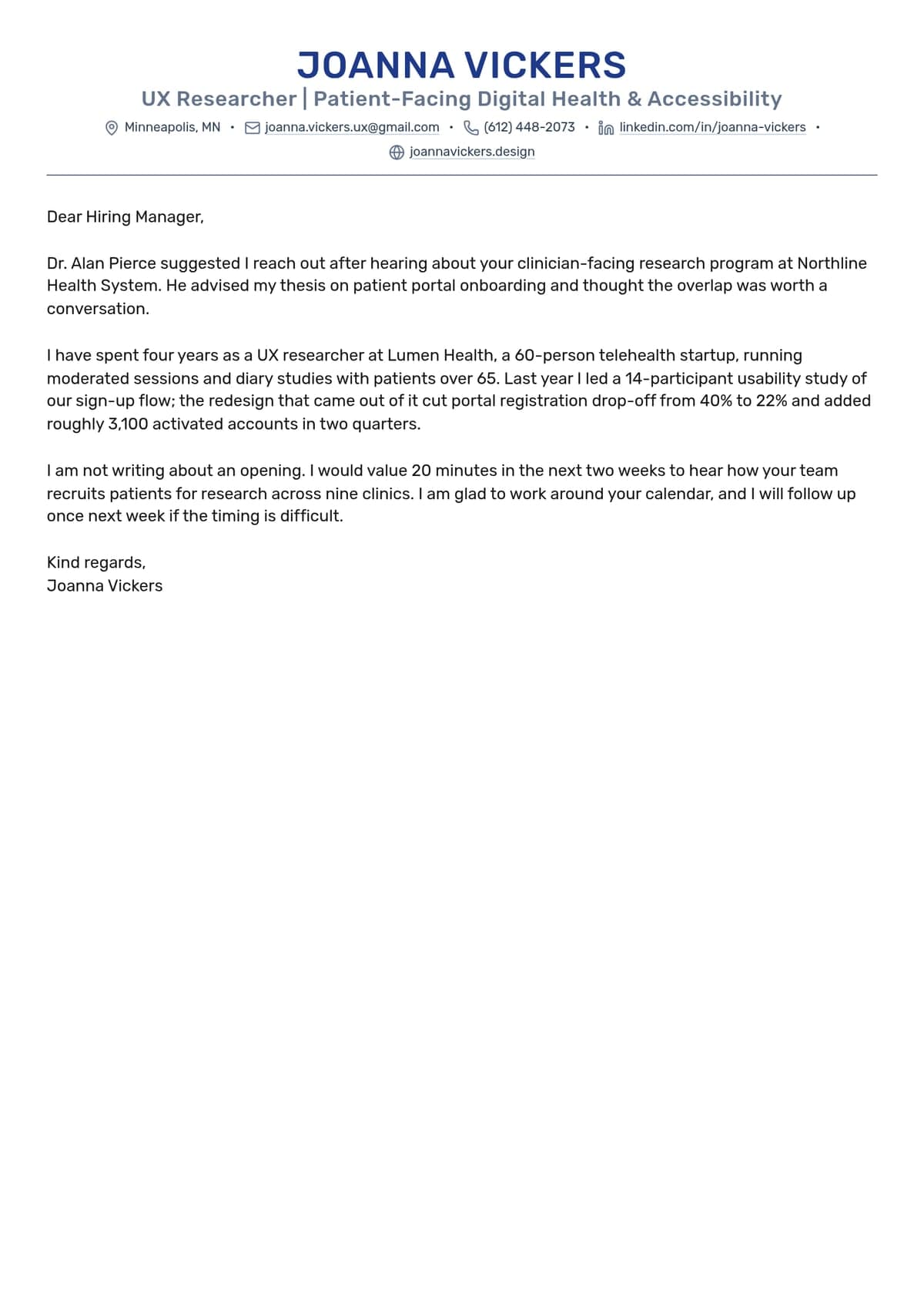
Write yours on the same template.
Every example here is built on a template you can open in the editor. Keep the structure that works and put your own story in it, or let Roleframe draft a first version from your resume and the job posting.


