Career Change Cover Letter: Example and Transferable Skills Map
by Larbi SahliLast Updated
Explain a career change with a truthful skills map and a fictional retail-to-project-coordination letter. Show relevant work without inventing metrics or authority.
Users have landed jobs at
- 1Password
- OpenAI
- Notion
- justworks
On this page
A career-change cover letter can help explain why your experience is relevant to a different role. Start with a requirement from the vacancy, find work that relates to it and describe both the connection and any difference in scope.
A small evidence map makes this easier. It should record what you actually did, the skill it may demonstrate and what you still need to learn. It should not turn an old duty into a new qualification by adding impressive numbers. If you are still choosing a direction, start with the career-change guide.
A complete career change cover letter example
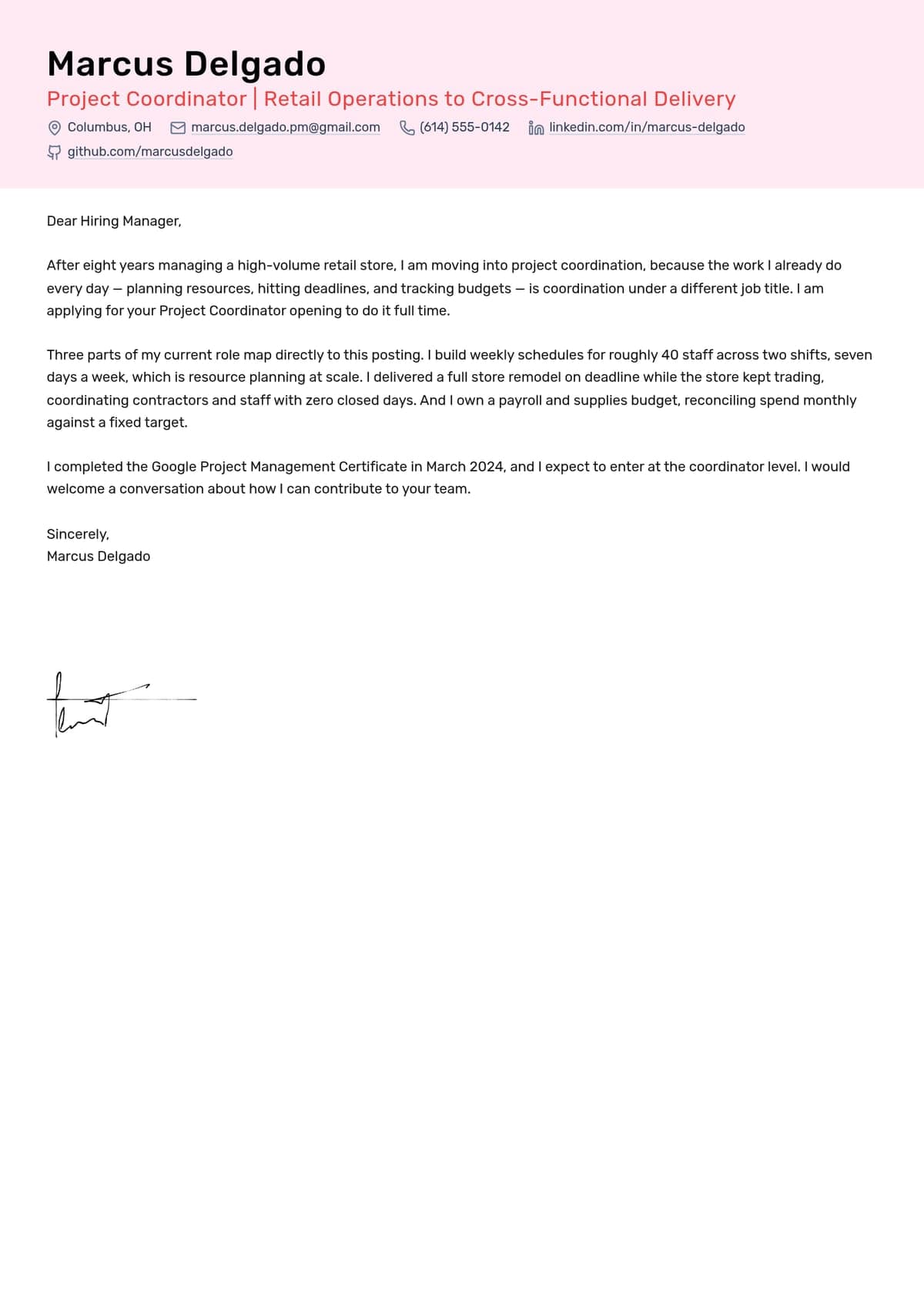
Marcus Delgado is a fictional retail manager applying to a fictional project-coordinator opening at Northline Services. The experience and employer below are teaching details. The example connects scheduling, a store refurbishment and expense checking with coordination tasks, while acknowledging that the target role has its own systems and responsibilities.
Replace all details with your own. The project coordinator resume example offers a related structure.
Marcus Delgado
Retail Manager | Project Coordination Candidate
Dear Hiring Manager,
I am applying for the Project Coordinator role at Northline Services. In retail management, the work I most want to develop is organizing shared tasks, keeping changes visible and following up with the people responsible.
I prepare our weekly staff rota, check planned absences and document agreed changes for shift leads. During a store refurbishment, I maintained the local task log and coordinated contractor arrival details with the project lead. When an access requirement changed, I updated the log and confirmed the revised arrangement with the affected teams. The project lead retained responsibility for the overall delivery plan.
I also compare supplies invoices with approved orders and refer discrepancies to finance. These tasks have given me relevant coordination and record-checking experience, while I would need to learn your team’s project systems, reporting conventions and approval process.
I am interested in the coordinator responsibilities described in the opening and would welcome a conversation about how my experience could contribute. Thank you for considering my application.
Sincerely,
Marcus Delgado

Explain the transition clearly
Name the role and explain a relevant reason for applying. You can identify the transition near the opening without forcing it into exactly two sentences.
The example focuses on coordination work Marcus wants to develop. It does not claim that a small part of retail management is the entire project-coordinator job. Use the actual vacancy to explain the connection and be candid about preparation still needed.
Give enough context to make the example understandable. A brief account of your previous work can be useful when it supports the application; you do not need to hide the original field.
Build the transferable-skills map before you write
Read the stated responsibilities and qualifications, then choose relevant examples from your record. Repetition in a posting can suggest emphasis, but it does not reveal the employer’s private scoring rules.
The map below belongs to the fictional letter. Its final column checks the boundary of the claim rather than supplying an invented performance metric.
| Actual task in the fictional example | Potential connection | Boundary to preserve |
|---|---|---|
| Prepared the staff rota and recorded agreed changes | Scheduling and keeping records current | Does not establish ownership of a cross-project resource plan. |
| Maintained a refurbishment task log and coordinated arrival details | Task tracking and communication | The project lead owned overall delivery; no on-time or budget outcome is invented. |
| Compared supplies invoices with approved orders | Checking financial records and raising discrepancies | Does not imply budget approval authority or accounting qualification. |
Use as many examples as you need to explain the fit concisely. There is no required three-row map, and a skill can be supported by a clear task description without a numerical result.
If a figure would help, confirm its definition, source and permission to share. Do not extract confidential payroll or customer data for an application without authorization. When the source is unavailable, describe the work accurately rather than inventing precision.
Turn the map into the middle paragraph
Turn the strongest connection into a short account: task, your action and what happened or what you learned. Either the task or the requirement can come first, depending on what reads clearly.
For example, “During a store refurbishment, I maintained the local task log and confirmed changed access details with the affected teams” gives useful evidence. It does not need to become “delivered a six-week project with zero disruption” unless that claim is both true and attributable.
Keep the paragraph focused, but do not treat a fixed word count as more important than explaining the responsibility accurately.
Describe preparation and credentials accurately
If you have completed relevant training or a project, explain what it involved and how it addresses a gap. Use the exact credential title, issuer and status from your record. Label work in progress and future plans as such.
A course certificate is not automatically a professional certification, and either may have requirements beyond a course. Do not imply a scheduled exam has been passed or that planned study is a current qualification.
Preparation can add evidence, but the letter does not require a purchased course. The certification placement guide covers the matching resume.

Check the responsibility level
Read the duties and reporting relationships rather than assuming that a title in one field equals a title in another. A coordinator role may differ from store management in several ways; it is not useful to describe every transition as a step down.
If relevant, state that you are applying for the advertised responsibilities and explain what attracts you. Ask for clarification where scope or expectations are unclear. You do not need to promise a lower salary or diminish prior experience to show willingness to learn.
Check for overstatement and vague claims
Review what the letter actually tells the reader. The following issues are more useful to check than a list of supposedly forbidden opening words.
- Claiming a skill without explaining a relevant task or learning experience.
- Renaming a former job or overstating authority to make it resemble the target role.
- Adding metrics, credentials or responsibilities that are absent from the source record.
- Explaining an old achievement without showing why it matters to the vacancy.
- Hiding a material qualification gap rather than describing your related experience and preparation accurately.
You can be confident and acknowledge a gap at the same time. Words such as “although” or “I haven’t used” are not inherently wrong; what matters is whether the statement is truthful and useful.
If discussing time away from paid work, share the detail you are comfortable with and keep dates accurate. The employment-gap guide offers ways to give concise context.
Three further examples of transferable evidence
These are fictional comparison exercises, not measured outcomes or claims about the most common career moves. Each shows a possible connection and a limit. A related task can support an application without establishing the whole target role.

Teacher to instructional designer
| Fictional teaching task | Possible instructional-design connection | What still needs evidence |
|---|---|---|
| Planned a sequence of lessons | Structuring learning material | The audience, learning goals and design method actually used. |
| Marked work against a provided rubric | Applying assessment criteria | Using a rubric is different from designing an assessment. |
| Helped colleagues upload course material | Supporting use of a learning platform | Uploading content does not establish system-administration access or ownership. |
Translate unfamiliar terms by explaining the task, not by substituting a more senior-sounding label. Instructional-design roles may involve audiences, tools and evaluation methods different from classroom teaching.
The teacher letter guide offers related examples, but your target vacancy determines which evidence is relevant.
Retail to HR coordinator
| Fictional retail task | Possible HR-coordination connection | Boundary to preserve |
|---|---|---|
| Arranged interview times for seasonal applicants | Scheduling and candidate communication | Did not make hiring decisions unless that authority was actually held. |
| Checked timesheets and raised queries | Record checking and payroll support | Does not prove payroll processing or use of a particular HR system. |
| Recorded an agreed coaching discussion | Accurate documentation | Does not establish employee-relations expertise; protect employee privacy. |
Hospitality to customer success
| Fictional hospitality task | Possible customer-success connection | Boundary to preserve |
|---|---|---|
| Clarified an escalated guest request | Listening and issue coordination | No invented retention rate or guarantee that the complaint was resolved. |
| Maintained contact notes for repeat bookings | Keeping customer information current | Repeat bookings are not automatically subscription renewals or account ownership. |
| Helped colleagues learn the booking process | Explaining a workflow | Training staff is different from onboarding software customers. |
Hospitality and customer-success work can share communication tasks, but commercial models and responsibilities differ. Check whether the target role owns renewals, implementation, support or something else.
The customer success resume example can help you understand presentation. Do not borrow its metrics or treat them as the facts of your earlier role.
Keep the letter and the resume telling the same story
Use one accurate source record for dates, titles, training and examples. A letter can explain one relevant story while the resume provides broader history. Both should preserve the same facts and distinguish your work from the team’s.
The career-change resume guide and objective guide offer optional structures. A summary or high skills section is useful when it clarifies evidence, not because every changer must use it.
If drafting with Roleframe or AI, compare both final documents with your notes. Shared inputs do not guarantee consistent output. A match score is a review aid, not proof that the employer will accept the transition.
Check the letter and final file
Before submitting, compare the draft with the actual vacancy and your source record.
- The role, company and reason for applying are accurate.
- Relevant examples explain your contribution and retain the original work setting.
- Numbers and credentials are supported, correctly labeled and permitted to share.
- The letter does not disguise a required qualification gap or promise authority you have not held.
- The final document follows the employer’s format and length instructions and matches the resume’s facts.
Use an accepted file format and inspect the exported text, page breaks, contact details and links. A PDF is an option, but no format guarantees identical rendering on every device or an exact match with an editor preview.
If you want to begin without an account, the free cover-letter tool guide explains that workflow. Review the result before sending it.
Frequently asked questions
- How do I explain a career change?
State the role and a truthful reason for applying, then connect relevant work or preparation with its responsibilities. Explain differences in scope and any material gaps. There is no required number of sentences, examples or metrics.
- What should I check for?
Unsupported outcomes, changed job titles, overstated authority, inaccurate credentials and examples that do not relate to the role. Acknowledging a real gap is appropriate; no word automatically disqualifies a letter.
- Should a career changer include a cover letter?
Follow the application instructions. If a letter is accepted and adds useful context, it can explain the transition. This guide does not establish that recruiters always read changers’ letters or that a letter determines the outcome.
- How should the resume support the letter?
Keep facts consistent and make relevant evidence easy to find. Preserve accurate titles, dates and project labels. The resume guide offers several presentation choices.
- How long should it be?
A concise page is a useful starting point for a conventional letter, subject to the employer’s instructions. Use enough detail to explain the connection accurately instead of meeting an arbitrary paragraph formula.
- Should I explain why I am leaving my field?
Give useful, truthful context if relevant. You can focus on what attracts you to the new work without inventing enthusiasm or concealing a material fact. You do not owe the reader every personal detail behind the decision.


Write yours on the same template.
Every example here is built on a template you can open in the editor. Keep the structure that works and put your own story in it, or let Roleframe draft a first version from your resume and the job posting.


