Career Change: A Practical Plan From Deciding to Starting
A sequenced career change plan: decide it's real, map transferable skills, test the field, budget the gap, rewrite your resume with a worked example, apply.


On this page
Job transitions are at a ten-year low, and global hiring is running about 20% below pre-pandemic levels, according to LinkedIn's Economic Graph. That is the market you would be changing careers into, and it explains why the leap-of-faith advice fails so often right now: when hiring is tight, employers take fewer chances, and a career changer is by definition a chance.
The changers who land well in this market work in a sequence. They confirm the change is real before spending money on it, test the field before quitting, budget the gap before it arrives, and rewrite their history in the new field's language before they apply. This article is that sequence, in order, including a worked example of fifteen years of teaching rewritten for a customer success role.
- Decide whether it's the career or just the job
- Work out which of your skills actually transfer
- Test the new field before you commit
- Do the money math and plan for the gap
- Rewrite your resume in the new field's language
- Talk to the right people and ask the right questions
- Apply as the least obvious candidate, deliberately
- Plan your first ninety days in the new field
Step 1: Decide whether it's the career or just the job
The most expensive career change is the one you didn't need. A surprising share of people who feel done with their career are actually done with a manager, a commute, a pay ceiling at one company, or a team that burned them out. All of those are job problems. They follow a much cheaper fix: a new employer in the same field, where your experience counts at full value instead of a discount.
Here is the test I give people. Imagine the best realistic version of your current career: a good company, a decent manager, a promotion, market pay. If that version still makes you flinch, the problem is the work itself and the change is real. If that version sounds fine, you need a job search, not a career change.
A few signals point specifically at the career rather than the job. You dread the core task even on good days, not just the meetings around it. You stopped being curious about the field years ago and read nothing about it voluntarily. The field's trajectory worries you more each year, and the people ten years ahead of you on the same path don't have lives you want. One or two of these can be a rough patch. All four is a verdict.
There is also a cheap way to test it: interview for a better job in your current field first. If two rounds in you feel relief at the thought of getting it, you found your answer for the price of a few conversations. If you feel dread at the thought of winning, that dread is data.
Step 2: Work out which of your skills actually transfer
This step matters more than most changers expect, because it is exactly what employers evaluate. Per People Matters Global research, 85% of surveyed hiring managers say they assess career changers primarily on skills and readiness rather than direct experience in the same role. Your task is to figure out, with evidence, what you are actually bringing.
Skip the online quizzes and go to the source: real job postings. Collect ten postings for the role you are targeting and build a simple spreadsheet. One row per requirement the postings mention, one column each for: have it, with proof (you have done this and can point to a result), have it, unnamed (you have done this but your field calls it something else), and genuinely missing. The guide on pulling resume keywords from a job description walks through extracting requirements this way.
The middle column is where career changes are won. A teacher who "rolled out the district's learning management system" has run a software adoption project. A restaurant general manager who "handled scheduling and inventory" has done workforce planning and supply management. The skill transfers; the vocabulary doesn't. Most changers undersell themselves because they audit their job titles instead of their actual work.
Be equally honest about the third column. Every target role has two or three requirements you cannot talk your way around: a tool, a certification, a body of knowledge. Naming them now turns Step 3 from vague exploration into a shopping list.
Step 3: Test the new field before you commit
Never quit to find out if you like a field. Testing is cheap; committing is not. Run the tests in order of increasing cost, and stop the moment one of them tells you no.
- Consume the field's actual work product for two weeks: its trade publications, its practitioner forums, the conference talks. If the day-to-day details bore you, the job will too.
- Do one real deliverable on a weekend. A would-be data analyst cleans and charts a public dataset. A would-be UX writer rewrites a bad onboarding flow. You learn more from four hours of the actual work than forty hours of reading about it.
- Take a short, credible course or certification in the field's core tool, and finish it. Quitting halfway is also information.
- Do the work for a real stakeholder: a freelance project, a volunteer engagement, a nonprofit that needs exactly this skill. This produces your first portfolio piece and your first reference in the field.
- Try to do a slice of the new work inside your current job. Internal moves are the lowest-risk career change that exists, because your context and reputation come with you.
The data says this evidence-building works. Per People Matters Global, 86% of surveyed hiring managers value relevant work experience over formal education, and 82% consider certifications potentially as valuable as a bachelor's degree. You do not need to go back to school to change careers. You need proof you can do the work, and a certificate plus a portfolio piece is proof.
One more test worth running in 2026: check whether AI fluency shortens your path. LinkedIn's Economic Graph reports that U.S. jobs requiring AI-literacy skills grew 70% year over year, and that more than 1.3 million AI-enabled jobs emerged globally over the past two years, many of them "new-collar" roles combining technical capability with domain knowledge. Those roles are unusually friendly to changers, because nobody has fifteen years of experience in them. Your domain knowledge plus demonstrable AI fluency can beat a specialist with neither.
Step 4: The money question, and how long the gap usually lasts
Plan for the transition to take longer than you want it to. The current market is slow even for same-field moves: U.S. hiring rose 1.9% in August 2026 but remained 6.5% below the prior year, per LinkedIn's Economic Graph, and LinkedIn attributes the broader slowdown across advanced economies to economic uncertainty rather than AI displacement. A career changer competes in that market with a built-in handicap, so budget for a search measured in months, not weeks, and longer the further you are moving from your current field.
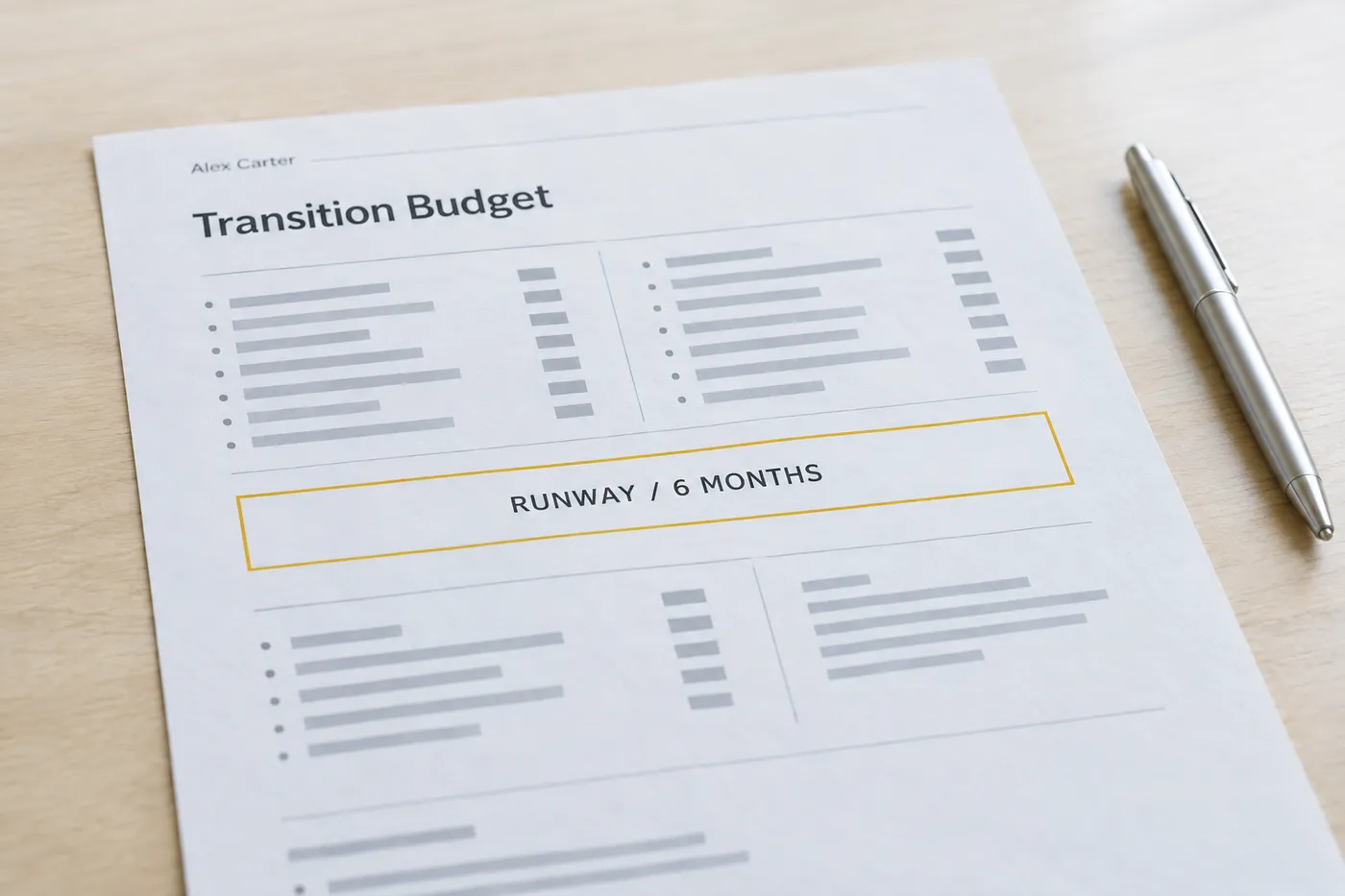
The math itself is simple. Add up your true monthly costs, multiply by the number of months you want to survive without panic, add the cost of any course or certification from Step 3, and add a buffer for the possibility that your first role in the new field pays less than your last role in the old one. That last part deserves a plain statement: a full career change often means a partial salary reset, because you are junior in the new thing even though you are senior as a professional. Adjacent moves reset less; distant moves reset more.
Then shorten the gap with structure instead of hope:
- Change careers while employed if you possibly can. A paycheck removes the desperation that shows in interviews, and an employed candidate reads as lower-risk.
- Consider a bridge role: same function in the new industry, or new function in your current industry. A teacher moving to edtech customer success changes industry-adjacent, not everything at once. Two half-steps often beat one leap.
- Look hard at internal transfers. Your current employer already trusts you, which is exactly the thing a career changer lacks everywhere else.
- Set a checkpoint, not just a budget. Decide in advance what three or six months of no traction means: adjust the target role, add a credential, or take a bridge role. A plan with checkpoints survives contact with a slow market. A plan built on willpower doesn't.
Step 5: Rewrite fifteen years of one career for a different one
Your resume is where the career change becomes real to a stranger, and it is where most changes die. A recruiter scanning for a customer success manager does not see "fifteen years of teaching" as fifteen years of stakeholder management, adoption work, and outcome delivery. They see a teacher. The rewrite's job is to close that gap before the recruiter has to do any imagining, and the full method lives in our guide to writing a career change resume. Here is the core of it, with a worked example.
The translation method
The rule is: same facts, new vocabulary. You are not inventing anything. You are re-describing work you genuinely did, using the terms the new field uses for it, with the numbers that field cares about. Your Step 2 spreadsheet already contains the dictionary: every requirement in the "have it, unnamed" column is a bullet waiting to be translated.
The mechanics matter because software reads your resume before a person does. Per People Matters Global, 71% of surveyed hiring managers use an applicant tracking system (ATS), 79% of companies have automated at least part of hiring, and 19% of hiring managers use AI to screen out applications before any human review. If your bullets say "parent-teacher conferences" and the posting says "stakeholder management," a keyword filter scores you as missing a skill you have used weekly for fifteen years. Match the posting's terminology exactly where it is honest to do so.
Worked example: a teacher's bullets, rewritten for customer success
The candidate: fifteen years as a high school English teacher, the last seven as department chair, targeting a customer success manager role at an education software company. (For what the target document looks like in full, see our customer success manager resume example.) Every bullet below describes the same underlying work; only the framing changes.
| Original teacher bullet | Rewritten for customer success | What changed |
|---|---|---|
| Taught English to five sections of about 30 students per semester | Managed outcomes for a portfolio of ~150 students per term across five concurrent groups, adapting delivery to widely different starting points | Class size becomes portfolio scope. "Taught" becomes "managed outcomes," which is the job a CSM is hired to do. |
| Served as English department chair (2018–present) | Led a team of 8 educators as department chair: ran weekly planning meetings, set curriculum priorities, and onboarded 6 new hires over 7 years | A bare title becomes evidence of team leadership and onboarding, both of which appear by name in CSM postings. |
| Held parent-teacher conferences each semester | Ran 60+ progress reviews per year with parents, many opening from a point of frustration; resolved nearly all concerns without escalation to administration | A routine duty becomes stakeholder management and de-escalation, with volume attached. |
| Helped roll out the district's new learning management system | Drove adoption of a new LMS across a 40-teacher school: built the training materials, ran the sessions, and reached daily active use department-wide within one semester | This is a software adoption story, the core CSM metric, told with a scope and a timeline. |
| Improved AP exam pass rates | Raised AP pass rates from 61% to 78% over three years by redesigning the course around weekly progress checkpoints | A vague improvement becomes a baseline, a result, and a method: the exact shape of a renewal-driving outcome. |
Two rules keep this honest. Every number must be true and checkable, because you will be asked about each one in the interview, and a claim you cannot defend costs more than a thin bullet ever would. And the translation must not stretch: "drove adoption" is fair for someone who built the training and ran the rollout; it is not fair for someone who attended the training. The test for every rewritten bullet is whether you could talk about it for three minutes without flinching.
Restructure the page, not just the bullets
A career changer's resume leads differently. Open with a three-line summary that names the change and the evidence in the same breath; our guide to the career change resume objective shows the pattern. Put a skills section above your experience, populated from the postings' own language, so the reader sees the match before they see the unfamiliar job titles. Experience follows, translated as above. The reasoning behind this order is covered in the best resume section order for your experience level: an experienced same-field hire leads with experience, a changer leads with the skills argument.
This is one place a tool honestly helps. In Roleframe, you paste the posting and get a fit report: an ATS score against that specific job, the exact keywords the posting asks for that your resume is missing, and a prioritized plan of what to rewrite. You make the edits yourself, with Remi, its career copilot, proposing rewrites bullet by bullet that you approve or discard. For a changer, that missing-keywords list is effectively your translation dictionary, generated per job. Export as PDF when you're done; it parses cleanly and the formatting holds.
Step 6: Who to talk to, and what to ask them
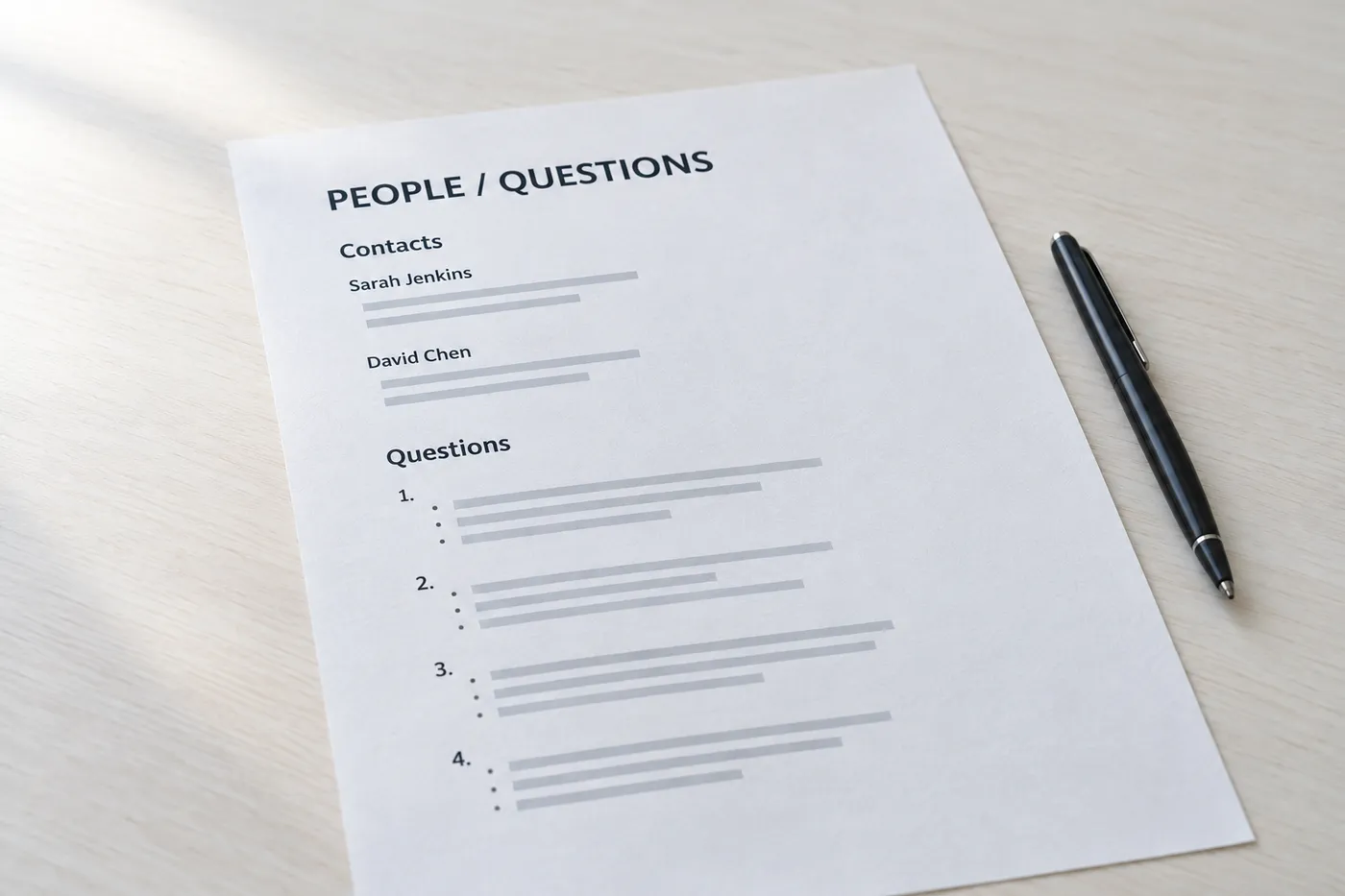
Three types of people can save you months, and they answer different questions. Do these conversations before you apply anywhere, not after the rejections start.
Someone who made your exact switch. Find people on LinkedIn whose profile shows your old field followed by your new one. They are usually generous with changers, because someone once helped them. Ask: What was your actual sequence, and what would you skip if you did it again? What did employers push back on, and what answer worked? What did the change cost you in pay, and how long did it take to recover?
Someone doing the target job right now. Their value is ground truth about the work. Ask: Walk me through yesterday, hour by hour. What separates the good people in this role from the mediocre ones? What do people from the outside consistently get wrong about this job? If the honest answers put you off, that is the cheapest failed career change you will ever have.
Someone who hires for the role. A recruiter or hiring manager in the field can calibrate your plan against reality. Ask: When you have hired a career changer, what convinced you? Which credentials actually move you, and which are noise? If my resume landed on your desk today, what would stop you? Do not ask for a job in these conversations. Ask for calibration, and the job leads follow on their own.
Step 7: Applying when you are the least obvious candidate
Accept the premise: for any given posting, someone with direct experience applied too. Your job is to pick the battlefields where that matters least and to remove every removable reason to filter you out.
Pick postings and companies that favor changers. Smaller companies weigh a strong conversation more heavily than a keyword match, because a human reads the applications. Postings written around skills and outcomes rather than "5+ years in an identical role" signal a team open to non-obvious candidates. Best of all are companies where your old field is the customer: a teacher applying to edtech, a nurse applying to a health-tech company, a chef applying to a restaurant-software firm. There, your "wrong" background is domain expertise the obvious candidates lack.
Make the cover letter do real work. For a same-field candidate the cover letter is optional. For you it is the document that pre-empts the recruiter's first objection. Name the change in the first sentence, then spend one paragraph on your single strongest proof point, like the LMS adoption story from the table above. No apology, no life story.
Get a human to carry you past the filter. Referrals matter more for changers than for anyone else, because a referral is a person vouching for exactly the thing your resume cannot prove. The Step 6 conversations are where referrals come from.
Prepare interview stories that translate. Every behavioral question can be answered from your old career if you frame the story in the new field's terms. Build five or six of them in advance using the STAR method, each mapped to a competency from the postings. The interviewer's unspoken question is always "will this person's experience actually carry over?" Every story you tell either answers it or doesn't.
And tailor every single application. A changer sending a generic resume is asking an already-skeptical filter to do imaginative work on their behalf. It won't.
Step 8: The first ninety days in the new field
The offer is not the finish line. Your first ninety days determine whether the change sticks, and they reward a different posture than the one that made you senior in your old field.
Days 1 to 30: learn the vocabulary and the systems. Your instincts are fifteen years old; your context is three weeks old. Write down every term, tool, and acronym you don't know and clear the list weekly. Ask the questions now, while "I'm new to the field" is a free pass. In month four the same questions cost you credibility.
Days 30 to 60: own one deliverable end to end. Pick something small enough to finish and visible enough to matter, and over-communicate progress while you do it. Your manager took a risk hiring a changer; early, visible follow-through is how you retire that risk. Agree explicitly with your manager on what "good at 90 days" looks like, in writing, so you are both measuring the same thing.
Days 60 to 90: land the translator win. Find the problem where your old career gives you an edge the lifers don't have: the ex-teacher CSM who rebuilds the training program, the ex-nurse product analyst who catches the workflow assumption everyone else missed. This is the moment your background flips from a gap to your differentiator, and it sets the trajectory for everything after.
One last thing: don't hide where you came from. The changers who thrive treat the old career as an asset to deploy. The ones who struggle spend their energy passing as lifelong members of the new field, which wastes the one advantage they walked in with.
Frequently asked questions
- What is the best career to switch to?
The best career to switch to is the one adjacent to what you already do, because adjacency shortens the search and softens the pay reset. Per People Matters Global, 85% of surveyed hiring managers assess career changers on skills and readiness rather than identical experience, so fields where your current skills map closely give you the strongest hand. If you want a growth signal, LinkedIn's Economic Graph reports more than 1.3 million AI-enabled jobs emerged globally over the past two years, and those "new-collar" roles reward domain knowledge plus AI fluency, which favors changers over specialists.
- What are the signs it's time to change careers, not just jobs?
Run the best-case test: picture your current career at its realistic best, with a good company, a good manager, and market pay. If that still repels you, the career is the problem. Supporting signs include dreading the core work rather than the circumstances around it, having lost all voluntary curiosity about the field, and not wanting the lives of the people ten years ahead of you on the same path. If your complaints are about one boss, one commute, or one company's pay, change jobs first; it's far cheaper.
- How long does a career change take?
Longer than a same-field job search, and the further you move, the longer it runs. The market is also slow right now: U.S. hiring in August 2026 was 6.5% below the prior year per LinkedIn's Economic Graph, and job transitions are at a ten-year low. Plan your savings around a search measured in months, ideally change while still employed, and set checkpoints in advance so a slow stretch triggers an adjustment, like adding a credential or taking a bridge role, instead of panic.
- Can I change careers at 40 or 50?
Yes, and the data is more on your side than the anxiety suggests. Per People Matters Global, 86% of surveyed hiring managers value relevant work experience over formal education, and 82% consider certifications potentially as valuable as a bachelor's degree, so a mid-career changer with translated experience and one targeted credential competes well. Your advantage at 40 is a deep evidence base: two decades of stakeholder management, delivery, and judgment that a younger candidate in the new field simply doesn't have. The work is translation, not reinvention.
- How do I change careers with no experience in the new field?
Build evidence instead of waiting for permission. Do one real deliverable in the field, earn a short credible certification, and complete a project for a real stakeholder, even a volunteer one. That gives you a portfolio piece, a reference, and proof of readiness, which is what 85% of surveyed hiring managers say they actually assess in career changers (People Matters Global). Then target companies where your old field is the customer, so your background reads as domain expertise rather than a gap.
- How can I make $10,000 a month without a degree?
No career path guarantees a specific income, and be wary of anyone selling one that does. That said, high earnings without a degree are real in commission-based sales, skilled trades, and running your own business, and all three pay for demonstrated skill rather than credentials. The trend supports skills-based paths generally: 86% of surveyed hiring managers value relevant experience over formal education per People Matters Global. Expect any of these routes to take years of deliberate skill-building, not months.
- What jobs will still exist after 2030?
Nobody can name the list with confidence, and the current data argues against panic: LinkedIn's Economic Graph attributes today's hiring slowdown primarily to economic uncertainty and monetary policy, not AI displacement. What the data does show is where growth is going: U.S. jobs requiring AI-literacy skills grew 70% year over year. The durable bet is a role that combines domain judgment, human skills like stakeholder management, and fluency with the field's tools including AI. Chase that combination rather than trying to predict a job title.

Ready to start your new resume?
Writing a resume takes time, and even a polished one can miss what a hiring manager is looking for. Roleframe helps you build a clear, ATS-safe resume in minutes and tailor it to the job you want.


