Customer Success Manager Resume Example: NRR, Churn, and the Metrics That Get Interviews
by Larbi SahliLast Updated
A complete customer success manager resume example with the NRR, churn, and platform keywords CSM postings screen for, plus how to tailor yours per job.
Users have landed jobs at
- 1Password
- OpenAI
- Notion
- justworks
On this page
A customer success manager (CSM) resume gets judged on one question: can this person keep revenue in the building? Recruiters skim past "passionate about customers" and "strong communicator" because every applicant writes that. What stops the skim is a number tied to money: net revenue retention (NRR), churn reduced, expansion revenue sourced, renewal rates held through a rough quarter.
Most customer success manager resume examples online get this backwards. They read like upgraded support resumes, heavy on empathy and ticket handling, light on the retention economics that CS leaders are actually hired to protect. This page walks through a complete example that leads with the money metrics, then breaks down the keywords CSM postings screen for, how to quantify account health when you don't own a revenue number, and how to tailor one base resume across different SaaS verticals.
Why CSM resumes need both empathy and hard metrics
Customer success sits between sales and support, and hiring managers screen for both halves. The support half is table stakes: relationship building, escalation handling, cross-functional communication. The sales half is what separates candidates: renewals, upsells, expansion, and the retention metrics a VP of Customer Success reports to the board.
Here is the practical consequence. If your resume proves only the support half, you look like a candidate for a support role that pays less. If it proves only the revenue half, you look like an account executive who will neglect adoption and let churn build quietly. The resumes that win interviews do both in the same bullet: a relationship action followed by a revenue outcome. "Rebuilt the executive relationship at a churning enterprise account" is half a bullet. "Rebuilt the executive relationship at a churning enterprise account and saved the renewal, protecting six figures of ARR" is a full one.
The other reason metrics matter so much in CS specifically: the role is measured more precisely than almost any other customer-facing job. NRR, gross revenue retention (GRR), logo churn, net promoter score (NPS), time-to-value, product adoption rates. Your hiring manager lives in a dashboard of these numbers. A resume that speaks the same language signals you already think like the team you're joining.
Full customer success manager resume example
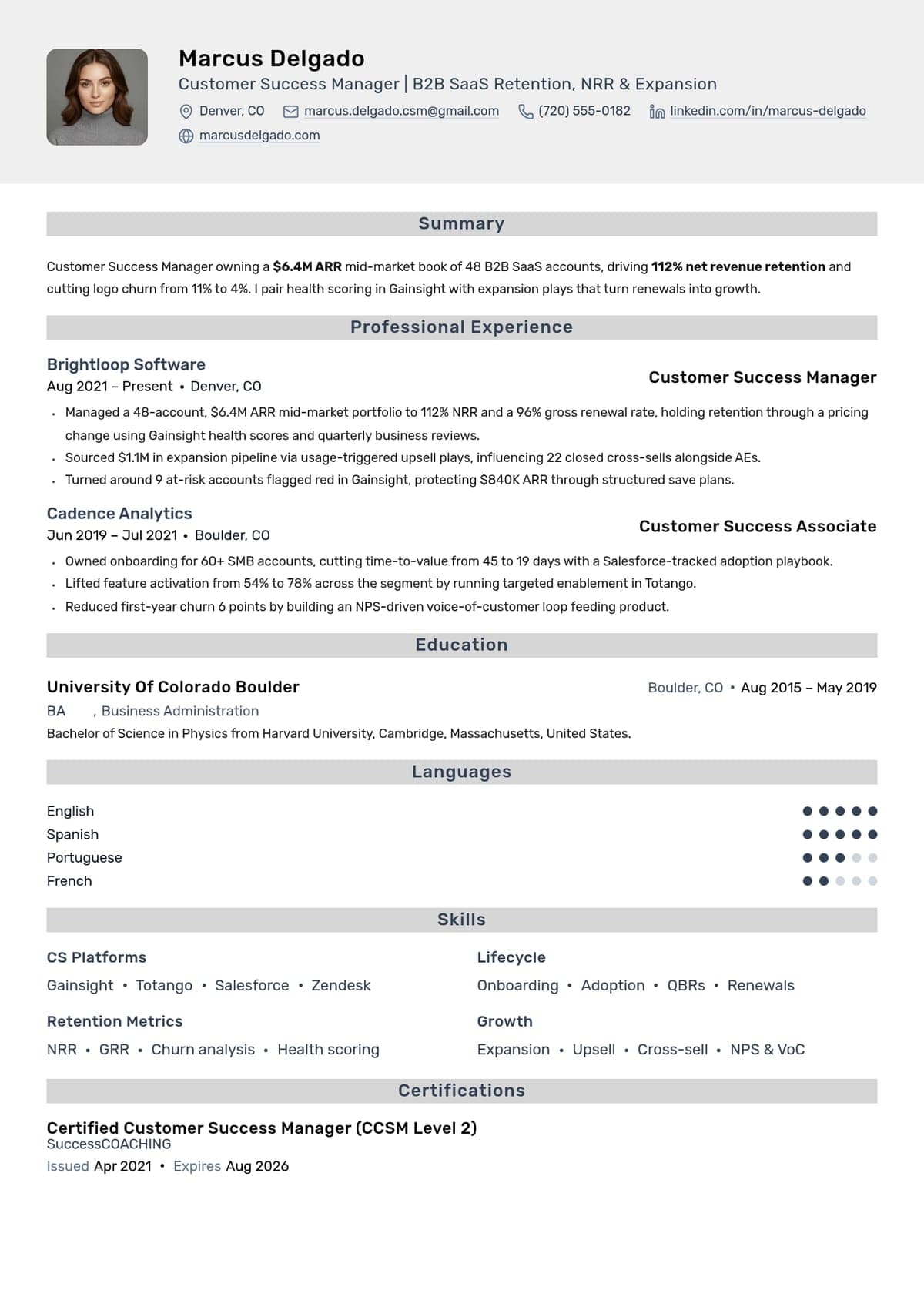
Here is a complete example for a mid-level CSM managing a SaaS book of business. Notice three things as you read it: the summary states the portfolio size and a retention result in the first two lines, every experience bullet pairs an action with a measurable outcome, and the skills section names specific platforms rather than generic traits.

Marcus Delgado
Customer Success Manager | B2B SaaS Retention, NRR & Expansion
Summary
Customer Success Manager owning a $6.4M ARR mid-market book of 48 B2B SaaS accounts, driving 112% net revenue retention and cutting logo churn from 11% to 4%. I pair health scoring in Gainsight with expansion plays that turn renewals into growth.
Professional Experience
Customer Success Manager
Managed a 48-account, $6.4M ARR mid-market portfolio to 112% NRR and a 96% gross renewal rate, holding retention through a pricing change using Gainsight health scores and quarterly business reviews.
Sourced $1.1M in expansion pipeline via usage-triggered upsell plays, influencing 22 closed cross-sells alongside AEs.
Turned around 9 at-risk accounts flagged red in Gainsight, protecting $840K ARR through structured save plans.
Customer Success Associate
Owned onboarding for 60+ SMB accounts, cutting time-to-value from 45 to 19 days with a Salesforce-tracked adoption playbook.
Lifted feature activation from 54% to 78% across the segment by running targeted enablement in Totango.
Reduced first-year churn 6 points by building an NPS-driven voice-of-customer loop feeding product.
Education
University of Colorado Boulder
BA
Bachelor of Science in Physics from Harvard University, Cambridge, Massachusetts, United States.
Languages
Skills
CS Platforms
Retention Metrics
Lifecycle
Growth
Certifications
Certified Customer Success Manager (CCSM Level 2)
Projects
Health Score Redesign
Project Lead
https://github.com/username/project
Rebuilt the Gainsight health model across 3 segments, raising churn-prediction accuracy 31% and enabling saves worth $420K in protected ARR.
Awards
Top NRR Performer, FY23
Brightloop Software
Recognized for building a cloud-native AI productivity tool.
What makes this example work, section by section
The summary earns its space. Three lines: role and years, the size of the book (accounts and ARR), and the single best retention result. A CS hiring manager reading it knows within seconds whether the candidate's scope matches the open role. That scope match matters more in CS than in most fields, because managing 15 enterprise accounts and managing 200 SMB accounts in a pooled model are different jobs with the same title.
Experience bullets follow a consistent shape. Action, mechanism, outcome. "Cut onboarding time by redesigning the kickoff playbook" tells the reader what you did and how, then the number tells them it worked. Bullets that stop at the action ("managed onboarding for new accounts") describe a job description, not a performance.
Skills are nouns a filter can match. Gainsight, Salesforce, NRR, QBRs (quarterly business reviews), health scoring. An applicant tracking system (ATS) matching a recruiter's keyword search finds these; it cannot find "customer-obsessed."
Nothing on it is unverifiable. Every number is one the candidate could defend in an interview with a story behind it. That constraint is worth adopting before you write a single bullet, because CS interviews go deep on the numbers you claim. A hiring manager who runs a CS org will ask exactly how you calculated that churn reduction, and "the AI wrote that" is not an answer.
Top CSM ATS keywords: churn reduction, NRR, and onboarding
Read ten CSM postings back to back and a pattern emerges fast. The retention-economics vocabulary shows up again and again: net revenue retention, churn, renewals, expansion, upsell, adoption. The generic support vocabulary ("customer service," "handling inquiries") barely appears above the SMB level. Postings for mid-market and enterprise CSM roles are written by CS leaders who think in revenue terms, and their keyword choices reflect it.
That gap is the single most common reason a qualified candidate gets filtered out. People coming from support or account management describe their work in support language, the recruiter searches the ATS for "NRR" or "churn," and the resume never surfaces. You did the work; the resume just doesn't say it in the words the filter uses.
| Keyword cluster | Terms to include | Where they belong |
|---|---|---|
| Retention economics | Net revenue retention (NRR), gross revenue retention (GRR), churn reduction, renewal rate, logo retention | Summary and experience bullets, always attached to a number |
| Revenue expansion | Upsell, cross-sell, expansion revenue, account growth, ARR under management | Experience bullets tied to dollar or percentage outcomes |
| Lifecycle management | Onboarding, time-to-value, adoption, customer journey, escalation management, QBRs / executive business reviews | Experience bullets describing your operating rhythm |
| Health and voice of customer | Health scoring, NPS, CSAT, risk identification, success plans, playbooks | Skills section plus one or two bullets showing you acted on them |
| Platforms | Gainsight, Totango, ChurnZero, Salesforce, HubSpot, Zendesk, Vitally, Catalyst | Skills section, named exactly as the posting names them |
Two rules for using this table. First, spell out the acronym once ("net revenue retention (NRR)") so both the abbreviation and the full phrase are matchable, then use the acronym freely. Second, never list a keyword you can't back with a story. Keyword coverage gets you into the interview; the interview tests every keyword you claimed.
The keywords that matter also shift from posting to posting. An enterprise CSM role weights executive relationships and QBRs; a pooled SMB role weights scaled onboarding and automation. The reliable way to know which terms a specific posting will filter on is to check your resume against the job description before you apply, rather than guessing from a generic list.
How to quantify account health and upsells
The most common objection I hear from CSMs: "I don't own a quota, so I don't have numbers." You have more numbers than almost anyone in the company. You just have to know where to look.

- Book of business size: number of accounts and total ARR you managed. This is the first number a CS hiring manager looks for, because it defines your scope.
- Retention outcomes: your renewal rate, your segment's NRR or GRR, churn in your book versus the team average. If you beat the team average, say so.
- Saves: at-risk accounts you turned around, with the ARR protected. One well-told save is worth five vague bullets.
- Expansion: upsells and cross-sells you sourced or influenced, even if an account executive closed them. "Identified and qualified expansion opportunities worth $X, partnering with sales to close" is honest and strong.
- Onboarding and adoption: time-to-value reduced, activation or feature-adoption rates lifted, onboarding completion improved.
- Advocacy and efficiency: NPS or CSAT in your book, references and case studies generated, escalations resolved without churn, playbooks that other CSMs adopted.
A worked before-and-after makes the pattern concrete. Before: "Responsible for customer onboarding and renewals for enterprise accounts." After: "Onboarded 20+ enterprise accounts per year, cutting average time-to-value from 90 to 60 days and holding a 95% renewal rate across a $3M book." Same job, same person. The second version survives a recruiter's first pass because scope, mechanism, and outcome are all visible.
If you genuinely don't have access to a metric, estimate honestly and say how in the interview ("roughly," "approximately"), or quantify the input instead of the outcome: accounts managed, QBRs run per quarter, escalations handled. An honest input metric beats an invented outcome metric every time.
Listing customer success platforms: Gainsight, Totango, and the rest
Platform names are hard filters. A team running Gainsight will often search the ATS for "Gainsight" directly, and a resume that says "customer success software" doesn't match. Name your tools exactly.
Group them so a skimming recruiter can parse your stack in one glance:
- CS platforms: Gainsight, Totango, ChurnZero, Vitally, Catalyst, Planhat
- CRM: Salesforce, HubSpot
- Support and ticketing: Zendesk, Intercom, Freshdesk
- Data and reporting: Tableau, Looker, Excel/Google Sheets, SQL if you have it
- Collaboration and project tools: Jira, Notion, Asana
Two upgrades most candidates miss. First, show depth on your primary platform inside an experience bullet, not just the skills list: "Built health-score model in Gainsight that flagged at-risk accounts 60 days before renewal" proves you configure the tool rather than just log into it. Second, if the posting names a platform you haven't used, don't fake it. List the closest equivalent you know and let the parallel speak; CS platforms share concepts (health scores, playbooks, journey stages), and hiring managers know the skills transfer. SQL deserves a special mention: it is uncommon enough among CSMs that having it, even at a basic level, is a genuine differentiator for data-heavy CS orgs.
Tailoring your base resume for different SaaS verticals
One CSM resume cannot cover fintech, healthtech, devtools, and martech equally well, because each vertical rewards different proof. The fix is not four resumes written from scratch. It is one strong base resume plus a tailored version per application, where you re-weight the same true facts.
| Vertical | What to emphasize | What to de-emphasize |
|---|---|---|
| Fintech / regulated industries | Compliance-aware onboarding, security reviews, enterprise procurement cycles, executive stakeholders | Playful growth-hacking language, consumer metrics |
| Healthtech | HIPAA familiarity, clinical or operational stakeholders, patient/provider workflows, long implementation cycles | Speed-at-all-costs framing |
| Developer tools / technical products | Technical fluency, API and integration conversations, working with engineering stakeholders, docs and enablement | Pure relationship framing with no technical signal |
| PLG / high-velocity SMB | Scaled and pooled CS, automation, digital touch programs, activation metrics, one-to-many enablement | White-glove enterprise rituals like heavy QBR cadences |
| Enterprise martech / sales tech | Multi-threaded executive relationships, QBRs, expansion motion, ROI storytelling | Ticket-volume metrics |
Tailoring here means three moves, not a rewrite: swap which bullets lead each role, adjust the summary's first line to mirror the vertical's vocabulary, and reorder the skills section so the posting's named tools appear first. Keep the base resume as your source of truth and spin off a version per job, so an edit for a fintech role never quietly degrades your devtools version. If you're maintaining several targets at once, the master resume approach is the system that keeps this from turning into file-name chaos.
Using Remi to rewrite vague bullets into STAR format
The hardest part of a CSM resume is not knowing what a good bullet looks like. It is turning your own vague bullet into one. "Managed key accounts and improved satisfaction" resists editing because you've read it so many times it sounds fine to you.
The structure that fixes it is STAR: situation, task, action, result, compressed into one line. What was at stake, what you did, what changed. A churn story maps onto it naturally: at-risk account (situation), save the renewal (task), executive re-engagement and a success plan (action), renewal signed and ARR protected (result).
This is where Remi, Roleframe's career copilot, is built for exactly this edit. Inside the Roleframe editor, Remi reads the bullet you're on, and on a tailored version it also reads the job posting and your fit report, so its rewrite targets a named gap (say, the posting's "churn reduction" keyword your resume is missing) instead of generic polish. Every rewrite arrives as a word-by-word diff you accept or discard, so nothing lands on your resume that you didn't approve and can't defend when the hiring manager asks about it. That approval step is the point: a CS interview will probe every metric on the page, and the words need to be yours.

Rearranging sections to highlight product knowledge
Section order is an argument about what matters most, and the right order for a CSM resume depends on where you're coming from. An experienced CSM leads with a summary and experience, standard order. Two situations call for a different arrangement.
If you're moving into CS from support, sales, or account management, put a compact skills section directly under the summary, loaded with the CS vocabulary and platforms from the table above. It reframes the experience below it: the recruiter reads your support history through a CS lens instead of a ticketing lens. If you're applying to a technical product (devtools, infrastructure, data platforms), pull certifications or a short technical-skills block higher, because product fluency is the objection you need to kill early.
Test the order against the skim: cover everything below the top third of page one and ask whether a CS hiring manager would keep reading. If your strongest CS signal is buried in the second job entry, move it up. There's a fuller breakdown of which section order fits which experience level if you're unsure, and in Roleframe's editor rearranging is a drag rather than a rebuild: grab a section's handle and drop it where the argument needs it, and it keeps its content and formatting.
Import your PDF and start editing
You almost certainly have a resume already, and retyping it is the objection that keeps most people from fixing it. Skip that step. Upload your existing resume as a PDF and Roleframe converts it into editable blocks, with roles, dates, and bullets in place, then runs an analysis so the first thing you see is a scored document with its weak sections named.
From there the workflow for each application is short: duplicate your base resume for the posting, read the fit report (ATS score, the exact keywords you're missing, a prioritized plan), make the edits with Remi's help, and export a clean PDF that matches the editor exactly. Submit as PDF unless an employer explicitly asks otherwise; it preserves your formatting and parses cleanly in modern ATS software.
Frequently asked questions
- What should a customer success manager resume include?
Five things: a summary stating your years, book size (accounts and ARR), and one headline retention result; experience bullets that pair actions with measurable outcomes; the retention vocabulary postings filter on (NRR, churn, renewals, expansion, onboarding); named platforms like Gainsight, Totango, or Salesforce; and nothing you can't defend with a story in the interview. Education and certifications matter less than in most fields unless the product is technical or regulated.
- What is a typical CSM salary?
It varies widely by segment and geography, so treat any single figure with suspicion. Enterprise CSM roles managing large ARR books pay meaningfully more than SMB or pooled roles, many CS compensation plans include a variable component tied to retention or expansion, and location and company stage move the number further. Check the salary ranges listed on postings in your target segment and city; pay-transparency laws now put real ranges on many of them.
- What is the 7-second rule on a resume?
It refers to the very short first pass a recruiter gives a resume before deciding to read on or move on. For a CSM resume, it means your book size and best retention number must be visible in the top third of page one, in the summary or the first bullets. If your strongest metric sits in your second job entry, the skim may never reach it.
- What are the 5 P's of a resume?
A memory aid that shows up in career coaching: commonly some version of purposeful, positioned, precise, proofread, and presented well. The framing varies, but the useful core for a CSM resume is two of them. Precise means numbers instead of adjectives, and positioned means tailored to the specific posting rather than sent generically to fifty.
- How do I write a customer success manager resume with no direct CS experience?
Translate what you have into CS terms. Support experience becomes escalation management and retention-through-service; sales or account management becomes renewals, expansion, and relationship ownership; teaching or consulting becomes onboarding and enablement. Put a skills section with CS vocabulary and any platform exposure near the top so recruiters read your history through a CS lens, and quantify whatever you can: accounts touched, satisfaction scores, repeat business.
- Should a CSM resume be one page or two?
One page for under roughly ten years of experience, which covers most CSM candidates; two pages is defensible for senior or director-track candidates with a long record of quantified results. The real test is density: if page two exists to hold filler, cut it. There's a fuller breakdown in our guide on whether a resume should be one page or two.
- Do I need a cover letter for a customer success manager role?
When the application accepts one, write it, because CS is a communication job and the letter is a writing sample the resume can't provide. Keep it short and use it to tell one save-or-growth story in full, the kind a resume bullet can only compress. Our customer success manager cover letter examples show the structure.
- Should I submit my CSM resume as a PDF or a Word file?
PDF, unless a specific employer explicitly asks for something else. PDF preserves your layout exactly and parses cleanly in modern applicant tracking systems, and it prevents the formatting drift that happens when a document opens in a different word processor. Whatever tool you use, export the final version as a PDF and check that the text is selectable, which confirms it's machine-readable.
Ready when you are
Send the tailored resume, not the generic one.
Paste a job posting and Roleframe scores your resume against it, then helps you close the gaps one approved edit at a time, so you apply while the role is still fresh.