Software Developer Cover Letter Sample (With Tech Stack Data)
by Larbi SahliLast Updated
A software developer cover letter sample you can adapt, plus what job postings actually ask for and how to frame your tech stack, refactoring wins, and teamwork.
Users have landed jobs at
- 1Password
- OpenAI
- Notion
- justworks
On this page
Most software developer cover letters are a paragraph of enthusiasm followed by a list of languages the recruiter already saw on the resume. That letter gets skimmed in seconds and forgotten. The letter that gets read does something the resume can't: it connects your stack to the company's actual problems and shows how you think.
This page gives you a complete software developer cover letter sample, a breakdown of why each section works, and guidance on the part every template site skips: how to match the letter to the specific technologies and soft skills the posting asks for, because those vary far more between jobs than most candidates assume.
Why your software developer cover letter needs to go beyond the tech stack
Your resume already proves the stack. It lists React, or Java, or AWS, and the applicant tracking system (ATS) has already matched those keywords before a human sees anything. Repeating that list in the letter wastes the one document where a hiring manager actually hears your voice.
Here is when a developer cover letter matters: at the decision margin. When a hiring manager has six comparable resumes and three interview slots, the letter is often what separates "schedule a call" from "maybe later." A letter that says I refactored a payment service under load without downtime, and here's why that experience maps to your migration project wins that margin. A letter that says I am a passionate developer with strong skills in JavaScript does not.
The letter's job is judgment and context. What did you choose, why, what happened, and why does that make you useful to this team specifically. Everything below is built around that idea.
Software developer cover letter sample: full-stack role
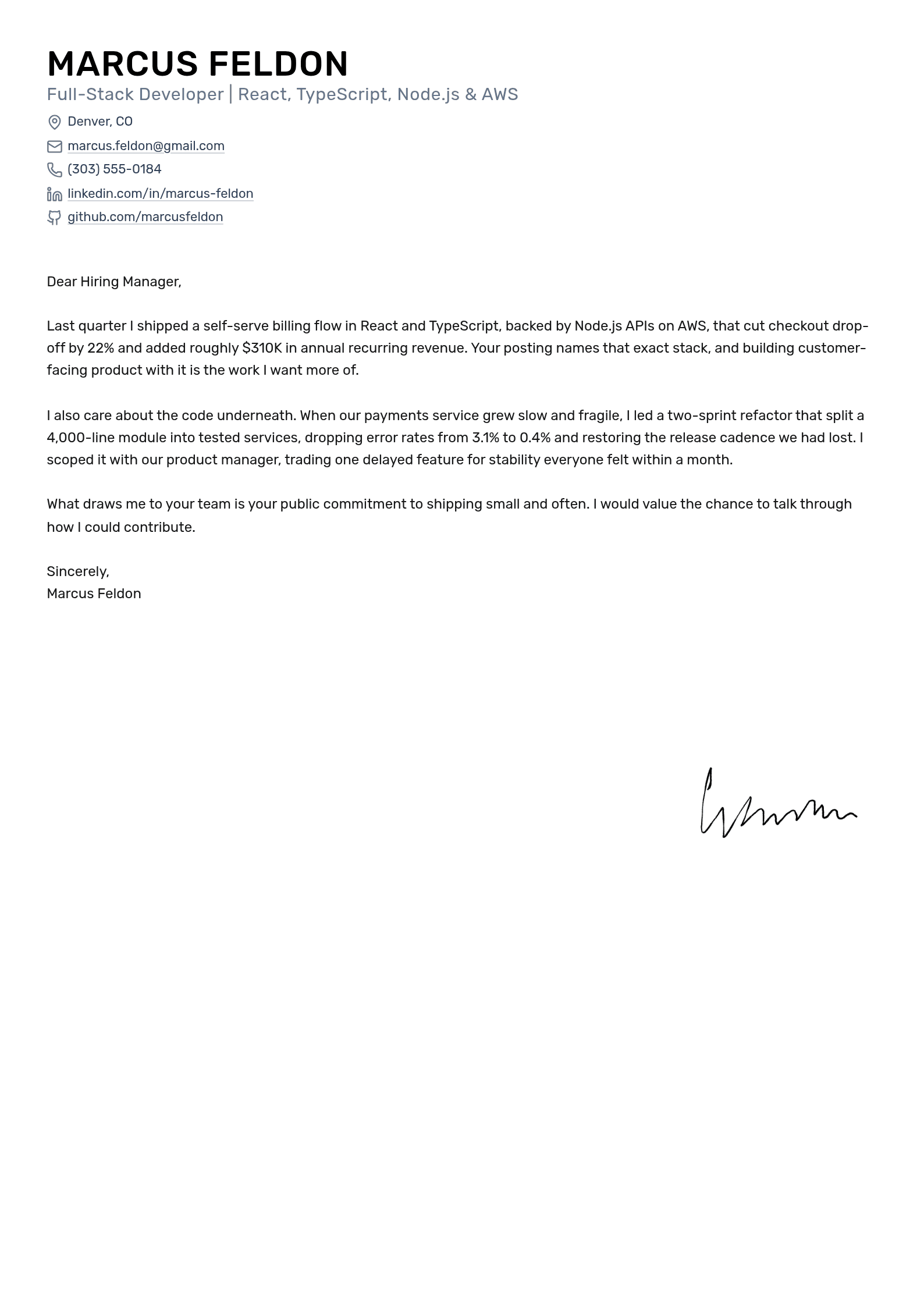
The sample below is written for a mid-level full-stack developer applying to a product company. Read it once for tone, then a second time for structure: notice that it names the company's stack early, leads with one concrete shipping win instead of a skills list, and spends a paragraph on a messy-codebase story rather than pretending every project was greenfield.
Marcus Feldon
Full-Stack Developer | React, TypeScript, Node.js & AWS
Dear Hiring Manager,
Last quarter I shipped a self-serve billing flow in React and TypeScript, backed by Node.js APIs on AWS, that cut checkout drop-off by 22% and added roughly $310K in annual recurring revenue. Your posting names that exact stack, and building customer-facing product with it is the work I want more of.
I also care about the code underneath. When our payments service grew slow and fragile, I led a two-sprint refactor that split a 4,000-line module into tested services, dropping error rates from 3.1% to 0.4% and restoring the release cadence we had lost. I scoped it with our product manager, trading one delayed feature for stability everyone felt within a month.
What draws me to your team is your public commitment to shipping small and often. I would value the chance to talk through how I could contribute.
Sincerely,
Marcus Feldon

What this letter gets right, section by section
The opener names the role and earns the second paragraph. No "I am writing to express my interest." It states the position, then immediately gives the strongest single proof point: a shipped result with a number attached. Hiring managers read openers the way you read commit messages, fast and looking for the point.
The stack match is woven in, not listed. The technologies appear inside accomplishment sentences. "Built the checkout flow in React and TypeScript" tells the reader you used the tools to ship something. "Skills: React, TypeScript, Node.js" tells them nothing the resume didn't.
The middle paragraph handles imperfect code honestly. Most real developer work happens in codebases with history. The sample treats that as evidence of maturity rather than something to hide, and frames the refactoring outcome in terms a non-engineer on the panel can value.
The close is specific to the company. One sentence on why this product or this engineering culture, grounded in something verifiable, like their engineering blog or a product decision you noticed. Generic flattery reads as a mail merge; a specific observation reads as someone who did twenty minutes of homework, which is rarer than it should be.
If you want more variations on this structure, the full stack developer cover letter examples page shows how to push the end-to-end ownership angle harder, and the software engineer cover letter examples cover more seniority levels.
Adapting the sample for a backend systems role
A backend systems posting rewards a different emphasis than a full-stack one, and the same letter should not go to both. Three changes matter most.
- Swap the shipping win for a reliability or scale win. Backend hiring managers care about what happened under load. Lead with latency you cut, throughput you handled, an incident you prevented, or a migration you landed without downtime. "Reduced p95 latency on the orders API" beats "built the orders API."
- Name the systems vocabulary the posting uses. Backend postings tend to specify queues, databases, and infrastructure by name: PostgreSQL, Kafka, Redis, Kubernetes, gRPC. If you have real experience with the ones listed, put one or two inside an accomplishment sentence. If you have an equivalent instead (RabbitMQ where they say Kafka), say so plainly and note the transferable concept.
- Show operational ownership. A sentence about being on call, writing runbooks, or instrumenting a service with metrics signals that you understand backend work doesn't end at the merge. Full-stack letters rarely need this; backend letters are weaker without it.
The structure stays identical. Opener with the role and one proof point, a paragraph of matched experience, a paragraph showing judgment in messy conditions, a specific close. Only the evidence changes.
What job posting data says about software developer requirements
Read enough software developer postings and a clear pattern emerges. Almost every one asks for the same five categories of things, and the mistake candidates make is answering only the first one.
| Requirement category | What postings typically ask for | How to handle it in your letter |
|---|---|---|
| Core language and framework | One or two primary languages (TypeScript/JavaScript, Python, Java, C#) plus a framework (React, Spring, .NET, Django) | Name the exact ones from the posting inside an accomplishment sentence, not a list. One sentence is enough. |
| Cloud and infrastructure | A cloud provider (AWS most commonly, then Azure and GCP), containers, sometimes Kubernetes or Terraform | Mention only if you have real experience. A deployment or migration story is stronger than the acronym alone. |
| Engineering practices | Git, CI/CD pipelines, automated testing, code review, agile ceremonies | Don't list these; they're assumed. Show one instead: a testing habit that caught something, a pipeline you improved. |
| Soft skills | Communication, cross-functional collaboration, ownership, mentoring, problem-solving | This is the letter's home turf. One concrete story of working with product or design covers what the resume can't. |
| Domain context | Fintech, healthcare, e-commerce, developer tools, and the compliance or scale constraints that come with each | If you've worked in their domain, say so early. If not, connect an adjacent constraint you've handled. |
Two things follow from this pattern. First, the soft skill requirements appear in nearly every posting, yet almost no developer letters address them with anything more concrete than the word "collaborative." That gap is your opening, and the collaboration section below shows how to fill it.
Second, the specific stack varies enough between postings that guessing is a losing strategy. One company's "full-stack" means React and Rails; another's means Angular and .NET on Azure. Paste the posting into Roleframe and the fit report shows the exact keywords that job filters on and which ones your materials are missing, so your letter and resume answer the posting in front of you rather than a composite of postings in general.
How to frame technical debt and refactoring in your letter
Refactoring stories are underused in developer cover letters, and they shouldn't be. Every team is sitting on debt, and every hiring manager is quietly asking the same question about you: can this person work productively in our imperfect codebase, or do they only function on greenfield?
The framing that works has three parts. State the business problem the debt caused, not the code smell. Describe the scoped, incremental approach you took. End with the measurable outcome. Compare these two versions of the same work:
- Weak: "Refactored legacy code to improve maintainability and follow best practices."
- Strong: "Our checkout service had grown fragile enough that every release risked breaking payments, so I led an incremental refactor behind feature flags. Deploys went from monthly and nerve-wracking to weekly and boring."
The second version tells the reader you understand why the debt mattered, that you managed risk instead of rewriting from scratch, and that you can name the result in terms the business cares about. "Boring deploys" is a phrase a VP of Engineering will remember.
One caution: never trash the previous team. "Inherited a mess from developers who didn't know what they were doing" reads as someone who will one day say the same about this team. "The service had grown faster than its architecture" carries the same information without the red flag.

Highlighting cross-functional collaboration with product teams
Postings ask for "cross-functional collaboration" because hiring managers have been burned by strong coders who can't work with product managers. The claim itself is worthless in a letter; everyone makes it. The story is what lands.
Good collaboration stories for a developer letter show one of three things:
- You shaped scope, not just executed it. "When the PM proposed real-time sync for launch, I prototyped both approaches in a day and showed that a polling fallback got us to market six weeks earlier. We shipped the fallback and added sync in the next quarter."
- You translated tradeoffs into decisions non-engineers could make. Explaining a technical constraint in terms of user impact or timeline, and letting product choose with real information, is the skill the posting is actually asking about.
- You pushed back with data rather than opinion. A sentence about instrumenting a feature to settle a debate signals maturity that no adjective can.
Pick one story, give it two or three sentences, and put it in the paragraph after your technical evidence. Resist the urge to include all three. A cover letter with one sharp story beats a letter with three compressed ones, every time.
Using Roleframe's Remi to draft a letter from your base resume
The slowest part of writing a tailored letter is the blank page, and the failure mode of most AI tools is that they fill it with generic text unconnected to your actual experience. Roleframe's approach is different because the draft starts from two real inputs: your resume and the specific posting.
The workflow looks like this. You keep one base resume per target role. When you find a job, you duplicate it for that posting and get a fit report: an ATS score, the exact keywords the posting asks for that you're missing, and a prioritized plan. From there, you ask Remi, the career copilot that lives in the editor, to draft a cover letter. Because Remi reads your resume and the attached posting, the draft references your real projects and the company's real stack instead of inventing either.
Then you edit. Every change Remi proposes arrives as a word-by-word diff you approve or discard, so the final letter is yours, in your voice, with claims you can defend in the interview. Export it as a PDF, which is what you should submit regardless of tool, since PDF preserves your formatting exactly as you see it.
The point isn't automation for its own sake. It's that tailoring stops costing an evening per application, so you can apply while the posting is fresh instead of a week in, after the first wave of candidates is already in the pipeline.
Common mistakes in developer cover letters (and how to fix them)
These are the failures that show up over and over in developer applications. Most are quick fixes once you see them named.
| Mistake | Why it hurts | The fix |
|---|---|---|
| Restating the resume in paragraph form | The reader already has the resume. A letter that adds nothing gets skipped, and skipping becomes a habit for the rest of your application. | Pick one or two accomplishments and add the context the resume can't hold: the why, the constraint, the tradeoff. |
| Listing every technology you've ever touched | Twelve technologies in one sentence signals breadth without depth, and buries the two the posting actually cares about. | Name the two or three from the posting, inside accomplishment sentences. Cut the rest. |
| Generic opener ("I am writing to express my interest...") | It's the opener on most letters in the pile, so it reads as filler and costs you the reader's attention in the first line. | Open with the role and your single strongest, most relevant proof point. |
| No specific reason for wanting this company | Reads as a mail merge. Hiring managers can tell within one paragraph, and it deflates everything above it. | One verifiable, specific observation: their engineering blog, a product decision, the problem space. Twenty minutes of research. |
| Apologizing for gaps or missing requirements | Volunteering weaknesses trains the reader to look for them. Most "requirements" lists are wish lists anyway. | Address a gap only if it's obvious, and frame it forward. For career gaps, there's a right way to do it without apologizing. |
| Going past a page | Nobody reads a 600-word cover letter from a developer. Length reads as inability to prioritize, which is itself a signal. | 250 to 400 words. If a paragraph doesn't advance the case, cut it. |
| Template artifacts (wrong company name, mismatched role title) | An instant rejection at many companies, and fair enough: it proves the letter is copy-paste. | Keep one tailored version per application rather than overwriting a single file. A per-job workspace makes this automatic. |
The gap point deserves one more sentence: if you have an employment gap, the letter can address it in a single confident line, and there's a full guide on explaining an employment gap in your cover letter without sounding defensive.
Frequently asked questions
- Do software developers even need a cover letter?
Often optional, sometimes decisive. Many developers skip it, which is exactly why a good one stands out: at companies where a human reads applications, the letter is frequently what breaks ties between comparable resumes. Skip it only when the application form doesn't accept one. When it's optional, a sharp 250-word letter is cheap insurance, and with a solid base resume it takes minutes to tailor, not hours.
- How long should a software developer cover letter be?
250 to 400 words, never more than one page. Three to four short paragraphs: role and strongest proof point, matched experience, one story showing judgment or collaboration, and a specific close. Hiring managers skim; a tight letter respects that and wins because of it.
- Should I list my full tech stack in the cover letter?
No. The resume carries the full stack, and the ATS matches keywords there. In the letter, name only the two or three technologies the posting emphasizes, and put them inside sentences about things you built or fixed. "Built the ingestion pipeline in Python on AWS" does more work than any comma-separated list.
- How do I write a junior software developer cover letter with little experience?
Substitute projects for jobs, but keep the same structure: one concrete proof point up front, then evidence. A capstone project, a bootcamp build, or a meaningful open-source contribution works if you describe the problem, your decisions, and the outcome rather than the tutorial you followed. Pair it with a strong entry-level software developer resume, and let the letter carry your motivation for this specific company, which is the one thing juniors can match seniors on.
- Should I send my cover letter as a PDF or a Word document?
PDF, always, unless the employer explicitly demands otherwise. PDF locks your formatting so the hiring manager sees exactly what you built, on any device. Match the header styling to your resume so the two documents read as one application.
- Should I mention my GitHub or side projects in the letter?
Yes, if a project is genuinely relevant to the role, and one sentence is the right dose: what it does and one interesting decision you made. The link itself belongs on the resume header. A side project in the posting's stack is one of the strongest cards a career changer or junior developer can play.
- How do I address the letter if I can't find the hiring manager's name?
"Dear Hiring Manager" or "Dear [Team Name] Team" ("Dear Platform Engineering Team") are both fine. Never use "To Whom It May Concern," which dates the letter instantly. Spending five minutes on LinkedIn to find the engineering manager's name is worth it, but a wrong guess is worse than the generic greeting.


Ready when you are
Send the tailored resume, not the generic one.
Paste a job posting and Roleframe scores your resume against it, then helps you close the gaps one approved edit at a time, so you apply while the role is still fresh.