
Full Stack Developer Cover Letter Examples (Proving End-to-End Ownership)
by Larbi SahliLast Updated
Full stack developer cover letter examples plus a guide to reading whether a posting leans frontend or backend, and adjusting your letter to match.

On this page
A full stack developer cover letter fails in one of two predictable ways. Either it lists every technology the candidate has ever touched, which repeats the resume and proves nothing, or it makes a vague claim about being "passionate about end-to-end development," which could describe ten thousand other applicants. Hiring managers reading a stack of these letters are looking for one thing: evidence that you have actually owned a feature from database schema to deployed UI, and that you can tell that story clearly.
There is a second problem specific to this role. Almost no "full stack" posting is a true 50/50 split. Most lean, sometimes hard, toward frontend or backend, and the lean is visible in how the posting is written. A letter that matches the lean reads like it was written for the job. A letter that ignores it reads like it was written for every job. This guide covers both: the example below shows what a strong letter looks like, and the second half shows you how to read a posting's lean and adjust your narrative to match it.
The 'jack of all trades' trap
The quiet fear in every full stack application is looking shallow everywhere. Hiring managers share it from the other side: they have interviewed "full stack" candidates who turned out to be frontend developers who once wrote an Express route, or backend developers who can render a form but have never debugged a state management problem. Your cover letter is where that doubt gets resolved, one way or the other.
The wrong fix is claiming depth in everything. "Expert in React, Angular, Vue, Node, Django, Rails, and Go" does not read as breadth. It reads as a resume keyword dump, and it invites the exact skepticism you are trying to kill.
The right fix is proving ownership of one thing, end to end. Pick a single feature or system you shipped and walk it across the stack: the data model you designed, the API you built on top of it, the interface that consumed it, and what happened after it went live. Anyone can list React and Node in a skills section. Very few applicants can narrate a schema migration, an API design decision, and a frontend performance fix as one connected story, because very few actually did all three. That narrative is the whole job of a full stack developer cover letter. Everything else is supporting detail.
Full stack developer cover letter example
Here is what that looks like in practice. Notice three things as you read: the letter opens with a shipped outcome rather than "I am writing to apply," it spends its middle paragraph walking one feature across the entire stack, and it gives more space to the frontend work, because the posting it targets leans frontend. That last choice is the one most applicants never make.
Marcus Delgado
Full Stack Developer | React & TypeScript · Node.js & PostgreSQL
Cover Letter
Dear Hiring Manager,
Last quarter I shipped a saved-search feature that lifted repeat sessions by 22% across roughly 40,000 weekly users, and I owned every layer of it. That kind of end-to-end delivery is why your full stack opening caught my attention, and why I think I would fit a team that clearly cares about the interface users actually touch.
The saved-search work started with a PostgreSQL schema for user filter sets and a Node.js API to persist and query them, but most of the effort lived on the front end. I built the UI in React and TypeScript, then chased the details that decide whether people return: I memoized the results grid, virtualized long lists, and cut Largest Contentful Paint from 3.1s to 1.2s on mid-range mobile. Working closely with our designer, I matched the mockups down to the spacing and reached an accessibility score of 98.
Your posting leans toward React, component quality, and design collaboration, and that is where I do my strongest work while staying fully comfortable owning the API and data model behind it. Over four years I have learned that a fast, honest UI is what a well-built backend is ultimately for.
I would welcome the chance to walk through the saved-search build and how I would apply that approach to your product. Thank you for considering my application.
Sincerely,
Marcus Delgado

What to steal from this example, section by section
The opening
The first sentence names a result, not an intention. "I am writing to express my interest in the Full Stack Developer position" wastes the only line the reader is guaranteed to see. A shipped feature with a number attached does the opposite: it tells the reader in ten seconds that you build things that reach users, and it makes them want the details.
If you do not have a dramatic number, a concrete scope statement works. What you shipped, who used it, and what changed. Specificity is the currency here, not scale.
The end-to-end story
The middle paragraph is where the example earns the "full stack" claim. One feature, traced through every layer you touched, with a decision at each layer. Why that data model. Why that API shape. Why that frontend approach. Decisions are what separate someone who owned the work from someone who was nearby while it happened.
Keep it to one story. Two half-told stories are weaker than one complete one, and a cover letter has room for exactly one done well.
The company paragraph
Generic flattery ("I admire your innovative culture") gets skimmed past. A specific observation about their product, their stack, or a problem they publicly face gets remembered. If the company's engineering blog mentions a migration to TypeScript or a move to server-side rendering, and you have done that work, say so. That one sentence does more than three paragraphs of enthusiasm.
The close
Confident and short. State what you would want to dig into in a conversation, thank them, and stop. No "I hope to hear from you at your earliest convenience." You are a peer proposing a conversation, not a supplicant requesting an audience.
Adjusting the letter for your level
Junior full stack developer cover letter
At the junior level, your projects are your work history, so treat them with the same seriousness the example above treats professional work. A deployed side project with real users, a bootcamp capstone, or a substantial open-source contribution can carry the end-to-end story just as well as a job can, provided you narrate the decisions. "I built a recipe app with the MERN stack" is a resume line. "I chose PostgreSQL over MongoDB because the data was relational, and rebuilding the queries taught me why" is a cover letter line.
Three junior-specific rules. First, link the work: a live URL and a GitHub repo turn claims into evidence, and our guide on where to put your GitHub link covers how to present it. Second, never apologize for your experience level. "Although I only have one year of experience" hands the reader a reason to stop. Third, show learning velocity with a concrete instance: a technology you picked up under deadline and what you shipped with it. For more on presenting the projects themselves, see how to list coding projects on a resume, the same principles apply to the letter.
Senior full stack developer cover letter
At the senior level, the letter shifts from execution to judgment. The end-to-end story is still the spine, but the interesting layer is no longer "I built the API," it is "I chose a monolith over microservices because the team was six people, and here is what that bought us." Tradeoffs, scope decisions, and things you decided not to build are senior signals. So is impact through others: a junior developer you brought up to speed, a code review culture you changed, an incident process you introduced.
Counterintuitively, senior letters should name fewer technologies, not more. A senior candidate listing fifteen tools looks like they are compensating. Name the stack that matters for this job, go deep on one decision, and let the seniority show in how you reason rather than how much you list. Tie the story to a business outcome where you can: revenue, retention, cost, or reliability, because at this level you are being hired to move one of those.
MERN stack focused cover letter
When a posting names the stack explicitly, MongoDB, Express, React, Node, mirror it precisely and prove depth in at least one layer of it. Applicant tracking systems and recruiter keyword filters match on exact terms, so write "React" and "Node.js" as the posting writes them, and mention the specific patterns you have used: hooks and context on the React side, aggregation pipelines on the Mongo side, middleware design in Express. One sentence per layer, anchored to a real project, beats a paragraph of stack enthusiasm.
If your experience is MERN and the posting asks for something adjacent, say Django and Vue, address the transfer directly rather than hoping nobody notices. Name the concept that carries over (REST design, component architecture, ORM-versus-query tradeoffs) and one instance where you crossed a stack boundary before. Hiring managers hire people who have switched stacks successfully far more comfortably than people who pretend the gap does not exist.
How to prove competence in both frontend and backend
The honest position for most full stack developers is a T shape: real depth on one side, working competence on the other. Claiming equal mastery of both usually reads as false, because it usually is. The letter that works claims the T shape openly and proves each side with a different kind of evidence.
For the backend side, the strong proof points are data modeling, API design, and reliability. A schema decision and its consequence, an API versioning choice, a query you made fast, an incident you resolved. For the frontend side, the proof points are state management, performance, and the user-facing outcome. A load time you cut, an interaction you simplified, an accessibility problem you fixed. One concrete artifact per side is enough; the reader is checking that you can operate on both, not auditing your entire history.
Do not forget the glue layer. Deployment, CI/CD pipelines, and monitoring are where a lot of "full stack" claims quietly collapse in interviews. A single sentence, "I own our GitHub Actions pipeline and set up the alerting that caught the issue," signals that your end-to-end claim includes the parts after the code is written. Your letter and your full stack developer resume should agree on all of this: the letter tells the story, the resume carries the keyword coverage, and a mismatch between them is the kind of thing a careful hiring manager notices.
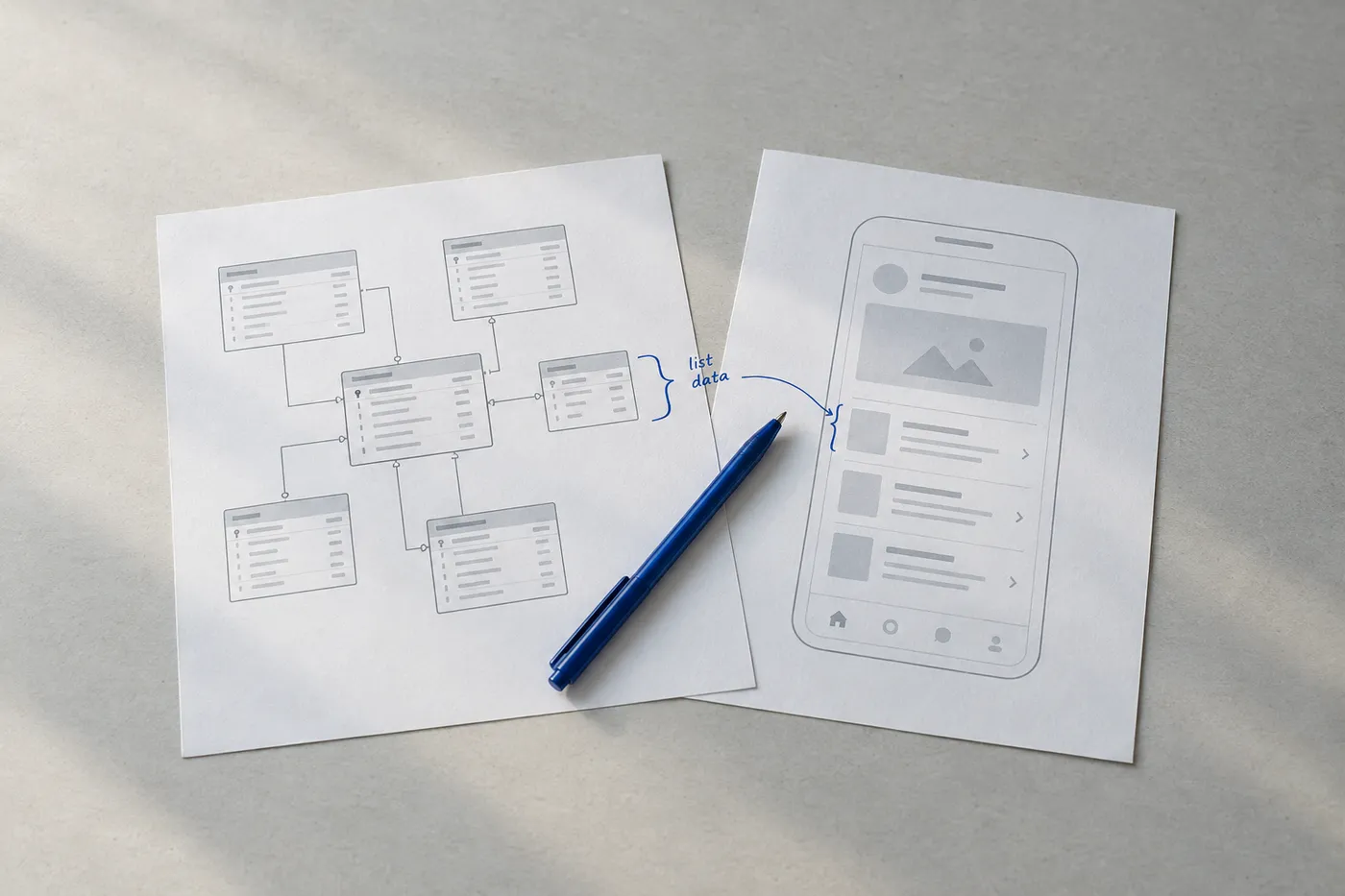
Matching your stack to the job description: reading the lean
This is the highest-value fifteen minutes you can spend on a full stack application, and almost nobody spends it. "Full stack developer" postings vary enormously in what they actually want. Some are frontend roles with occasional API work. Some are backend roles that need someone who will not break the UI. Some genuinely split the work. The posting tells you which one you are looking at, if you know where to look.
| Signal in the posting | What it usually means | How to adjust your letter |
|---|---|---|
| Frontend technologies listed first and repeated (React named three times, Node once) | The team's pain is on the frontend | Lead with your UI story; anchor backend credibility in one sentence |
| Requirements heavy on databases, scaling, APIs, and system design | Backend-leaning role with frontend as a bonus | Lead with data model and API decisions; mention frontend fluency briefly |
| Phrases like 'pixel-perfect,' 'design collaboration,' or a designer named as a close partner | Frontend lean, with UI quality as a hiring criterion | Show a performance or accessibility win and comfort working from designs |
| Phrases like 'high throughput,' 'data pipeline,' 'reliability,' or an SLA mentioned | Backend lean, with production ownership expected | Show an incident, a scaling decision, or a reliability improvement |
| Team described as 'product engineering' on a consumer app | Likely frontend-weighted day to day | Emphasize shipped user-facing features and iteration speed |
| Reporting line into infrastructure or platform | Backend-weighted, possibly DevOps-adjacent | Emphasize the glue layer: deployment, CI/CD, observability |
| Genuinely balanced list, small company, 'wear many hats' | True full stack; breadth is the point | Lead with the end-to-end story itself and your comfort owning everything |
Read the posting twice with this table in hand. The first read tells you the requirements. The second read tells you the lean: which words repeat, which come first, and what kind of pain the team is describing between the lines. Then reweight your letter, not by inventing experience, but by choosing which true story leads. The mid-level developer in the example above has both a backend reliability story and a frontend performance story. For a frontend-leaning posting, the frontend story leads. For a backend-leaning one, the same candidate writes a different letter with the same facts.
This is also why one cover letter for all applications quietly underperforms. The letter is not wrong for any single job; it is just never right for the specific one. The same logic applies to your resume, which is the argument for keeping a base version and per-job tailored versions rather than one document for everything.
Drafting a letter grounded in your real projects
The hard part of everything above is not the writing. It is holding the job posting and your own history side by side and deciding what leads. This is where generic AI tools fall down: ask a chatbot for a full stack developer cover letter and you get confident, hollow prose about "passion for scalable solutions," because it knows the genre but not your work. We wrote about why most AI cover letter generators fail, and the short version is that a letter is only as good as the specifics behind it.
Roleframe approaches it from the specifics. You attach the actual posting to a tailored version of your resume and get a fit report: how the document scores against this job, which keywords the posting emphasizes, and which ones you are missing, which is a direct, evidence-based read on the frontend-versus-backend lean. Remi, the career copilot, then drafts a cover letter grounded in that report and in what is actually on your resume, and hands it to you to edit. You approve every line, which matters, because the end-to-end story in your letter is exactly what the interviewer will probe, and you need to be able to defend every word of it. Send the finished letter as a PDF so the formatting survives whatever system opens it.
Frequently asked questions
- Are cover letters outdated in 2026?
For some high-volume roles, yes, they often go unread. For full stack positions they still earn their keep, because the resume cannot answer the question every hiring manager has: which side of the stack are you actually strong on, and can you really work across both? A short, specific letter resolves that doubt before the interview. When a posting marks the letter optional, treat it as a free tiebreaker that most applicants will skip.
- Can I use ChatGPT to write a full stack developer cover letter?
You can use it for structure and a rough first pass, but do not send its output unedited. Generic AI drafts converge on the same hollow phrasing, and worse, they sometimes invent claims you cannot defend in an interview. If you go this route, feed it your real project details and rewrite the result in your own voice; our guide to writing a strong AI cover letter prompt shows how to get a usable draft instead of filler.
- What are the most common cover letter mistakes for developers?
Five show up constantly: repeating the resume as prose instead of telling one story, listing every technology instead of proving depth in one, opening with 'I am writing to apply' instead of a result, ignoring the posting's frontend or backend lean, and running past one page. A sixth, specific to developers, is claiming a technology in the letter that appears nowhere on the resume, which reads as padding the moment anyone compares the two documents.
- What does a full stack developer actually cover?
The core is frontend (the user interface, typically a framework like React or Vue) and backend (server logic, APIs, and databases). In practice most roles also expect the glue layer: deployment, CI/CD pipelines, and basic monitoring. The exact split varies by company, which is why reading the posting's lean matters more for this title than for almost any other engineering role.
- How long should a full stack developer cover letter be?
Under one page, and closer to three-quarters of it. Roughly: a two-sentence opening with a concrete result, one meaty paragraph walking a feature across the stack, a short company-specific paragraph, and a two-line close. If you are cutting to fit, cut technologies from the list, never detail from the story.
- Should I send my cover letter as a PDF?
Yes. PDF preserves your formatting exactly, no matter what system or device opens it, and it is what applicant tracking systems handle cleanly. Match the header styling to your resume so the two documents read as one application, and only deviate from PDF if an employer explicitly asks for another format.
- Do I need a different cover letter for every full stack job?
You need a different emphasis, which is less work than it sounds. Keep one base letter with your strongest end-to-end story, then reweight it per application: swap which project leads based on the posting's frontend or backend lean, mirror the exact stack terms the posting uses, and rewrite the company paragraph. Fifteen minutes per application, and it is the fifteen minutes that separates a letter written for the job from one written for every job.


Ready when you are
Send the tailored resume, not the generic one.
Paste a job posting and Roleframe scores your resume against it, then helps you close the gaps one approved edit at a time, so you apply while the role is still fresh.