
Entry-Level Software Developer Resume Example & Writing Guide
by Larbi SahliLast Updated
A complete entry level software developer resume example, plus the tech stacks employers actually request and how to structure a resume with no experience.

On this page
An entry-level software developer resume has one job: prove you can ship working code before anyone has paid you to do it full-time. Most candidates fail at this in a predictable way. They list every language they have ever touched, bury their best project under a retail job, and write a summary that says "passionate about technology" instead of naming a single thing they built.
This guide walks through a complete entry-level software developer resume example, then breaks down every section: how to order them when your experience is thin, how to present your tech stack honestly, how to turn class projects into evidence, and which stack combinations show up most often in real entry-level postings. Developer roles at enterprises, consultancies, and agencies screen differently than startup engineering roles, and this page is written for that pipeline.
Why Entry-Level Developer Resumes Fail the ATS Screen
The applicant tracking system (ATS) is not a judge. It is a parser and a filter. It extracts your text into structured fields, and a recruiter then searches or filters those fields for the terms in the job posting. Entry-level developer resumes fail this process for three reasons, and none of them is a lack of talent.
First, keyword mismatch. The posting asks for "Java, Spring Boot, SQL" and your resume says "backend development coursework." A recruiter filtering on "Spring Boot" never sees you. You need the exact terms from the posting, spelled the way the posting spells them, in your skills section and ideally inside a project bullet where they carry context.
Second, formatting that breaks parsing. Two-column layouts with skills in a sidebar, text inside tables or graphics, skill bars rendered as images. All of these can turn into scrambled or missing text once parsed. A recruiter searching the parsed text for "Python" finds nothing, because your Python line lived in a graphic. Keep the layout simple and machine-readable; there is a full walkthrough in our guide to building an ATS-friendly software engineer resume.
Third, burying the technical evidence. If your resume leads with two years as a barista and your capstone project sits at the bottom of page one, the human reviewing the shortlist skims past your strongest material. Recruiters move fast on a first pass, seconds rather than minutes, and whatever sits in the top third of the page is what gets read. For a junior developer, that top third should be technical: summary, skills, and your best project or internship.
Get those three things right and you clear the screen that eliminates most entry-level applicants. Everything below shows you how.
Entry-Level Software Developer Resume Example
Here is a complete entry level software developer resume sample. Notice the order of sections, the way every project bullet names a technology and an outcome, and how short the whole thing is. One page, no filler, nothing the candidate could not defend in an interview.
Nathan Whitfield
Entry Level Software Developer | Java, React & REST APIs

Summary
Computer Science graduate (Ohio State, 2024) who builds and ships working software. Comfortable in Java and React across the full stack, with hands-on REST API and PostgreSQL experience. Built TrailLedger, a deployed full-stack expense-splitting app now used by 300+ students. Seeking an entry level developer role at an enterprise or consultancy.
EXPERIENCE
Undergraduate Teaching Assistant, Data Structures
Led weekly lab sections for 45 students, walking through Java implementations of trees, graphs, and hash tables; section pass rate rose from 78% to 91%.
Built an autograder script in Python that cut assignment grading time from 6 hours to under 40 minutes per batch.
Debugged student code in office hours, resolving 200+ tickets across two semesters.
Software Development Intern
Shipped three REST endpoints in a Spring Boot service, adding pagination that dropped average response payloads by 60%.
Wrote JUnit and Mockito tests raising coverage on the billing module from 41% to 82%.
Fixed 14 backlog bugs merged to production, closing tickets flagged by QA before the fall release.
Retail Associate
Handled 80+ customer transactions per shift while funding tuition through school.
Trained four new hires on the point-of-sale system and inventory workflow.
Recognized as top upsell associate two quarters running.
EDUCATION
Ohio State University
BSc
Bachelor of Science in Physics from Harvard University, Cambridge, Massachusetts, United States.
SKILLS
Languages
Frameworks & Tools
LANGUAGES
PROJECTS
TrailLedger — Full-Stack Expense-Splitting App
Solo Developer
https://github.com/nwhitfield/trailledger
React front end, Node/Express API, PostgreSQL backend; deployed on Render and used by 300+ students to split group trip costs, with settle-up logic reducing manual math complaints to zero.
CERTIFICATIONS
AWS Certified Cloud Practitioner
Validated foundational knowledge of AWS cloud concepts, security, and billing.
Covered core services including EC2, S3, RDS, Lambda, and CloudFront.
Demonstrated understanding of shared responsibility model and basic architectural best practices.
AWARDS
Dean's List (five semesters)
Ohio State University
Recognized for building a cloud-native AI productivity tool.
Steal the structure, not the content. The sections below explain why each part is built the way it is, and how to adapt it to a bootcamp background, a career switch, or a resume with an internship or two already on it.
Structuring Your Resume When You Have Limited Experience
The standard reverse-chronological resume assumes your work history is your strongest asset. Yours probably is not, yet. So you keep the reverse-chronological format, which every ATS and recruiter expects, and you change the section order so your strongest evidence comes first.
For most entry-level developers, that order is:
- Header: name, phone, email, city, GitHub link, LinkedIn. No photo, no full street address.
- Summary: two to three lines naming your degree or training, your core stack, and one concrete thing you built.
- Technical skills: grouped by category, matched to the posting.
- Projects: two or three, each with a stack line and outcome-focused bullets.
- Experience: internships and any technical work first; unrelated jobs compressed to one or two lines if you need them at all.
- Education: degree, institution, graduation date, relevant coursework. Moves above projects in some cases, covered below.
Keep it to one page. A hiring manager reading a stack of junior resumes treats a second page as a red flag for judgment, since nobody at entry level has two pages of relevant material. If you are fighting for space, cut the unrelated job history before you cut a project bullet. There is a longer treatment of the length question in should a resume be one page or two.
Your GitHub link belongs in the header, and it should point to a profile where your pinned repositories are the projects on the resume, each with a real README. A recruiter who clicks through and finds three abandoned forks of tutorial repos learns something you did not want them to learn. How to format the link and prepare the profile is covered in how to include your GitHub link on a resume.
Crafting a Developer Summary That Stands Out
A weak junior summary is a personality statement: "Motivated and detail-oriented computer science graduate passionate about solving problems." That sentence appears on thousands of resumes and tells the reader nothing they can verify. A strong junior summary is a fact statement with three ingredients: your credential, your stack, and one built thing.
Compare: "Computer science graduate with production experience in Java and Spring Boot from a six-month internship; built and deployed a REST API handling inventory sync for a campus bookstore, including test coverage and CI." Every clause in that sentence is checkable, and the recruiter now has three things to ask about in a phone screen. That is what a summary is for.
Skip the objective statement ("seeking a position where I can grow..."). Objectives describe what you want; summaries describe what you offer, and only one of those helps the person screening. The distinction, and when a career changer might still want an objective, is covered in resume summary vs. objective. If you are staring at a blank summary field, there are worked examples for candidates with no experience in resume summary examples for freshers.
How to Detail Your Tech Stack and Proficiencies
Group your skills by category rather than dumping them in one comma-separated wall. Languages, frameworks and libraries, databases, and tools is a grouping every developer recruiter can scan in two seconds. It also makes keyword matching easier for the ATS filter, because "PostgreSQL" sitting under "Databases" parses exactly the same as anywhere else, and the human reading afterward finds it instantly.
Three rules for what goes in the list:

- Only list what you can be interviewed on. A stray "C++" from one semester invites a whiteboard question you will fail, and a failed question on your own listed skill hurts more than the missing keyword would have.
- Mirror the posting's spelling. If the job says "React.js", write "React.js". If it says "CI/CD", do not write only "continuous integration". Recruiter filters are literal.
- Skip proficiency bars and percentages. "JavaScript: 85%" is meaningless to a hiring manager and often invisible to a parser. If you want to signal depth, do it in a project bullet: "Built the frontend in React with TypeScript" says more than any bar chart.
Soft skills like "teamwork" and "communication" do not belong in a technical skills section. Demonstrate them in bullets instead: "paired with two teammates to refactor the auth module" proves collaboration without ever using the word. The reasoning behind that split is laid out in hard skills vs. soft skills on your resume.
Showcasing Academic and Personal Coding Projects
Projects are the experience section you actually control. Nobody can stop you from building something this weekend, which means a thin projects section reads as a choice. Two or three substantial projects beat six tutorials, and "substantial" means the project has users, data, deployment, or a problem you can explain in one sentence.
Write each project like a job entry. Name the project, add a one-line stack ("React, Node.js, PostgreSQL, deployed on AWS"), then two to four bullets that follow the pattern: what you built, with what, and what happened. "Built a course-scheduling web app in Django used by 40 students in my program; cut manual timetable conflicts to zero" is a hiring signal. "Worked on a web app using Django" is not.
Three traps to avoid. Do not lead with the follow-along tutorial project every bootcamp cohort ships; if you must include it, describe the part you extended beyond the tutorial. Do not list a group project without naming your slice of it, because interviewers will probe and "I did the frontend" needs to survive follow-up questions. And do not link a repository with no README, since the repo is part of the resume once you link it.
Capstones deserve special care because they are often your largest codebase: how to title, place, and bullet one is covered in how to list a capstone project on your resume, and the broader mechanics of the section live in how to list coding projects on a resume.
Framing Internships as Impactful Work Experience
An internship entry written as a duty list wastes your best asset. "Assisted the development team with various tasks" tells the reader you were present. What they want to know is whether you shipped anything, and interns ship more than they give themselves credit for.
Reconstruct your internship as a list of artifacts. Did any of your code reach production? Did you fix bugs from a real backlog? Write tests? Sit in code review and revise based on feedback? Each of those is a bullet: "Fixed 14 backlog defects in a Java/Spring service, each merged after peer code review" describes junior professional work, which is exactly what an entry-level role is.
Include the scale markers that make the work feel real: the size of the team, the codebase's stack, the process ("two-week sprints", "trunk-based development"). Enterprise and agency hiring managers care about process fluency almost as much as language fluency, because onboarding someone into Jira, Git workflows, and standups is half the cost of a junior hire. If your practical experience came from a bootcamp rather than an internship, the same shipped-work framing applies, and how to put a coding bootcamp on your resume shows where the entry goes.
The Most Requested Tech Stacks for Junior Developers
Roleframe's job-analysis engine reads real job postings the way a recruiter does, mapping each requirement against a candidate's resume. Across entry-level developer postings, a clear pattern shows up: employers rarely ask for a single language. They ask for a stack, a language plus a framework plus a data layer, and the combination tells you what kind of shop is hiring. Junior "developer" titles skew toward enterprises, consultancies, and agencies, and those employers have strong stack conventions.
| Stack combination | Where it shows up | What to pair it with on your resume |
|---|---|---|
| Java + Spring Boot + SQL | Enterprises, banks, consultancies | REST APIs, unit testing (JUnit), Maven/Gradle, Git |
| C# + .NET + SQL Server | Enterprise IT, Microsoft-shop consultancies | Azure basics, Entity Framework, Agile/Scrum experience |
| JavaScript/TypeScript + React + Node.js | Agencies, product companies, startups | HTML/CSS, REST or GraphQL APIs, a deployed project |
| Python + Django or Flask + PostgreSQL | Startups, data-adjacent teams, internal tooling | Pandas or scripting experience, API integration work |
| PHP + Laravel or WordPress + MySQL | Digital agencies, web shops | JavaScript, responsive frontend work, client project examples |
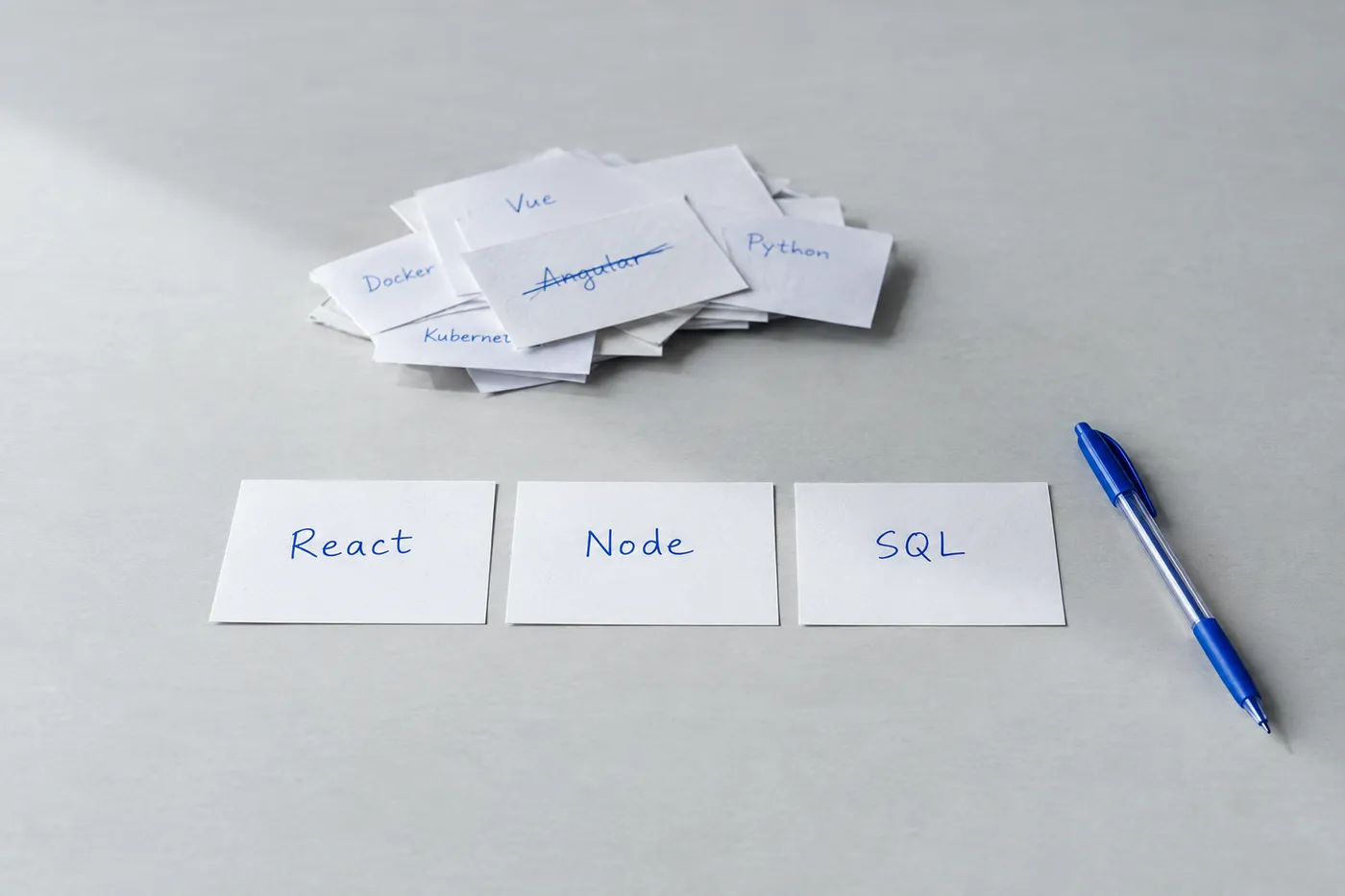
Two takeaways from this pattern. First, pick a lane on your resume. A junior candidate listing all five stacks reads as shallow in each; a candidate showing depth in one stack, with a project proving it end to end, reads as hireable. Match the lane to the jobs you are actually applying for.
Second, a cluster of requirements repeats across nearly every posting regardless of stack: Git, SQL, REST APIs, unit testing, and Agile or Scrum familiarity. Cloud basics, most often AWS or Azure, appear in a large share of postings too. These are the cheapest keywords to earn, because a weekend of adding tests and a deploy step to an existing project legitimately puts three of them on your resume. If you want to see exactly which terms a specific posting filters on and which ones your resume is missing, paste the posting into Roleframe and the fit report shows your keyword gaps against that job, ranked by how much each matters.
Rearranging Your Sections: Why Education Might Go First
Section order is an argument about what your strongest evidence is. For a recent computer science graduate applying to enterprises and consultancies, that is often the degree itself, because many of those employers still filter on "BS in Computer Science or related field" before anything else. In that case education goes directly under your summary: degree, university, graduation date, and a relevant-coursework line that doubles as keyword coverage (data structures, algorithms, databases, operating systems).
The rule flips as your evidence shifts. An internship at a recognizable company beats coursework, so it moves above education. A bootcamp graduate with a strong portfolio leads with projects, since the credential matters less than the proof. A career switcher leads with skills and projects and lets the unrelated degree sit at the bottom. There is no single correct order; there is a correct order for your situation, and the full decision tree is in the best resume section order for your experience level.
Include your GPA if it is strong and you graduated recently; leave it off otherwise, and never round up. The specifics are in should I put my GPA on my resume. Once you are two or three years into your career, both the GPA and the coursework line come off, and education drops below experience for good.
Import Your Existing Resume and Fix It Section by Section
You probably have a resume already, and retyping it into a new tool is the reason most people never fix the one they have. Roleframe imports your existing PDF and turns it back into editable blocks, with your roles, dates, and bullets in the right places. The import runs a full analysis on its own, so the first thing you see is a scored resume with its weak sections named, and you can drag any section to a new position when this guide's ordering advice applies to you. Remi, the career copilot in the editor, will rewrite a vague bullet on request, and you approve every change word by word, which matters because every line on a junior resume gets probed in interviews.
One formatting note before you send anything: submit as PDF. It preserves your layout exactly, parses cleanly in modern ATS software, and it is what Roleframe exports. Only send another format if a specific employer explicitly asks for one.
Frequently asked questions
- What is the 7-second rule for resumes?
The 7-second rule is the widely repeated idea that a recruiter spends only a few seconds on a first-pass scan of your resume before deciding whether to read further. Treat the exact number as folklore, but the behavior is real: first passes are fast, and only the top third of the page reliably gets read. For an entry-level developer, that means your summary, skills, and best project must sit above the fold, with unrelated work history pushed down or cut.
- Can I become a software developer with no experience?
Yes, and every working developer did. What you cannot do is apply with no evidence. Projects substitute for experience at entry level: two or three substantial builds with real stacks, deployment, and outcomes give a recruiter the same signals a job would. Add the near-universal posting requirements, Git, SQL, REST APIs, and unit testing, to a project you already have, and your resume covers most of what junior filters screen for. Internships, freelance work, and open-source contributions accelerate this, but none of them is mandatory to get a first interview.
- What are the 5 P's of a resume?
The 5 P's are a career-coaching mnemonic, usually given as: proofread, purpose, personality, professionalism, and presentation. It is a decent checklist but a blunt one for developers. The technical version worth remembering: parseable formatting, precise keywords matched to the posting, projects with outcomes, proof you can defend in an interview, and PDF as your submission format.
- What is the recommended resume format for a fresher software developer?
Reverse-chronological, one page, single column, submitted as a PDF. Order the sections summary, technical skills, projects, experience, education for most candidates, and move education directly under the summary if you have a fresh computer science degree and the postings you target require one. Avoid the "functional" resume format that hides dates; recruiters read it as hiding something, and ATS parsers handle it poorly.
- Should an entry-level developer resume be one page?
Yes. At entry level you do not have two pages of relevant material, and a padded second page signals poor judgment to the person screening. If you are out of space, compress or cut unrelated jobs before touching a project bullet. The page count question changes around ten years of experience, not before.
- Do I need a GitHub link on my resume?
For developer roles, yes, put it in your header. But treat the profile as part of the application: pin the repositories that match the projects on your resume, give each a README that explains what it does and how to run it, and archive or unpin abandoned tutorial forks. A recruiter who clicks through should find confirmation of your resume, and a bare or messy profile can undo a strong page.
- Should I list technologies I only used in one class?
Only if you could survive an interview question on them today. A listed skill is an invitation to be tested, and failing a question about your own resume damages you more than a missing keyword would. If a posting demands a technology you barely know, the honest fix is to build a small project with it this week, which turns the keyword into a defensible claim instead of a bluff.


Ready when you are
Send the tailored resume, not the generic one.
Paste a job posting and Roleframe scores your resume against it, then helps you close the gaps one approved edit at a time, so you apply while the role is still fresh.