How to Build an ATS-Friendly Software Engineer Resume
Check a software engineer resume for readable text, accurate technology names and relevant project evidence. Learn what parsing and keyword checks can tell you.


On this page
An ATS-friendly software engineer resume makes your contact details, experience and relevant skills easy to read and extract. It still needs to explain what you did. A list of matching tools or a high score from a resume checker does not establish that you meet an employer’s requirements.
This guide separates three tasks: checking the exported file, choosing accurate terminology and presenting evidence for the role. It also explains the limits of common tests. There is no universal ATS template, pass score or keyword formula that guarantees an interview.
How ATS platforms parse engineering resumes
Parsing extracts information from a document into fields. It is distinct from searching, evaluating qualifications or making a hiring decision.
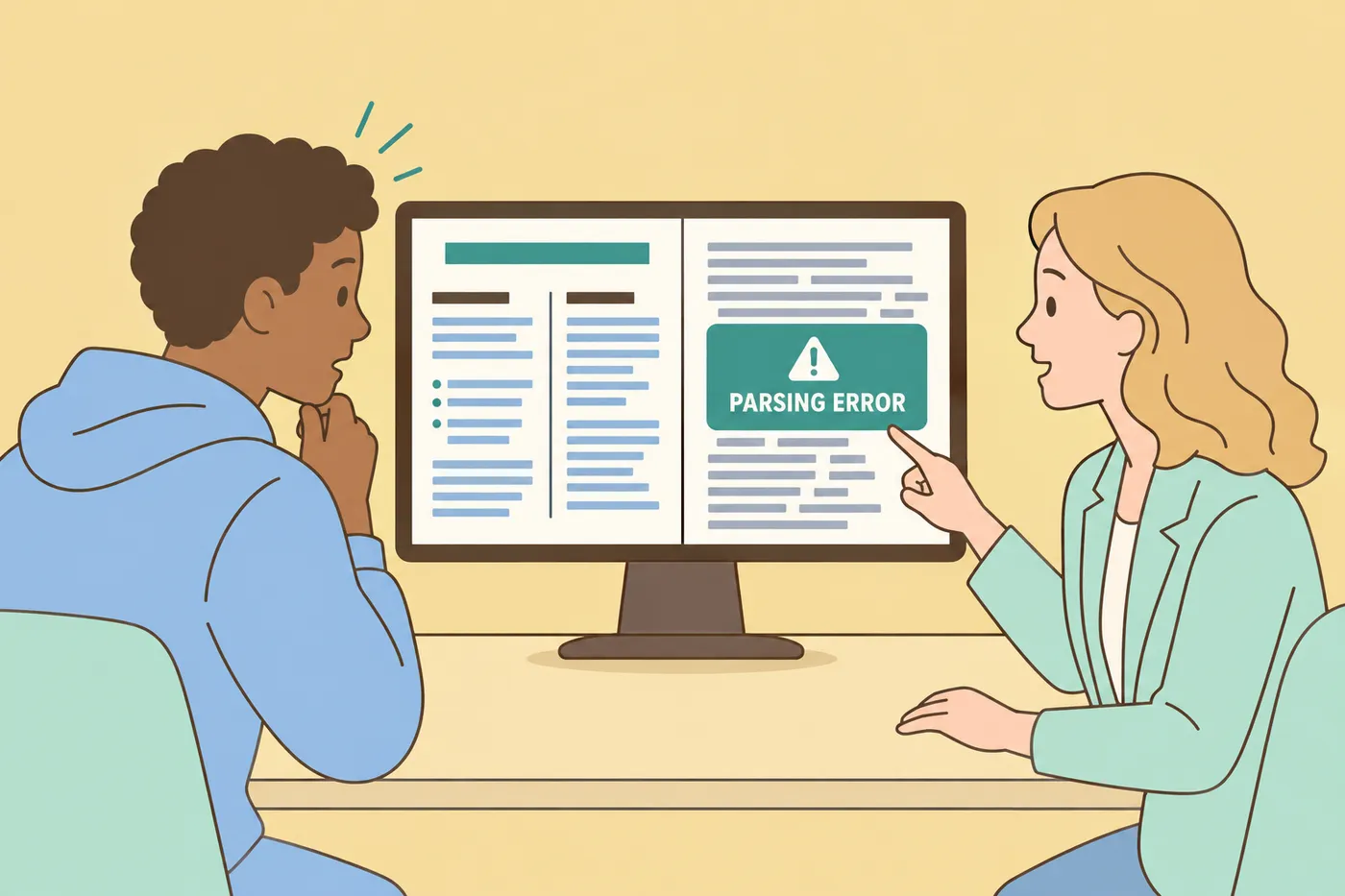
Greenhouse’s parsing guidance describes possible partial or unsuccessful extraction, including problems with images, complex layouts and contact details in headers or footers. In its documented workflow, a failed parse can leave the resume attached while details need manual entry.
That is evidence about a particular product, not a ranking of every vendor. Employers configure different workflows and may use additional tools. This guide does not establish that Workday or Taleo is the strictest parser, or that passing one system proves compatibility with all others.
Can an ATS automatically reject an application?
Some systems support employer-configured automatic rejection. For example, Greenhouse documents rules based on answers to application questions. The employer chooses the rule; this is different from a universal resume keyword score.
A rejection email alone does not tell you whether the cause was a screening answer, human review or another process. Answer application questions honestly, meet the stated requirements where possible and check the information the form extracts. Formatting cannot substitute for a required qualification.
Write technology names clearly and accurately
Use recognizable technology names and relevant terminology from the posting. Search behavior and normalization vary, so avoid assuming every abbreviation is equivalent or that one spelling guarantees a match.
Spell out an unfamiliar abbreviation once when it helps the reader. You do not need to repeat every possible variant. The table below gives clarity examples, not tested pass/fail rules for specific ATS products.
| Technology or concept | Clear wording | When to add detail |
|---|---|---|
| React | React | Name the project or component work; do not add multiple spelling variants solely for a score. |
| Node.js | Node.js | Explain the API, service or task you worked on. |
| JavaScript | JavaScript | A shorthand such as JS is optional after the full name. |
| CI/CD | Continuous integration and delivery/deployment, as applicable | Describe the pipeline work and the meaning that matches your experience. |
| REST APIs | REST APIs | Describe the interface work rather than treating the phrase as proof of design skill. |
| C++ | C++ | Check that the plus signs remain readable in the exported text. |
| TypeScript | TypeScript | Connect it to relevant implementation or maintenance. |
| Kubernetes | Kubernetes | K8s may be added when useful, but is not required in every application. |
| PostgreSQL | PostgreSQL | Describe relevant data-model, query or operations work. |
Include a version when it matters to the work or the vacancy, such as a migration between versions. Do not remove useful context because of an unsupported claim that all version numbers confuse parsers. Keep version claims accurate.
Put skill names in readable text rather than relying on a logo or a proficiency graphic. If you use a visual element, make sure the underlying qualification is still explained in words. A self-assigned “90%” skill bar does not tell the reader what you can build, maintain or troubleshoot.
Choose keywords from the actual role
Start with one real posting. Separate languages and tools from duties, required qualifications and preferences. Then map the relevant items to evidence from your work, projects or training. A keyword without supporting experience is not a qualification.
For example, a role mentioning code review may connect with a change you reviewed and the issue you helped identify. A role mentioning distributed systems calls for a relevant system and your contribution, not simply adding the phrase to a skills list.
Use the most relevant terminology naturally in a skills section or project description. Mention a tool in more than one place when the context helps explain your experience, not because repetition is guaranteed to raise a rank.
A useful fictional bullet pattern is: “Added validation to the Node.js orders API and regression tests for invalid requests.” It connects tools with an action and checking process. Replace it with your own work; add an outcome only when you can support it.
Choose a section order that makes your evidence easy to find
Reverse-chronological experience is a practical starting point because it makes the recent timeline clear. Your best section order also depends on whether you have relevant employment, projects, education or a career transition to explain.
One workable structure is:
- Name and current contact details in readable text, with relevant permitted portfolio links.
- A short summary if it adds useful context about your role or transition.
- Technical skills grouped into a few meaningful categories.
- Recent relevant experience, with clear employer, role and date information.
- Selected projects, moved earlier when they provide the strongest relevant evidence.
- Education and relevant credentials, with accurate status.
Categories such as Languages, Frameworks, Databases and Platforms can make a skills list easier to scan. Choose categories that fit your experience rather than creating empty sections for every possible specialty.
Include AI-assisted tools only when relevant and true, and describe the work or review you performed where useful. Tool use alone does not establish expertise in machine learning or responsibility for a system’s design.
Keep contact details easy to find in the main content. A portfolio link should point to work you can share and explain. The guides to repository links and coding projects provide more detail about contribution, context and access checks.
Check reading order instead of assuming a layout will pass
A single-column layout is a practical choice when you want a straightforward reading order. Columns and tables can create extraction problems in some workflows, as the Greenhouse guidance above notes, but they do not automatically cause rejection everywhere.
Inspect your actual exported file. Keep section headings, dates and job descriptions clearly associated, with readable spacing and type. If the text appears in the wrong order during extraction, simplify the layout and check again.
The resume-format guide offers a broader checklist. The aim is a clear document for the application you are using, not a claim that a design has passed every parser.
Standardizing job titles and dates
Keep the actual job title and employment dates accurate. If an internal title needs explanation, add a truthful functional description without inventing seniority. For example, an internal “Member of Technical Staff” title can be clarified with the kind of work performed; it should not automatically become “Senior Software Engineer.”
Use a consistent date style and verify the dates from your records. Month and year can make a timeline clearer, especially when the application requests them. Do not invent months merely to fill a format.
For each role, explain your contribution and relevant results. A result may be qualitative. If you use a metric, know its source, scope and attribution. Choose length based on relevant information and the employer’s instructions rather than treating one or two pages as a universal system requirement.
Tailoring the ATS resume for every application
Review your resume against each vacancy and decide what needs a clearer emphasis. That may mean moving a relevant project earlier, clarifying a skill or shortening unrelated detail. Some applications can use the same accurate version; others need more changes.
Do not change the underlying facts to fit a posting. A tool you have not used remains a gap, even if a keyword checker flags it. A required qualification cannot be supplied by rewriting.
A master resume and saved application copies can help keep dates and claims consistent. Roleframe can support that drafting workflow, but its feedback is not access to the employer’s private criteria. See managing multiple resumes and the tailoring guide for a method. Take the time needed to check the version you submit; there is no universal speed advantage or tailoring-time estimate.
Testing your resume's ATS readability
Use three checks before submitting:
- Inspect the file. Open the exported document and check text, links, symbols, page breaks and reading order. If it is a PDF, try selecting and copying the text into a plain text editor. This can expose missing text or ordering problems, but it does not reproduce every employer’s parser.
- Inspect the content. Compare the posting with your evidence. Confirm technology names, dates, credentials and individual contributions. Treat checker scores as prompts for review, not predictions of selection.
- Inspect the application. Follow the allowed file types and size limits. Where the form shows extracted fields, correct errors before submission. Check that the intended file is attached.
Use the employer’s requested format. When several are accepted, choose a readable export you have inspected; neither PDF nor Word guarantees perfect parsing. Keep the submitted copy. The resume review checklist and resume writing guide cover additional content checks.
Frequently asked questions
- Can an ATS automatically reject an application?
Some support employer-configured rules, such as rejection based on an application-question answer. That is different from a universal resume score. You usually cannot identify the cause of a rejection from the email alone.
- What format should a developer resume use?
A readable single-column layout with clear sections is a practical starting point. Inspect the actual file and any extracted application fields. No layout is certified to work perfectly in every system.
- How should I choose keywords?
Use the actual posting and include relevant terms that accurately describe your experience. Support them with work or project context. There is no universal frequency list or repetition rule that guarantees a higher rank.
- Should I write React, React.js or ReactJS?
Use a recognizable, accurate name and clarify the work you did. React is a clear product name. Search handling varies, so do not assume a particular spelling or repeating all variants guarantees a match.
- Should I submit PDF or Word?
Follow the application instructions. If both are accepted, use a readable version you have checked. Inspect the attachment and correct extracted fields where the application allows it.
- Do I need a different resume for every job?
Review each posting and adjust the emphasis when it helps explain your relevant experience. Reusing an accurate version is reasonable when it fits. Keep the underlying facts consistent and save the submitted copy.



Ready to start your new resume?
Writing a resume takes time, and even a polished one can miss what a hiring manager is looking for. Roleframe helps you build a clear, ATS-safe resume in minutes and tailor it to the job you want.


