Resume Cover Page Example: The Letter That Goes on Top
by Larbi SahliPublished
A resume cover page usually means the cover letter in front of your resume. See a full example pair, a fresher version, and when a real title page applies.

Users have landed jobs at
- 1Password
- OpenAI
- Notion
- justworks
On this page
When people search for a resume cover page, they almost always need a cover letter: the one-page letter that sits in front of the resume, carries the same header, and tells the reader why this application is worth their next five minutes. A decorative title page with just your name on it is a different, rarer document, and sending one where a letter was expected reads as a mistake.
This page settles both. You'll see a complete cover letter built as a matched pair with a resume, a shorter version for new graduates, and the short list of cases where a literal cover sheet is actually the right call, plus exactly what goes on it.
The example: a cover letter and resume that read as one set
The example below is for Luis Romero, a project coordinator with three years at a commercial builder, applying for a facilities project coordinator job at a hospital. Notice what makes it work before you read a word of the body: the header is identical to his resume. Same name block, same contact line, same font, same margins. A hiring manager flipping from letter to resume should never feel like the documents came from two different people.
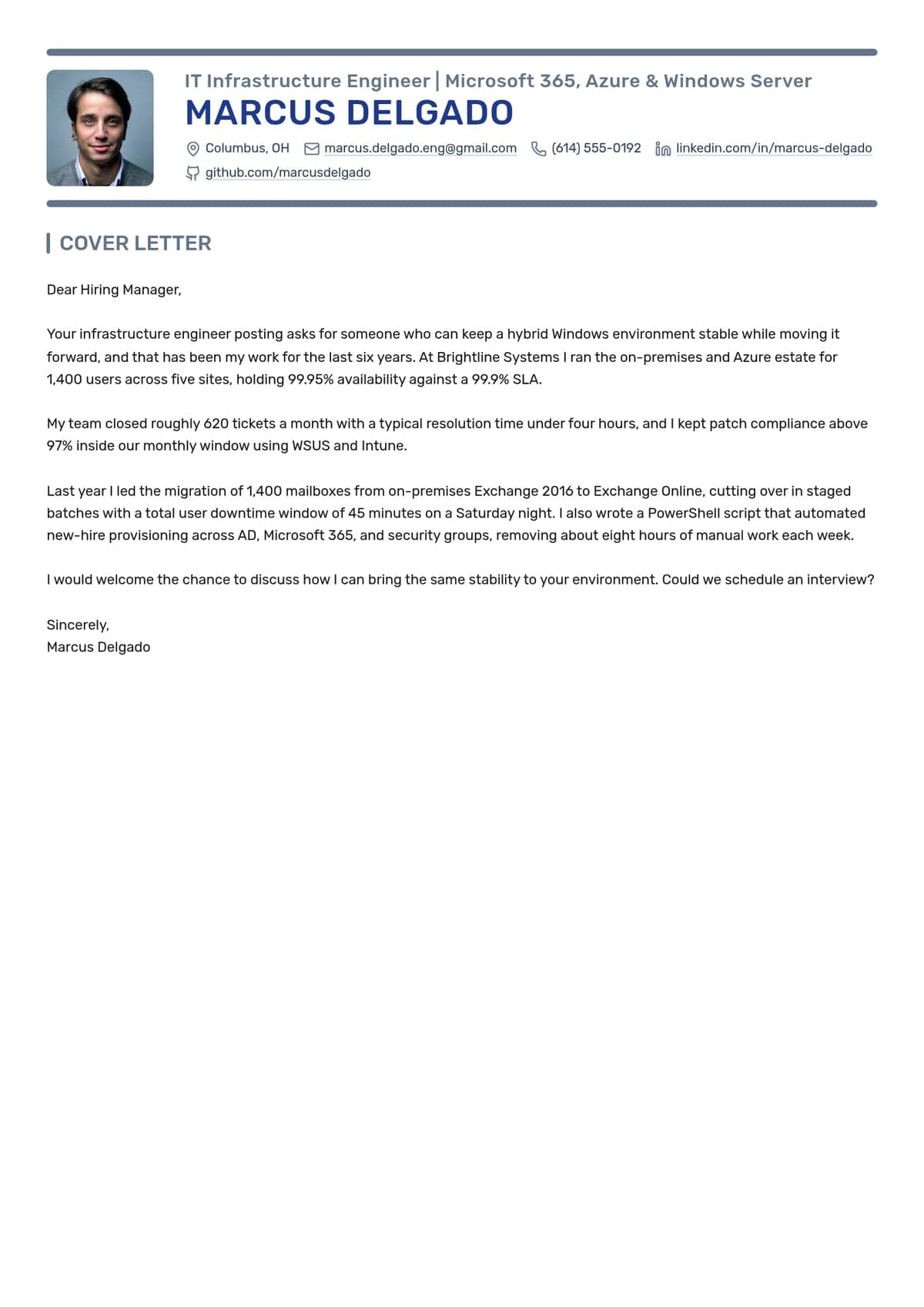
The letter itself does three things fast. It names the exact job title in the first sentence, it proves fit with two numbers instead of adjectives, and it closes by asking for the interview. That's the whole formula.
His resume follows the same structure a strong project coordinator resume should: the submittal tracking and closeout numbers from the letter appear there too, with more detail. The letter picks the two proofs that matter most for this posting; the resume backs them up. Repetition of a number across both documents is fine. Contradiction between them is not.
What "resume cover page" actually means
The phrase gets used for three different documents, and the confusion is why so many search results for it are a mess of Word templates, college handouts, and portfolio screenshots. Here is the sorting:
- The cover letter. What most searchers need. One page, in front of the resume, with a date, the reader's name, a greeting, three or four short paragraphs, and a sign-off. Sometimes called a cover page or cover sheet informally.
- A literal title page. A page with your name, target role, contact line, and sometimes a contents list. Belongs only in packets that call for one: portfolios, bid packets, some formal application packets. More on this below.
- A fax cover sheet. The historical ancestor of the phrase. If you are faxing a resume in the 2020s, the employer's instructions will tell you what the sheet needs, and that's the only rule that matters.
For an ordinary online application, the answer is the cover letter. The rest of this page shows you how to build one that earns its place.
What to put on a resume cover page: the five parts
Walk through Luis's letter above and you can label every element. Each of the five is doing a specific job, and each one is a place where weak letters fail.
- A header that matches the resume. Same name, same contact details, same typography. This is what turns two documents into an application package, and it is the first thing that signals care.
- A named greeting. "Dear Ms. Okafor" beats "Dear Hiring Manager," which beats "To Whom It May Concern" by a mile. The name is usually findable: the posting, the company's team page, or LinkedIn. If you genuinely can't find it, "Dear Hiring Manager" is acceptable. "To Whom It May Concern" never is.
- An opening that names the job. First sentence, exact title from the posting. Recruiters handle multiple openings at once; a letter that could apply to any of them helps none of them.
- Proof paragraphs with numbers. Luis doesn't say he is detail-oriented. He says he tracked submittals for 11 jobs at once and cut punch list closeout from 30 days to 18. One or two paragraphs, one or two numbers each, chosen for what this posting asks for.
- A close that asks for the interview. Not "I hope to hear from you." Something with a spine: "I'd welcome the chance to talk through how I'd handle closeout on your renovation program." Then a sign-off and your typed name.
The five mistakes that sink cover letters
Reading a lot of these letters teaches you that they fail in the same five ways. In rough order of how often they appear:
- A generic greeting on a letter that was clearly mass-produced. The reader can tell in one line.
- Repeating the resume in paragraph form. The letter's job is to interpret your record for this job, and pick the two proofs that matter, rather than to summarize all of it.
- No numbers anywhere. "Strong organizational skills" is a claim. "Tracked submittals for 11 concurrent jobs" is evidence.
- Another company's name left in from the last application. This is the single most fatal copy-paste error, and it happens constantly.
- More than one page. A cover letter that runs long signals that you can't prioritize, which is exactly the skill most jobs are testing.
The fresher version: a cover page with no work history to lean on
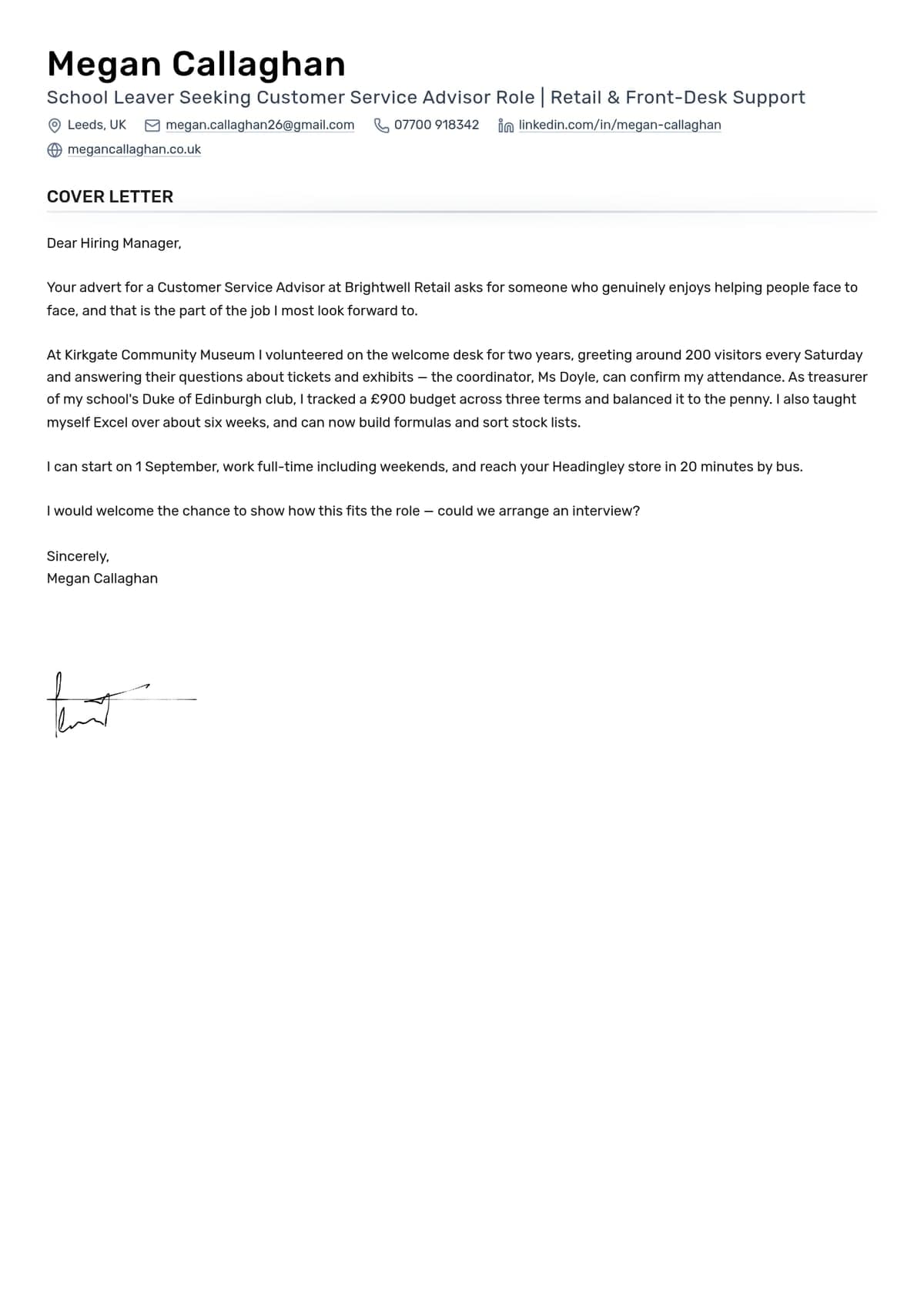
A new graduate's letter follows the same five-part structure, just shorter, and with proof pulled from wherever proof exists. Consider Aisha Karim, a new business graduate applying for her first operations assistant job. She has no full-time history, so her proof paragraph draws on two things: a summer internship where she organized intake for 300 client files, and a final-year group project where she kept a five-person team on schedule.
The structure of her letter changes in three ways. The whole thing runs shorter, closer to three paragraphs than four, because stretching thin experience across a full page makes it look thinner. The opening adds one clause on why this company, since a fresher's letter has to answer "why us" more explicitly than an experienced hire's does. And the proof paragraph frames the internship and project in the employer's terms: file intake becomes process handling, and the group project becomes coordination under a deadline.
The mistake to avoid is apologizing. "Although I have limited experience" hands the reader a reason to stop. Lead with what you did do, with a number where you have one. If you're writing at this stage, the internship cover letter examples show the same short-letter pattern across five fields, and the fresher resume summary guide covers the matching top of the resume.
When a literal cover page is right, and what goes on it
A true title page belongs in exactly three situations. Design and architecture portfolios, where the packet is a bound or multi-page document and the cover page functions as the front of a book. Bid and proposal packets, where a contractor binds key staff resumes behind a cover sheet identifying the firm and the project. And application packets whose instructions explicitly ask for a cover sheet, common in government, academic, and grant contexts. In that last case, the instructions win over anything on this page: if they specify fields, include those fields, in that order.
When one of those applies, the page carries five things and nothing else:
- Your name, in the same type treatment as the documents inside
- The target role or project ("Portfolio: Junior Architect Candidate" or "Key Personnel: Riverside Clinic Renovation Bid")
- One contact line: phone, email, city
- A one-line headline if it earns its place ("Licensed architect, 6 healthcare projects delivered")
- A short contents list if the packet has multiple sections
For an ordinary online application, skip the title page entirely. The cover letter already introduces the packet, and an extra page of nothing before the resume just delays the reader. Here's the full sorting in one view:
| Situation | What goes in front of the resume |
|---|---|
| Ordinary online application | Cover letter with matching header. No title page. |
| Email application | Short letter in the email body, or attached; still no title page. |
| Design or architecture portfolio | Literal cover page: name, role, contact, contents list. |
| Bid or proposal packet with staff resumes | Cover sheet identifying firm and project, per the bid instructions. |
| Packet whose instructions request a cover sheet | Exactly what the instructions specify, field for field. |
Making the letter and resume one set
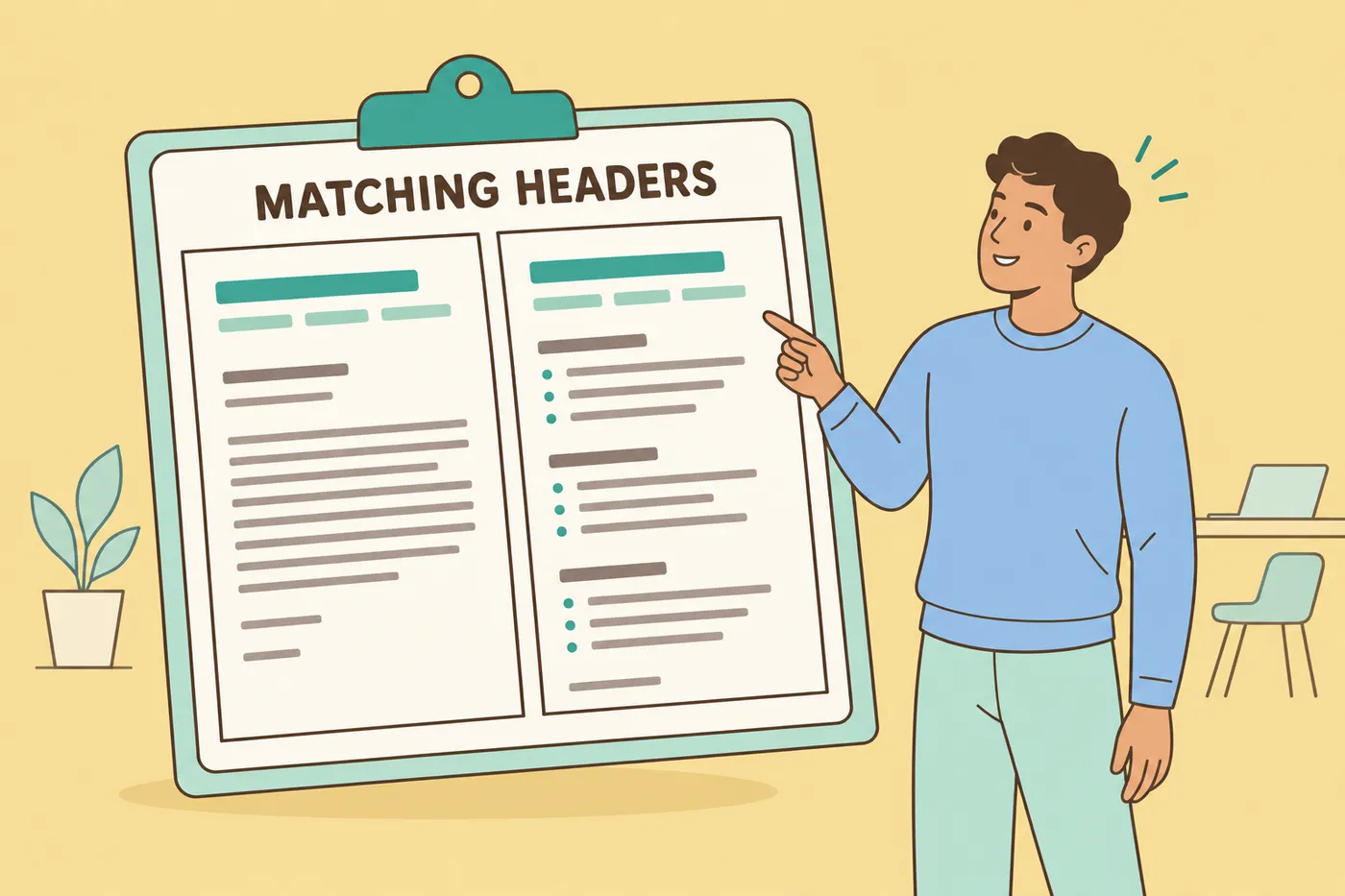
Five things have to match: the header block, the font, the font size, the margins, and the accent color if you use one. Get those right and the two pages read as one application even before anyone reads a word. Get them wrong, say a serif letter in front of a sans-serif resume, and the mismatch registers as carelessness, quietly and immediately.
Delivery depends on the portal. When it accepts one file, combine them into a single PDF with the letter first and the resume second, which is the order a reader expects. When it takes separate uploads, use two files named the same way: Luis-Romero-Cover-Letter.pdf and Luis-Romero-Resume.pdf. Consistent naming matters more than people think, because your files sit in a folder next to dozens of documents named "resume_final_v3.pdf".
Before you send, check the details against each other. A phone number that differs between the letter and resume, a job date that doesn't line up, a title that's "Project Coordinator" on one page and "Project Manager" on the other: each reads as a red flag, because the reader can't tell which version is true. In Roleframe, a cover letter is drafted alongside the resume it belongs to and inherits the same theme, so the header, font, and margins match without you rebuilding them, and you edit every line before anything goes out. Always send PDF; it locks the formatting so the pair looks identical on every screen.
Cover page ideas that stay readable
Most "resume cover page ideas" you'll find are decoration looking for a job. The header is the only part of the letter where design belongs, and three styles cover nearly every case:
- A slim band across the top, matching the band on your resume: name large on the left, contact details small on the right, a single rule beneath. The safest choice when your resume template has one.
- A minimal single column: name centered or left-aligned, one contact line under it, generous white space. Works with any resume and never fights the text.
- A split header: name on the left, contact stacked on the right. Reads as slightly more designed without adding a single graphic element.
Under any of the three, the letter body stays identical: plain paragraphs, one column, a font you'd read a book in. What to avoid, and why: photos, unless you're applying in a field or country where they're expected, because in the US they create bias risk that some employers screen out. Graphics or watermarks behind text, because they wreck readability on screen and in print. Tables in the letter body, because applicant tracking systems (ATS), the software that parses applications, handle them unpredictably. And text saved as an image, which parses as nothing at all. If your letter will pass through an ATS, the same parsing rules that apply to resumes apply here.
The executive briefing variation: "You need / I bring"
One format from the search results worth knowing is the executive briefing letter, an idea long associated with career author Martin Yate. The middle of the letter pairs each of the employer's stated requirements with your matching proof, as short paired lines rather than paragraphs. For Luis, against the hospital's posting, the middle section would run:
- You need someone who can run multiple projects at once. I bring three years coordinating commercial builds, most recently tracking submittals and RFIs across 11 active jobs without a missed deadline.
- You need clean project closeout. I bring a punch list process that cut closeout from 30 days to 18 across our last two projects.
- You need someone comfortable with contractors and inspections. I bring daily experience scheduling subcontractors and walking inspections with city officials.
Use paired lines, never an actual table, since tables in a letter body risk parsing problems and look bureaucratic besides. The format shines when the posting has a clear, numbered requirement list and the role is senior or technical enough that the reader is literally checking boxes. It reads worse for early-career letters, where three thin pairs expose gaps that a well-written paragraph would carry gracefully, and for roles where tone matters as much as qualifications. Luis could go either way. Aisha should stick to paragraphs.
Your next step
Start from the structure above and put your own two numbers where Luis's are. If you want the matched pair without doing the design work yourself, Roleframe's editor is free to use with no account: pick a template, and the cover letter takes the resume's theme so the header, font, and margins match automatically. The download is a real PDF with no watermark. Note that the export is PDF only, which is what you should be submitting anyway; if you also need the resume half of the pair, the free resume templates use the same editor, and there are no sign-up cover letter options compared here.
Frequently asked questions
- What do you put on a cover page for a resume?
If you mean the cover letter, which is what most applications need: a header matching your resume, the date, the reader's name, a greeting, three or four short paragraphs that name the job and prove fit with numbers, and a sign-off. If you mean a literal title page for a portfolio or bid packet: your name, the target role, one contact line, an optional one-line headline, and a contents list.
- Does a resume need a cover page?
An ordinary application never needs a title page; the cover letter already introduces the packet. A cover letter is worth sending whenever the posting gives you a place for one, because it lets you connect your two strongest proofs to this specific job. Skip the letter only when the application explicitly says not to send one.
- What are 5 common cover letter mistakes?
A generic greeting like "To Whom It May Concern," repeating the resume instead of interpreting it, making claims with no numbers behind them, leaving another company's name in from a previous application, and running past one page. The company-name error is the most fatal, and the easiest to catch with one slow read before sending.
- What is a red flag on a resume or cover letter?
For the pair specifically, the biggest one is inconsistency: a phone number, job title, or employment date that differs between the letter and the resume. The reader can't tell which version is true, so both lose credibility. Check every shared detail against the other document before you submit, especially after tailoring for a new job.
- What are the 5 P's of a resume?
There is no single official list; it's a coaching mnemonic that varies by who's teaching it. The versions you'll encounter usually cover the same ground: prepare (research the job), pick a clean format, prove claims with numbers, personalize for each posting, and proofread. The mnemonic matters less than the habits, and the proving and personalizing steps are where most resumes actually fail.
- Should the cover letter and resume be one PDF or two files?
Follow the portal. If it accepts one file, send a single PDF with the letter first and the resume second. If it has separate upload fields, send two PDFs named consistently, like Jane-Park-Cover-Letter.pdf and Jane-Park-Resume.pdf. Either way, use PDF rather than a Word file so the formatting arrives exactly as you built it.
Write yours on the same template.
Every example here is built on a template you can open in the editor. Keep the structure that works and put your own story in it, or let Roleframe draft a first version from your resume and the job posting.


