Relocation Cover Letter Example: Timing and Interview Options
by Larbi SahliPublished
Adapt a fictional relocation letter with honest wording for a confirmed move, an offer-dependent move or a recent arrival, plus interview and location guidance.
Users have landed jobs at
- 1Password
- OpenAI
- Notion
- justworks
On this page
A relocation cover letter can connect your experience to the role and clarify practical details: where you are based, whether the move is confirmed or conditional, and what interview or start arrangements you can realistically discuss. You do not need to disclose a partner’s job, a family address or a signed lease to explain your plans.
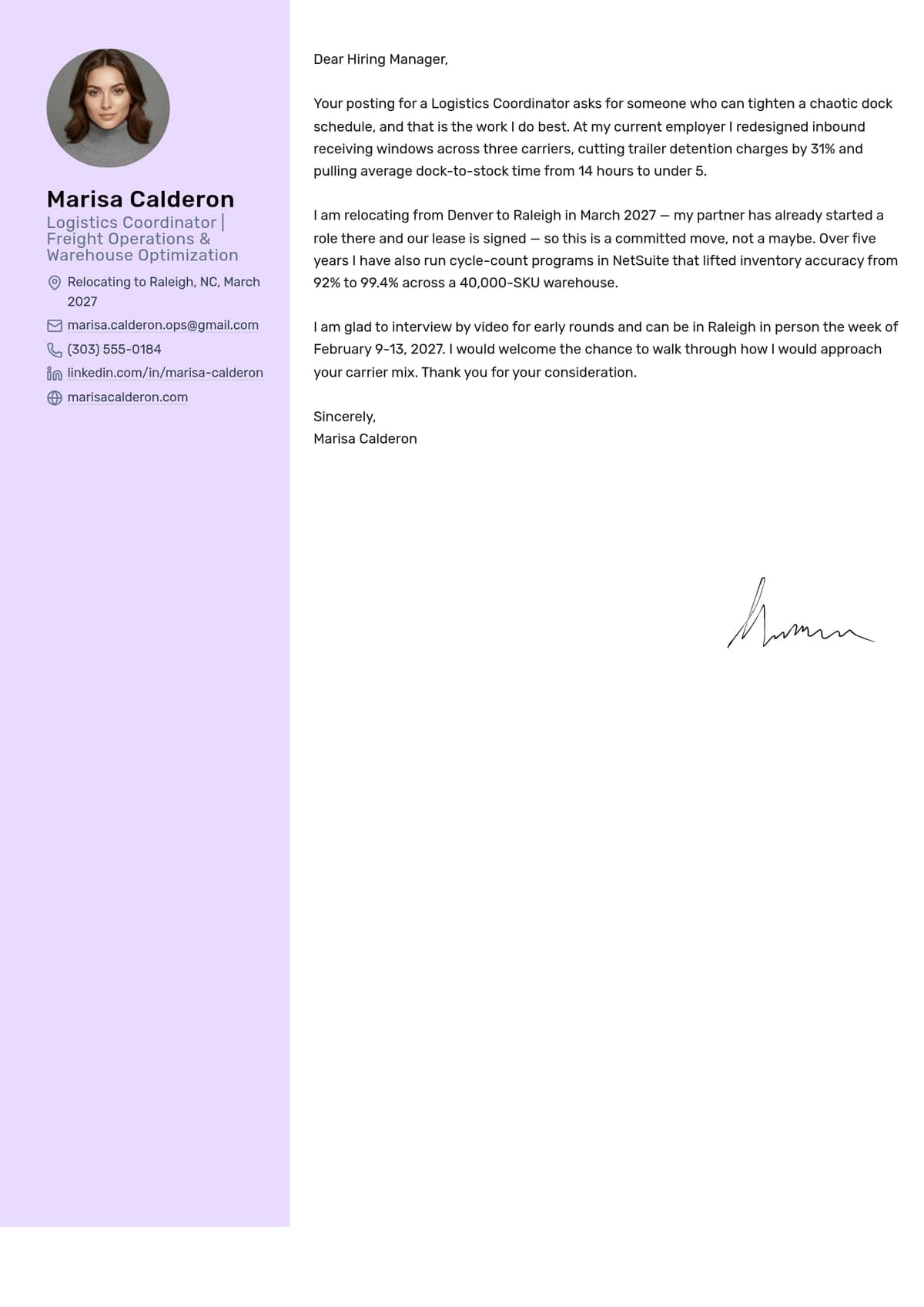
The letter below is a fictional January 2027 application. Marisa Calderon, the employers, work history and move are invented for illustration. She is planning to move from Denver to Raleigh in March 2027 and has a February visit scheduled. These are sample dates, not current availability or a proven successful application.
Use the wording that matches your circumstances. A move date is different from a start date, and a willingness to relocate is different from a confirmed plan. Replace all details and sample graphics before using the document.

Marisa Calderon
Logistics Coordinator | Freight Operations & Warehouse Optimization
Dear Hiring Team,
I’m applying for the Logistics Coordinator position at Cedar Distribution. In five years of logistics work at Juniper Supply, I have coordinated inbound appointments, tracked exceptions and kept warehouse teams informed when carrier schedules changed.
My current work includes maintaining receiving appointments across three carriers and using NetSuite records to follow up on inventory discrepancies with the warehouse team. I check changes with the responsible supervisor before updating the shared schedule.
I currently live in Denver and plan to relocate to Raleigh in March 2027. I would like to discuss a start date that fits both your requirements and my notice and moving arrangements.
I am available for video interviews by arrangement and expect to be in Raleigh from February 8 to 12, 2027. If an in-person meeting is useful, I can discuss a time during that visit. Thank you for considering my application.
Sincerely,
Marisa Calderon

Explain Relevant Timing Where It Helps the Reader
The example begins with logistics experience, then explains the move. That is one clear order, but the timing can appear earlier if it is central to the application or explicitly requested. There is no mandatory sentence count or paragraph position.
Include enough detail to avoid a misleading impression. “Planned move in March” does not mean “available to start March 1.” Explain any material conditions and discuss an achievable start date rather than promising a date you have not worked through.
Your reason for moving is optional unless a relevant question requires an answer. Focus on the information needed for planning instead of assuming the employer needs private family or housing details.
Three Ways to Describe Your Move Status
Choose the version that reflects your current plans. These are wording patterns, not a ranking of candidates. An offer-dependent move can be a reasonable decision, and being open to relocation is not evidence that someone is unreliable.
You have a fixed move date
If the date is confirmed, you might write: “I plan to relocate to Raleigh on March 2, 2027, independently of this application. I would be happy to discuss a start date around my notice and moving arrangements.”
Use a firm date only when it is accurate. You do not need to add a lease, a partner’s employer or a promise that no circumstance could change the plan. If an important condition remains unresolved, make that clear.
You'll move once an offer is signed
If you intend to move only after securing a suitable role, say so. For example: “I am open to relocating to Raleigh for this position. I expect to need approximately four weeks after an agreed offer to complete my notice and moving arrangements, subject to confirming the details.”
The four-week period is illustrative, not a standard. Consider your actual notice, housing, travel and other requirements. If relocation support is necessary for the move, clarify that with the recruiter before making a commitment that assumes it.
You've already moved
If you have moved, use your current location and accurate availability. For example: “I am now based in Raleigh and am available to discuss local interviews.” Do not promise any day or time unless you can offer it.
You can use a current city for temporary accommodation without publishing a full residential address. Being nearby does not guarantee eligibility for every location policy or an advantage over other candidates.
Offer Interview Options You Can Actually Arrange
You can offer a video interview and, if a visit is already planned, mention the dates. A hypothetical line is: “I am available for video interviews by arrangement and expect to be in Raleigh from February 8 to 12, 2027. I can discuss an in-person meeting during that visit.”
Check your calendar and time zone. If you have no visit planned, a video-only offer is fine; do not book unnecessary travel merely to make a letter sound committed. If the employer requests travel, clarify scheduling and any reimbursement arrangements before assuming who pays.
Plans sometimes change. Update the recruiter promptly when they do rather than treating a changed date as proof that the application has failed.
The contact block: what address to show
Use an accurate location line and answer application location questions truthfully. A free-text relocation note can clarify your plans to a reader, but it does not control a portal’s location fields or guarantee that you pass an employer’s screening criteria.

| Situation | Possible header wording | What it communicates |
|---|---|---|
| Move is planned | Denver, CO | Planned move to Raleigh, NC, March 2027 | Current location and a future plan, without claiming current residence. |
| Move depends on a suitable role | Denver, CO | Open to relocation to Raleigh, NC | Willingness to discuss a move, not a confirmed date. |
| Already based in the destination | Raleigh, NC | Current location; interview and start availability still need agreement. |
| Full address requested in a form | Provide the requested accurate information in the appropriate field | A form requirement is separate from the design of the letter header. |
Keep the letter and resume factually consistent. A resume can accurately say Denver while a letter explains a future Raleigh move; they do not need identical wording. If you update one document, check the other for an outdated plan.
The resume address guide discusses how much location detail to include. Follow any specific application requirements, and do not list a destination as your current residence before you move.
Share a Reason for Moving Only if It Helps
You can mention returning to an area, a personal plan or interest in the local work, but there is no required personal “anchor.” A partner, family connection or lease does not prove how long someone will stay, and applicants without those ties are not less serious by definition.
A simple line such as “I have decided to move to Raleigh and am seeking roles in the area” may be enough when true. Keep your interest in the specific work clear too; the why this company guide offers ways to describe that connection without invented praise.
Clarify Relocation Support When It Affects the Decision
Read the vacancy for any relocation policy. If support is necessary for you to proceed, it is reasonable to ask the recruiter about eligibility and what the employer offers before investing in a move or a lengthy process. If the cover letter specifically asks about relocation needs, answer accurately.
A possible question is: “Does this role offer relocation support, and are there eligibility or repayment conditions I should understand?” Do not assume that funding is available or that asking at a particular stage has no downside or a guaranteed negative effect.
You can keep the letter focused on the work while discussing practical constraints separately. The compensation discussion guide provides related wording. The illustration below is not a rule to hide a material support requirement.

Adapt the Letter for a Return Move or Internal Role
The following hypothetical paragraphs show two other situations. Keep the details you can support and remove anything that does not fit. Neither situation establishes a preferred hiring category.
Moving back to your home town
A concise option is: “I plan to return to Columbus in June 2027 and am looking for roles that use my logistics coordination experience. I am available for video interviews by arrangement and can discuss an in-person visit if needed.”
You may add a personal reason if you want to, but you do not need to disclose relatives’ names, neighborhoods or addresses. If the move depends on an offer or another unresolved detail, adapt the sentence to say so.
Internal transfer to another office
Read your employer’s internal application or mobility process before choosing how to approach another office. Confirm any eligibility, notification or approval steps; do not assume every organization requires you to tell your manager before applying.
A hypothetical paragraph is: “I am interested in the Raleigh operations opening and would like to discuss an internal move. My Denver work includes carrier scheduling and inventory follow-up. I plan to relocate in March 2027, subject to agreeing the transfer and start arrangements.”
Mention manager support only if it is real and appropriate to share. There is no need to threaten departure to another employer to explain your interest.
Check the Role, Dates and Submission Requirements
Review the posting alongside the letter. Select relevant experience and check that the job’s actual location or working arrangement fits your plans. The resume comparison guide can help organize that review without assuming a hidden screening formula.
Then check the practical details below.
- The employer, role and destination are correct for this application.
- The current location, planned move and earliest possible start are distinguished accurately.
- Dates and conditions agree across the letter, resume and application fields.
- Interview availability is realistic, with time zones and any travel needs considered.
- A necessary relocation-support condition has not been hidden behind an unconditional promise.
- The final document or email follows the requested format and contains no sample contacts, graphics or fictional work results.
Use Roleframe to work on the letter with your own experience and current plans. Check any suggested wording and inspect the final export. The cover-letter builder guide discusses drafting options; check current product terms and limits before choosing a workflow.
For general writing guidance, Yale’s cover-letter advice recommends a concise explanation of relevant experience and interest. This page’s relocation phrases are editorial examples, not a guarantee of an employer’s response.
Frequently asked questions
- How do I write a relocation cover letter?
Explain relevant experience and interest, then clarify your current location, move status and realistic timing where useful. Mention interview options you can arrange. Follow any specific questions in the posting.
- Should I mention a move?
It can help clarify plans for an on-site or hybrid role, especially if your current location differs. Do not assume a particular sentence bypasses a location filter. Answer application fields accurately.
- What if I have no move date?
Say that the timing is still to be agreed or that you are open to relocating for a suitable role. Give an estimate only when realistic, including its conditions. Do not invent a firm date or local family tie.
- Can I ask about relocation support before an offer?
Yes, when it affects whether you can proceed, ask the appropriate recruiter about the role’s policy and eligibility. Follow any explicit application questions. Neither support nor a particular reaction is guaranteed.
- What should I check for in the final letter?
Incorrect destinations or dates, an offer-dependent move presented as confirmed, invented availability, unnecessary private details and unsupported work results. Inspect the final file and requested format too.
- When should I tell my current employer?
Check the relevant notice terms and any internal mobility process, then decide how to discuss your circumstances. There is no universal instruction to resign before discussing a move or notify a manager before every internal application. Claim support only when it has actually been given.
- Should I change the resume location too?
Keep both documents accurate and consistent. A current city plus a planned relocation note is one option. Do not list the destination as current residence before moving, and answer any separate application location fields truthfully.


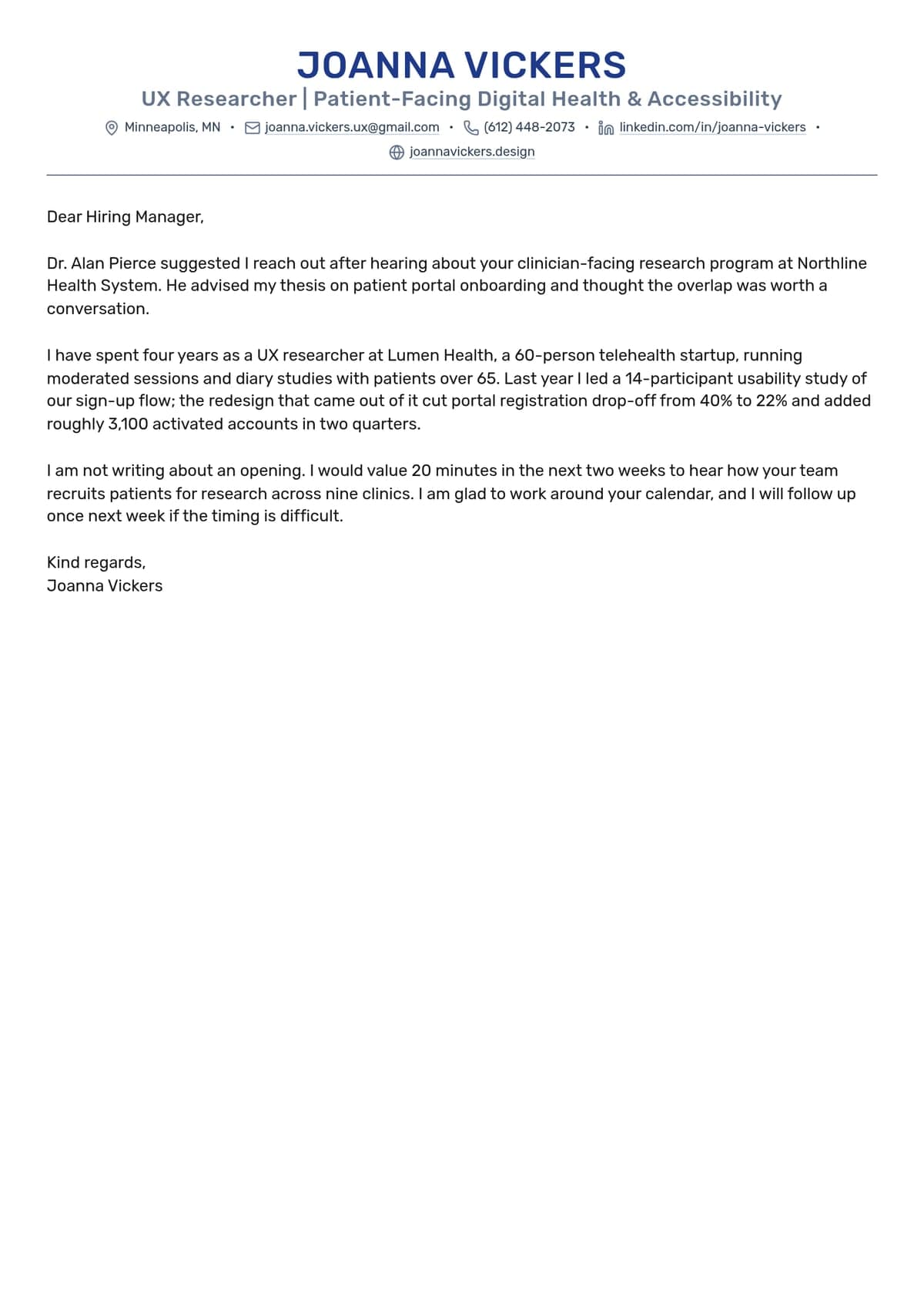
Write yours on the same template.
Every example here is built on a template you can open in the editor. Keep the structure that works and put your own story in it, or let Roleframe draft a first version from your resume and the job posting.


