How to Answer "Why Do You Want to Work Here?"
by Larbi SahliLast Updated
Answer "why do you want to work here" in three parts: a specific company fact, your matching skill, and what you'd contribute. Two full examples inside.

On this page
Answer "Why do you want to work here?" in three parts: name one specific thing about the company you genuinely respect (a product, a mission, a recent decision), connect it to a skill or experience you actually have, and finish with what you would contribute in this role. Keep it under 90 seconds, make it about their needs, and never lead with salary, commute, or "I need a job."
Why interviewers ask this question
This question is a preparation test disguised as small talk. The interviewer already knows you want a job. What they don't know is whether you want this job, and the answer tells them in about a minute.
Three things are being checked at once. First, did you do any homework, because a candidate who researched the company will also research the customer, the codebase, or the client file. Second, will you stay, because hiring managers who have watched a new hire quit at month four ask this question defensively. Third, do you understand what the role actually is, because plenty of applicants apply to a title without reading past it.
A vague answer fails all three checks simultaneously. That's why this question, simple as it sounds, ends more interviews than the technical rounds do.
The wrong way to answer: making it about you
The most common failure is an answer that is entirely true and entirely about the candidate. These openers sink interviews every day:
- "The salary and benefits look great." Honest, and instantly disqualifying as a lead. Compensation is a negotiation topic, not a motivation answer.
- "It's close to where I live." You've just told them any closer office would win your loyalty.
- "I saw good reviews on Glassdoor." This is research about what the company does for you, not what you'd do for it.
- "I'm looking for growth opportunities." Every company hears this from every candidate. It says nothing about them.
- "Honestly, I just need a job right now." Sympathetic, human, and the fastest way to signal you'll leave the moment something better appears.
Notice the pattern: each of these describes what the company can do for you. The interviewer is silently asking the opposite question. You don't have to lie about wanting stability or a paycheck. You have to answer the question they actually asked, which is about fit, and save your own priorities for the negotiation stage where they belong.
The right way: connect their needs to your skills
A strong answer has three moving parts, in this order: them, you, the match.
Part 1: one specific thing about the company. Not "your great culture." A named product, a market position, a recent launch, a mission you can state in their words. Specificity is the whole game here, because it's the only part of the answer a competitor's candidate can't copy.
Part 2: the skill or experience you bring that maps to it. One or two sentences from your real history. This is where your resume and your answer should tell the same story, in the same language.
Part 3: what you'd do in this role. Close by pointing forward. "That's exactly the kind of problem I want to spend the next few years on" lands better than trailing off after a compliment.
A working template: "I've followed [specific thing about the company], and it matters to me because [genuine reason]. In my current role I've [relevant experience], and this position would let me apply that directly to [specific challenge from the job posting]." Fill it with real details and it stops sounding like a template.
How to research the company for your answer
Twenty to thirty minutes of targeted research produces a better answer than an hour of aimless browsing. Work through these sources in order:
- The job posting itself. Requirements that appear more than once, or in both the summary and the bullet list, are the ones the hiring manager actually cares about. Your answer should speak to those, not to the boilerplate.
- The company's own words. The About page, the mission statement, a recent blog post. You're looking for language you can echo naturally, not recite.
- The product. Use it if you possibly can. "I signed up last week and noticed..." is worth more than any amount of secondhand praise.
- Recent news. A funding round, a product launch, an expansion, a leadership change. One recent, specific reference proves your interest is current, not copy-pasted from an old application.
- The team. Look up your interviewer and the department on LinkedIn. Knowing the team just doubled, or just shipped something big, gives you a concrete hook.
- For public companies, the latest earnings call or annual report. Ten minutes of skimming gives you the strategic priorities straight from leadership.
From all of that, extract exactly two things: one company-level fact for part 1 of your answer, and one role-level challenge for part 3. More than that and the answer bloats. Interviewers reward precision, not volume.
Example answer: aligning with the company mission
Here's the formula applied by a candidate interviewing for a program coordinator role at a healthcare nonprofit:
"What drew me to this posting is your focus on rural care access. I grew up in a town where the nearest specialist was two hours away, so the problem you're solving isn't abstract to me. In my current role I coordinate outreach programs across twelve county sites, and I've built the scheduling and volunteer systems that keep them running. This role would let me bring that operational experience to a mission I'd be proud to explain at a dinner table, and the expansion mentioned in the posting is exactly the kind of scaling work I do best."
Why it works: the personal connection is specific and verifiable, the experience maps directly to the job's requirements, and it closes on the company's stated challenge rather than the candidate's wish list. It runs about 40 seconds out loud, which is the right length.
Example answer: excitement about the product or tech stack
For technical roles, genuine enthusiasm for the product or the stack is a legitimate and powerful answer, as long as it ends in contribution. A backend engineer interviewing at a payments company:
"Two things pulled me in. First, I've integrated your API on a previous project, and it was the cleanest payments documentation I've worked with, which tells me a lot about how the engineering team operates. Second, the posting mentions migrating core services to event-driven architecture, and that's the exact work I led at my current company, where I moved our order pipeline off a monolith over eighteen months. I want to do that kind of migration again, at your scale, on a product I already know from the outside."
The pattern is identical: specific admiration, matching experience, forward-looking close. Notice the candidate quotes the job posting's own priority ("event-driven architecture") back at the interviewer. That single move signals more preparation than ten minutes of company-history recitation.
Your tailored resume already wrote this answer
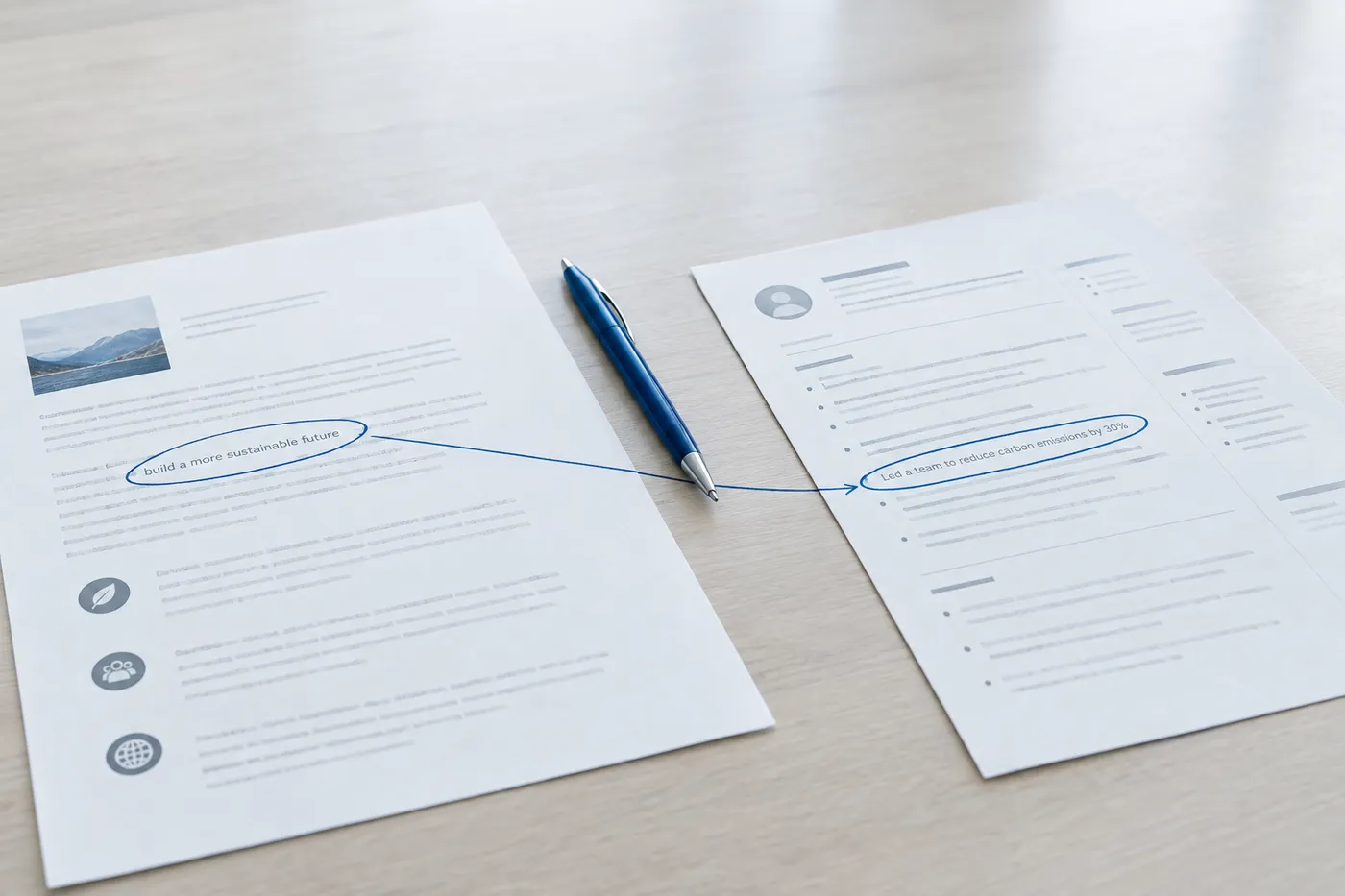
Here's the part most interview guides miss: if you tailored your resume properly, the research for this question is already done.
When you duplicate your base resume for a job in Roleframe, the fit report reads the posting the way a recruiter does. It identifies the role archetype and seniority, maps every requirement against your actual experience, and shows which keywords the posting asks for that your resume covers or misses. That analysis is a ranked list of what this employer cares about most, which is exactly what "why do you want to work here" is probing for.
Use it directly. The top requirements in your fit report are part 3 of your answer, the challenge you speak to. The experience the report matched against those requirements is part 2, your evidence. And because your resume was edited around the same analysis, your interview answer and your resume tell one consistent story. Interviewers notice when the person in the room matches the document that got them there, and they notice even harder when it doesn't.
If you're still sending one generic resume everywhere, that consistency gap is worth fixing before your next interview. The case for keeping a base resume plus tailored versions per job is the same case for a tailored interview answer: employers respond to specificity.
Practice your answer out loud, with feedback
An answer that reads well on paper can still collapse when spoken. The fix is rehearsal with feedback, not rehearsal alone.
Say it out loud three times, ideally recorded. You're listening for two failure modes: running past 90 seconds, and sounding memorized. If a sentence keeps tripping you, it's written language, not spoken language. Simplify it.
If you want a sparring partner, Remi, Roleframe's career copilot, runs interview practice built from your own resume and, on a tailored version, the job posting you attached. It asks one question at a time, you answer, and it scores each answer and flags what was thin, whether that's a missing specific, a claim your resume doesn't back up, or an answer that never got to the contribution part. It's practice against your own material, not a prediction of how a real interviewer will judge you, but it catches the gaps a mirror can't.
One final check before the interview: can you defend every sentence of your answer with a real example from your history? If yes, you're ready. If any line is aspirational padding, cut it now, because the follow-up question will find it.
Frequently asked questions
- What's the difference between "why do you want to work here" and "why are you interested in this position"?
The first asks about the company, the second about the role, but interviewers use them almost interchangeably and a good answer covers both. Weight your answer toward whichever was asked: company mission and market for the first, day-to-day work and required skills for the second. The three-part structure (them, you, the match) works for either version without changes.
- How do I answer "why should we hire you" in five sentences?
Use this structure: one sentence naming the role's core requirement as you understand it, two sentences of proof from your experience with a concrete result, one sentence on what makes you different from an equally qualified candidate, and one closing sentence connecting all of it to what you'd deliver in the first months. It's a different question from "why do you want to work here": that one is about your motivation, this one is about their risk. Answer it with evidence, not enthusiasm.
- What if I honestly just need a job?
Needing a job and having a real reason to want this one aren't mutually exclusive, and the interviewer only asked about the second. Do the twenty minutes of research, find one thing about the company or role that genuinely appeals to you more than the average posting, and build your answer on that. It's not dishonest to lead with your second-strongest motivation; it's answering the question that was asked. If you truly can't find a single appealing thing about the company, that's useful information about whether to take the offer.
- How long should my answer be?
Sixty to ninety seconds spoken, which is roughly 100 to 200 words. Shorter reads as unprepared, longer reads as rehearsed or rambling. If the interviewer wants more, they'll ask a follow-up, and a tight answer invites exactly the follow-up you want: "tell me more about that project."
- Can I mention salary, benefits, or work-life balance in my answer?
Not in this answer. All three are legitimate priorities and fair game later in the process, especially once an offer is on the table. But "why do you want to work here" is testing your motivation to do the work, and leading with what the company gives you answers the opposite question. If flexibility genuinely drew you to the posting, translate it: "the remote-first setup means I can do my deepest work" points at output, not perks.
- What if the company is small or there's nothing exciting to research?
Small companies are easier, not harder, because specific research stands out more. Read the founder's LinkedIn posts, try the product, look at who they've hired recently. For genuinely unglamorous businesses, anchor on the role instead of the brand: the problems you'd solve, the skills you'd use daily, the team you'd join. "I want to do this kind of work, and your posting describes it more concretely than any other I've seen" is a strong answer that requires no famous logo.



Ready when you are
Send the tailored resume, not the generic one.
Paste a job posting and Roleframe scores your resume against it, then helps you close the gaps one approved edit at a time, so you apply while the role is still fresh.